CONJOINED TWINS WITH SEPARATE BRAINS SUCCESSFULLY SEPARATED IN A REMARKABLE 15-HOUR OPERATION
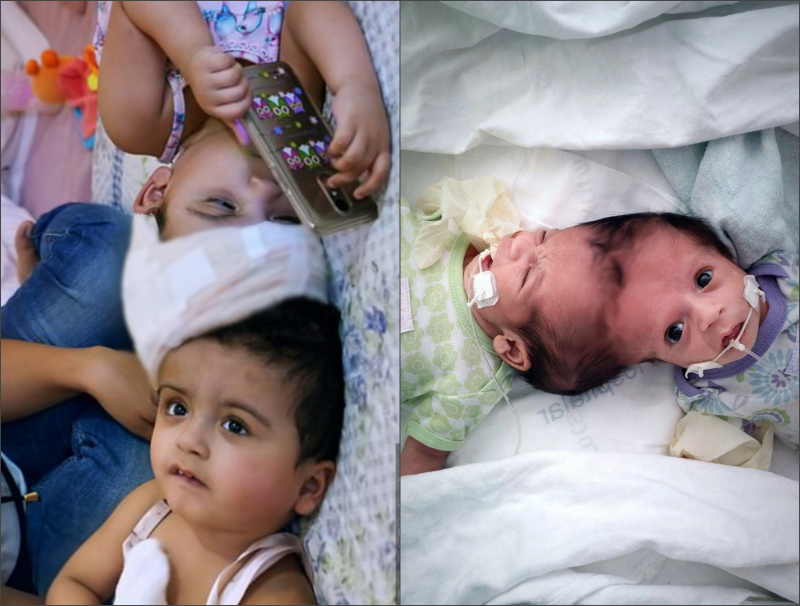
Conjoined two-year-old twin girls finally separated after a remarkable 15-hour surgery
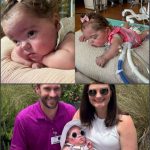
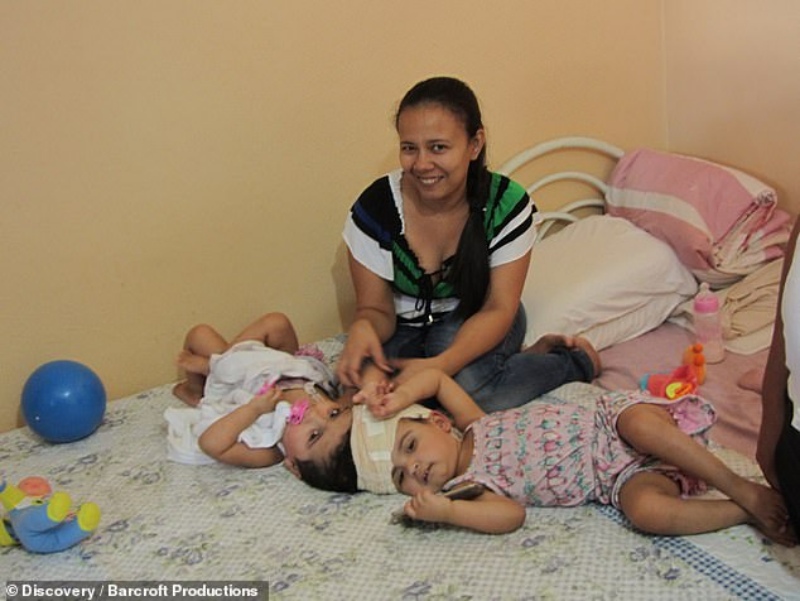
Ysabelle and Ysadora Freitas, from Ceará, Brazil, were the first pair of craniopagus conjoined twins to be born in the country.
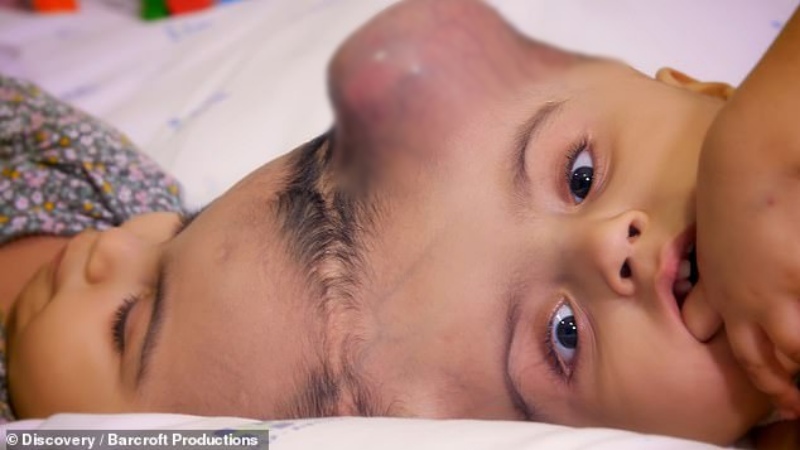
This rare condition meant the girls had separate brains despite being joined at the head. However, they shared blood flow through a complex network of vessels.
Their mother, Débora, faced the challenge of raising them with little support for 18 months, holding onto the hope that one day her daughters would be able to lead independent lives.
Medical specialists from around the world came together for a pioneering series of operations on four separate occasions, with the final procedure taking place in November.
Mrs Freitas and her husband, Diego, were able to hold their daughters separately for the first time after the procedure, describing the experience as ‘magic’.
Mr and Mrs Freitas, who said the twins are continuing to thrive, were overjoyed when they first discovered they were expecting twin girls.
However, an ultrasound revealed that something was unusual about their babies.
Mrs Freitas said: ‘When I had the ultrasound he [the consultant] said “Yes, it’s two girls but there’s a malformation. I’m not sure if they have a face or not, maybe it’s the stomach because it’s very small. They could be conjoined”.’
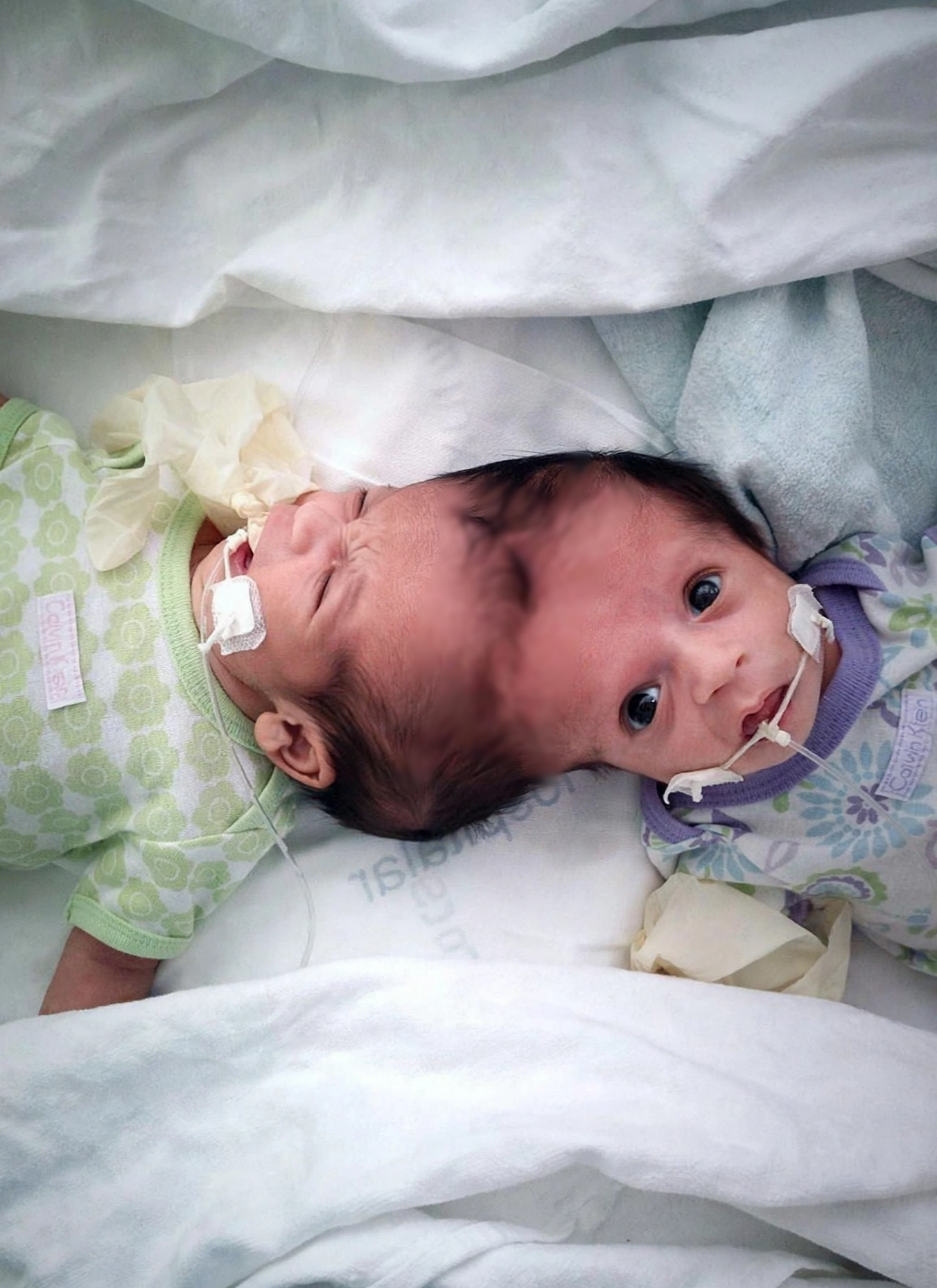
This was later confirmed, and in her 41st week of pregnancy, Mrs Freitas welcomed her daughters through a caesarean section.
Each baby weighed more than 7.7lbs (3.5kg) and was in good health, despite sharing a head.
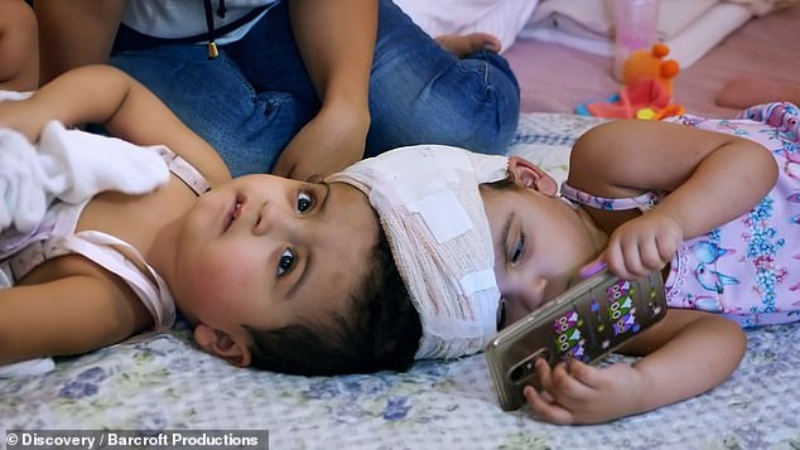
Mrs Freitas said: ‘We spent three months in the hospital then we went home. We hoped they could have surgery.
‘I learned how to feed them. I learned how to cope alone with them.’
The family was later introduced to neurosurgeon Professor Hélio Machado, who temporarily transferred them to his hospital at Ribeirão Preto’s Medical School in São Paulo.
He examined a series of scans that revealed the complex network of blood vessels connecting the twins’ heads.
The scans also confirmed that the girls had separate brains.
Professor Machado said: ‘The rarity of this condition makes the medical procedures extremely complex. So we organised a group of people to help us with the treatment of these children.’
A member of that team was American neurosurgeon Dr James Goodrich, who had successfully separated nine pairs of craniopagus conjoined twins before.
He had developed a new surgical approach in which the head was divided into four sections, with the procedures carried out across four separate operations.
The first operation, when the twins were 18 months old, was led by Brazilian neurosurgeon Dr Ricardo Oliveira, who carefully redirected sections of the twins’ shared blood supply.
During the second and third operations, surgeons successfully separated parts of Ysabelle and Ysadora’s heads where their brains were almost touching.
To everyone’s surprise, the girls recovered quickly after each operation, with no reported complications.
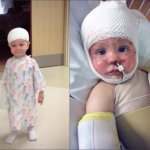
In preparation for the fourth surgery, skin expanders were placed beneath the girls’ scalps to create additional skin, which would later be used to cover both their heads after they were separated.
Mrs Freitas said before the operation: ‘Just imagining picking up my daughters separately makes me so emotional.
‘It’s going to be such a wonderful thing that I can’t even explain what I’m feeling.’
The final operation was expected to take 14 hours in total – the first part to finally separate the girls, and the second to reconstruct their heads.
Mr Freitas said: ‘They told us not to worry about time. And that the important thing is that everything will be okay.’
And after an intense eight hours and 40 minutes, Ysabelle and Ysadora were finally separated.
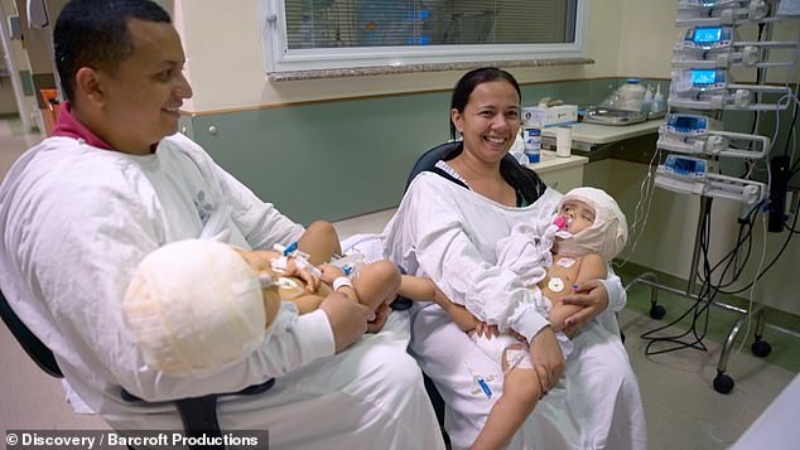
Mrs Freitas said: ‘They were born again. Second birth. First by me, second by the doctors. I am so happy, I’m going to jump and my heart is going to explode.’
Dr Oliveira said: ‘We all worked together as a team on the girls and we had great expectations.
‘When we saw that they were separated it was like magic. Suddenly we have two separate children.’
After a total of 15 hours in surgery, the parents were finally able to see their daughters as two separate little girls.
Mrs Freitas said: ‘It has been a battle we’ve needed a lot of patience. Just to be able to hold our babies feels joyous.’
Mr Freitas added: ‘It’s a lovely moment holding the girls in our arms.’
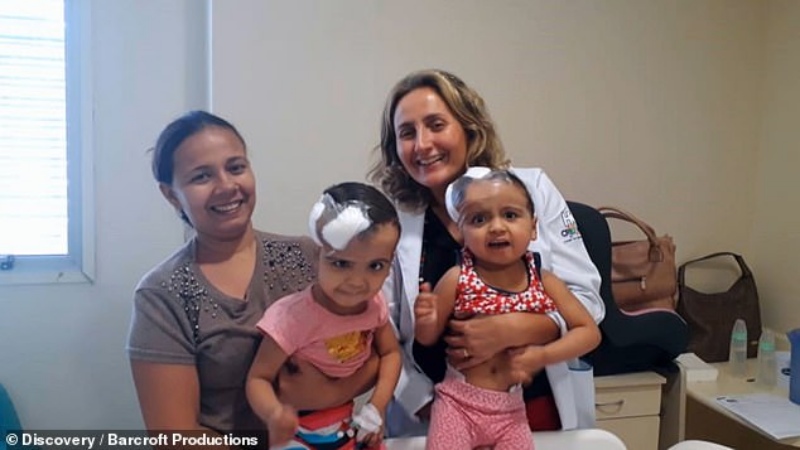
Although it is not yet known how long it will take for Ysabelle and Ysadora to fully heal and complete their rehabilitation, the girls are showing encouraging signs of recovery.
They are now working on strengthening their leg muscles so they can learn to walk properly, with the support of paediatrician Dr Maristela Bergamo and her team.
Dr Bergamo said: ‘I believe that they’ll need physical motor and neurological rehabilitation for quite some time, maybe until they’re five years old.
‘From there, my prediction is that they will have a normal life. They will develop normally and can be whatever they want.’
Source: Daily mail