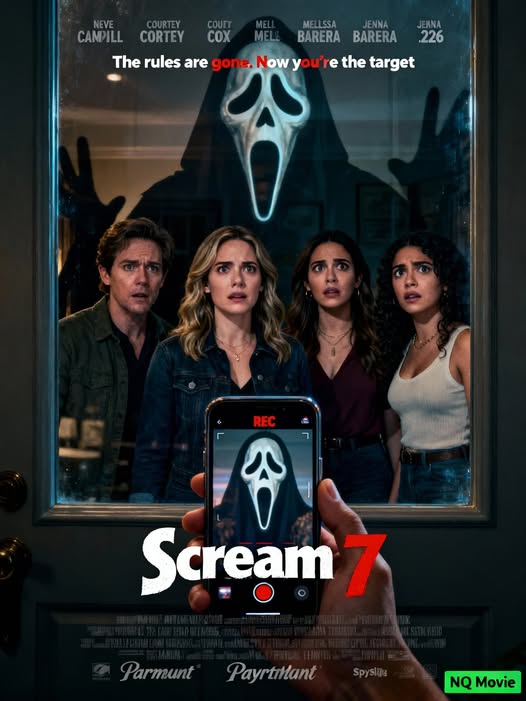
Sam Carpenter is now living under a different name, in a smaller, quieter city, trying to outrun both her family history and the online mythology built around her. But when a wave of killings begins targeting people connected to a private trauma-recovery network for violent-crime survivors, the pattern feels disturbingly intentional.
The strongest element of Scream 7 is its thematic target:
weaponized fandom and trauma tourism.
This time, Ghostface is not obsessed with movies.
He’s obsessed with narratives.
Podcasts, reconstruction videos, livestream reenactments, and AI-generated “what really happened” edits become part of the killing ecosystem. The film cleverly blurs the line between spectators and participants — making the audience uncomfortably aware of how modern horror culture feeds on real pain.
Melissa Barrera’s Sam is written with more emotional authority than in previous entries. She is no longer defined by fear of becoming her father. Instead, she’s exhausted by everyone else refusing to let her be anything else.
The tension sequences are tight and inventive — especially the film’s best set piece: a closed-door group therapy retreat where no one knows who checked in under a fake name.
Where the film slightly falters is its reveal.
The motive is smart, but the emotional connection between killer and victim lacks the raw personal sting that made earlier reveals land harder.
Still, as a modern continuation, it feels purposeful.
Overall verdict:
⭐️⭐️⭐️⭐️ / 5
Scream 7 doesn’t ask who the killer is.
It asks something far more uncomfortable:
Why do we still want to watch?