
A Life Measured in Love, Not Time
A Life Measured in Love, Not Time
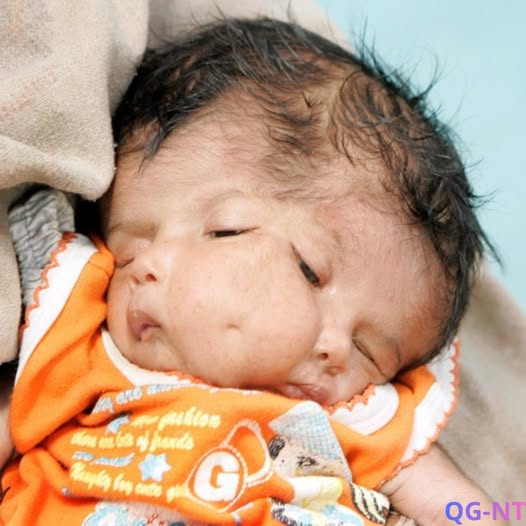
When baby Amara was born, the room fell into a silence that no one had prepared for, a silence that carried both shock and uncertainty as the reality of her condition became clear.
She entered the world with an incredibly rare condition—two faces—something most people had only ever encountered in medical textbooks, never expecting to see it in real life, never imagining the emotions it would bring.
In that moment, fear filled her parents’ hearts, heavy and immediate, as questions without answers crowded their minds and the future felt impossibly uncertain.
Doctors spoke in careful, measured tones, explaining the risks, the complications, and the fragile nature of Amara’s life, painting a picture that was more clinical than comforting.
But when Lila, her mother, finally held her, something shifted.
She did not see something strange or frightening.
She saw her daughter.
In her arms, Amara was not defined by difference, but by presence, by warmth, by a quiet and undeniable connection that only a mother could fully understand.
Where others saw rarity, Lila saw perfection in its own form, a child who deserved love not in spite of who she was, but exactly because of it.
The doctors discussed the possibility of surgery, outlining procedures that were complex, dangerous, and filled with uncertainty, offering only a small chance of success at the cost of immense pain.
Every option came with risk, with suffering, with the possibility that Amara’s short life could become defined by hospitals, machines, and interventions that might not change the outcome.
Faced with these choices, her parents made a decision that many did not expect, a decision that required both courage and clarity in the face of overwhelming pressure.
They chose not to pursue surgery.
They chose not to put her through pain that offered so little hope.
They chose something else entirely.
They chose love.
Instead of operating rooms and procedures, they gave Amara warmth, gentle touches, and the comfort of being held close, surrounded by the people who loved her most.
Every moment became precious, not something to fix or extend at all costs, but something to experience fully, to honor while it lasted.
They spoke to her, sang softly, and stayed present, allowing her life—no matter how brief—to be filled with care rather than fear.
Time moved differently for them, measured not in days or hours, but in moments of connection, in quiet breaths, in the feeling of her resting peacefully in their arms.
Amara’s life was short, but it was not empty.
It was filled with meaning, with tenderness, with a kind of love that does not depend on perfection or permanence.
She reminded everyone who heard her story that life is not defined by how long it lasts, nor by how closely it fits expectations, but by the depth of love that surrounds it.
In choosing comfort over intervention, her parents gave her something rare and profound—a life, however brief, that knew only care and acceptance.
And though her time in the world was fleeting, the impact she left behind was lasting, a quiet lesson that continues to echo far beyond her short days.
Because in the end, Amara’s story was never about difference or limitation.
It was about love—unconditional, unwavering, and limitless.