BORN WITH A RARE ENCEPHALOCELE, THIS 8-MONTH-OLD BOY HAS A TENNIS-BALL-SIZED MASS COVERING HIS NOSE

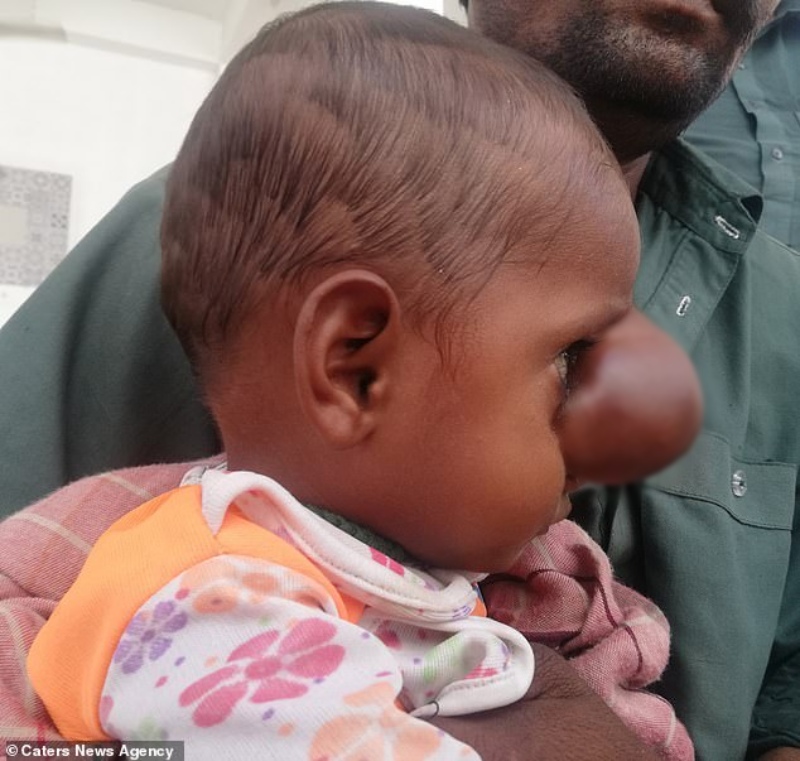
An eight-month-old boy has a tennis ball-sized mass covering much of his face as part of his brain extends through an opening in his skull.
Daeima Manghrio, from Pakistan, was born with a small lump roughly the size of a ring stone on his nose.
But it gradually grew in size. The mass now covers his eyes and causes him discomfort, according to local reports.
The condition is due to encephalocele, a rare birth defect where part of the baby’s skull does not fully develop, allowing brain tissue or surrounding structures to extend through the opening.

Doctors believe surgery is the main treatment option, but they said they can only proceed if tests on his health come back with positive results.
Daeima’s parents, Jayram, 38, and Laxmi, 32, have spent all their life savings on medical tests and visits to doctors.
The couple, from Badin in Sindh province, have even used their savings that had been set aside for their eldest daughter’s wedding.
They have since taken their child 129 miles (208km) to Jinnah Postgraduate Medical Centre, also known as Jinnah Hospital, in Karachi.
Dr Raza Haroon, head of the neurology department at Jinnah Hospital, said: ‘The infant was brought to us four days ago.
‘It is a case of nasal encephalocele. We are waiting for more tests and an MRI, but in such cases, surgery is the main treatment.

‘But as the child is too young, we will only proceed with the surgery if all reports are positive.’
He added: ‘In the meantime, we have suggested a diet plan to improve his health condition and also admitted him for observation.’
Jayram said: ‘The mass was as small as a stone in a ring his mother was wearing when he was born. But it constantly kept growing.
‘It causes discomfort as his eyes are getting covered by the mass. One eye is almost covered by it.
‘I took him to so many hospitals and finally brought him to Jinnah Hospital two months ago.’
Jayram, a daily-wage farm labourer who makes the equivalent of just £2 a day, said they were extremely happy when their only son was born.
They had waited for fifteen years to have a son, in the meantime raising five daughters.
With treatment taking time, Laxmi fears the condition could affect her only son’s vision as the large mass has covered one of his eyes.
Encephaloceles are rare birth defects, with approximately 375 babies born with the condition each year in the US, according to the Centers for Disease Control and Prevention (CDC).
In Western populations and females, encephaloceles are more common in the back of the skull, while in Southeast Asia and in males, they are more common toward the front of the skull.
As many as one in 5,000 babies in Southeast Asia are born with an encephalocele in the front of the skull, like Daeima, according to studies.

The condition is caused by a defect in the neural tube, which is a narrow channel in the developing foetus that allows the brain and spinal cord to develop.
Normally, the neural tube folds and closes early during pregnancy to complete the formation of the brain and spinal cord.
But when development is incomplete, it doesn’t completely close, allowing brain tissue or surrounding structures to extend through a gap in the skull or neck.
What the mass contains varies from person to person — and it is not clear what Daeima’s contains — but it could be brain fluid, the membrane that covers the brain, or brain tissue itself.
The brain tissue is usually covered by a thin membrane. A layer of skin usually covers the mass or sac, but if it doesn’t, surgery is recommended shortly after birth because there is less protection.

The cause is not clear, but some studies have shown that pregnant women who take folic acid have a lower risk of some neural tube defects.
Symptoms that can develop include intellectual disability, learning difficulties, growth delays, seizures, vision impairment and uncoordinated voluntary movements — known as ataxia.
In a severe case, it can cause hydrocephalus, a condition in which excess cerebrospinal fluid in the skull creates pressure on the brain.
Treatment is normally surgery before four months of age, where the protruding contents are placed back into the skull and an artificial piece of skull closes the opening.
Normally, surgical correction of an encephalocele can be performed without causing disability, even in cases involving large encephaloceles.
Source: Daily Mail