TWO HUNDRED MARINE OFFICERS LAUGHED WHEN A MAJOR ORDERED ME OUT—THEN MY HIDDEN RANK MADE THE ENTIRE ROOM SNAP TO ATTENTION
PART 1 — THE WOMAN IN THE CHARCOAL COAT
Nearly two hundred Marine officers erupted in laughter when an arrogant major pointed directly at me and announced through a microphone:
“Unless you’re here to clean the tables, you don’t belong in this room.”
He ordered security to remove me, convinced I was an ordinary civilian who had wandered into an officers-only event.
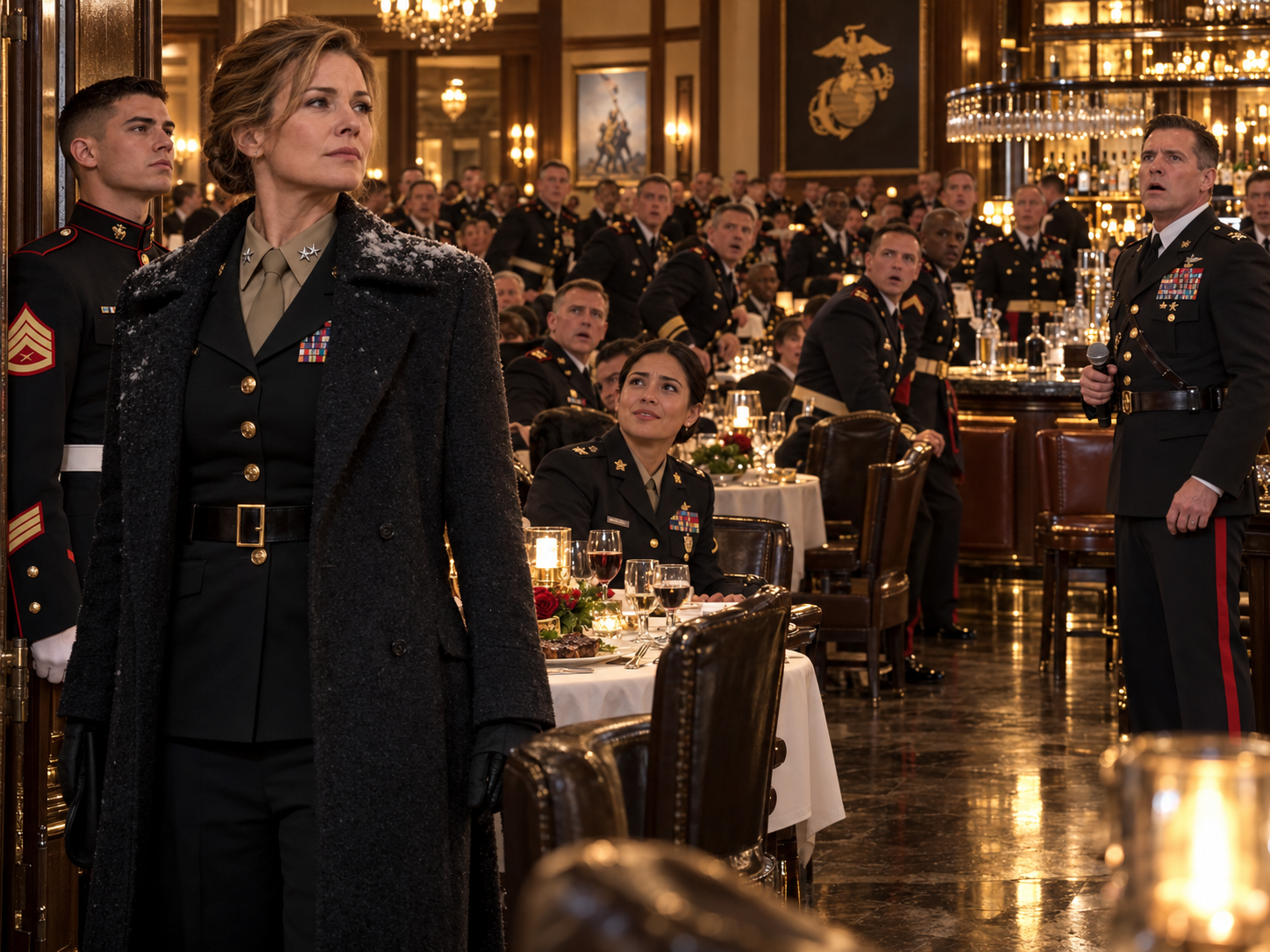
I stood silently near the entrance, my charcoal coat still covered with melting snow.
I didn’t argue.
I didn’t explain who I was.
And I didn’t react when the major continued humiliating me in front of his fellow officers.
Because Major Preston Hale had absolutely no idea what was hidden beneath my collar.
And when a young Marine sergeant finally discovered the two silver stars concealed there, the entire room changed in an instant.
But Major Hale was still smiling when the sergeant first approached me.
He had no idea that the woman he’d just mocked was about to become the most important person in that room.
“Officers only, ma’am.”
Major Preston Hale’s voice thundered through the club’s sound system.
He stood beside the bar with a microphone in his hand, leaning casually against the polished counter as though the building and everyone inside it belonged to him.
Warm amber lighting reflected off the decorations arranged across his chest.
His uniform was immaculate.
His posture was relaxed.
And his expression carried the unmistakable confidence of a man who enjoyed exercising authority in front of an audience.
Nearly two hundred Marine officers occupied the dining room.
The tables were covered with plates of steak, half-finished meals, beer glasses, and small candles flickering beneath the warm ceiling lights.
Conversations filled the air.
Some officers were laughing with colleagues.
Others were exchanging stories or enjoying the evening after long days of duty.
Then Hale noticed me standing near the entrance.
And the atmosphere began to change.
I watched him look me over.
His gaze traveled from my dark winter coat to my boots, then back toward my face.
A slow, amused smile spread across his mouth.
I recognized that expression immediately.
He wasn’t simply concerned about someone entering a restricted gathering.
He saw an opportunity.
He wanted to make an example of me.
And he wanted everyone in the room to watch.
Hale lifted the microphone closer to his mouth.
“Unless you’ve come to clear away the dishes,” he announced, “I’m afraid you’ve found yourself in the wrong building.”
Laughter rolled through the room.
Some officers turned in their chairs to look at me.
Others laughed without even bothering to see who had become the target of the major’s joke.
I remained standing just inside the doorway.
Snow was slowly melting into the shoulders of my charcoal coat, leaving dark patches across the fabric.
A trace of freezing air still clung to me after the heavy entrance doors closed.
The room smelled of grilled meat, freshly polished floors, and expensive cologne.
I could feel the difference between the cold outside and the heavy warmth of the crowded dining hall.
But I didn’t move.
I kept my hands relaxed.
My shoulders remained straight.
And I looked toward Major Hale without saying a word.
That seemed to irritate him.
Men like Hale rarely humiliate someone publicly without expecting a reaction.
They want their audience to see the damage.
Embarrassment.
Anger.
Tears.
Perhaps a desperate explanation from the person they’ve chosen to ridicule.
They want proof that their words have power.
I gave him none.
No defensive argument.
No nervous apology.
Not even the satisfaction of watching me lower my eyes.
Hale’s smile tightened slightly.
He adjusted his grip on the microphone.
Then he tried again.
“Now, ma’am, I’m only attempting to help you.”
His tone was exaggeratedly polite.
The kind of false courtesy that makes an insult sound almost respectable.
“The enlisted dining facility is two buildings down. Perhaps someone over there can find you a useful job.”
Another wave of laughter followed.
But this time, the reaction wasn’t quite the same.
I noticed several officers who had been laughing earlier were now studying me more carefully.
One looked down at my footwear.
Another examined the way I stood.
A third seemed interested in my shoulders and the controlled posture beneath my winter coat.
They were beginning to notice something Hale had overlooked.
I wasn’t standing like someone who had accidentally wandered into a building where she didn’t belong.
Nor did I seem confused about where I was.
I remained composed.
Patient.
Completely untroubled by the spectacle Hale was creating.
The laughter gradually became less enthusiastic.
A few conversations stopped entirely.
Then a young female lieutenant seated near the front moved her chair backward.
She looked toward Hale.
“Sir, perhaps we should—”
He cut her off immediately.
“Sit down, Lieutenant Torres.”
He didn’t even turn to face her.
His voice remained amplified through the microphone.
“The grown-ups are talking.”
A few people gave uncomfortable chuckles.
But most remained silent.
Lieutenant Torres froze beside her chair.
I watched the color rise into her cheeks.
For a moment, she seemed uncertain whether to continue.
Then she slowly sat down.
Our eyes met briefly across the room.
And I understood something from the expression on her face.
She wasn’t embarrassed because Hale had reprimanded her.
She was embarrassed by what her fellow officers were allowing to happen.
I held her gaze for a second.
Then I looked back toward the major.
He interpreted the silence as another victory.
To him, nobody speaking meant nobody objected.
He didn’t realize that the room was beginning to turn against him.
Hale leaned farther away from the bar.
The microphone remained close to his lips.
He studied me with a patronizing expression.
Then he asked another question.
“Are you lost, sweetheart?”
The word struck me harder than the others.
Not because I hadn’t heard worse.
I had.
Many times.
But because it carried me backward through more than two decades of memories.
For a brief, painful moment, the club around me seemed to disappear.
The amber lights.
The crowded tables.
The sound of chairs shifting against the floor.
All of it faded.
And suddenly, I was twenty-three years old again.
Freshly commissioned.
Standing inside a different officers’ club.
My uniform was new.
The gold bars on my collar still felt unfamiliar.
I’d worked hard to earn them.
I’d endured training, examinations, physical demands, and expectations that had tested me in ways I hadn’t fully anticipated.
I remembered entering that room as a young officer, proud of the commission I’d received.
Then I remembered the senior men who had looked at me with the same mocking amusement Hale now wore.
They questioned whether I belonged.
They made jokes about my rank.
They spoke as though my presence were an intrusion into a world they believed belonged exclusively to them.
And one sentence had stayed with me ever since.
“You’re a guest in our Marine Corps.”
I’d carried those words for twenty-three years.
Not because they were true.
But because, at the time, I’d been young enough to wonder whether they might be.
I remembered standing there with my new commission, trying to remain composed while experienced officers laughed at something I’d worked so hard to achieve.
I remembered how small they’d made me feel.
How difficult it had been to believe that the insignia resting on my collar truly belonged there.
For one terrible moment, I’d questioned myself.
Maybe I wasn’t ready.
Maybe I didn’t belong.
Maybe the men mocking me understood something I didn’t.
Then the years had passed.
And I’d learned exactly how wrong they were.
I’d served through difficult assignments.
Accepted responsibilities that demanded judgment and discipline.
Led Marines through moments when mistakes could carry terrible consequences.
I’d faced decisions that required more courage than anything those men had demanded of me in that officers’ club.
And I had continued moving forward.
Not because their approval mattered.
But because the work mattered.
The Marines mattered.
The oath mattered.
Now, twenty-three years later, another officer was standing before me with a microphone, attempting to humiliate a woman whose qualifications he hadn’t bothered to verify.
The similarity was almost painful.
But there was one important difference.
I was no longer that uncertain young officer.
I was forty-six years old.
And I knew exactly who I was.
The present returned around me.
The flickering candles.
The smell of damp wool against my neck.
The low hum of the club’s ventilation system.
The silence of officers who were no longer entirely comfortable with what they were witnessing.
Major Hale stood beside the bar, clearly enjoying the attention.
He had no idea what memories his careless remark had stirred.
More importantly, he had no idea that the woman he was addressing had spent decades earning the authority he now believed he could dismiss.
I watched him calmly.
He frowned.
My continued silence seemed to frustrate him more than any argument could have.
Finally, he pointed toward the entrance.
“Sergeant!”
A young Marine standing near the doorway straightened.
Hale gestured toward me.
“Escort this civilian out before she embarrasses herself any further.”
The order echoed through the dining room.
A few officers shifted uncomfortably.
Nobody laughed this time.
The young Marine near the door hesitated for only a moment before beginning to approach.
I turned my attention toward him.
The name tape on his uniform read:
DALTON.
He looked to be in his mid-twenties.
His uniform was properly arranged.
His expression was serious, but as he walked closer, I noticed a growing uncertainty in his eyes.
He had received a direct order from a superior officer.
He intended to carry it out.
But something about the situation clearly troubled him.
Perhaps it was my composure.
Perhaps it was the fact that I hadn’t argued with Hale or attempted to leave.
Or perhaps Dalton had simply been trained well enough to recognize that the major was behaving in a way no professional officer should.
Whatever the reason, his pace began to slow.
I could see him studying me as he approached.
Not rudely.
Carefully.
As though he were trying to understand what Hale had missed.
The room was nearly silent now.
I could hear the faint clink of glass from somewhere near the bar.
A chair shifted.
Someone cleared his throat.
Dalton stopped a short distance away.
He lowered his voice so only I could hear him.
“Ma’am…”
He hesitated.
Then he extended one hand toward my shoulder.
I didn’t move away.
There was no reason to make his position more difficult.
He was a young Marine following an order.
And I wasn’t going to punish him for attempting to handle an uncomfortable situation with as much courtesy as possible.
His fingers touched the heavy fabric of my coat.
I remained still.
Then I turned slightly toward him.
And reached for my collar.
I moved the fabric carefully to one side.
The thick charcoal coat had concealed the insignia beneath it from everyone standing across the room.
Until now.
Dalton’s eyes followed my hand.
His gaze dropped toward the collar.
For one second, nothing happened.
Then he saw it.
Two silver stars.
The young sergeant’s expression changed so abruptly that I could almost feel the moment he understood.
His eyes widened.
His shoulders stiffened.
The uncertainty disappeared from his face, replaced by immediate recognition.
He withdrew his hand.
Straightened his posture.
And snapped sharply to attention.
Then his voice rang across the entire dining room.
“TWO-STAR GENERAL ON DECK!”
The effect was instantaneous.
Chairs scraped violently against the polished floor.
Conversations stopped.
Officers who had been seated only moments earlier rose almost simultaneously.
Napkins were set aside.
Boots shifted into position.
Spines straightened.
The relaxed atmosphere of the club vanished in a single breath.
Nearly two hundred Marine officers were now standing at attention.
The same officers who had laughed when Hale called me a civilian.
The same officers who had watched him question whether I belonged.
The same officers who had listened while he suggested I should clear tables or find work in the enlisted dining facility.
Now they knew.
The woman standing quietly beside the entrance wasn’t an intruder.
She wasn’t an unauthorized guest.
And she certainly wasn’t someone who needed to be escorted out for lacking military authority.
She was a two-star general.
I let the collar settle back into place.
Dalton remained rigidly at attention.
I could see the shock on several faces across the room.
Lieutenant Torres stood near the front, her expression filled with something very different from the embarrassment she’d shown earlier.
Others stared forward, clearly aware that they had just witnessed a serious lapse in professional judgment.
But I wasn’t looking at them.
My attention was fixed on one man.
Major Preston Hale.
He stood beside the bar exactly where he’d been moments earlier.
But everything about him had changed.
His shoulders were no longer relaxed.
The smug smile had disappeared.
The confident posture he’d maintained while mocking me had collapsed into stunned disbelief.
For several seconds, he didn’t move.
He simply stared at me.
Then his eyes shifted toward Dalton.
Toward the rows of officers now standing at attention.
And finally back to the collar of my coat.
I could see the realization spreading across his face.
He had been speaking to a general.
Not just any senior officer.
A two-star general whose identity he’d never bothered to confirm before making her the subject of his public ridicule.
He had used a microphone to insult her.
Ordered a lieutenant to remain silent when she tried to intervene.
Mocked the woman’s presence in front of nearly two hundred officers.
And finally instructed a young Marine sergeant to remove her from the building.
Now everyone in the room knew exactly what he’d done.
Hale’s mouth opened slightly.
No words came out.
His fingers tightened around the microphone.
Then loosened.
For the first time that evening, he looked genuinely afraid.
I didn’t raise my voice.
I didn’t smile.
And I didn’t give him the satisfaction of watching me celebrate his humiliation.
I simply stood near the entrance, the melting snow still darkening the shoulders of my coat.
The entire room had fallen silent.
The officers remained at attention.
Sergeant Dalton stood beside me, his expression perfectly controlled.
And Major Preston Hale stared at me as though the floor had disappeared beneath his feet.
Then his grip finally failed.
The microphone slowly slipped from his fingers.
I watched it fall.
And in that suspended moment, with nearly two hundred officers witnessing the consequences of his arrogance, Hale finally understood something he should have learned long before that night.
Rank was never something he could determine by looking at someone’s coat.
And the woman he’d tried to publicly humiliate had possessed the authority he was so eager to display all along.
PART 2 — THE GENERAL WHO DIDN’T COME FOR DINNER
The microphone struck the polished floor with a sharp metallic crack.
Nobody moved.
I could hear the faint electrical hum of the speakers and the wind pressing against the tall windows of the officers’ club.
Major Preston Hale stood motionless beside the bar.
I finally broke the silence.
“At ease.”
Nearly two hundred Marines relaxed their posture, although nobody sat down.
I removed my charcoal coat and handed it to Sergeant Dalton.
Beneath it, my service uniform was immaculate.
The two silver stars on my collar caught the overhead light.
“My name is Major General Eleanor Whitcomb,” I said. “I’m the newly appointed deputy commanding general responsible for operational readiness and personnel oversight at this installation.”
The words traveled through the room like a cold wind.
Several officers exchanged startled glances.
Hale looked as though he’d swallowed something sharp.
I continued.
“Colonel Nathaniel Reeves was expecting me this evening. His office was informed that weather might delay my arrival.”
A gray-haired colonel near the center table immediately stepped forward.
“General Whitcomb. Ma’am. Colonel Reeves.”
He looked toward Hale, and the expression on his face tightened.
“My apologies. I wasn’t informed you’d arrived.”
“That much is clear, Colonel.”
Reeves glanced toward the entrance.
“The general’s visit was on the command calendar, Major Hale.”
Hale swallowed.
“Sir, I wasn’t aware—”
“I didn’t ask whether you were aware,” Reeves replied.
I raised one hand.
“That’s enough.”
The colonel stopped.
I looked across the dining room.
There were young lieutenants barely removed from training, captains with years of service, majors who had endured difficult deployments, and senior officers whose responsibilities extended far beyond this building.
Many had laughed at me.
Others had remained silent.
A few had tried to intervene.
And one young sergeant had behaved with more professionalism than the officer holding the microphone.
That distinction mattered.
“Please sit down,” I said.
Chairs moved cautiously.
Nobody reached for a drink.
Major Hale remained standing.
“Major,” I said, “you may sit as well.”
He looked confused.
“Ma’am, I—”
“Sit.”
He obeyed.
I stepped toward the center of the room.
“I wasn’t scheduled to give a speech tonight,” I told them. “I intended to arrive quietly, meet some of the officers assigned here, and listen.”
I let that final word settle.
“Listen.”
A captain at the nearest table lowered his eyes.
“Because when headquarters receives a report about conditions at an installation, the first thing I want isn’t a polished presentation. I want to understand what people experience when they believe nobody important is watching.”
Reeves’ expression changed.
He understood the implication immediately.
Hale apparently did, too.
“General, may I explain?” he asked.
“In a moment.”
I turned to Sergeant Dalton.
“Sergeant, would you please tell me your full name?”
“Sergeant Matthew Dalton, ma’am.”
“How long have you been stationed here?”
“Fourteen months, ma’am.”
“And when Major Hale ordered you to remove me, what was your understanding of the situation?”
Dalton hesitated.
I softened my voice.
“I’m not asking you to criticize your superior. I’m asking what you understood.”
“That an unauthorized civilian might have entered a restricted event, ma’am.”
“Reasonable concern. What did you do?”
“I approached to verify your status.”
“Did I threaten anyone?”
“No, ma’am.”
“Did I refuse a lawful instruction?”
“No, ma’am.”
“Did you see evidence that I intended to cause trouble?”
“No, ma’am.”
“Then you exercised judgment.”
Dalton remained silent.
“That’s what we ask our Marines to do.”
His shoulders relaxed slightly.
I turned toward Hale.
“Major, why did you use the microphone?”
He blinked.
“Ma’am?”
“You had a suspected unauthorized visitor standing near the door. You could have asked a member of the staff to check her credentials. You could have approached her privately. Instead, you chose to announce her presence to the entire room. Why?”
Hale’s jaw tightened.
“I was attempting to maintain the integrity of the event.”
“By suggesting I should clear tables?”
A long silence followed.
“That was intended as humor, ma’am.”
“Humor.”
“Yes, ma’am.”
“Was Lieutenant Torres laughing?”
His eyes shifted toward the lieutenant.
“I don’t recall.”
“I do.”
Lieutenant Torres sat perfectly still.
I looked at her.
“Lieutenant, you attempted to speak. What did you intend to say?”
Hale began to shift in his chair.
“General, with respect—”
“Major, I asked the lieutenant.”
Torres stood.
“Ma’am, I wanted to suggest we verify your identity before taking any action.”
“Why?”
“Because we didn’t know who you were.”
“Did you suspect I was a general?”
“No, ma’am.”
“Then why intervene?”
She swallowed.
“Because I didn’t think the way you were being treated was appropriate.”
There it was.
A simple answer.
One that required no rank insignia.
“Thank you, Lieutenant.”
She sat down.
Hale’s face had turned a dull red.
I could have ended the evening there.
A public reprimand.
A humiliating apology.
Perhaps a few stern words about dignity.
The officers would have discussed the incident for weeks.
Hale would have avoided me.
And eventually, everyone might have returned to normal.
But I hadn’t traveled through a snowstorm simply to observe a rude major.
Three weeks earlier, an anonymous envelope had arrived at my headquarters office.
Inside were eleven pages.
No signature.
No return address.
Only photocopied documents, fragments of correspondence, and a handwritten message:
“Please look at what happens to Marines who disagree with Major Hale. Nobody here will listen.”
The documents suggested that unfavorable evaluations had appeared shortly after personnel raised concerns about training safety, equipment readiness, and improper reporting.
One officer had requested reassignment.
Another had withdrawn a complaint.
A third had left active duty.
No single document proved misconduct.
But together they described a pattern I couldn’t ignore.
My staff had already begun a preliminary review.
That evening’s visit was arranged to observe the installation before formal interviews began.
Colonel Reeves knew about the review.
Major Hale did not.
And now I had witnessed something that made the anonymous warning considerably harder to dismiss.
I looked toward Reeves.
“Colonel, I’d like a private meeting with you, Major Hale, Lieutenant Torres, and Sergeant Dalton after dinner.”
“Yes, ma’am.”
“Please have the club manager preserve any security footage and the event’s audio recording. The material may be relevant to an administrative review.”
The room became noticeably quieter.
Hale’s chair moved backward.
“General, surely this doesn’t require an investigation.”
I faced him.
“Major, I haven’t decided what the incident requires.”
He tried to smile.
“It was an unfortunate misunderstanding.”
“No,” I said quietly. “Mistaking my identity was a misunderstanding. Your conduct after making that mistake was a choice.”
He stopped smiling.
I looked toward the servers waiting uneasily beside the kitchen.
One older woman stood with a silver tray balanced against her hip.
She had watched everything.
I wondered how often officers had spoken to her with the same contempt Hale had shown me.
“Before we continue,” I said, “I believe dinner was interrupted.”
Nobody moved.
“Please finish your meals. The kitchen staff worked to prepare them.”
Several officers began reaching awkwardly for their utensils.
I turned toward the servers.
“Thank you for your patience.”
The older woman gave a small nod.
Then, to my surprise, she said, “You’re welcome, General.”
Her expression held something more than gratitude.
Something cautious.
As though she wanted to speak but wasn’t sure she dared.
I recognized that look.
I had seen it on young Marines, civilian employees, and exhausted parents waiting outside military hospitals.
People who had something important to say.
People who had learned the cost of saying it.
I approached her.
“What’s your name?”
“Mrs. Evelyn Parker, ma’am.”
“How long have you worked here?”
“Nineteen years.”
“Then you’ve probably seen more commanding officers pass through this club than I have.”
She smiled faintly.
“A fair number, ma’am.”
I lowered my voice.
“Would you be willing to speak privately tomorrow?”
Her smile vanished.
Her eyes moved instinctively toward Major Hale.
That single glance told me more than a dozen formal briefings could have.
Then she nodded.
“Yes, General.”
As I turned away, Hale stood.
“General Whitcomb, may I request permission to speak with you privately?”
I looked at him.
“You will have that opportunity.”
He leaned closer.
“There’s something you need to understand about the people making complaints around here.”
I waited.
His next words were almost a whisper.
“They’re trying to destroy my career.”
I studied him.
“Then you should welcome an impartial review, Major.”
For a moment, neither of us moved.
Then I walked toward Colonel Reeves.
Behind me, the sounds of dinner resumed.
But the room was no longer relaxed.
Every officer understood that the evening’s embarrassment was only the beginning.
And I understood something else.
Major Hale wasn’t merely afraid of being reprimanded.
He was afraid of what I might discover.
PART 3 — THE REPORT THAT DISAPPEARED
At 0600 the following morning, snow covered the installation.
The parade ground lay beneath a pale blanket of white, broken only by tire tracks and the footprints of Marines reporting for duty.
I stood in Colonel Reeves’ office overlooking the training facilities.
A cup of black coffee sat untouched beside a stack of documents.
Reeves had barely slept.
Neither had I.
“Major Hale has an impressive official record,” he said.
He placed a personnel summary before me.
“Two combat deployments. Strong fitness reports. Several commendations. Outstanding marks for administrative efficiency.”
I examined the documents.
“Who’s been writing those evaluations?”
“His previous commanding officers.”
“Have they reviewed the complaints?”
Reeves hesitated.
“Some of them.”
“And the others?”
“General, I believe there may have been failures in the reporting process.”
I looked up.
“Failures?”
He exhaled.
“That’s what we need to determine.”
I pushed the summary aside.
“Colonel, how long have you known about the allegations?”
“Some complaints reached my office six months ago.”
“And?”
“They were referred through the appropriate channels.”
“Do you have confirmation they were received?”
He opened a folder.
That was when I saw the problem.
Several complaints had been marked resolved.
But there were no corresponding interview summaries.
No findings.
No documented explanations.
One report claimed a training safety concern had been corrected.
Yet the supporting inspection record was missing.
Another described allegations of retaliation as unsubstantiated, even though the file contained no indication the complainant had been interviewed.
I looked at Reeves.
“Who handled these cases?”
He knew the answer before I asked.
“Major Hale’s administrative section.”
“Was Hale named in the complaints?”
“In some.”
“And the complaints were sent back through his section?”
Reeves closed his eyes briefly.
“Yes, ma’am.”
I said nothing for several seconds.
Then I picked up the telephone.
“Have the legal officer and the command inspector general meet us at 0800. We need to review the routing of these complaints, preserve the relevant records, and decide who should conduct an independent inquiry.”
Reeves nodded.
“Understood.”
“And Colonel?”
“Ma’am?”
“Nobody who raised concerns is to be pressured into changing a statement.”
“Absolutely.”
I turned toward the snow-covered parade ground.
Twenty-three years earlier, I’d learned how a careless remark could make a young officer question her place in the Corps.
But experience had taught me that public humiliation was rarely the most destructive form of abuse.
The most dangerous kind happened quietly.
In performance reports.
In assignments.
In recommendations that never reached their intended destination.
In opportunities that disappeared without explanation.
And in the silence of people who had learned that telling the truth could cost them everything.
By 0830, I was meeting with Lieutenant Sofia Torres.
She entered the conference room carrying a slim notebook.
Her uniform was perfectly pressed.
Her expression was composed.
But she looked exhausted.
“Please sit down, Lieutenant.”
“Thank you, ma’am.”
I had asked an inspector general representative to join us and make an official record of her account.
Torres noticed him immediately.
“Am I under investigation, General?”
“No. You’re being offered an opportunity to describe what you’ve witnessed. You can ask questions about the process before we begin.”
She looked down at her notebook.
“I’ve never filed a formal complaint.”
“Why not?”
A bitter little smile crossed her face.
“Because I watched what happened to Captain Reed.”
The name was familiar.
Captain Daniel Reed appeared in the anonymous packet.
His most recent evaluation described him as resistant to supervision and unsuitable for positions requiring independent judgment.
Six months earlier, he’d been considered one of the installation’s strongest training officers.
“What happened to him?” I asked.
Torres opened her notebook.
“Captain Reed reported that a field training exercise was being scheduled using vehicles with unresolved maintenance discrepancies.”
“To whom?”
“Major Hale.”
“And what happened?”
“Hale told him the inspection delays were exaggerated. Captain Reed insisted that the discrepancies needed to be reviewed before the exercise.”
She paused.
“Two weeks later, his evaluation changed.”
“Do you know whether the vehicles were unsafe?”
“I know the maintenance records raised concerns. I don’t know who had authority to clear them.”
“That’s an important distinction.”
Torres nodded.
“Yes, ma’am.”
“What happened next?”
“He was removed from the training planning team.”
“Was a reason documented?”
“Officially, it was a leadership development reassignment.”
“And unofficially?”
She looked straight at me.
“Major Hale told us what happens when someone mistakes stubbornness for loyalty.”
I wrote the words down.
“Did you hear that yourself?”
“Yes, ma’am.”
She shifted in her chair.
“And there was something else.”
I waited.
“Last month, my name appeared on a preliminary assignment roster for an advanced planning course. Three days later, it disappeared.”
“Did anyone explain why?”
“Major Hale said I needed to learn how to follow instructions before I could expect leadership opportunities.”
“What instructions had you failed to follow?”
She swallowed.
“I had asked about the missing training report.”
Silence settled between us.
I looked toward the investigator.
He continued taking notes.
“Lieutenant, do you have documents supporting your account?”
Torres placed the notebook on the table.
“Dates. Names. Email references. I saved what I was authorized to keep.”
I opened it.
Page after page contained careful handwritten notes.
No emotional accusations.
No exaggerated claims.
Just dates, conversations, and references to documents that could be located in official systems.
She had been preparing for this conversation long before she knew it would happen.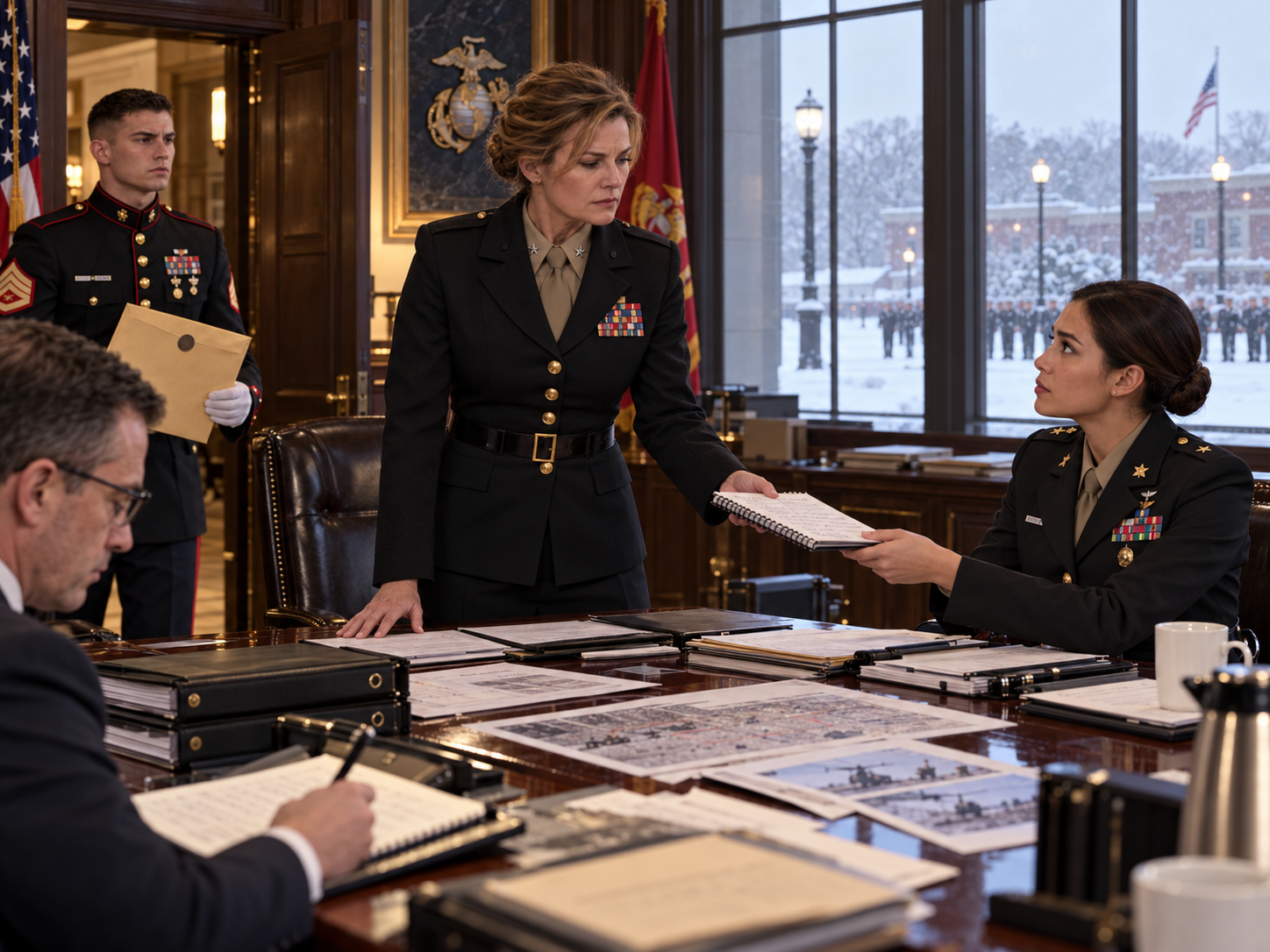
“Why keep these records?” I asked.
Her eyes lowered.
“Because I was afraid that someday someone would tell me none of it happened.”
I felt the words settle heavily in my chest.
Twenty-three years.
A different woman.
A different officers’ club.
The same fear of having one’s experiences dismissed.
I closed the notebook.
“You did the right thing by keeping an accurate record.”
Torres’ expression shifted.
Not quite relief.
Something more fragile.
Hope.
But before she could speak, someone knocked.
Sergeant Dalton entered.
“General, excuse me. Colonel Reeves requested that I bring these documents immediately.”
He carried a sealed folder.
I took it.
Inside was a printed maintenance report.
An equipment inspection record.
And a message forwarded from the installation’s logistics office.
The original report carried Captain Reed’s name.
It identified unresolved brake system defects on two transport vehicles scheduled for a training movement.
Attached was a later version showing both vehicles cleared for operational use.
But the approval field contained a name that did not match the personnel roster for the maintenance section.
I examined the document again.
“Sergeant, where did these come from?”
“Staff Sergeant Marcus Bell from logistics provided them, ma’am. He said the original records were found in a retained inspection file.”
“Has anyone verified the copies?”
“Not yet, ma’am.”
I looked toward the investigator.
“We’ll need the source records and their audit history.”
He nodded.
Dalton remained standing.
“General, there’s another issue.”
“Go ahead.”
“Captain Reed was ordered to report to Major Hale’s office this morning.”
I checked my watch.
“At what time?”
“0900, ma’am.”
It was 0857.
“Who issued the order?”
“Major Hale.”
I stood.
“Have Colonel Reeves contact Major Hale immediately. The order is to be held pending review.”
Dalton nodded.
“Yes, ma’am.”
I turned to Torres.
“Thank you for coming forward.”
She rose.
“General, can I ask something?”
“Of course.”
“Will Captain Reed lose his career over this?”
I wished I could promise her that the next few days would be simple.
They wouldn’t.
Investigations rarely were.
Even when people told the truth, the process could be painful.
“Lieutenant, I can’t promise anyone a particular outcome. But I can promise that relevant evidence will be examined, and that retaliation allegations will be taken seriously.”
She nodded slowly.
It wasn’t the easy reassurance she’d hoped for.
But it was the truth.
After she left, I examined the two maintenance reports once more.
One marked the vehicles as requiring corrective action.
The other showed them cleared.
The difference wasn’t merely administrative.
If faulty equipment had been knowingly sent into training, Marines could have been placed in unnecessary danger.
But there was another possibility.
The discrepancies might have been repaired.
The paperwork might simply have been filed incorrectly.
That was why evidence mattered.
Anger was not proof.
Suspicion was not a verdict.
And I wasn’t going to abandon those principles simply because Major Hale had insulted me.
At 0940, Colonel Reeves returned.
His expression was grim.
“General, there’s a problem.”
“What kind?”
“Major Hale says he never authorized the amended maintenance report.”
“Then we’ll examine that claim.”
“He’s also alleging Captain Reed falsified the original.”
I set down my pen.
“On what basis?”
“He’s submitted a written statement.”
“And Reed?”
Reeves hesitated.
“He’s requested legal counsel.”
I nodded.
“Good. He should understand his rights and responsibilities.”
The colonel remained standing.
“There’s something else, General.”
He handed me another sheet of paper.
It was a memorandum bearing Hale’s signature.
The date was three weeks earlier.
The subject line read:
RECOMMENDATION FOR ADVERSE ADMINISTRATIVE ACTION — CAPTAIN DANIEL REED.
I read the allegations carefully.
Failure to follow directives.
Conduct undermining command confidence.
Unauthorized retention of maintenance documents.
Then I reached the final paragraph.
Hale had recommended that Reed be relieved from his current duties and considered unsuitable for continued leadership responsibilities.
I looked up.
“Has this been acted upon?”
“No, ma’am.”
“Why wasn’t it in the packet I received?”
“Because the recommendation was withheld at battalion level pending review.”
“By whom?”
Reeves’ expression darkened.
“Major Hale.”
I looked back at the paper.
Hale had accused Reed of misconduct.
Prepared an adverse recommendation.
And apparently retained control over the material needed to evaluate the allegation.
I thought of Lieutenant Torres’ notebook.
I thought of the anonymous envelope.
And I thought of the older server, Evelyn Parker, glancing fearfully toward the major.
A pattern was emerging.
But we needed to know who had created it, who had permitted it, and how far it reached.
Then Reeves said something that changed the direction of the entire investigation.
“General, Staff Sergeant Bell says there’s a second set of inspection records.”
I looked at him.
“Where?”
“In a secured archive used during last year’s equipment transition.”
“Who can access it?”
“Only a small group from logistics and the command administrative staff.”
He paused.
“Major Hale is one of them.”
Outside, a vehicle engine started in the cold.
Inside, I felt the investigation narrowing toward a question neither of us could ignore.
Why had someone needed two versions of the same report?
PART 4 — THE TRUTH BENEATH THE UNIFORM
By the following afternoon, Major Hale had retained counsel.
That was his right.
He was also temporarily removed from responsibilities involving personnel evaluations and the disputed records while independent reviewers examined the allegations.
That was a necessary precaution, not a finding of guilt.
I wanted everyone involved to understand the distinction.
Including Hale.
Especially Hale.
The independent investigation had begun under an officer from outside the installation, Colonel Rebecca Shaw.
Shaw was experienced, meticulous, and unimpressed by the reputations of the people she interviewed.
When she entered my office, she carried a thick folder and an expression suggesting she hadn’t enjoyed what she’d found.
“We’ve confirmed several inconsistencies,” she said.
I offered her a chair.
“Start with the records.”
“The original vehicle inspection report was authentic. The discrepancies were entered by authorized maintenance personnel.”
“Was corrective work completed?”
“Some work was completed. But the later clearance document was entered before the remaining deficiencies had been resolved.”
I leaned forward.
“Who entered it?”
“We’re still identifying the individual. The system audit shows use of an administrative account associated with Hale’s section.”
“That doesn’t establish who used the account.”
“Correct.”
I appreciated that.
An investigation conducted to satisfy a predetermined conclusion was no investigation at all.
Shaw opened another folder.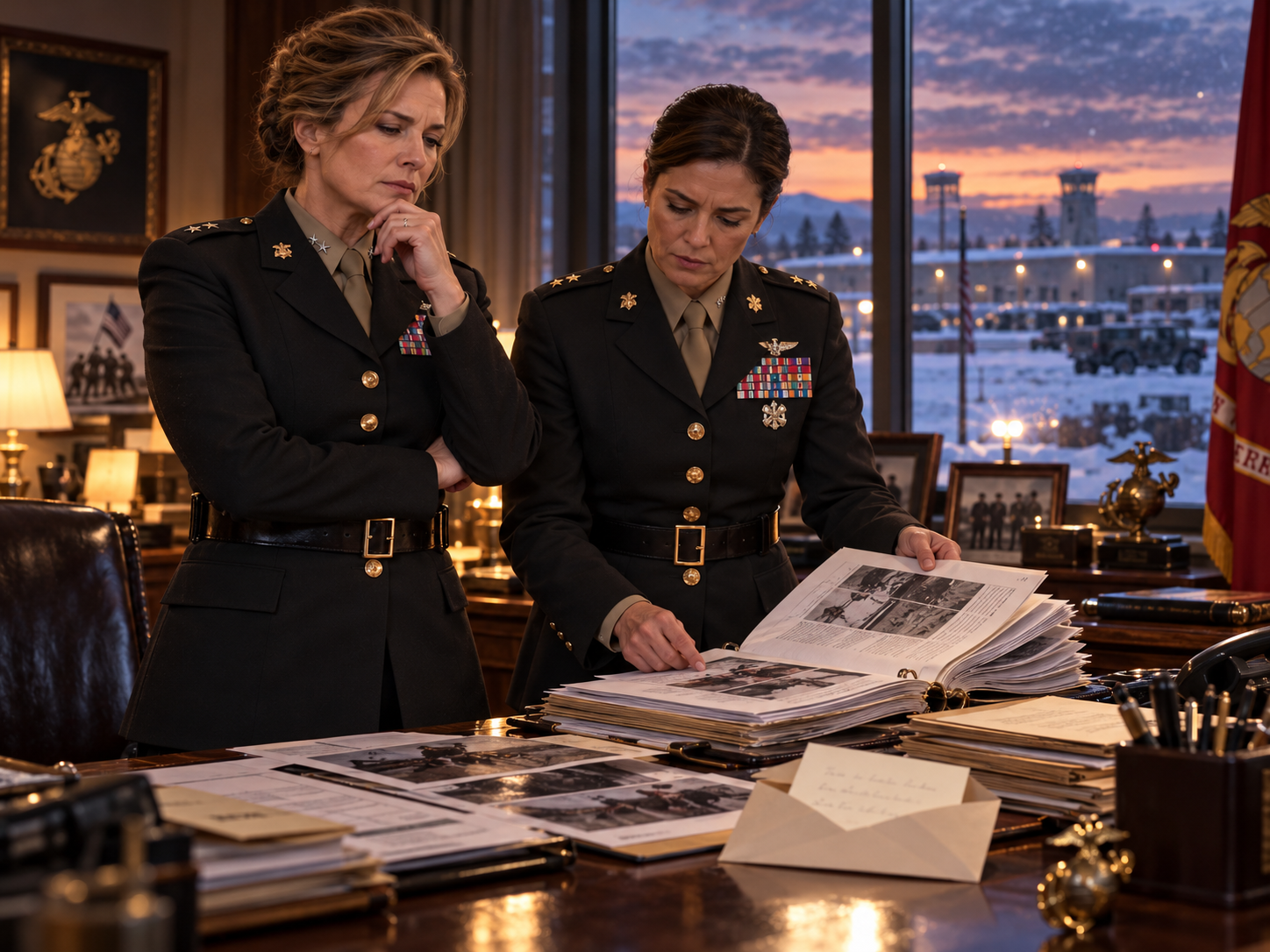
“However, we also found a series of emails directing administrative staff to revise the wording of Captain Reed’s training risk assessment.”
“From Hale?”
“From his official account.”
“What did they say?”
She slid the correspondence toward me.
I read it twice.
The language was careful.
No open admission of wrongdoing.
No direct instruction to fabricate an inspection.
Instead, phrases about avoiding unnecessary delays and eliminating language that might create command-level concern.
One sentence stood out:
“The final readiness picture must support the approved exercise schedule.”
I looked up.
“That could mean several things.”
“It could,” Shaw agreed. “We’ve requested interviews with everyone involved.”
She continued.
“There’s also evidence concerning personnel evaluations.”
My stomach tightened.
“Tell me.”
“Three officers raised concerns about Hale’s conduct or decisions. All three subsequently received adverse comments in evaluation materials prepared through his section.”
“That timing alone isn’t proof of retaliation.”
“No. But the supporting narratives contain unusually similar language, and we found inconsistencies between the evaluation summaries and earlier documented performance.”
I examined the materials.
Captain Reed’s evaluation had been altered substantially.
Lieutenant Torres’ advanced-course recommendation had disappeared after being approved at a lower level.
A third Marine, Captain Olivia Grant, had been reassigned after questioning training documentation.
The pattern was disturbing.
But what troubled me most was the fact that nobody had connected these cases before the anonymous packet arrived.
“How is Captain Grant?” I asked.
Shaw paused.
“She resigned her active-duty commission eight weeks ago.”
I sat back.
“Have you spoken to her?”
“She’s agreed to an interview.”
“Good.”
Shaw closed the folder.
“General, there’s one more person you should hear about.”
“Who?”
“Evelyn Parker.”
The server.
“She approached the investigator yesterday.”
“What did she say?”
“That the incident in the officers’ club wasn’t the first time Major Hale publicly humiliated someone.”
I remembered the look in her eyes.
“Go on.”
“She described repeated disparaging comments toward civilian employees and junior personnel. She also identified witnesses.”
I looked toward the window.
Outside, Marines were crossing the courtyard beneath the gray winter sky.
The investigation had begun with reports about operational readiness.
Now it was exposing something broader.
An atmosphere in which people were afraid to challenge a man who controlled their opportunities.
I had spent decades in uniform.
I knew the difference between demanding leadership and abusive leadership.
A demanding officer established high standards, gave honest feedback, and accepted responsibility when things went wrong.
An abusive officer used standards selectively.
Rewarded silence.
Punished disagreement.
And confused fear with respect.
I wasn’t prepared to conclude Hale had done everything alleged.
But I was no longer prepared to ignore the cost of waiting.
“Colonel Shaw,” I said, “make sure the witnesses understand the process and have access to the appropriate support.”
“Yes, ma’am.”
“And keep me informed of any evidence that contradicts these allegations.”
She gave a small nod.
“That’s exactly what I intend to do.”
After she left, I remained alone for several minutes.
Then my assistant announced a visitor.
“Captain Daniel Reed is here, General.”
I hadn’t requested an interview.
Shaw was responsible for gathering evidence, and I had no intention of interfering.
But Reed had asked to speak about an urgent personnel concern unrelated to his formal testimony.
I allowed him in.
He was thirty-four, broad-shouldered, with tired eyes and a uniform that had seen a long day.
He stood at attention.
“Captain Reed.”
“General.”
“Have a seat.”
He remained standing.
“Ma’am, I don’t want anyone to think I’m trying to influence the investigation.”
“Then don’t discuss your testimony with me. Colonel Shaw will handle that.”
He nodded.
“Understood.”
“What did you need?”
He hesitated.
“My Marines are afraid.”
I studied him.
“Of what?”
“That speaking up will make things worse. That the investigation will end, people will be reassigned, and nothing will change.”
I considered that.
“Have they experienced retaliation since the review began?”
“Not that I know of. But they’re worried.”
“That’s understandable.”
He looked surprised.
I continued.
“Captain, you and I both know that issuing a directive against retaliation doesn’t automatically eliminate fear. Trust takes longer to rebuild.”
He nodded.
“Yes, ma’am.”
“How are you holding up?”
He looked away.
For several seconds, he said nothing.
Then his voice grew quiet.
“My wife asked me last night whether staying in the Marine Corps was worth it.”
I didn’t answer immediately.
Reed rubbed his hands together.
“I’ve wanted to be a Marine since I was a kid. My father served. My grandfather served. I believed that if I worked hard, followed the standards, and did what was right, the institution would stand behind me.”
He looked directly at me.
“I don’t know if I believe that anymore.”
Those words hurt more than Hale’s insults ever could.
Because they came from a man whose loyalty had been strained not by an enemy, but by the people responsible for leading him.
“Captain,” I said, “I won’t tell you that every leader deserves your trust.”
His expression changed.
“Ma’am?”
“They don’t. Some fail. Some make poor decisions. Some use authority badly. The uniform doesn’t erase human weakness.”
I paused.
“But the standards you believed in are still worth defending. That’s why independent review, accountability, and the right to raise concerns matter.”
Reed’s shoulders lowered slightly.
“I needed to hear that.”
“Then let me add something.”
He waited.
“You do not have to sacrifice your family or your health to prove your loyalty. Whatever you decide about your future, make the decision because it is right for you, not because someone has convinced you that you have no place here.”
He nodded.
For a moment, I thought he might cry.
Instead, he stood.
“Thank you, General.”
After he left, I sat quietly.
I thought about the officer who had told me I was a guest in the Marine Corps.
For years, I’d imagined what I would say if I encountered him again.
I’d rehearsed sharp replies.
Imagined promotions.
Decorations.
The satisfaction of showing him how wrong he’d been.
But somewhere along the way, I’d stopped caring about proving myself to that man.
I’d learned that the true measure of a leader wasn’t how impressive she appeared to her superiors.
It was what happened to the people beneath her authority.
That evening, Colonel Shaw called.
“We have a significant development.”
I straightened.
“What is it?”
“The secured archive contained copies of the original inspection report, related maintenance records, and additional correspondence.”
“Does it establish who authorized the clearance?”
“Not conclusively. But we’ve interviewed the administrative clerk who made the entry.”
I waited.
“The clerk says Major Hale instructed him to submit the amended document.”
“Has Hale responded?”
“Through counsel. He denies ordering any false entry.”
“What does the clerk say he was told?”
Shaw paused.
Then she answered.
“He says Hale told him the exercise couldn’t be delayed and that the remaining discrepancies would be addressed later.”
I looked at the darkening window.
“Was the exercise conducted?”
“Yes.”
“Using those vehicles?”
“One of them.”
A cold sensation moved through me.
“Was anyone injured?”
“No, General.”
I exhaled.
Then Shaw continued.
“But a vehicle experienced a braking problem during the movement. The convoy stopped, and maintenance personnel removed it from service.”
For several seconds, I couldn’t speak.
No one had been hurt.
But the possibility had been there.
A risk someone had identified.
A concern someone had raised.
A warning someone might have ignored.
“Did the incident report reach command?”
Shaw’s voice hardened.
“Not in its original form.”
I stared at the telephone.
“What happened to it?”
“The initial report described the braking defect. The version included in the completed exercise summary referred only to an unscheduled mechanical inspection.”
“Who approved the final summary?”
“Major Hale.”
I closed my eyes.
Outside, snow began falling again.
I thought about the nearly two hundred officers laughing in the club.
I thought about Hale smiling as he told me to find a useful job.
And suddenly the insult seemed almost insignificant.
Because the same arrogance that had made him dismiss a stranger at a dinner might also have made him dismiss warnings about equipment carrying his own Marines.
I opened my eyes.
“Colonel Shaw, follow the evidence wherever it leads.”
“We will, General.”
“And if the findings support further action, they need to go through the proper legal and command channels.”
“Understood.”
After the call ended, I sat in silence.
Then my assistant knocked.
“General, there’s a letter for you.”
She handed me a plain white envelope.
No official letterhead.
No rank.
Only my name.
Inside was a short handwritten message.
“I was the one who sent the first packet. I didn’t think anyone would come. Thank you for listening.”
It was signed:
Evelyn Parker.
I read the letter twice.
Then I looked toward the snow.
A civilian employee who had spent nineteen years serving meals to Marines had been brave enough to start a process that officers with far more authority had struggled to begin.
And I understood why that mattered.
Sometimes the person who saves an institution isn’t the one standing at the front of the room.
Sometimes it’s the one nobody bothers to notice.
PART 5 — THE RANK THAT MATTERED MOST
Six weeks later, the snow had begun to melt.
Dirty white piles remained along the roads, but the parade ground was mostly clear.
The investigation had concluded its principal fact-finding work.
Colonel Shaw’s team had reviewed records, interviewed witnesses, and examined the chain of decisions surrounding the training exercise and personnel complaints.
The findings were serious.
Investigators concluded that Major Hale had directed the submission of a readiness clearance that did not accurately reflect the remaining vehicle deficiencies.
They also found that his conduct had contributed to the alteration of the exercise summary and that several personnel actions were improperly influenced by officers’ protected reporting of safety concerns.
Not every allegation was substantiated.
Some witnesses remembered events differently.
Some records were incomplete.
And certain decisions, though poorly handled, did not establish misconduct.
Those distinctions mattered.
I insisted on them.
Accountability required fairness, even when the accused had behaved disgracefully toward me.
Hale received the findings through the appropriate channels and had the opportunity to respond with counsel.
The command initiated formal administrative proceedings and referred the relevant findings for legal review.
He was relieved of his duties involving the personnel and readiness programs at issue while that process continued.
There was no dramatic arrest.
No theatrical removal in handcuffs.
No speech announcing that his career had been destroyed.
Real accountability was often quieter than people expected.
Documents.
Evidence.
Witnesses.
Decisions made under established procedures.
Consequences that could withstand scrutiny.
But the investigation revealed failures beyond one major.
Complaint routing procedures were revised.
Personnel reporting channels were placed under independent oversight.
Training-readiness documentation received additional review requirements.
Colonel Reeves accepted responsibility for failing to recognize the weaknesses in his command’s reporting process.
I respected him for that.
A commander who admitted failure had a chance to correct it.
One who refused would only preserve the conditions that allowed it to continue.
Captain Reed’s disputed evaluation was referred for formal correction.
Lieutenant Torres’ course nomination was reconsidered using the original selection criteria.
Captain Grant, who had resigned, was contacted and offered assistance reviewing the personnel records affected by the investigation.
None of those steps could erase what had happened.
But they were beginnings.
And beginnings mattered.
One bright morning in early spring, I returned to the same officers’ club where Major Hale had first confronted me.
This time, the visit was scheduled.
The room had been rearranged.
Long tables faced a small podium.
Marines from several units had gathered, along with civilian employees and senior officers.
There were fewer than two hundred people.
But the atmosphere was very different.
No exaggerated ceremony.
No expensive dinner.
No atmosphere of self-congratulation.
I’d requested a professional leadership forum focused on trust, accountability, and the responsibility to raise concerns.
I entered wearing my service uniform.
Sergeant Dalton stood near the door.
When he saw me, he straightened.
“Good morning, General.”
“Good morning, Sergeant.”
He smiled.
I glanced toward the entrance.
“No need to announce me quite so loudly this time.”
For a brief second, he looked startled.
Then he laughed.
It was the first time I’d seen him laugh.
“Yes, ma’am.”
I extended my hand.
He shook it.
“How are things going?”
“Well, ma’am. I’ve been selected to attend the advanced leadership course.”
“Congratulations.”
“Thank you.”
He hesitated.
“General, may I ask you something?”
“Of course.”
“That night, when Major Hale ordered me to remove you… why didn’t you tell me who you were immediately?”
I’d considered that question myself.
More than once.
“Because you approached me professionally,” I said. “And because I wanted to see how you handled the situation without knowing whether I outranked you.”
He looked down.
“I almost made a mistake.”
“You stopped and verified. That’s what mattered.”
He nodded.
Then his expression grew serious.
“Some of the officers have been talking about that night.”
“I’m sure they have.”
“They say they’ll never forget it.”
I looked toward the dining room.
“Neither will I, Sergeant. But I hope they remember more than the stars.”
He seemed to understand.
As we entered, I noticed Lieutenant Torres speaking with Captain Reed near the front.
Both looked different.
Not because their problems had magically disappeared.
But because the fear that had surrounded them was beginning to loosen.
Torres wore a small smile.
Reed stood straighter than he had during our first private conversation.
I approached.
“Captain. Lieutenant.”
They greeted me.
“How’s the course nomination?” I asked Torres.
“Approved for the next available class, ma’am.”
“Good.”
She hesitated.
“General, I wanted to thank you.”
“For what?”
“For letting me finish my sentence.”
The words surprised me.
I remembered Hale cutting her off.
“The grown-ups are talking.”
I remembered her standing beside her chair, her cheeks flushed, uncertain whether to speak again.
And I realized that the moment had stayed with her as vividly as it had with me.
“Lieutenant, you had something worth saying.”
Her smile widened.
“I know that now.”
I turned to Reed.
“How’s your family?”
“Better, ma’am.”
He paused.
“My wife and I talked for a long time. I still have some decisions to make, but I don’t feel trapped anymore.”
“I’m glad.”
“And my Marines?”
“Yes?”
“They’re asking questions again.”
I raised an eyebrow.
“That sounds like a good sign.”
“It is.”
He smiled.
“For a while, everyone just kept their heads down. Now they’re raising concerns when they see something wrong. They’re suggesting improvements. They’re actually talking to us.”
“Then don’t punish them for it.”
“I won’t, General.”
I believed him.
Not because he had promised.
Because I had seen what it cost him to learn that lesson.
At the podium, Colonel Reeves began the event.
He spoke briefly about the changes being implemented.
He acknowledged his own responsibility.
He thanked the personnel who had cooperated with the review.
Then he introduced me.
I walked forward to respectful applause.
For a moment, I looked over the room.
The same walls.
The same polished floor.
The same amber lights.
Yet everything felt different.
I rested my hands lightly on the podium.
“Good morning.”
The room responded.
I waited until the murmurs faded.
“Several weeks ago, I entered this building wearing a winter coat. Some of you were here.”
A few heads lowered.
“An officer believed I didn’t belong. He made that judgment without asking my name, verifying my credentials, or considering whether I deserved ordinary courtesy.”
I paused.
“Then a sergeant recognized my rank, and the room stood at attention.”
Several people looked toward Dalton.
He remained motionless beside the door.
“That moment has been discussed considerably.”
I looked across the officers.
“But there is something about it that concerns me.”
The room grew quiet.
“When my rank became visible, my treatment changed immediately.”
I let the words settle.
“That is understandable within military protocol. Rank carries responsibilities and establishes authority.”
I drew a breath.
“But I want you to consider what would have happened if I hadn’t been wearing those stars.”
No one moved.
“What if I had been a civilian employee?”
I looked toward the back of the room.
“What if I had been a military spouse?”
A woman near the aisle folded her hands.
“What if I had been a young Marine asking for help?”
Silence.
“Would the humiliation have been acceptable then?”
Nobody answered.
I hadn’t expected them to.
“The problem that evening wasn’t simply that an officer insulted a general.”
I looked toward the place where Hale had stood beside the bar.
“The problem was that he believed he had the right to humiliate someone he considered less important.”
I paused.
“And too many people watched without intervening.”
The sentence hung in the room.
A few officers shifted in their seats.
“I understand why speaking up can be difficult. I remember what it felt like to be a young lieutenant surrounded by people who outranked me. I remember wondering whether objecting would damage my career.”
My throat tightened unexpectedly.
For a moment, I could see the old officers’ club again.
The men laughing.
The polished gold bars on my collar.
My twenty-three-year-old self trying desperately not to cry.
I continued.
“Someone told me I was a guest in the Marine Corps.”
I looked directly at Torres.
“For years, I carried those words.”
The room remained still.
“Today, I’d like to tell you what twenty-three years of service taught me.”
I leaned slightly toward the microphone.
“No Marine who has earned the right to wear the uniform should be made to feel like a guest in the organization they serve.”
A long silence followed.
Then I continued.
“And no civilian who supports our mission should be treated as though their dignity depends on their position.”
I looked toward Sergeant Dalton.
“Courtesy is not weakness.”
Then toward Torres.
“Respect is not surrender.”
And finally toward Reed.
“Accountability is not betrayal.”
I rested my hands on the podium.
“The most important test of leadership isn’t how you treat a general.”
My voice remained steady.
“It’s how you treat someone who has nothing to offer you except their trust.”
For several seconds, nobody moved.
Then applause began.
Not thunderous.
Not theatrical.
Just genuine.
It spread gradually through the room.
I stood quietly until it ended.
Then I stepped away from the podium.
There was one more thing I wanted to do.
“Evelyn Parker, would you please come forward?”
A murmur moved through the audience.
Near the back, Mrs. Parker looked startled.
She wore a simple dark dress beneath a gray cardigan.
Her silver hair was pinned neatly behind her head.
She had expected to serve refreshments after the event.
She had not expected to be called to the front.
She glanced toward a colleague.
Then slowly stood.
I walked down from the podium to meet her halfway.
“Mrs. Parker,” I said softly, “would you join me?”
Her eyes widened.
“General, I don’t think—”
“Please.”
She followed me to the front.
I turned toward the room.
“Mrs. Parker has worked at this installation for nineteen years. During that time, she has served thousands of Marines, officers, families, and guests.”
Evelyn looked deeply uncomfortable.
I gave her a reassuring smile.
“Recently, she demonstrated something that deserves our recognition.”
I did not mention the anonymous packet.
Her identity as the source of the original warning was not something I intended to expose.
That choice belonged to her.
Instead, I continued.
“She raised concerns about the way people were being treated. She did so professionally and at personal risk.”
I looked toward Evelyn.
“That took courage.”
Tears gathered in her eyes.
“General, I only wanted people to be treated properly.”
“Exactly.”
I turned back toward the audience.
“Mrs. Parker reminded me that moral courage is not limited to those who wear a uniform.”
I presented her with a certificate of appreciation recognizing her years of service and her commitment to the well-being of the installation community.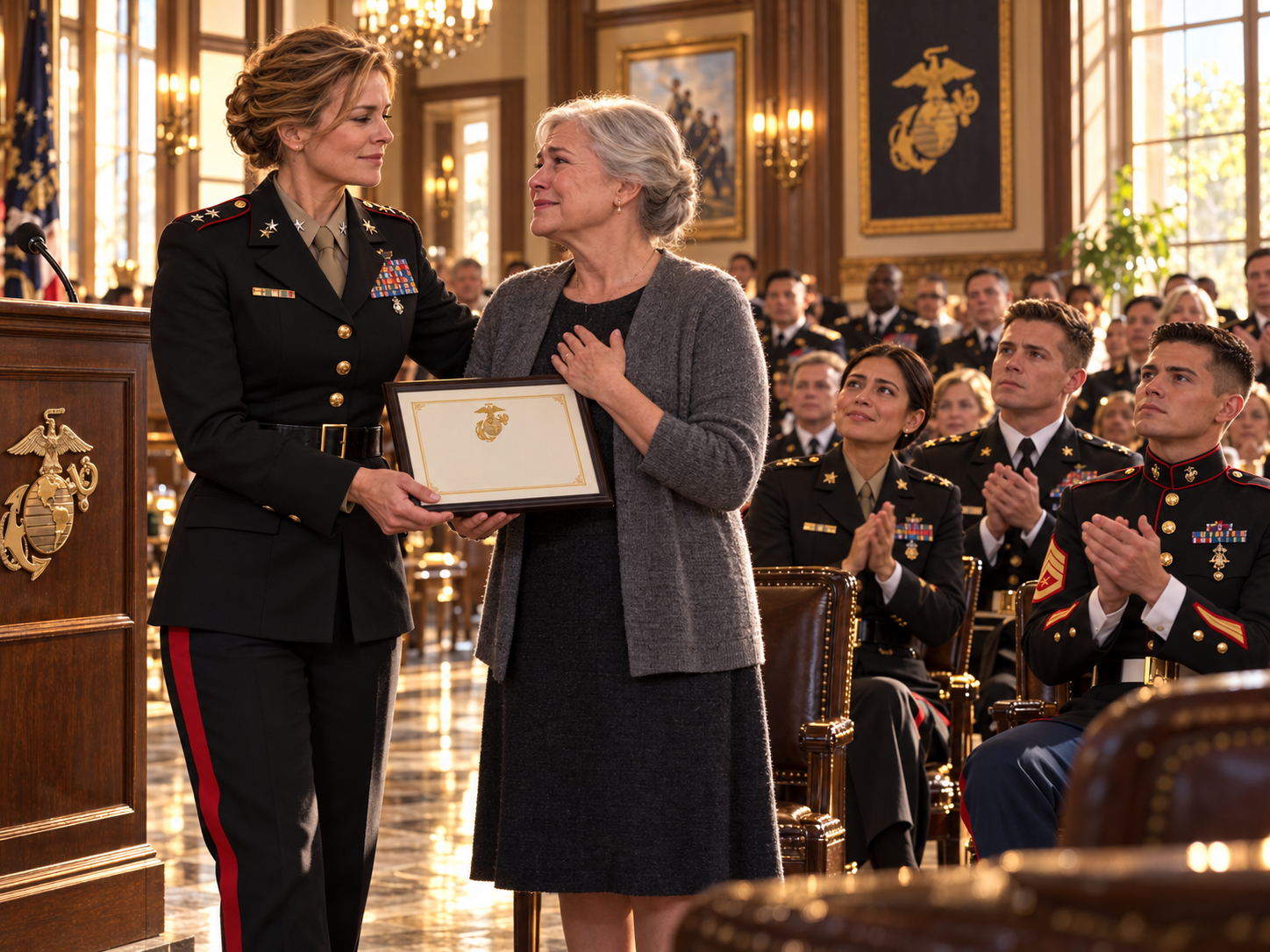
The applause began immediately.
Evelyn covered her mouth.
Her eyes filled.
And when I offered my hand, she surprised me by taking it in both of hers.
“Thank you,” she whispered.
I shook my head.
“No, Mrs. Parker. Thank you.”
After the ceremony, the room gradually emptied.
Officers returned to their duties.
Civilians gathered their belongings.
The kitchen staff began preparing for the afternoon.
I remained near the window, looking across the parade ground.
The snow was almost gone.
Only a few patches remained beneath the trees.
I heard footsteps behind me.
“General?”
I turned.
It was Colonel Reeves.
“There’s someone who requested a final opportunity to address you.”
My expression tightened.
“Who?”
“Major Hale.”
For a moment, I considered refusing.
The formal process was still underway.
I had no intention of discussing evidence or influencing any decision.
But I also believed that accountability and personal reflection were not the same thing.
“Is his counsel aware?”
“Yes, ma’am. He understands that you won’t discuss the case.”
I nodded.
“Then he can come in.”
Hale entered a few moments later.
He wore his uniform.
It was as immaculate as it had been the night we met.
But he no longer carried himself with the same careless arrogance.
He stopped several feet away.
“General Whitcomb.”
“Major Hale.”
He looked toward Colonel Reeves.
Then back at me.
“I know you can’t discuss the proceedings.”
“That’s correct.”
He nodded.
“I came to say something else.”
I waited.
He took a slow breath.
“That night, I thought you were a civilian.”
“I know.”
“I thought you didn’t belong in the room.”
“I know that too.”
He looked at the floor.
“I’ve spent weeks thinking about what happened.”
I said nothing.
“When Sergeant Dalton recognized your rank, I was terrified.”
His voice tightened.
“I thought my career was over. I thought about my evaluations, my deployments, everything I’d worked for.”
He raised his eyes.
“But I wasn’t thinking about what I’d done to you.”
I watched him carefully.
He continued.
“I was thinking about what would happen to me.”
The admission sounded painful.
Perhaps it was.
“I heard your speech today,” he said.
I waited.
“And I realized something.”
He swallowed.
“If you had been a civilian employee, I probably would have forgotten that night before I finished dinner.”
The words hung between us.
I didn’t soften them.
He had finally identified the real problem.
Hale lowered his voice.
“I’m sorry for the way I treated you.”
I studied him.
“Major, an apology is a beginning. It doesn’t erase what happened.”
“I understand.”
“And whatever you believe about the allegations under review, you still have responsibilities.”
“Yes, ma’am.”
“You have the right to a fair process. The Marines affected by your decisions have the right to one as well.”
He nodded.
“I know.”
For the first time since I’d met him, his voice contained no trace of performance.
No microphone.
No audience.
No easy laughter.
Just a man facing consequences.
I hoped he would learn from them.
But that was his responsibility, not mine.
“Thank you for coming, Major.”
He stood at attention.
Then turned and left.
I watched the door close.
Reeves remained beside me.
“Do you think he’ll change?” he asked.
I considered the question.
“I don’t know.”
It was the truth.
“Some people grow after facing their failures. Others spend the rest of their lives explaining them away.”
I looked toward the door.
“What happens next is up to him.”
Reeves nodded.
Then he left.
I was alone.
For the first time in weeks, the club seemed peaceful.
No shouting.
No scraping chairs.
No uncomfortable laughter.
Just sunlight pouring through the windows.
I retrieved my charcoal winter coat from the rack beside the entrance.
The same coat I’d worn that night.
The same coat that had concealed two silver stars and convinced Major Hale that I was someone he could insult without consequence.
I slipped it over my shoulders.
Before leaving, I noticed a young Marine standing near the doorway.
A private first class.
He couldn’t have been older than nineteen.
He looked nervous.
“Excuse me, General?”
I stopped.
“Yes, Marine?”
He straightened.
“I just wanted to say that my sister is joining the Marine Corps next month.”
I smiled.
“Congratulations to her.”
“Thank you, ma’am.”
He hesitated.
“She was worried she wouldn’t fit in.”
I looked at him.
“What did you tell her?”
His expression softened.
“I told her about what you said today.”
I waited.
“That if she earns the uniform, she belongs.”
Something moved in my chest.
Something warm and unexpected.
For twenty-three years, I’d carried the memory of being told I was a guest in my own Marine Corps.
I’d allowed those words to push me.
To challenge me.
To remind me of every door I had been told was closed.
But standing there, looking at that young Marine, I understood that I no longer needed to carry them as a wound.
They had brought me to this moment.
And now I could leave them behind.
“Tell your sister something for me,” I said.
“Yes, ma’am.”
“Tell her the standards are demanding. Tell her the responsibility is real. Tell her she’ll make mistakes and encounter difficult people.”
He nodded.
“But tell her this, too.”
I paused.
“She doesn’t have to become someone else to deserve her place. She has to become the best Marine she can be.”
The young man smiled.
“I’ll tell her, General.”
I returned his smile.
“Good.”
Outside, the air was cold but clear.
The last traces of winter were disappearing from the sidewalks.
I descended the steps slowly, listening to the sounds of the installation coming to life around me.
Engines starting.
Boots striking pavement.
Marines calling greetings across the courtyard.
Ordinary sounds.
The sounds of an institution built not by stars on collars, but by the daily efforts of thousands of people whose names would never appear in history books.
As I reached my vehicle, Sergeant Dalton approached.
He had finished his duties at the club.
“General?”
I turned.
“Yes, Sergeant?”
He smiled.
“Safe travels, ma’am.”
“Thank you.”
I opened the vehicle door.
Then he spoke again.
“And General?”
“Yes?”
He hesitated.
“I’m glad I checked your collar.”
I looked at him for a long moment.
Then I smiled.
“So am I, Sergeant.”
He laughed.
I climbed into the vehicle.
As we pulled away, I looked back once at the officers’ club.
Six weeks earlier, nearly two hundred officers had stood at attention because they discovered who I was.
But that morning, something far more important had happened.
A young lieutenant had found her voice.
A captain had begun rebuilding his trust.
A sergeant had learned that sound judgment mattered more than blind compliance.
A civilian employee had received the recognition she deserved.
And a room full of Marines had been reminded of a truth that should never have been forgotten.
Respect should not begin when someone reveals their rank.
It should begin the moment another human being walks through the door.
I leaned back against the seat.
For the first time in twenty-three years, the memory of that young lieutenant standing alone in an officers’ club no longer hurt quite so much.
I could still see her.
Her new uniform.
Her uncertain eyes.
The gold bars on her collar.
I wished I could reach back through time and tell her what I knew now.
That she would survive the laughter.
That she would earn the confidence she didn’t yet possess.
That her service would be difficult, meaningful, and imperfect.
That there would be moments when she doubted herself.
And moments when others depended on her more than she could imagine.
But most of all, I wished I could tell her one thing.
“You were never a guest here.”
I looked out at the Marines crossing the parade ground.
And for the first time in a very long while, I felt completely at peace.
THE END.
