PART 3 — THE TRUTH THEY BURIED WITH MY HUSBAND
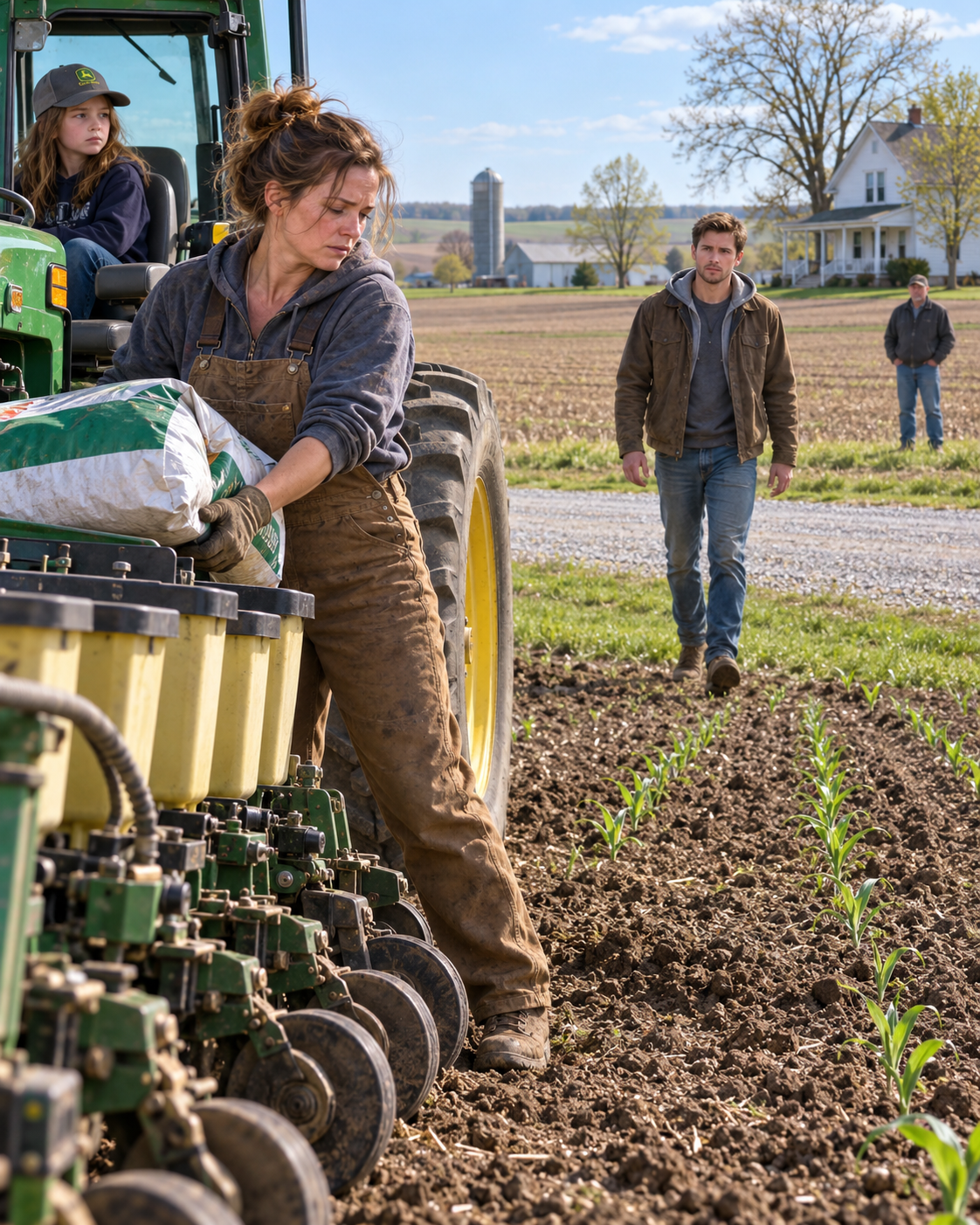
Randy stood in my kitchen holding two photographs and a folder full of documents.
He had come expecting me to be frightened into silence.
But after discovering Jeff’s letter, the forged signature, and the secret amendment, I was no longer the grieving widow who had accepted a $500,000 check without asking questions.
I was beginning to understand that my husband had been fighting a battle long before he died.
And his brothers had been determined to make sure I never discovered it.
The first photograph showed Jeff standing inside the old grain storage building.
Beside him was Arthur Bell, the family’s longtime attorney.
Arthur had been the man who approached me at Jeff’s funeral, held my hands, and promised that everything concerning my husband’s estate would be handled properly.
He had also witnessed the amendment that named me as the surviving beneficiary.
The second photograph showed Jeff standing beside another man.
A man I recognized immediately.
Samuel Mercer.
Eleven years earlier, Sam had disappeared after a devastating fire destroyed his grain truck. His family had announced that he had died, although no body had ever been recovered.
For years, everyone in the county had believed the same story.
Including me.
But there he was, standing beside my husband.
Alive.
I looked at Randy.
“Why are you showing me these?”
He closed the folder.
“Because you don’t understand what you’re getting yourself into.”
“Then explain it.”
He glanced at Luke.
“Not in front of him.”
Luke stepped forward.
“She’s my aunt. Whatever you have to say, you can say it in front of me.”
Randy’s jaw tightened.
Then he looked back at me.
“Jeff made a terrible mistake. He trusted people he shouldn’t have trusted. And now you’re making the same mistake.”
I held up the photograph.
“Is Sam Mercer alive?”
Randy didn’t answer.
“Is he?”
Scott finally spoke.
“Melissa, some things are better left alone.”
I almost laughed.
“That’s interesting. Because I’ve spent the last six weeks being told what I should and shouldn’t do. First, you told me to leave my home. Then you tried to sell land that apparently requires my authorization. Now you’re telling me not to ask questions about a man everyone believed was dead.”
I placed Jeff’s letter on the table.
“Here’s what I think. You two have been hiding something for a long time. And my husband found out.”
Randy’s expression hardened.
“You have no idea what Jeff was involved in.”
“Then tell me.”
He stared at me.
Finally, he said:
“Go to the bank. Withdraw your objection. Take the money you were given. Move on with Abby. You can have a comfortable life without turning this into a war.”
I looked at him for several seconds.
Then I answered quietly.
“Randy, I already had a comfortable life. I had a husband, a daughter, and a home. You took two of those things away from me in a matter of months. I’m not giving you the third.”
His face turned red.
He picked up his folder.
“You’re going to regret this.”
I opened the door.
“Then I suppose we’ll find out.”
He walked outside.
Scott followed him.
But Luke remained in the kitchen.
After their truck disappeared down the driveway, he turned toward me.
“Aunt Melissa, I think we need to go to that grain building.”
I nodded.
“We leave in ten minutes.”
The old grain building stood at the northern edge of the original farm.
It was a weathered wooden structure with a rusted metal roof and a heavy sliding door.
Jeff had used it years ago to store old equipment, spare parts, and boxes of paperwork.
The brothers had stopped using it after installing a newer storage facility closer to the main barn.
According to the demolition notice, a contractor was scheduled to begin clearing the building the following morning.
We arrived just after nine.
Luke had brought a flashlight and a set of tools.
I carried Jeff’s letter and the photographs.
The lock on the door had been replaced recently.
Luke examined it.
“That’s new.”
“Are you sure?”
He nodded.
“I used to store equipment here. That lock wasn’t here last month.”
He took out a small set of tools and worked on the mechanism.
A minute later, it opened.
The smell of old wood, dust, and machine oil filled the air.
Sunlight slipped through gaps in the walls.
We walked slowly toward the back.
There were rusted cultivator parts, empty chemical containers, old tires, and several wooden cabinets.
Luke pointed toward the far wall.
“Uncle Jeff used to keep his records over there.”
Most of the cabinets were empty.
But one had been moved away from the wall.
Behind it was a narrow wooden door.
I stared at it.
“I’ve never seen that before.”
Luke pushed against it.
It opened with a low creak.
Behind it was a small storage room.
Inside sat a metal filing cabinet, a desk, and several cardboard boxes.
On the desk was a photograph of Jeff and Sam Mercer.
This one was newer.
Jeff looked older, but his smile was unmistakable.
I picked it up.
On the back, he had written:
Sam — February 18. We finally have the truth.
My hands began trembling.
Luke opened the first box.
Inside were bank statements.
The second contained copies of partnership agreements.
The third held several handwritten ledgers.
I began examining the papers.
At first, they looked like ordinary accounting records.
Then I noticed the same company name appearing repeatedly.
Red Valley Development Group.
The company that wanted to purchase the family farm.
There were payments listed under consulting fees, land assessments, and administrative expenses.
But the dates went back almost four years.
I turned another page.
Then another.
The payments totaled more than $680,000.
I looked at Luke.
“Did you know about these?”
He shook his head.
“No.”
I continued reading.
Several payments had been authorized by Randy.
Others carried Scott’s initials.
But the most disturbing entries were associated with a third name.
Arthur Bell.
The attorney.
The same man who had witnessed Jeff’s amendment.
The same man who had assured me at the funeral that everything was being handled properly.
I found a separate folder.
Inside was a typed statement signed by Samuel Mercer.
The first paragraph explained that Sam had worked as the farm’s outside financial adviser eleven years earlier.
He had discovered that money was being transferred from the partnership into accounts controlled by Randy and Scott.
When he confronted them, he received threats.
A few days later, his truck was found burned near an abandoned road.
There had been no confirmed body.
But Randy and Scott told everyone that Sam had died.
Sam had left Nebraska and lived under a different name in Colorado.
He had remained silent for years because he feared what would happen if he returned.
Until Jeff found him.
The final page contained a statement dated February 18.
It explained that Jeff had contacted Sam after discovering irregularities in the partnership’s financial records.
Together, they had traced the missing money.
And they had found something even worse.
The brothers had been using the farm’s assets to secure loans for Red Valley Development Group without properly disclosing the transactions to the partnership.
If the sale went through, the company would acquire the land while the outstanding financial obligations remained buried in a complicated series of agreements.
It was a plan that could have cost the family everything.
I sat down on the old wooden chair.
For several moments, I couldn’t speak.
Then Luke pointed toward the bottom of the cabinet.
“There’s another envelope.”
It was sealed.
My name was written across the front.
Again, in Jeff’s handwriting.
I opened it carefully.
Inside was a letter.
Melissa,
If you have found this, then the people I was worried about have probably made their move.
I’m sorry I didn’t tell you everything sooner.
I wanted to protect you and Abby. I believed I had enough time to resolve this before it became your problem.
I was wrong.
The land across the road is important. Do not let anyone convince you otherwise. The Wiebe property contains the only practical access route that cannot be controlled by the development company.
I wanted you to have the opportunity to build something of your own. I also wanted to make sure that nobody could force you away from the farm.
The amendment is real. The original is in this building.
The partnership agreement is not the only document that matters.
Most importantly, never sign anything Arthur Bell brings you without having an independent attorney examine it.
I love you. I love Abby.
And no matter what happens, remember that you were never just my wife.
You were my partner.
Jeff.
I pressed the letter against my chest.
For the first time in weeks, I allowed myself to cry.
Not because I was helpless.
But because I finally understood how hard my husband had tried to protect us.
Luke stood quietly beside me.
After a moment, he placed a hand on my shoulder.
“Uncle Jeff knew you could do this.”
I wiped my eyes.
“Then let’s finish what he started.”
At the bottom of the final cabinet, we found a sealed metal box.
Inside were the original partnership amendment, a trust agreement, copies of the land deeds, and a USB drive.
The amendment had been properly witnessed and notarized.
It gave me the authority to act as successor trustee for the family’s agricultural land and required my written approval for any sale or long-term development arrangement.
The trust agreement also protected the farmhouse and certain agricultural properties from being transferred without the trustee’s authorization.
The document had been signed months before Jeff died.
The witness signature belonged to Arthur Bell.
But there was another detail.
The USB drive contained scanned copies of the financial records, emails, and recorded statements from Sam Mercer.
I looked at Luke.
“This is enough to show the bank.”
He nodded.
“And the police.”
I put everything into my bag.
Before leaving, I took one last look around the little room.
Jeff had known there might come a day when I needed to find these things.
He had left us a trail.
And we had finally found it.
At eleven the following morning, I walked into First County Bank with Luke beside me.
I had also brought an attorney named Margaret Ellis.
Margaret had represented several local farming families and had no previous connection to the partnership.
She examined the amendment, the trust agreement, and the bank’s documents.
Then she looked at the banker.
“Has the closing been suspended?”
The banker nodded.
“Temporarily. We received Mrs. Melissa’s objection yesterday, but we need to investigate the conflicting documents.”
Margaret placed the photocopy of my supposed waiver on the table.
“This document is disputed. My client denies signing it. We have requested a forensic examination of the signature.”
The banker looked uncomfortable.
“That’s understandable.”
Margaret opened another folder.
“And these are the original agreements establishing Mrs. Melissa’s authority.”
The banker read them carefully.
Then he looked up.
“Who submitted the waiver?”
I answered.
“My husband’s brothers.”
“And who notarized it?”
Margaret turned the page.
“Arthur Bell.”
The banker’s expression changed.
He leaned back.
“Mr. Bell is the attorney who has been handling the partnership’s legal paperwork.”
“Correct,” Margaret said. “And he is also the witness to the original amendment that appears to contradict the waiver.”
The banker slowly removed his glasses.
“I think we need to contact our legal department.”
Margaret nodded.
“Please do. And I want the transaction frozen until the ownership and authorization issues are resolved.”
Within an hour, the proposed closing was suspended.
The bank also flagged the disputed documents and referred the matter for further review.
For the first time, Randy and Scott were no longer controlling the situation.
The following week, everything began unraveling.
An independent forensic document examiner concluded that the signature on my supposed waiver had not been written by me.
Further examination of the notarial records revealed inconsistencies in the date and supporting identification information.
Then came the financial investigation.
The records from the grain building were compared with the partnership’s bank statements.
Investigators found that hundreds of thousands of dollars had been transferred through accounts connected to Red Valley Development Group.
Some payments had been disguised as equipment purchases.
Others had been listed as consulting fees for services that had never been performed.
The company itself had been created by an associate of Randy and Scott.
And Arthur Bell had helped prepare the paperwork.
But the biggest development came when Margaret located Samuel Mercer.
He was living outside Fort Collins, Colorado.
He had changed his name and kept a low profile for years.
When he learned that Jeff’s family had discovered the records, he agreed to return to Nebraska.
I met him at Margaret’s office.
He was seventy-one years old, with silver hair and a deeply lined face.
He stood in the doorway for several seconds.
Then he looked at me.
“Melissa?”
I nodded.
He removed his hat.
“I’m sorry about Jeff.”
I couldn’t help crying.
“Thank you.”
He sat down.
For nearly two hours, he explained what had happened.
He had not died in the truck fire.
Someone had deliberately set the vehicle ablaze after he left it near the old highway.
He had escaped before the fire spread.
He had been terrified that the people responsible would come after him.
When Jeff contacted him years later, Sam initially refused to get involved.
But Jeff kept asking questions.
He wanted to know why so much money had disappeared from the farm’s accounts.
Eventually, Sam agreed to help.
Together, they uncovered the financial transfers.
They also discovered that Randy and Scott were planning to use the proposed development sale to settle certain debts without disclosing the true extent of the partnership’s financial obligations.
Sam had kept copies of the records.
Jeff had kept copies of the legal agreements.
Neither man trusted the other brothers.
And Jeff had made sure that the original documents were stored somewhere Randy and Scott wouldn’t think to look.
I asked Sam one question.
“Why didn’t you come forward when Jeff died?”
His eyes filled with tears.
“Because I was afraid, Melissa. And because I thought your husband had left enough protection for you.”
He paused.
“Then I heard what they had done at his funeral.”
He shook his head.
“I knew I couldn’t stay silent anymore.”
I reached across the table and held his hand.
“Jeff would have been grateful.”
Sam nodded.
“I hope so.”
Three weeks later, the county courthouse was full.
Randy and Scott had been summoned to answer questions concerning the disputed partnership documents.
Arthur Bell had also been called to testify.
I sat beside Margaret.
Luke sat on my other side.
Abby was with a neighbor because I didn’t want her exposed to the details of the investigation.
Randy entered first.
He looked older than he had at the funeral.
Scott followed him.
Neither man looked in my direction.
Arthur arrived several minutes later, carrying a briefcase.
For the first time, I saw him look genuinely nervous.
The hearing lasted most of the day.
The evidence was presented in order.
The original amendment.
The trust agreement.
The bank records.
The forged waiver.
The suspicious payments.
Sam Mercer’s sworn statement.
And finally, the document examination report.
Arthur tried to argue that the paperwork had been prepared according to the instructions he received from his clients.
But Margaret asked him one question.
“Mr. Bell, were you aware that the document you witnessed in February gave Melissa the authority to approve or reject a sale of the agricultural property?”
Arthur hesitated.
“I would need to review the document.”
Margaret placed the original amendment in front of him.
“Please do.”
He read it.
Then he looked down.
“Yes.”
“Then why did you prepare a waiver stating that Mrs. Melissa had voluntarily surrendered those rights?”
“I was instructed to prepare it.”
“By whom?”
Arthur looked toward Randy.
Randy stared straight ahead.
“I don’t recall.”
Margaret placed another document on the table.
“This is an email dated April 8, sent from Mr. Randy’s account to yours. It says, ‘We need Melissa’s name on the release before the bank asks questions. Make sure the paperwork is completed before the closing.’ Is that your email address?”
Arthur didn’t answer.
Margaret continued.
“And this message from the following morning says, ‘The signature is taken care of.’ Is that also your email?”
Arthur finally spoke.
“Yes.”
The courtroom became silent.
I looked at Randy.
His face had turned pale.
The investigation continued for several months.
Eventually, the evidence was sufficient for prosecutors to bring criminal charges.
Randy and Scott were charged in connection with the financial scheme, fraudulent documents, and the unauthorized use of partnership assets.
Arthur Bell faced charges related to his role in preparing and submitting the fraudulent paperwork.
The bank withdrew from the proposed transaction.
Red Valley Development Group abandoned its purchase agreement.
And the court issued orders protecting the disputed properties while the remaining financial claims were resolved.
The consequences were severe.
Randy and Scott eventually entered plea agreements after the evidence against them became overwhelming.
They were convicted of financial offenses connected to the scheme and received prison sentences, along with orders to repay substantial amounts of the money they had taken.
Arthur lost his law license and was also convicted for his role in the fraudulent transactions.
The partnership’s stolen funds were partially recovered through the legal proceedings and the sale of assets connected to the scheme.
But the most important thing was that the farm was no longer being sold behind my back.
The court recognized the validity of Jeff’s amendment and my authority as successor trustee.
The sale was permanently stopped.
And the farmhouse remained protected.
One Saturday morning, several months later, I stood outside the little white farmhouse watching Abby run across the yard.
Spring had returned.
The air smelled of damp earth and freshly cut grass.
My eighty acres were planted.
The John Deere tractor sat beside the machine shed.
It wasn’t the biggest operation in the county.
It wasn’t even close.
But every acre was ours.
Luke had continued helping me.
After everything that happened, he decided he no longer wanted to work under his father’s control.
He rented a small house nearby and began managing some of the agricultural work with me.
We also hired two local workers during planting and harvest seasons.
For the first time, I wasn’t trying to prove that I could do everything alone.
I was building something sustainable.
Something that Abby could be proud of.
One afternoon, she came running into the kitchen.
“Mom! Come outside!”
I followed her.
She was standing near the fence holding something behind her back.
“What is it?”
She smiled.
Then she revealed Jeff’s old seed cap.
The same cap she had worn when we first planted the field.
It was faded and worn, but she had carefully washed it.
“I found something inside.”
She turned the cap over.
There was a small piece of paper tucked into the inner band.
I recognized Jeff’s handwriting immediately.
It was a note he must have written years earlier.
Only one sentence.
For my girls. Keep growing, even when the ground gets hard.
I covered my mouth.
Abby looked at me.
“Do you think Dad knew we’d be okay?”
I knelt beside her.
“I think your daddy believed we were stronger than we knew.”
She hugged me.
And for the first time in a long time, the farm felt peaceful again.
The following September, we held a small gathering at the edge of the eighty acres.
Luke invited Sam Mercer.
A few neighbors came.
Margaret stopped by with her husband.
Even some of the old farm workers came to see the new grain storage building we had installed.
I had decided to name the operation Jeff’s Legacy Farm.
Not because I wanted people to remember what happened to us.
But because I wanted Abby to understand that her father’s life had meant more than the business he had worked so hard to build.
He had taught people.
He had helped people.
He had loved his family.
And he had believed that doing the right thing mattered, even when it cost something.
That afternoon, Luke stood beside the new sign.
He looked across the gravel road toward the old farmhouse.
Then he turned to me.
“Do you ever wish things had gone differently?”
I thought about the funeral.
The envelope.
The $500,000 check.
The nights I had cried when Abby was asleep.
The fear of trying to plant eighty acres without Jeff.
Then I looked at the green tractor and the rows stretching across our field.
“Of course,” I said. “I’d give anything to have Jeff back.”
Luke nodded.
“But?”
I smiled faintly.
“But I don’t regret buying this land.”
He laughed.
“Neither do I.”
I looked toward the farmhouse.
Abby was standing on the porch wearing her father’s cap.
She waved at us.
And suddenly, I understood something.
Randy and Scott had believed that giving me $500,000 would make me disappear.
They thought I was simply a widow who knew how to balance a few books.
They had forgotten that I had spent twenty years learning how that farm worked.
They had forgotten that Jeff had trusted me with his life.
And most importantly, they had forgotten that land wasn’t just something you bought and sold.
Sometimes, it was where a family learned to stand again.
Six months later, I received one final letter.
It came from the state correctional facility where Randy was serving his sentence.
I recognized his handwriting.
For several days, I left it unopened on the kitchen counter.
Eventually, I decided to read it.
The letter was short.
He admitted that he had underestimated me.
He wrote that he had convinced himself that the money was fair compensation and that the farm would be better off without me.
He said he regretted what had happened.
He also asked whether I would consider visiting him.
I folded the letter and placed it inside a drawer.
I didn’t hate Randy.
But forgiveness didn’t mean pretending that nothing had happened.
It didn’t mean allowing someone to walk back into your life and take control again.
And it certainly didn’t mean forgetting what he had done to my daughter.
I wasn’t ready to visit him.
Maybe I never would be.
Instead, I walked outside.
The sun was setting over the fields.
Abby was helping Luke load seed bags into the storage shed.
They were laughing about something.
I stood near the porch and watched them.
Then I looked across the road at the farmhouse where Jeff and I had spent twenty years together.
For a moment, I could almost hear his voice.
I could imagine him standing beside the tractor, telling me I was planting too slowly.
I smiled.
“Well, Jeff,” I whispered, “we did it.”
The wind moved gently through the young corn.
And somewhere in the distance, a tractor engine started.
Life was moving forward.
Not the way I had planned.
Not the way Jeff and I had imagined.
But forward.
And that was enough.
I had lost my husband. I had lost the home where we raised our daughter. And for a little while, I had nearly lost the future we had worked so hard to build.
But I had not lost my dignity.
I had not lost my daughter.
And I had not lost the land that my husband had fought so hard to protect.
The two men who had tried to push me out of the family farm ended up losing their freedom, their money, and the business they had tried to steal from everyone else.
Meanwhile, I was still there.
Planting.
Growing.
And raising my daughter on the very land they had tried to take from us.
Because sometimes, the best revenge isn’t watching the people who hurt you fall.
It’s building a life so beautiful that you no longer need anything from them.
And every spring, when I climb into that old green John Deere and watch the first rows appear across our eighty acres, I remember the last thing Jeff wrote to me.
Keep growing, even when the ground gets hard.
I intend to do exactly that.