Tonight, a rare and spectacular celestial event will unfold in the sky as a crescent moon aligns with several planets. This alignment includes Mercury, Venus, Earth, Mars, Jupiter, Saturn, Uranus, and Neptune, creating a stunning visual display that can be seen just after sunset. The crescent moon will serve as a guide to spot the planets in the twilight sky, offering a unique opportunity for sky gazers to witness this cosmic event. This planetary alignment is not only a beautiful sight but also a reminder of the vastness and precision of the universe.
The alignment of these planets is a rare occurrence, as the planets align in such a way that they become visible in a straight line across the sky. Each of the planets will shine brightly, with the sun’s reflection lighting up their surfaces. The different colors and features of each planet, like the red hue of Mars, the rings of Saturn, and the gaseous layers of Jupiter, will make the sight even more mesmerizing. As the planets are aligned, the view offers a rare chance to see how our neighboring planets fit together in the solar system.
The crescent moon, though much smaller in size, will add to the beauty of the alignment. It will shine faintly, casting a soft light as it reflects the sun’s rays. The moon’s position will make it the starting point of the planetary line, offering a perfect contrast against the deepening blue sky. The image of the crescent moon paired with the bright planets will create a serene and peaceful atmosphere, making it a perfect moment to pause and appreciate the wonders of the cosmos.
For stargazers and astronomy enthusiasts, this event provides a chance to witness something truly special. Although the planets are often visible in the sky, this alignment creates a spectacle that can be seen with the naked eye. No special equipment is needed to appreciate the alignment, but binoculars or a telescope can enhance the experience. Whether you’re an experienced observer or a casual sky watcher, tonight’s event is one to remember.
As the evening progresses, the alignment will become more visible and prominent. Watching these planets align is not just about observing a beautiful sight; it also serves as a reminder of how small we are in the grand scale of the universe. Each alignment of planets brings with it a sense of awe and wonder, as we realize just how much there is to explore and understand about the universe. This event is a brief but breathtaking display of cosmic order, reminding us to look up and embrace the beauty of the night sky.
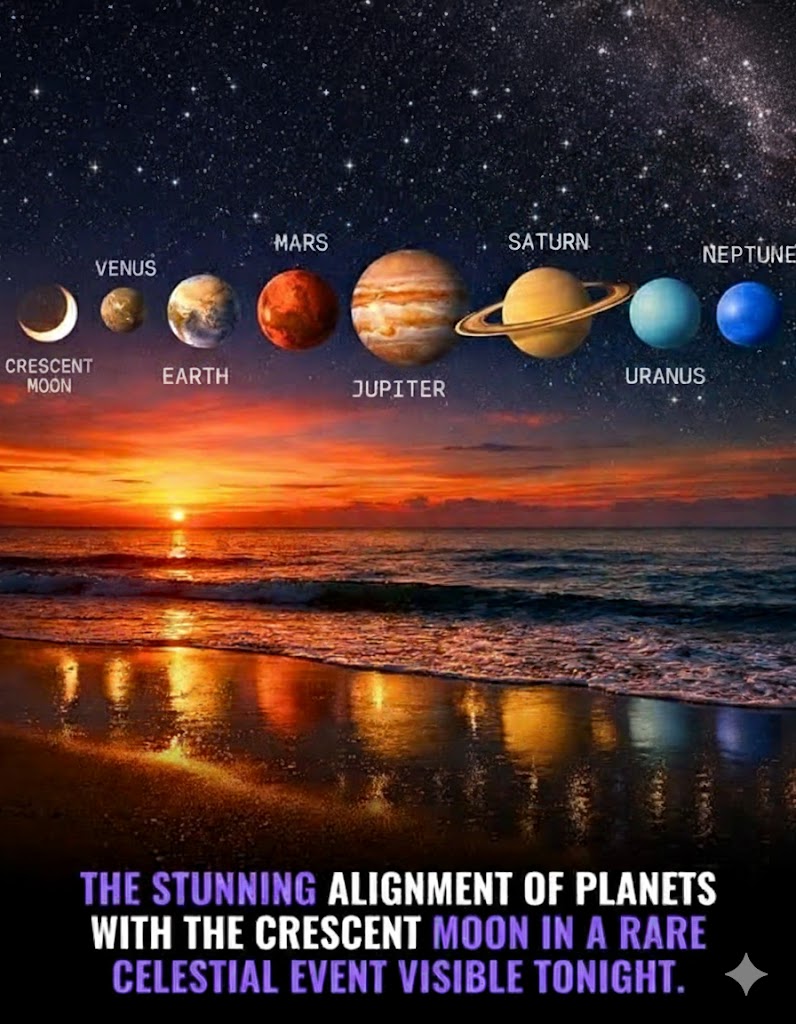
Skywatchers are in for a truly breathtaking evening as a delicate crescent moon guides observers to a rare and striking planetary line-up just after sunset.
Several planets will appear gathered along the same path in the sky — known as the ecliptic — creating the visual impression of a graceful celestial alignment stretching across the fading blue horizon. Bright Venus and Jupiter will be the easiest to spot with the naked eye, while Mars adds its subtle reddish glow nearby. Mercury may briefly appear low above the horizon, depending on local conditions.
More distant worlds such as Saturn, Uranus and Neptune also lie along this same line, although only Saturn may be faintly visible without optical aid. Uranus and Neptune require binoculars or a small telescope to detect.
The crescent moon will act as a natural marker, helping observers locate the planetary chain and adding a soft, poetic touch to the scene. While the planets are not physically lined up in space, their shared position along the solar system’s plane creates a rare and visually stunning perspective from Earth.
Moments like this highlight the elegant order of our cosmic neighborhood — and remind us how extraordinary it can be simply to look up.