Historic Spacewalk Keeps Hubble Alive as Astronauts Service Legendary Telescope Above Earth
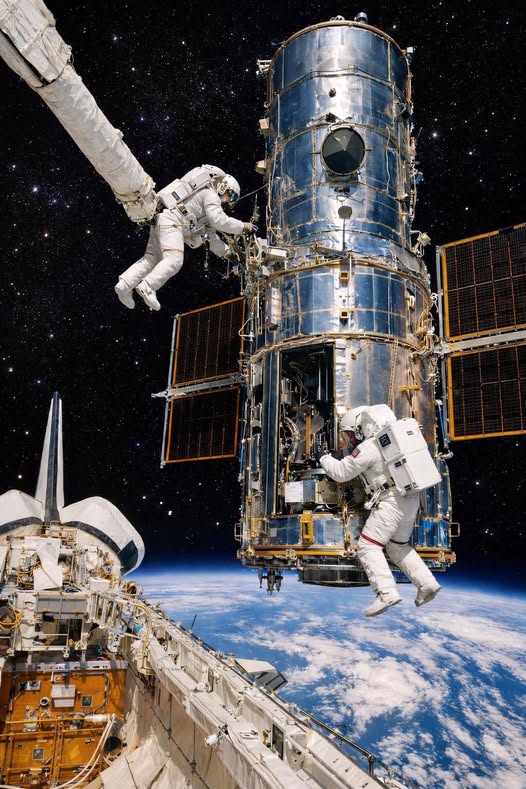
High above Earth’s glowing horizon, two astronauts have carried out a remarkable and delicate spacewalk to service the world-famous Hubble Space Telescope, one of humanity’s most important scientific instruments.
Drifting silently in orbit, the astronauts carefully worked along Hubble’s reflective outer structure and its sensitive scientific systems, performing maintenance designed to extend the telescope’s operational life and preserve the quality of its observations. Every movement was precise, as even the smallest mistake in the vacuum of space could risk damage to hardware that has transformed modern astronomy.
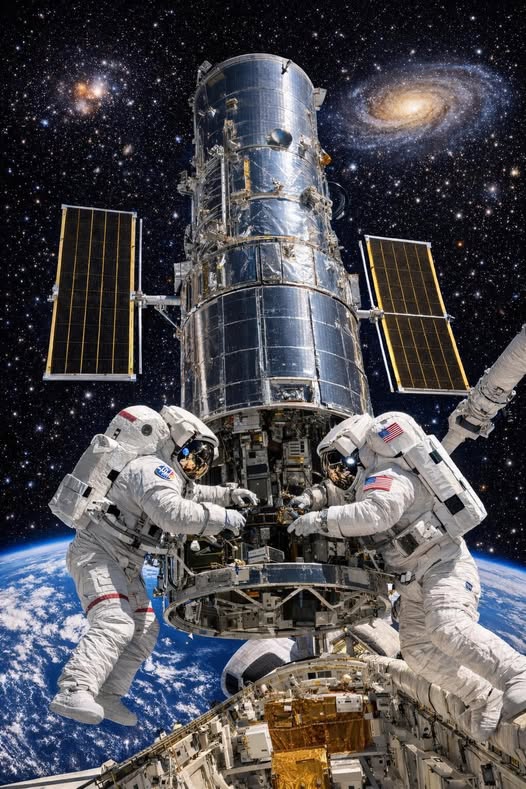
From their vantage point, the curved edge of Earth stretched beneath them in brilliant shades of blue and white. The view offered a striking reminder of how close Hubble orbits our planet, despite the extraordinary role it plays in observing galaxies billions of light-years away.
The telescope’s iconic golden solar panels extended outward, continuously collecting sunlight to power the instruments that have delivered some of the most celebrated images in scientific history. These systems are essential to keeping Hubble operational as it continues to study star formation, distant galaxies and the large-scale structure of the universe.
Engineers on the ground coordinated closely with the astronauts throughout the spacewalk, guiding each step of the operation. The mission required careful planning, as Hubble’s instruments are both fragile and highly specialized. Servicing tasks in open space demand advanced tools, extensive training and constant communication with mission control.
Hubble has played a central role in reshaping how scientists understand the universe, helping refine measurements of cosmic expansion, revealing the evolution of galaxies and providing unprecedented views of nebulae and star systems. Keeping the telescope functioning remains a high priority for the scientific community, even as newer observatories come online.
This spacewalk highlights the unique partnership between human skill and advanced engineering. Suspended in zero gravity, the astronauts carried out work that cannot be replicated by automated systems alone, ensuring that Hubble can continue delivering valuable scientific data for researchers around the world.