When the Walls Spoke: Rethinking the Origins of Human Creativity
For decades, archaeologists believed the timeline of early human art was largely settled. From the ochre handprints of prehistoric caves to the gradual emergence of symbolic storytelling, the development of creativity appeared carefully mapped. Sites such as Lascaux Cave and Chauvet Cave stood as proud milestones of humanity’s artistic awakening. Their paintings of horses, bison, and mysterious signs were seen as benchmarks — evidence of the moment when early humans began expressing not just survival instincts, but imagination.
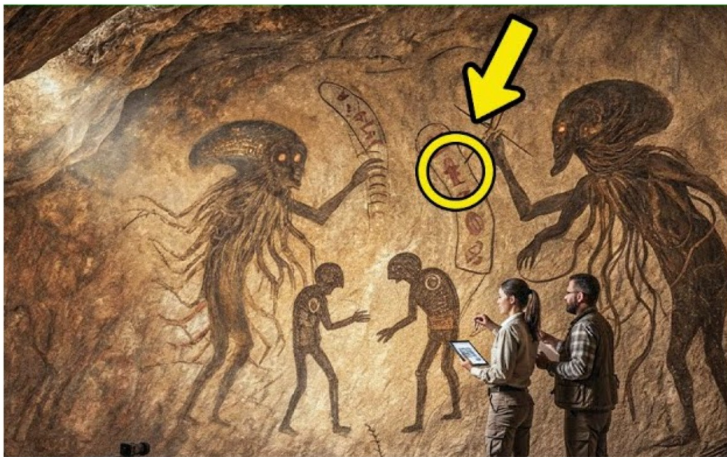
Now, however, a newly uncovered cave site — its location kept confidential to prevent damage and looting — is challenging that long-held confidence. Hidden beneath layers of stone and sealed by time, researchers have discovered paintings whose sophistication appears startlingly advanced for their estimated age. The pigments are unusually refined, showing careful preparation and chemical complexity. The shading suggests depth and motion, as though the figures were meant to move in flickering torchlight. Even more puzzling, certain symbols bear no resemblance to motifs associated with any known culture in the archaeological record.
The discovery has forced scientists to confront difficult questions. How could artwork of such technical skill exist thousands of years earlier than established timelines allow? Were ancient humans experimenting with advanced techniques far earlier than we assumed? Is it possible that entire cultural chapters — rich in expression and innovation — vanished without leaving additional traces? Or have we fundamentally misunderstood the pace at which human creativity evolved? Each possibility carries profound implications, not only for archaeology but for our broader understanding of cognitive development.

In laboratories around the world, teams are working meticulously to verify the findings. Mineral analyses of the pigments are underway, comparing their composition with known prehistoric materials. Carbon dating samples are being reexamined to rule out contamination. Microscopic imaging has revealed layered brushwork — overlapping strokes that suggest deliberate technique and practiced hands rather than spontaneous, primitive markings. The more closely researchers examine the cave walls, the clearer it becomes that these works were created with intention and mastery.
If these results are confirmed, the implications would extend far beyond a simple adjustment of dates in textbooks. The emergence of advanced symbolic thinking could be pushed back by millennia. Such a shift would reshape our understanding of when humans began to perceive the world not merely as hunters and gatherers, but as storytellers and abstract thinkers. It would suggest that the spark of imagination — the impulse to represent life through image and symbol — ignited much earlier than we ever realized.
There is something deeply moving in that possibility. Long before cities rose, before writing etched history into clay or stone, before monuments declared power and permanence, someone stood in darkness with pigment and purpose. By firelight, they painted forms that carried meaning beyond survival. Thousands of years later, as modern scientists carefully study those silent walls, we are reminded that history is never entirely settled. Sometimes, it waits patiently beneath stone, ready to speak again — and to change everything we thought we knew.