Voyager 1: A Whisper from the Edge of Interstellar Space
- TranThuy
- February 24, 2026
After nearly half a century drifting through the silent ocean of space, Voyager 1 has whispered back to Earth once more. Launched in 1977 and now traveling beyond the outer planets, the probe resides at the threshold of interstellar space — a region where the Sun’s influence begins to fade into the wider galaxy. Recently, it transmitted what researchers describe as one of the clearest wide-perspective images of our solar neighborhood ever captured from such an unimaginable distance. The signal was faint, but its implications were profound.
Inside control rooms at NASA, the reaction was immediate and intense. Screens flickered as raw telemetry streamed in across billions of miles. Engineers and astronomers leaned closer to their monitors. At first, there was only focused silence — then visible disbelief. Not because the image dazzled with dramatic colors or cinematic spectacle, but because of its precision. The boundaries between light and shadow appeared sharper than predictive models had suggested. Subtle alignments within the data caught the attention of even the most seasoned scientists.
Teams began verifying every variable. Instruments were recalibrated remotely. Signal integrity was rechecked. Cosmic ray interference was ruled out. Yet the data remained consistent. From its distant vantage point, the Sun appeared as a fragile point of light suspended in vast darkness — an echo of the perspective that once inspired the famous “Pale Blue Dot.” But this time, analysts observed something new: faint structural details along the boundary of the heliosphere, the immense bubble formed by solar wind pushing against interstellar space.
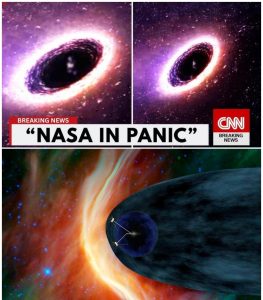
For decades, the heliosphere had been modeled as relatively smooth and symmetrical. However, Voyager’s new transmission suggests a far more textured frontier. Plasma patterns appear uneven, almost rippled. Magnetic field lines curve in ways that challenge the simplified arcs often depicted in textbooks. These are not alarming distortions, nor signs of cosmic instability — but they are reminders that space is not empty silence. It is dynamic, alive with charged particles, radiation flows, and invisible forces interacting in delicate balance.
Scientific discussions are unfolding cautiously before formal publication. The hesitation is not secrecy, but rigor. Extraordinary clarity demands extraordinary verification. Every anomaly must be tested, retested, and independently confirmed. If upheld, these findings will refine our understanding of how our solar system moves through the galaxy — not as a static diagram, but as a vessel navigating a shifting cosmic sea.
What Voyager has captured does not overturn physics overnight. Instead, it deepens it. It humbles our assumptions and expands our perspective. Our solar system is not an isolated island floating in emptiness; it is a living structure shaped by interaction with a far larger environment. And from billions of miles away, a small, aging spacecraft — humanity’s quiet messenger — continues to look back toward home, reminding us of a simple truth: the more clearly we see the universe, the more beautifully mysterious it becomes.