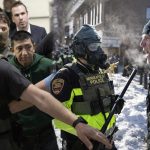
DEADLY BACKLASH EXPOSED: “Operation Silent Thunder” Just HIT the Eastern Seaboard — 167 Leaders Vanish Overnight

NEW YORK — An online account describing a sweeping, multi-state FBI crackdown dubbed “Operation Silent Thunder” is drawing attention for its blockbuster claims: 167 alleged gang leaders arrested across five Eastern Seaboard states, $127 million traced through an illicit financial network, and 412 firearms seized in coordinated dawn raids.
The story, published Tuesday by the website Family Stories, presents the operation as the culmination of a years-long investigation that began with a 2023 homicide in Baltimore—a case the article portrays as the “trigger” that helped investigators identify a wider, multi-jurisdictional structure linking rival street groups into what it calls a “franchise model” for narcotics distribution.
According to the article, agents working under the FBI’s Safe Streets Task Force reportedly connected a pattern of communications, financial anomalies and social media activity suggesting that competing gangs were quietly coordinating territory, sharing supply routes and exchanging intelligence to protect operations. The report describes the network as unusually corporate in design: compartmentalized leadership, delegated logistics and enforced separation between decision-makers and street-level crews.
Following the financial trail
The account’s central claim is that investigators “followed the money” across Pennsylvania, New Jersey, Delaware, Maryland and Virginia, tracing a flow of illicit proceeds totaling $127 million. It describes agents reviewing ledgers recovered in Philadelphia and using patterns in transactions to map how money moved between nodes of the network, which the article suggests operated with “logistical precision.”
The same narrative says the investigation relied heavily on electronic interception—citing 40,000 hours of wiretaps—and argues that the group’s compartmentalization meant individual leaders controlled only a fragment of the enterprise, limiting the damage of arrests while making the overall machine harder to dismantle.
A further allegation in the piece is that parts of the network benefited from corrupt law-enforcement contacts, including tip-offs that allegedly enabled shipments to evade scrutiny. The article frames this as a turning point that complicated the investigation, forcing authorities to treat intelligence leaks as an operational risk.
The raids described in the report
By the article’s timeline, federal planners launched “Silent Thunder” in late 2024 after months of surveillance, route mapping and arrest coordination designed to prevent suspects from warning one another across state lines. It claims that a suspected leak during planning prompted investigators to adjust timing and redeploy personnel.
The report describes the raids as a synchronized early-morning strike across the five states, targeting what it calls the network’s command structure. In addition to the headline figure of 167 arrests, the article says authorities seized 412 firearms, recovered luxury vehicles, cash stashes and encrypted phones, and located hidden storage rooms and coded communications linked to drug and weapons trafficking.
The story adds a dramatic detail that one target allegedly escaped using an “underground tunnel system,” suggesting that some factions were already positioned to regroup despite the raids’ scale.
“Success,” then uncertainty
In the aftermath, the article claims the operation produced an immediate drop in violent crime in certain areas, but warns the broader network remained adaptive—able to reorganize leadership, restore funding and rebuild supply channels through offshore contacts and intermediaries. It also argues that major takedowns can trigger turf wars among surviving factions, producing unstable swings in street violence even as prosecutions move forward.
The most consequential claim in the piece is that the arrested leaders may not have been the true decision-makers. It alleges investigators uncovered evidence of “hidden players”—financiers and “shadow operators”—and that encrypted messages suggested some individuals appearing cooperative were secretly feeding information back to criminal groups.
The article concludes with a cliffhanger: a purported warning message suggesting “kingpins remain” and urging investigators to find them before violence returns—an ending that frames “Silent Thunder” not as closure, but as the first phase of a broader campaign.
What can be verified
The “Operation Silent Thunder” account is currently circulating primarily through commentary-driven web pages and social video posts, rather than through court filings or official agency statements cited in mainstream reporting. A YouTube video using similar framing appears in search results, but widely recognized outlets and public documentation are not clearly linked within the article itself.
As presented, the story reads like a narrative reconstruction of an investigation—rich in operational detail, but light on verifiable identifiers such as case numbers, charging documents, named defendants, or a dated FBI press release. For readers, the key question remains whether the operation occurred exactly as described, or whether the account blends general enforcement themes into a dramatized storyline.
What is clear is that the article taps into a broader reality of modern organized crime enforcement: multi-state trafficking networks are frequently investigated through financial forensics, electronic surveillance, and coordinated task forces—methods that law enforcement agencies have long used to target both street violence and the infrastructure that funds it.