Rebuilding a Face. Restoring a Life.
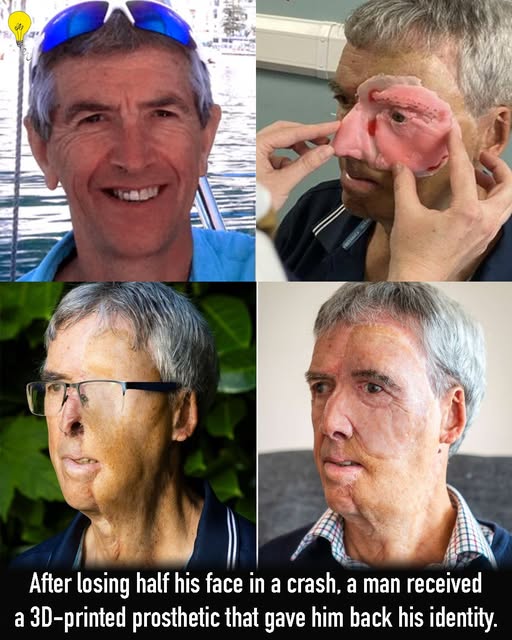
In 2021, a quiet bike ride through Devon, England, changed everything for 75-year-old Dave Richards.
A drunk driver struck him with devastating force. He was dragged beneath the vehicle, suffering injuries so catastrophic that survival itself was uncertain. His ribs were crushed. He lost an eye. Severe trauma destroyed much of his facial structure.
But he lived.
And survival was only the beginning.
What followed wasn’t just physical recovery — it was a fight for identity. For dignity. For the simple human experience of walking outside without feeling every stare land like a wound.
A team of surgeons within the National Health Service stepped in with determination and innovation. Using advanced 3D scanning technology, specialists mapped the exact contours of Dave’s skull. They digitally reconstructed what had been lost — calculating curves, symmetry, shadows.
Then they brought it into the physical world.
A custom facial prosthetic was 3D-printed using medical-grade materials, carefully shaped and color-matched to blend naturally with his skin. Every detail mattered. Not for vanity — but for wholeness.
This wasn’t about aesthetics.
It was about reclaiming the right to be seen without shock.
About stepping outside without bracing for fear in someone else’s eyes.
About feeling like yourself again.
“It wasn’t vanity,” Dave explained.
“I just wanted people to look at me without horror. Now… I finally can.”
That sentence carries weight. Because beneath the technology and surgical precision lies something deeply human: the need to belong in your own skin.
A man who lost half his face now faces the world again — not by chance, but through science, compassion, and relentless care meeting at exactly the right moment.
Sometimes healing doesn’t look like a miracle.
Sometimes it looks like innovation guided by empathy — layer by layer, printed into hope.