Japan Sets New Internet Speed Record at 1.02 Petabits Per Second
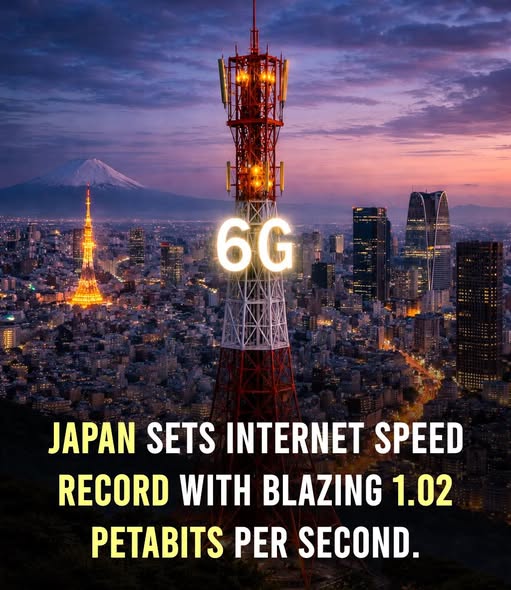
Japan has achieved a groundbreaking milestone in data transmission, recording an internet speed of 1.02 petabits per second — fast enough in theory to download millions of high-definition movies in just one second.
The achievement was reported by researchers at National Institute of Information and Communications Technology (NICT), who conducted the experiment using advanced multi-core optical fiber technology. By transmitting data through specially designed fiber cables with multiple cores, the team dramatically increased the amount of information that could travel simultaneously across long distances.
Unlike traditional single-core fiber, multi-core fiber allows parallel data streams within a single strand, significantly boosting capacity without requiring entirely new infrastructure layouts. Combined with improved signal amplification and processing techniques, the system maintained high-speed transmission over extended distances — a key factor for real-world application.
To put the scale into perspective, one petabit equals one million gigabits. At 1.02 petabits per second, the data flow far exceeds current commercial broadband speeds, which are measured in megabits or gigabits per second.
Experts caution that residential users should not expect petabit-level home internet in the near future. Experimental laboratory results often take years, if not decades, to translate into consumer-ready services. However, breakthroughs like this lay the technical foundation for future innovations.
Ultra-high-definition streaming, advanced artificial intelligence systems, smart city infrastructure, next-generation cloud computing, and even real-time holographic communication all require enormous bandwidth and low latency. Expanding backbone network capacity is essential to support these emerging technologies.