A Warning Beneath the Laughter: Bill Maher’s Political Wake-Up Call
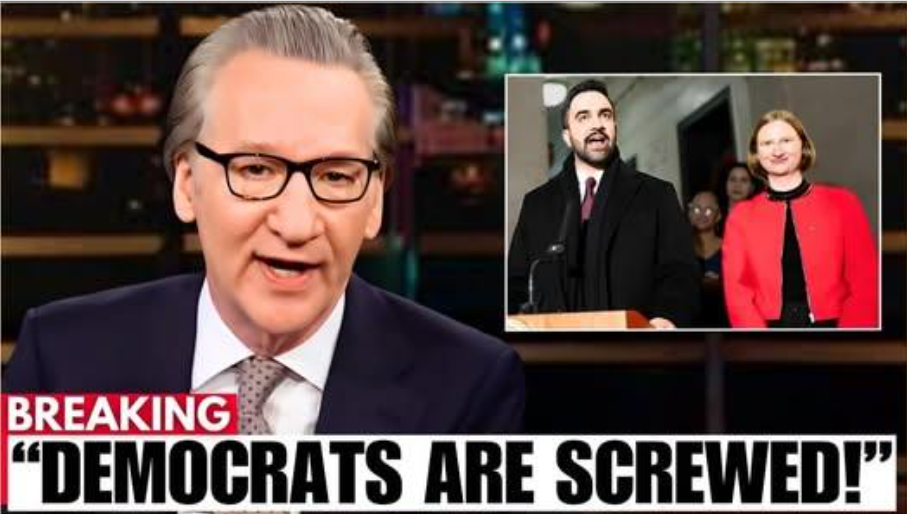
The studio lights of Real Time with Bill Maher glowed softly as Bill Maher leaned back in his chair and delivered a line that felt less like comedy and more like a caution bell. “It’s not a goth phase,” he warned, suggesting that if Democrats dismiss shifting voter perceptions, they risk losing more than arguments — they risk losing elections. The audience, accustomed to punchlines and playful provocation, sensed immediately that this moment carried unusual weight. Beneath the polished timing and dry humor lay something more serious: a political alarm sounded in prime time.
The laughter that followed was brief and uncertain. Then the room grew still. Maher’s remark was not framed as an attack, but as a plea for reflection. In recent years, the Democratic Party has faced internal debates over messaging, identity, generational divides, and strategy. Maher’s metaphor implied that what some party members might see as temporary backlash or cultural turbulence could, in fact, signal a deeper shift in public mood. Dismissing criticism as fleeting, he implied, could be a dangerous miscalculation.
At the heart of his warning was the power of perception. Politics has always been shaped not only by policy but by narrative — how ideas are presented, how leaders are understood, and how voters feel about the direction of their country. Maher suggested that even if policies remain consistent, the way they are perceived can dramatically influence electoral outcomes. In a media environment saturated with commentary, social platforms, and rapid-fire opinion cycles, perception can harden into political reality with startling speed.
His comments also reflected a broader anxiety within American politics. Voters today are less predictable, more polarized, and often more skeptical of institutions than in previous decades. Cultural debates frequently overshadow economic ones, and symbolism can carry as much weight as substance. Maher’s message implied that ignoring these dynamics — or assuming they will simply pass — risks alienating moderates and independents who often determine the outcome of national elections. In that sense, his warning extended beyond party lines to the mechanics of democracy itself.
Critics might argue that late-night commentary oversimplifies complex political challenges. After all, governing involves balancing ideals, compromise, and long-term vision. Yet supporters of Maher’s perspective would counter that comedians, precisely because they stand slightly outside formal politics, sometimes see cultural shifts more clearly. Humor can disarm audiences, allowing uncomfortable truths to surface. In that studio moment, the boundary between entertainment and civic discourse blurred, reminding viewers that comedy has long played a role in American political conversation.
Whether embraced or rejected, Maher’s words landed with the force of a storm warning on live television. They underscored a fundamental truth of democratic life: elections are not won solely on policy papers but on trust, tone, and public sentiment. If perception shapes destiny, then ignoring perception can reshape destiny as well. As the credits rolled and the studio lights dimmed, the echo of his caution lingered — a reminder that sometimes the most serious political messages arrive wrapped in humor, waiting to be taken seriously.