House Floor Tensions Escalate: Omar, Schiff and Swalwell Highlighted in Controversial Video Moment
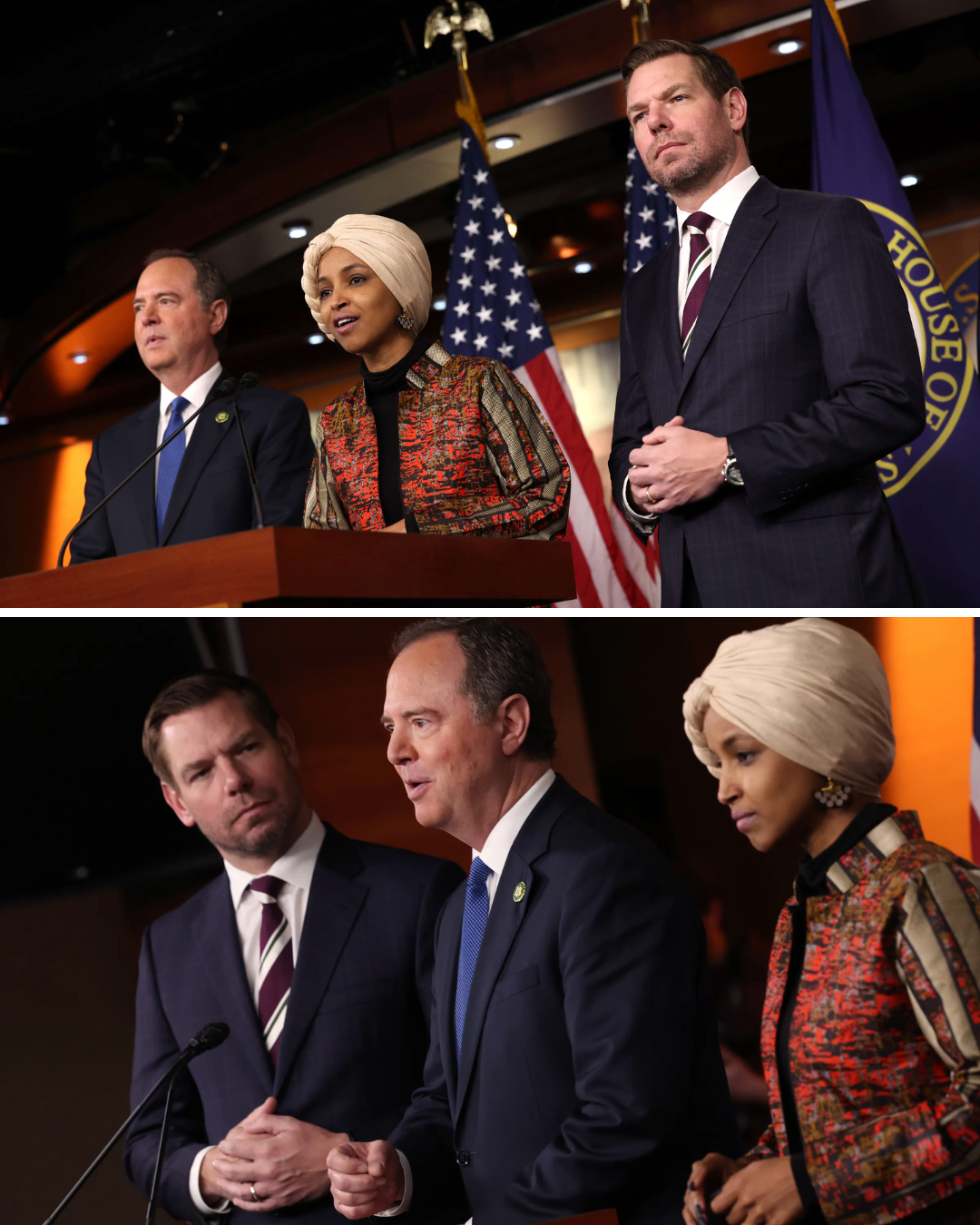
In a scene that rapidly circulated across social platforms, Representatives Ilhan Omar, Adam Schiff, and Eric Swalwell were depicted in viral clips appearing to move quickly toward the exits of a House chamber while a contentious video played during a session. Headlines characterizing the incident as a chaotic retreat suggested dramatic implications for the Democratic lawmakers—prompting significant public discussion and analysis.
At first glance, the imagery appeared striking: cameras capturing rapid movement, animated commentary overlaying the clip, and text suggesting that Democratic Members of Congress were fleeing in response to a revealing video played by a Republican colleague. However, a closer examination of congressional procedure and political communication reveals that such interpretations often lack substantive context and rely on sensational framing rather than factual detail.
In legislative settings, it is entirely routine for multiple representatives to enter and exit committee hearings or floor debates due to overlapping obligations, scheduled votes, constituent meetings, and other professional responsibilities. Movement within the chamber should not automatically be interpreted as a sign of panic or implied guilt; rather, such moments often reflect the logistical demands of congressional service.
The clip in question was paired with a narrative suggesting that a Republican lawmaker’s presentation of an “exposing video” had left Democrats scrambling. Yet, in formal congressional practice, presenting visual material is a common rhetorical strategy used by members of both parties to illustrate points, challenge arguments, or introduce evidence during deliberations. The presence of disputed footage in a hearing does not itself trigger formal sanctions, investigations, or disciplinary measures.
Indeed, Representative Omar, Representative Schiff, and Representative Swalwell are high-profile figures who have frequently been centers of partisan debate and media focus. Their actions and statements in legislative venues naturally attract heightened scrutiny and are frequently repurposed in politically charged narratives. Footage showing lawmakers departing a room may merely capture a procedural transition rather than an extraordinary event.
Political media ecosystems increasingly amplify moments that resonate with audience biases or predetermined storylines. Sensational language—such as suggesting that an “entire party ran for the exit”—serves engagement metrics by stimulating emotional reactions, even if the underlying incident is a routine procedural occurrence. Thus, fragmented clips may grossly exaggerate both scale and significance in order to fit a dramatic frame.
For observers seeking to understand the substance behind such viral moments, consulting full hearing transcripts, extended video recordings, and official legislative records provides essential context. These sources clarify that congressional debate is inherently adversarial and performative, and that the institutional framework is built to weather heated exchanges without succumbing to spontaneous political narratives.
Ultimately, while energetic debate and strategic media use shape public perceptions of legislative action, the constitutional processes governing committee assignments, procedural motions, and member conduct remain structured by formal rules and deliberative norms. Dramatic headlines may draw attention, but they do not replace systematic, evidence-based analysis of what occurred on the House floor.