SIX BASES, FOUR DEAD: The Map of America’s Broken Fortress in the Gulf
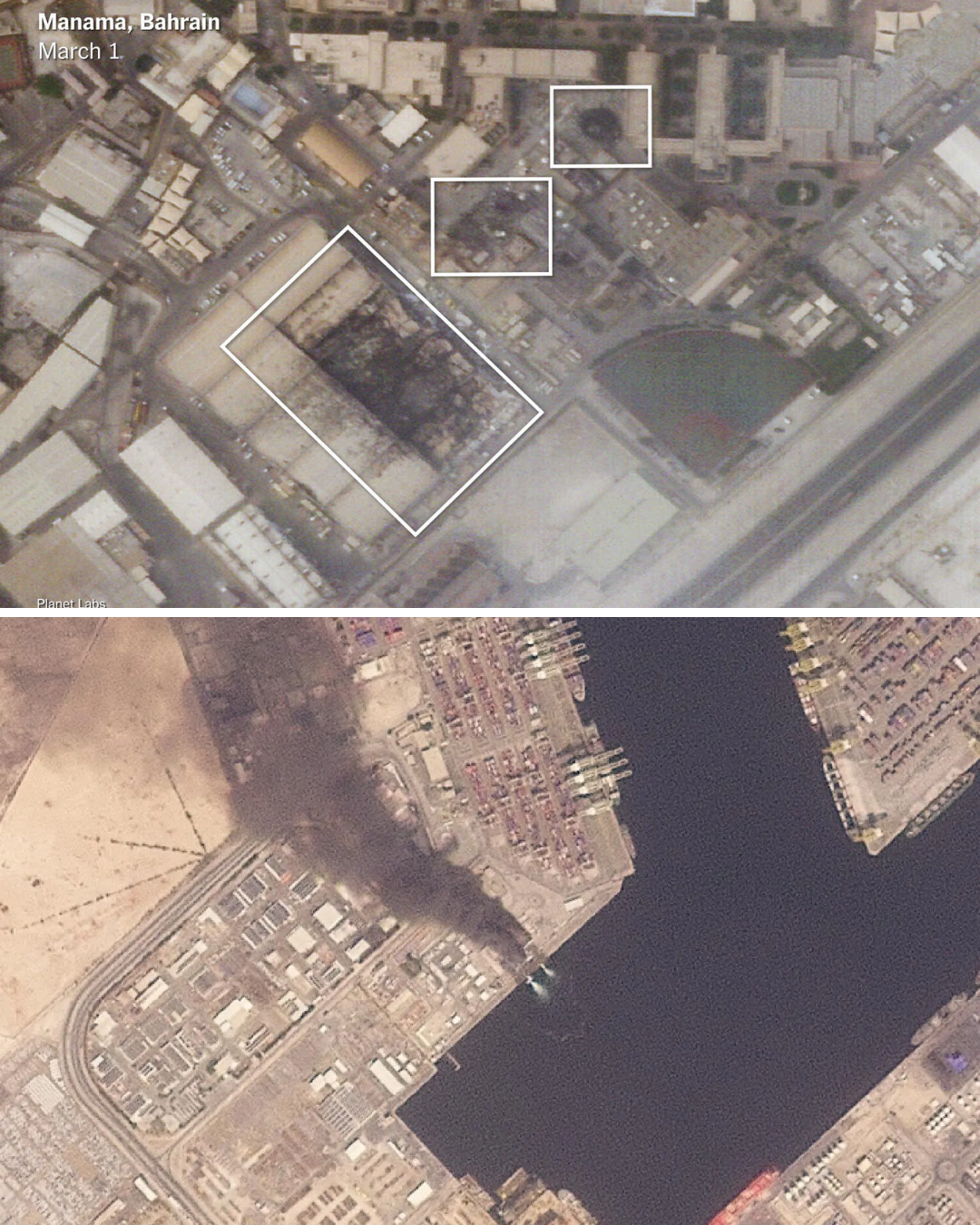
The United States military entered this conflict with a network of bases that, on paper, represented one of the most formidable military presences in any region on earth. Two carrier strike groups in the Gulf. The Fifth Fleet headquarters in Bahrain. Al Udeid Air Base in Qatar, the nerve center of American air operations across the Middle East. Camp Arifjan in Kuwait, one of the largest U.S. Army installations anywhere in the world. Erbil in Iraq. This was not a forward deployment. It was a fortress.
By Sunday evening, that fortress had been struck in six separate locations, and four American service members were dead.
The New York Times, drawing on satellite imagery, verified videos, and statements from U.S. military officials, mapped the strikes with meticulous precision. On Saturday and Sunday, Iranian missiles and drones hit U.S. installations in Bahrain, Iraq, the UAE, and three separate sites in Kuwait. The Fifth Fleet headquarters in Manama, Bahrain — the command center of U.S. naval power across the entire Persian Gulf — had several buildings destroyed. Satellite imagery confirmed that two satellite communications terminals were obliterated, alongside extensive damage to large structures at the base. The port, notably, was largely empty of naval vessels at the time of the attack, suggesting that the Navy had deployed its ships to reduce their vulnerability — a tactical success — but the base infrastructure itself remained highly exposed.
Camp Arifjan in Kuwait bore the heaviest human cost: three U.S. service members killed and five others seriously injured in a direct strike. Camp Arifjan is not a small outpost. It is a massive logistics hub that has served as the primary staging area for U.S. Army operations across the Middle East for two decades. Its vulnerability underscores a reality that military planners have known, and publicly avoided discussing, for years: fixed bases, however large and however well-defended, are increasingly vulnerable to precision-guided munitions available to state-level adversaries.
At Erbil International Airport in Iraq, where U.S. forces are stationed, verified videos showed plumes of smoke and flames rising throughout Saturday and Sunday as Iran targeted the installation repeatedly. At Al Salem Air Base in Kuwait, satellite images showed roofs of multiple buildings collapsed following Iranian strikes. The range of the Iranian strike campaign — from Bahrain in the south to Iraq in the north, across Kuwait, the UAE — demonstrated an operational reach that surprised some analysts and confirmed the worst fears of others.
The fourth American death — confirmed by CBS News and NBC News on Monday, bringing the total to four — was the data point that forced a shift in the domestic political conversation. Defense Secretary Pete Hegseth, while affirming that the war would not be “endless,” acknowledged the American casualties and warned of additional deaths in the days ahead. The statement was notable for its honesty, and for what it implicitly acknowledged: that the bases, despite their air defense systems, cannot achieve complete protection against a sustained Iranian missile campaign.
The political vulnerability of American forces in the Gulf has been an uncomfortable subject in defense circles for years. The 2020 Iranian ballistic missile strikes on Al Assad airbase in Iraq — which caused over 100 traumatic brain injuries without killing a single American — were a warning shot that was, in retrospect, not taken seriously enough. Iran demonstrated its ability to strike U.S. bases with precision. What it demonstrated this week is that it is willing to do so repeatedly, at scale, across multiple countries simultaneously.
Six bases struck in 48 hours. Four Americans dead. The fortress, it turns out, had windows.