IRAN SANK A TANKER IN THE STRAIT OF HORMUZ: The Ship That Tried to Pass Through — And the Warning That the World Ignored
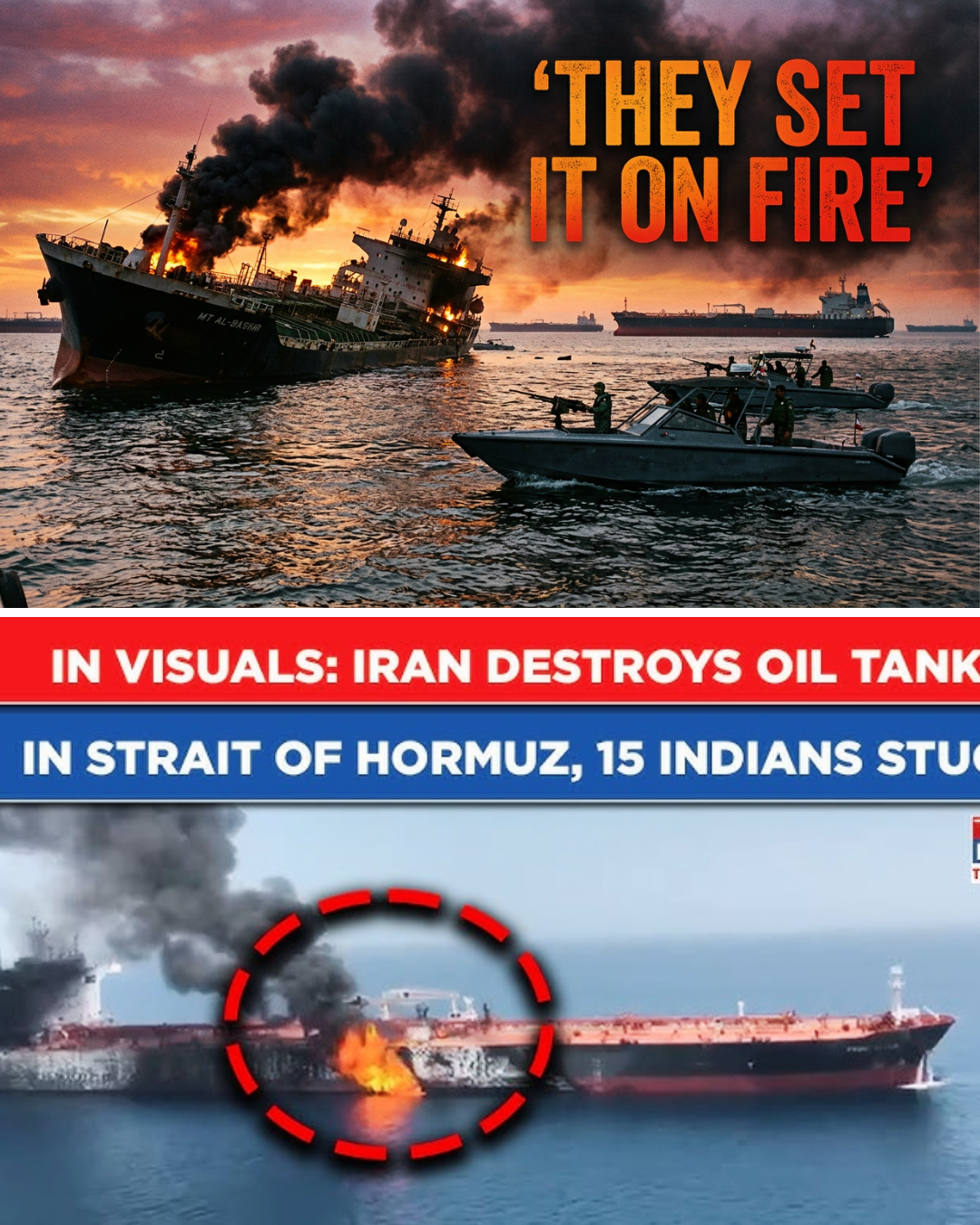
The commander of Iran’s Revolutionary Guard made it simple: the Strait of Hormuz is closed. Any ship that tries to pass will be set on fire.
On Sunday, that warning stopped being rhetoric and became reality. Iran’s semi-official Mehr News Agency reported that a tanker attempting “unauthorized passage through the Strait of Hormuz” was struck and was sinking after sustaining heavy damage. It was not the first vessel hit since the conflict began — at least four ships have been attacked in Gulf waters — but it was the most dramatic demonstration of Iran’s willingness to enforce its threat.
The world had been warned. For years, Iran had threatened to close the Strait of Hormuz, the narrow waterway through which roughly 20 percent of the world’s daily oil consumption flows. For years, analysts dismissed it as bluster. Iran’s economy depends on the strait as much as anyone’s, they argued. Closing it would be economic suicide. Iran would never do it.
Iran did it.
Within hours of the initial US-Israeli strikes on Saturday, Iran’s Islamic Revolutionary Guard Corps began transmitting VHF radio warnings to every vessel in the strait: no ship is allowed to pass. Although Iran did not issue a formal blockade declaration, the threats — combined with actual attacks on vessels — produced the same result. Ship-tracking data shows a 70 percent reduction in traffic through the strait. More than 150 tankers have dropped anchor outside the waterway, their owners and insurance companies unwilling to risk passage.
The numbers are staggering. About 14 million barrels of oil passed through the Strait of Hormuz every day in 2025. That represents roughly one-third of the world’s total seaborne crude exports. Three-quarters of those exports go to China, India, Japan, and South Korea. The factories, power grids, and transportation networks of the world’s fastest-growing economies depend on this narrow channel.
Major shipping companies, including Maersk and Hapag-Lloyd, have suspended transits through the strait and related routes. War-risk insurance premiums have surged by up to 50 percent. Ships that do attempt passage face not just the risk of Iranian attack but the near-certainty that no insurance company will cover the loss.

The economic consequences are already cascading. Brent crude surged past $82 a barrel on Monday, the highest since January 2025, before settling around $78. Analysts at Barclays warn prices could hit $100. UBS says $120 is possible if the disruption persists. JPMorgan estimates that a three-to-four-week squeeze could force Gulf producers to shut down production entirely.
Saudi Arabia has contingency plans to divert oil through the East-West Pipeline to the Red Sea, bypassing the strait. But terminal infrastructure limitations mean this alternative can only handle a fraction of normal volumes. The UAE’s Fujairah pipeline offers another partial route, but it too has capacity constraints.
For the tanker crews caught in the middle, the situation is terrifying. The MKD VYOM, an oil tanker attacked by an explosive-laden boat 52 nautical miles off Muscat’s coast in Oman, suffered a fire and engine-room explosion that killed at least one crew member. A US-flagged tanker, the Stena Imperative, was hit by Iranian drone or missile fire on Monday. These are not warships — they are commercial vessels crewed by ordinary seafarers from countries like the Philippines, India, and Ukraine.

The Strait of Hormuz is only 33 kilometers wide at its narrowest point. The shipping lanes are just 3 kilometers in each direction. It is, as one analyst put it, like blocking the aorta in a circulatory system. And right now, that aorta is effectively clamped shut.
Every day the strait remains closed, the global economy bleeds a little more. Oil inventories drain. Prices climb. Supply chains stretch. And somewhere in the Persian Gulf, a sinking tanker serves as a monument to the warning the world chose to ignore.