THE PILOT WHO FELL FROM THE SKY: Kuwait Shot Down 3 American Jets by Accident — Inside the Most Terrifying Friendly Fire Incident in Decades
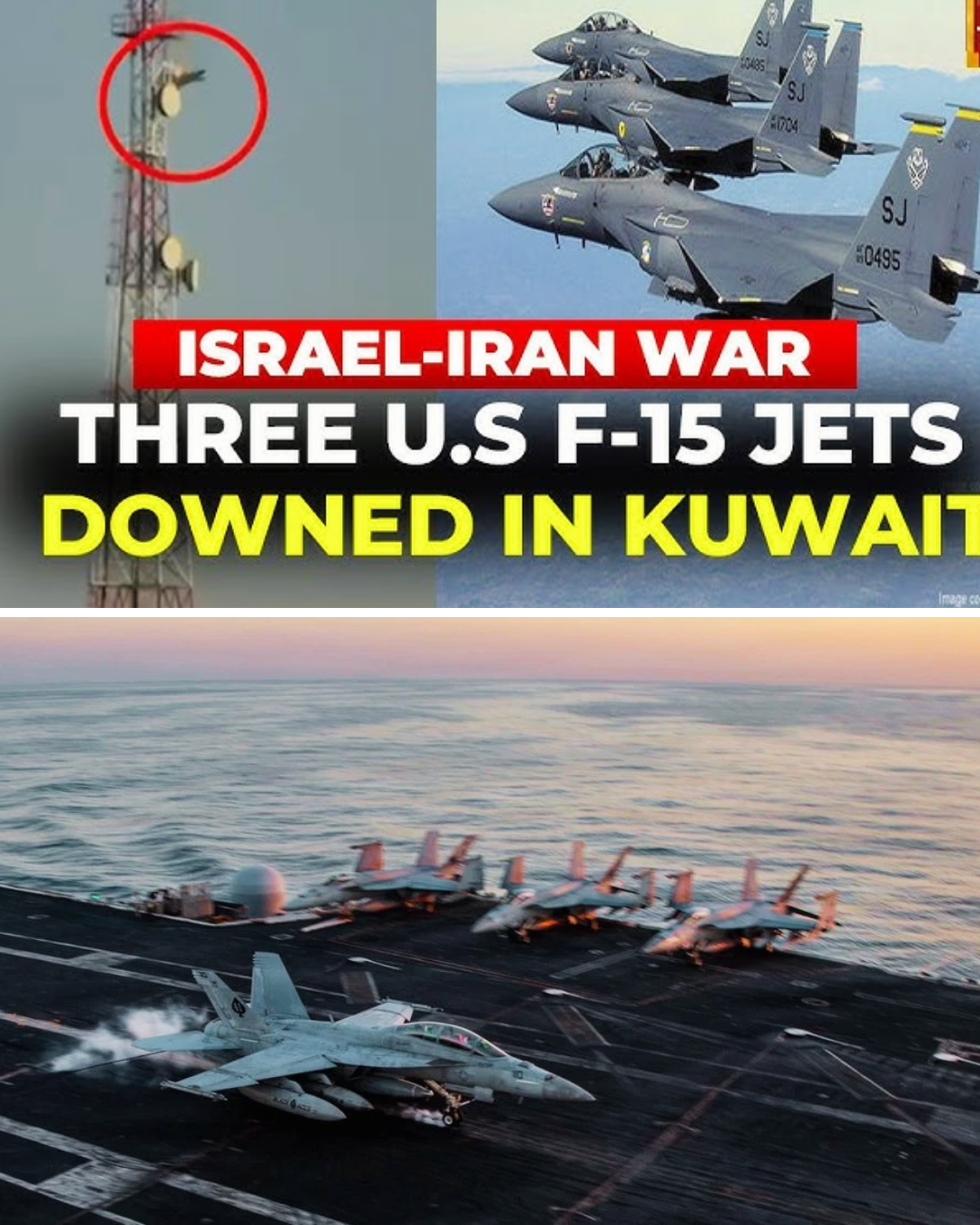
The video is 14 seconds long and it has already become one of the most watched clips of the entire Iran conflict.
Filmed from a street in Al Jahra, Kuwait, just 32 kilometers from the capital, it shows a burning fighter jet tumbling from the sky, trailing fire and smoke. Moments later, a figure appears — a pilot, dangling beneath an orange parachute, drifting slowly toward the desert floor. The cameraman’s voice, audible beneath the roar of the crash, shifts from shock to prayer.
The jet was American. An F-15E Strike Eagle, one of the most advanced fighter-bombers in the US Air Force’s arsenal, flying in direct support of Operation Epic Fury against Iran. And it was shot down not by Iranian missiles, but by Kuwaiti air defense systems.
Three US jets were destroyed in total. All six crew members ejected safely and were recovered in stable condition — a fact that US Central Command emphasized in its terse announcement on Monday. CENTCOM added that the Kuwaitis had “acknowledged this incident, and we are grateful for the efforts of the Kuwaiti defense forces and their support in this ongoing operation.”
But behind the diplomatic language lies one of the most alarming military failures of the 21st century: an allied nation’s air defenses could not distinguish American fighter jets from incoming Iranian threats.
Military experts say the incident exposes the terrifying complexity of modern multi-front aerial warfare. On any given hour since Saturday, the skies over Kuwait have contained a chaotic mix of American fighters, Iranian ballistic missiles, Iranian drones, Kuwaiti interceptors, and defensive missiles from multiple national air defense systems — all operating simultaneously in overlapping airspace. The electronic signatures of a fast-moving fighter jet and a ballistic missile can look remarkably similar on a radar screen, particularly when operators are under extreme stress and making split-second decisions.
The Identify Friend or Foe systems that are supposed to prevent exactly this kind of tragedy apparently failed. Whether the failure was technical, procedural, or human — or some combination of all three — is the subject of an urgent investigation that CENTCOM has already initiated.
The Kuwait friendly fire incident is not unprecedented. In 1994, two US Black Hawk helicopters were shot down over northern Iraq by American F-15 fighters in a friendly fire incident that killed all 26 people aboard. In 2003, a US Patriot missile battery shot down a British Tornado aircraft over Iraq, killing two crew members. In 2014, a Malaysian Airlines jet was shot down over Ukraine by a Russian missile system operated by separatists who may have believed they were targeting a military aircraft.
Each of these tragedies led to extensive reviews, reforms, and improved identification protocols. And yet, in Kuwait in 2026, allied air defenses shot down three allied jets in a single incident.
For the six pilots who survived, the experience must have been surreal. They launched from a base presumably in the region, flew combat missions against Iranian targets, survived whatever anti-aircraft fire Iran threw at them, and then were shot down by the country they were defending. They ejected over a friendly nation’s territory, not enemy soil, and landed in a desert that was supposed to be safely behind the front lines.
The incident has particular resonance in Kuwait because of the country’s history with American military protection. The United States led the coalition that liberated Kuwait from Saddam Hussein’s occupation in 1991. The relationship between the two countries has been defined by that rescue ever since. American military bases in Kuwait have been a cornerstone of the US presence in the Gulf for over three decades.
For Kuwaiti officials, the embarrassment is acute. Their defense systems — likely Patriot batteries sold to them by the United States — shot down the planes of their protector. The diplomatic fallout could strain a relationship that has been one of America’s most reliable in the region.
But for the six pilots who parachuted into the Kuwaiti desert, the aftermath is simpler. They are alive. They survived being shot down by friends. And somewhere in their military careers, they will have to process the impossible fact that the most dangerous thing in their sky that day was the country they were defending.