THEY BOMBED A UNESCO WORLD HERITAGE SITE: Iran’s 500-Year-Old Golestan Palace Destroyed — The Cultural Crime That Should Haunt the World
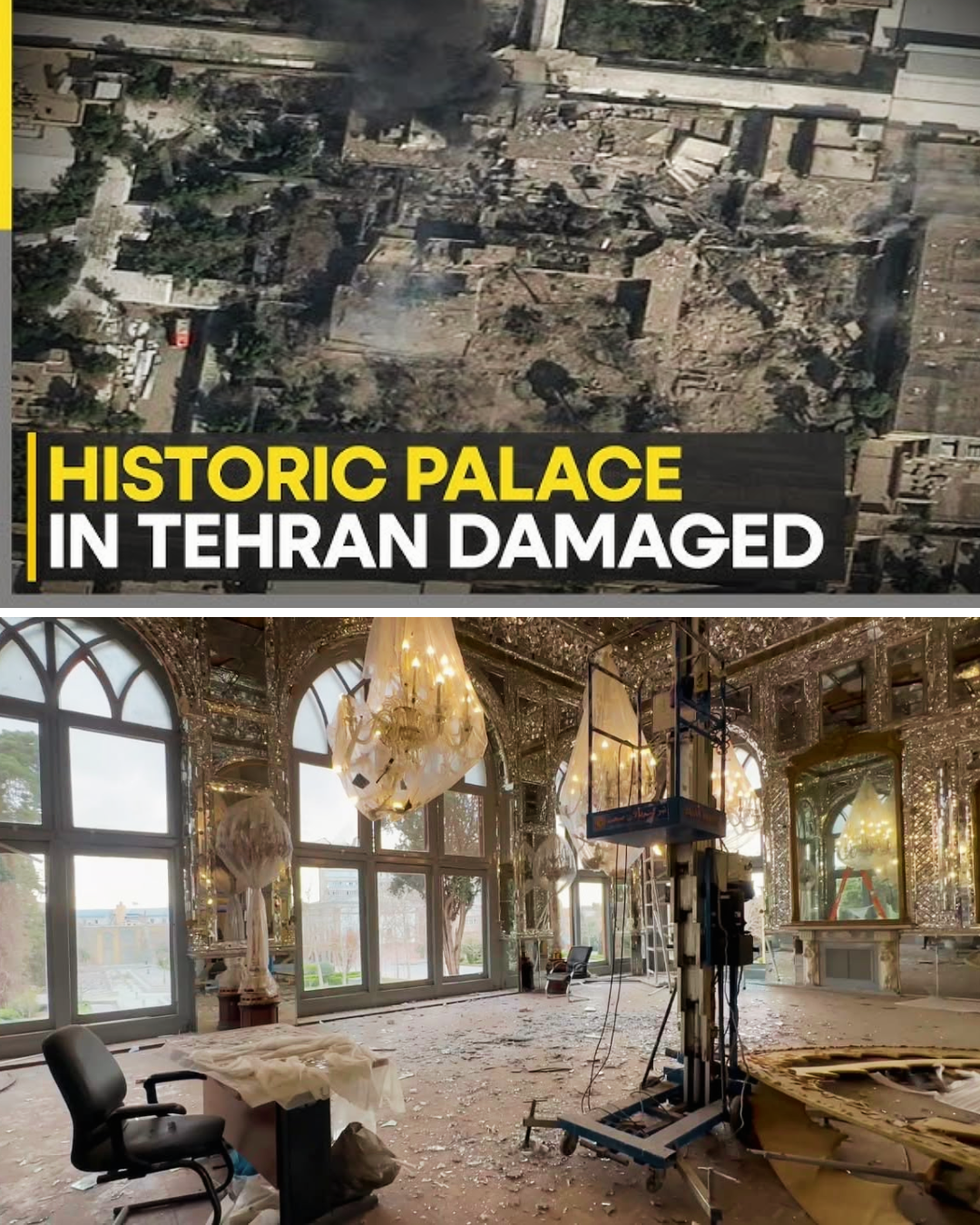
For five centuries, the Golestan Palace stood at the heart of Tehran — a masterpiece of Persian art, a symbol of Iranian identity, and a UNESCO World Heritage Site recognized as one of humanity’s most precious cultural treasures.
On Monday night, blast waves from a US-Israeli strike on Arg Square in southern Tehran tore through the palace complex, shattering its famous orsi windows — the intricate traditional Persian stained-glass panels that took generations of artisans to create. Wooden doors were blown open. The legendary mirror work, painstakingly assembled tile by tile across centuries, was cracked and scattered.

Iran’s cultural heritage minister, Reza Salehi-Amiri, visited the site and delivered a statement that reverberated across the Muslim world and among cultural preservationists globally: “This was not merely an attack on a building. This was an assault on Iran’s cultural and national identity.” He announced that Tehran would submit a formal report to UNESCO, calling the damage a violation of international law.
The Golestan Palace is not just another old building. Inscribed on the UNESCO World Heritage List in 2013, it is described by the organization as “a masterpiece of the Qajar era, embodying a successful integration of earlier Persian crafts and architecture with Western influences.” The palace first became the seat of power during the Qajar dynasty when Tehran was established as Iran’s capital in the late 18th century. It served as the coronation site of Iranian monarchs. Its Marble Throne terrace, Mirror Hall, and Shams-ol-Emareh tower are among the most photographed and studied architectural works in the Islamic world.
There is a grim irony in the timing. The palace’s most precious artifacts — including the famous mirrored throne and museum collections — had already been moved to a secure vault. This was done not because of the current war, but because of earlier threats: the massive anti-government protests in January 2026 and a previous 12-day military confrontation in June 2025. The foresight of Iranian cultural authorities saved irreplaceable objects. But the building itself — the walls, the windows, the mirror work, the gardens — cannot be placed in a vault.

Under international humanitarian law, cultural property is supposed to receive special protection during armed conflict. The 1954 Hague Convention for the Protection of Cultural Property in the Event of Armed Conflict specifically prohibits attacks on sites of cultural significance. The 1977 Additional Protocol to the Geneva Conventions reinforces this prohibition. UNESCO’s own conventions create a framework of obligations for belligerents to avoid damage to World Heritage Sites.
The US and Israel have not commented specifically on the Golestan Palace damage. The strike that caused the blast waves was reportedly targeted at Arg Square, not the palace itself. But international law does not require that a cultural site be directly targeted — collateral damage to protected cultural property is also a violation if the attacking force fails to take adequate precautions.
The precedent is alarming. When ISIS destroyed the ancient city of Palmyra in Syria, the world condemned it as barbarism. When the Taliban dynamited the Bamiyan Buddhas in Afghanistan, it was called a crime against civilization. The destruction of cultural heritage during conflict has been prosecuted as a war crime by the International Criminal Court. In 2016, the ICC convicted a Malian militant for destroying mausoleums in Timbuktu — the first conviction solely for the destruction of cultural property.

The Golestan Palace has survived earthquakes, revolutions, invasions, and centuries of political upheaval. It survived the constitutional revolution of 1906. It survived the Allied occupation during World War II. It survived the Islamic Revolution of 1979. It survived the Iran-Iraq War of the 1980s.
It did not survive February 28, 2026.
For Iranians — regardless of whether they support or oppose the Islamic Republic — the damage to Golestan Palace strikes at something deeper than politics. It is their history, their art, their identity rendered in stone and glass and mirror. And it is now broken.
The bombs were aimed at military targets. But the blast waves do not discriminate between a military compound and a 500-year-old palace. And the cultural destruction left behind will be remembered long after the war is forgotten.