Guarded for Eternity: A Painted Farewell from Roman Egypt
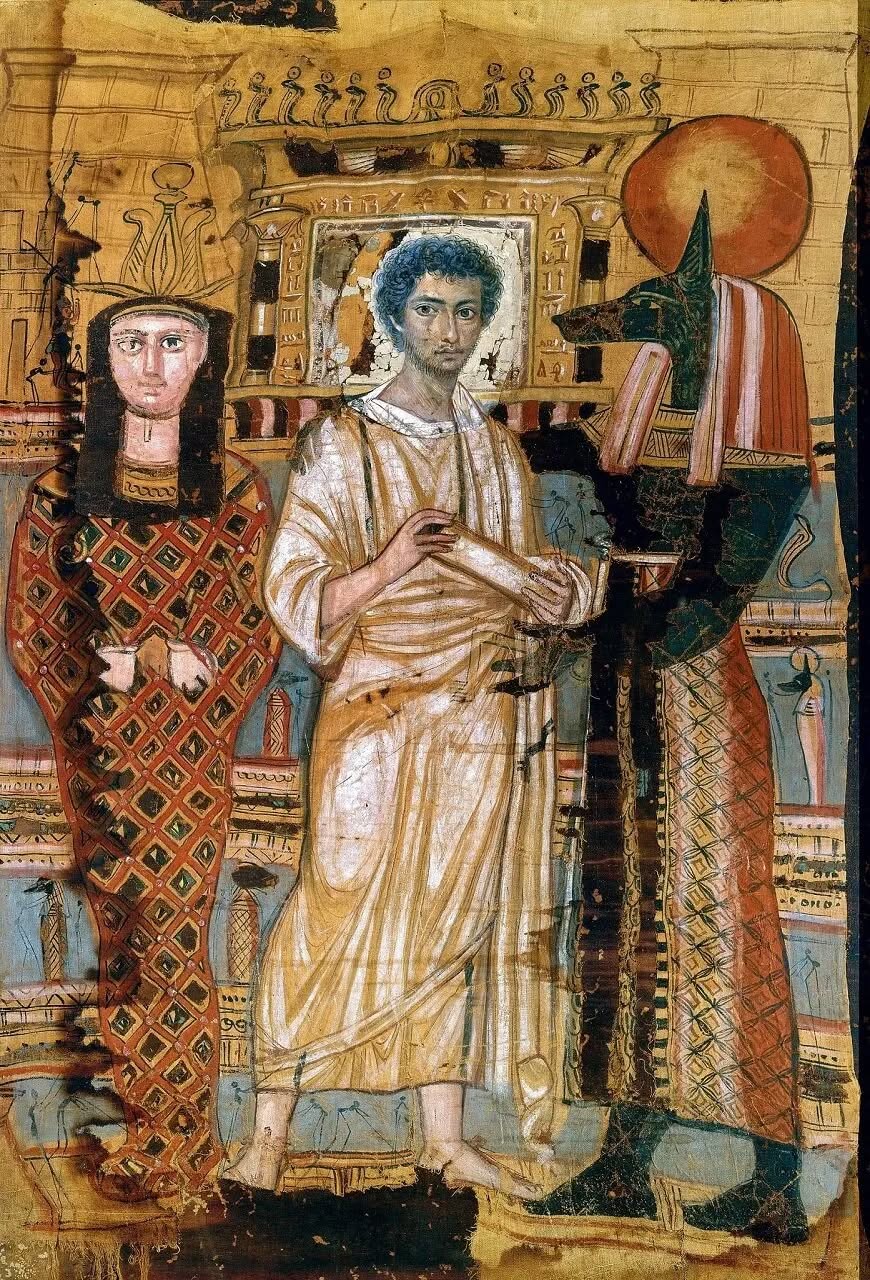
Funerary Shroud, 2nd Century A.D.
Now in the Pushkin State Museum of Fine Arts
In the stillness of Roman Egypt, where ancient pharaonic belief met imperial influence, a painted linen shroud carried both memory and hope into eternity.
This funerary shroud depicts the deceased flanked by two powerful guardians of the afterlife: Osiris, lord of resurrection and judge of the dead, and Anubis, the jackal-headed protector of tombs and embalmer of souls. Their presence was not decorative — it was protective, theological, essential.
By the 2nd century A.D., Egypt had been under Roman rule for generations. Yet despite political change, funerary tradition endured. Mummification remained practiced. The promise of rebirth under Osiris still shaped the imagination of the faithful. What evolved was artistic style: portraiture became more naturalistic, faces individualized, blending Egyptian symbolism with Greco-Roman realism.
On this shroud, the deceased is presented frontally, dignified and eternal, embraced visually by divine forces. Osiris stands as assurance of resurrection; Anubis as guide and guardian through the perilous threshold between worlds. The linen itself — once wrapped around a body — became both garment and icon, binding flesh to belief.
Such objects speak of continuity. Empires shifted, languages mingled, and rulers changed — but the Egyptian longing for protection beyond death endured. In pigment and textile, theology remained alive.
Now preserved in Moscow, this shroud is more than an artifact. It is a testament to a world where death was not disappearance, but transformation — and where the journey beyond was entrusted to gods who had guided souls for millennia.