“74 — And The Only Place I Wanted To Be Was Here”
“74 — And The Only Place I Wanted To Be Was Here”
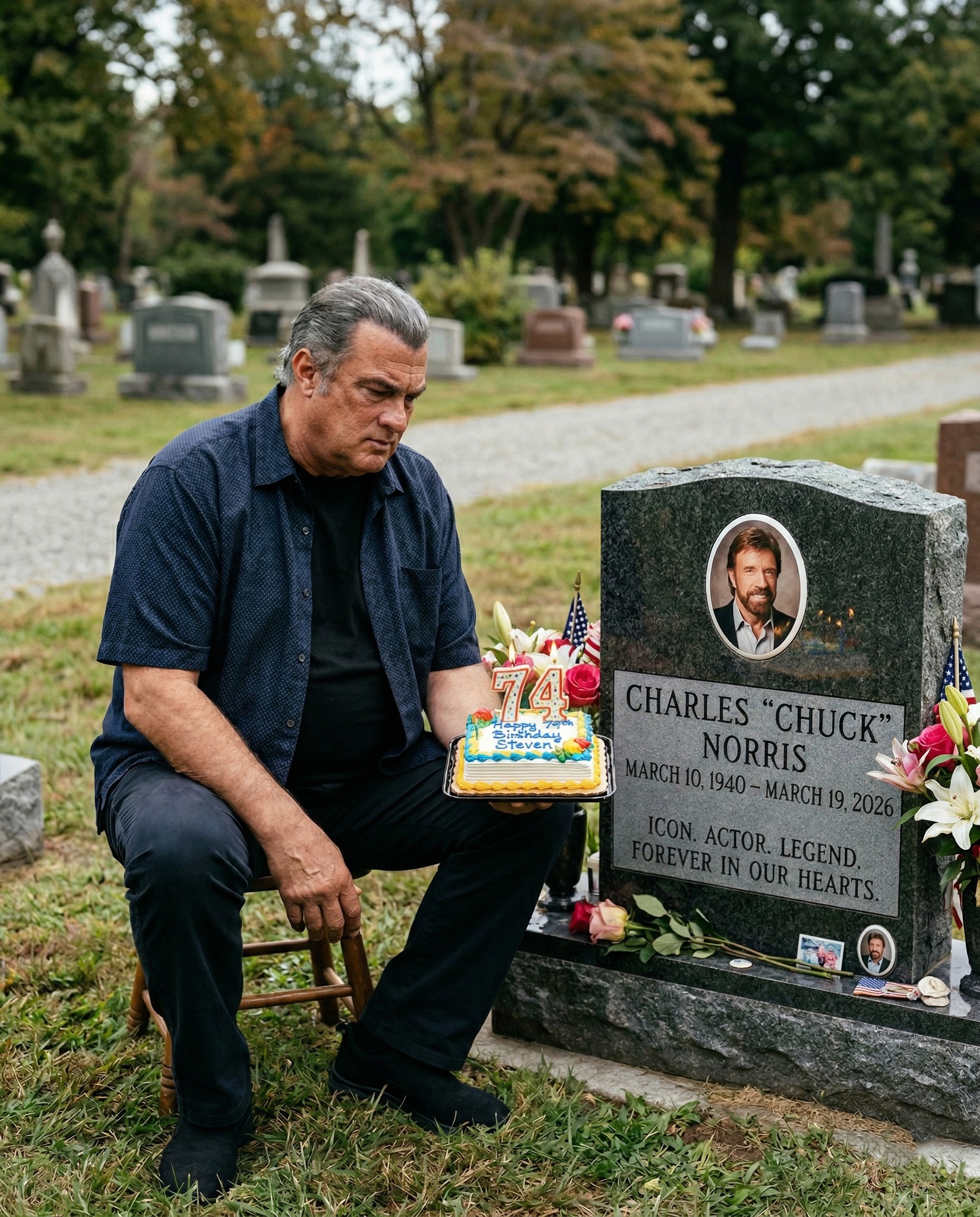
On his 74th birthday, Steven Seagal drove to the grave of Chuck Norris, sat down in a wooden chair, and held a birthday cake that said both their names — because the only celebration that made sense was the one shared with the man who understood him best
The cake says Happy 74th, Steven.
But he did not come here to celebrate himself.
He came here because seventy-four years old is the kind of age that makes a man honest — that strips away the vanity and the performance and the elaborate architecture of public identity that decades in the spotlight construct around a person, and leaves what is underneath. The real accounting. The inventory of what matters and what doesn’t and who was there when it mattered and who is gone now and what the going has done to the shape of the world.
Steven Seagal sits on a wooden chair beside the grave of Chuck Norris and holds his birthday cake in his hands and looks down at it with the expression of a man who is having a conversation that only one side can speak aloud.
Charles “Chuck” Norris.
March 10, 1940 — March 19, 2026.
Icon. Actor. Legend.
Forever In Our Hearts.
The dates bracket eighty-six years of the most complete, most disciplined, most authentically lived life that either of them had ever witnessed up close. Born on March 10. Gone on March 19. Nine days into what should have been his eighty-seventh year — as if even at the end, Chuck Norris was moving forward, past the birthday, still going somewhere, still refusing to let the calendar be the last word on anything.
He died nine days after his last birthday.
And Steven Seagal has come to his grave on his own birthday, with a cake that bears his own name, to share the occasion with a man who can no longer share occasions in the ordinary way.
This is not a small thing.
This is, in fact, everything.
Think about the weight of what Steven Seagal is carrying in this moment.
Not the cake — though the cake is heavy in its own way, the specific weight of something prepared with intention, with the understanding that birthdays matter and that some birthdays matter more than others and that the seventy-fourth birthday of a man who has lived as he has lived deserves to be marked in a place that is true rather than comfortable.
The weight he is carrying is grief. The complicated, layered, completely specific grief of a man who has lost his peer — not just a colleague or a famous acquaintance or someone he admired from a distance, but a peer. Someone who understood the territory from the inside. Who knew what it cost to build yourself from nothing into something real in the world of martial arts and film and the specific American mythology of the action hero. Who walked the same road from a different direction and arrived at the same understanding.
They were peers in the way that only people who have mastered the same discipline can be peers — with the mutual recognition that comes from both having spent years on the mat, having tested themselves against genuine opposition, having arrived at their extraordinary physical abilities not through talent alone but through the daily, unglamorous, absolutely non-negotiable commitment to showing up and working.
Chuck Norris was six-time undefeated world professional middleweight karate champion.
Steven Seagal was a 7th dan black belt in Aikido, the first foreigner to operate an Aikido dojo in Japan.
Two different traditions. Two different paths. The same understanding of what discipline actually means when you take it all the way to its natural conclusion.
They understood each other completely.
And now one of them is in the ground and the other is sitting beside the ground on his birthday with a cake that says his own name, and the understanding flows in only one direction now, and that asymmetry is the thing that grief is made of.
He sits in a wooden chair.
Not standing — sitting. This is deliberate. This is a man who has decided that this visit is not a quick stop, not a respectful moment of pause on the way to somewhere else. He brought a chair. He intends to stay.
The sitting says: I am not passing through. I am not performing a tribute for anyone watching. I am here the way you are here — present, without agenda, willing to let this be whatever it needs to be for however long it needs to be.
The wooden chair is simple and straight-backed and carries within it the specific quality of chairs that were not designed for comfort but for presence — for sitting upright in a place that requires attention, for occupying space in a way that says I am here deliberately. I chose this. I am not going anywhere yet.
He sits.
He looks at the cake.
He looks at the headstone.
He does not look at the camera.
Happy 74th, Steven.
The cake is cheerful in the way that birthday cakes are supposed to be cheerful — colored frosting, celebration in every application of the decorator’s bag, the whole bright apparatus of a birthday that someone prepared because birthdays deserve preparation.
But the cheer and the setting are in conversation with each other, and the conversation is not simple.
Because a birthday cake beside a grave is simultaneously a celebration and a lament — a insistence that life continues, that years still accumulate and deserve marking, and at the same time an acknowledgment that the person you most wanted to celebrate with is the person whose name is carved in the stone.
Steven Seagal at seventy-four.
Chuck Norris never made it to seventy-four — he died at eighty-six, which is beyond seventy-four, which means he was seventy-four once, which means there was a birthday on a March morning somewhere in his extraordinary life when the number was the same as the number on this cake.
Was Chuck Norris happy at seventy-four?
He was always happy. That was the particular grace of Chuck Norris — not the performed happiness of someone who has decided that positivity is a brand strategy, but the genuine, earned, faith-rooted contentment of a man who believed that life was a gift and received it accordingly, every day, including every birthday, including every year that the number went up.
He was happy at seventy-four.
Steven Seagal is trying to find the same.
The American flag at the base of the headstone catches the autumn air.
Small. Red and white and blue. The flag of the country that both men served in their different ways — Chuck Norris in the Air Force, in the physical service of putting on a uniform and meaning it; Steven Seagal in his own complicated relationship with service and honor and the American values that both men wore not as a political statement but as a personal one.
The roses beside the stone — someone placed them recently, or Seagal brought them, or both. Pink and yellow against the grey granite, the colors of things that insist on being alive in the presence of death, that refuse to make concessions to the occasion.
Good.
Chuck Norris would have approved of flowers that refuse to make concessions.
Seventy-four years old.
Sitting in a wooden chair
in an autumn cemetery
with a birthday cake
and the name of a friend
carved in granite
and the American flag
catching the afternoon air
and nothing —
not one single thing —
to say
that the words on the stone haven’t already said
more completely
than any birthday speech
could manage.
Icon. Actor. Legend.
Forever In Our Hearts.
Forever.
That includes today.
That includes every birthday
that comes after the goodbye.
Happy birthday, Steven.
He knows.
He’s been watching since March.
He sees the cake.
He sees you sitting there
in your wooden chair
with your seventy-four years
and your grief
and your absolute refusal
to spend this birthday
anywhere else.
He sees all of it.
And he is glad you came.
He always was glad
when you came.
That never changes.
That is what forever means.