“He Passed Beneath His Own Legend”
“He Passed Beneath His Own Legend”
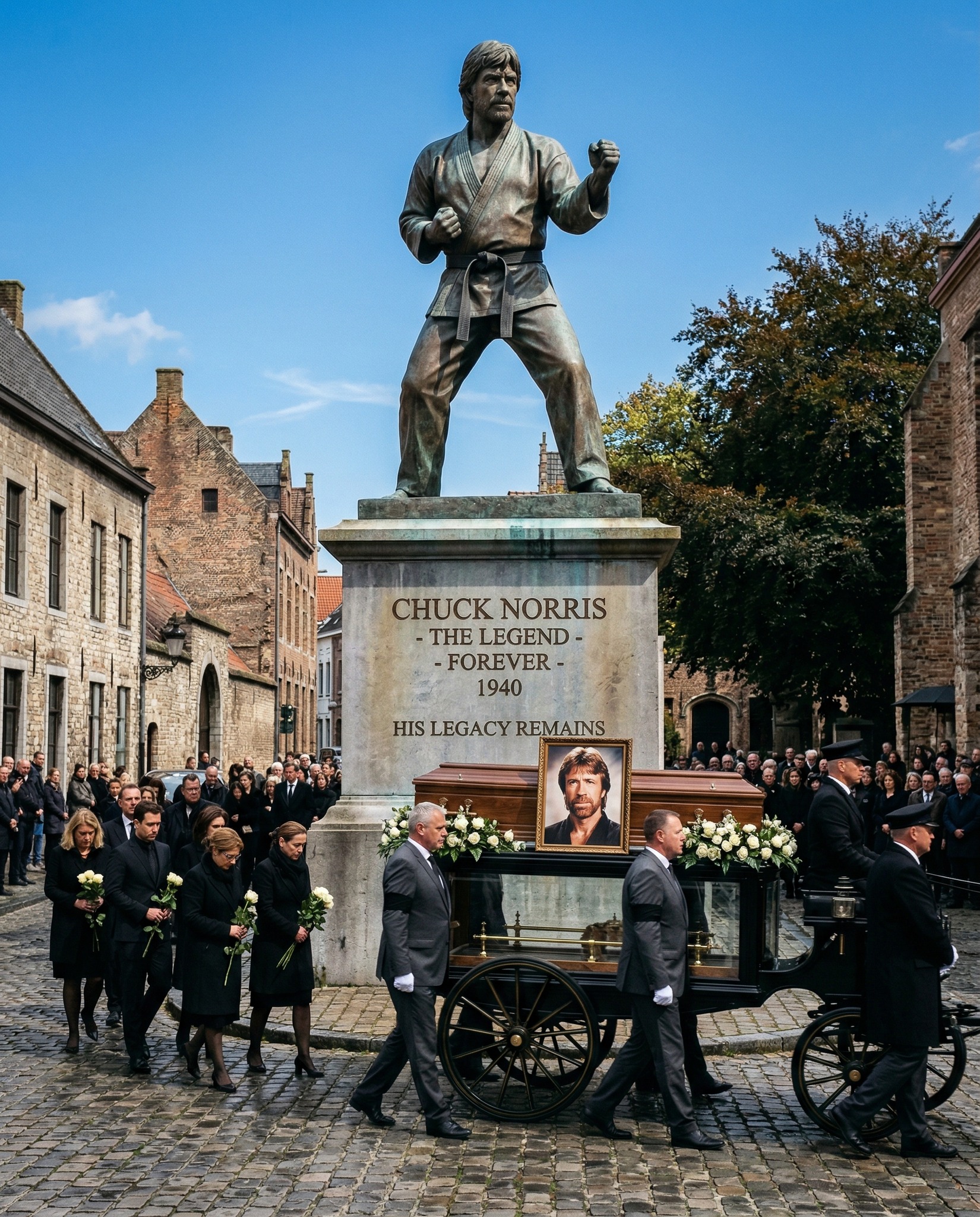
The funeral procession of Chuck Norris carried him one final time past the bronze statue of the man he became — and the statue stood at attention as the man himself went home
The cobblestones have seen everything.
Centuries of feet and wheels and the slow accumulation of history pressing itself into the ancient stone streets of a city that was old before America was born. They have felt the weight of kings and soldiers and merchants and mourners — the full, unedited parade of human existence moving across their surface without pause, without sentiment, without any particular acknowledgment that what passes over them matters.
But today they feel something different.
Today the cobblestones of this ancient street carry the weight of a funeral procession — the black-draped carriage, the pallbearers in white gloves, the family in black holding white roses, the crowd gathered on both sides in the specific silence of people who have come not to observe but to witness — and at the center of the procession, on the carriage, a portrait of Chuck Norris surrounded by white flowers, being carried through the city one final time.
Past his own statue.
Look at what has happened here — really look at it.
The bronze Chuck Norris stands above the procession on his pedestal, frozen in the fighting stance that defined a career, one fist raised, his face set in that expression of complete and untroubled readiness that was his default setting for eighty-five years. He is permanent. He is unchanging. He will stand on this pedestal in this stance in this city long after everyone present today has joined him in the democracy of the departed.
And beneath him — moving slowly, deliberately, on the ancient cobblestones — the man himself. Carried by the hands of people who loved him, preceded by the family that was the true center of his extraordinary life, accompanied by the portrait that captures what the bronze cannot: the warmth, the specific humanity, the eyes that always carried something alive in them that sculpture cannot replicate.
The bronze Chuck Norris watches the mortal Chuck Norris pass beneath him.
The legend watches the man go home.
There is no image in the entire record of his life more complete than this one.
The pedestal inscription reads:
Chuck Norris — The Legend — Forever — 1940.
His Legacy Remains.
His Legacy Remains.
Not remained. Not past tense. Present tense, permanent tense, the tense that belongs to things that do not end when the person ends — that continue in the people they shaped and the values they demonstrated and the quiet, daily influence of an example that keeps working long after the exemplar has gone.
The family walks behind the carriage with white roses.
White — the color of peace, of completion, of a life that ended cleanly without loose ends or unspoken words or promises unkept. Chuck Norris lived a life that could be handed white roses at its conclusion without irony. He was who he said he was. He did what he said he would do. He loved the people he loved with his full attention and his complete commitment and the particular generosity of a man who understood that time was the most precious thing he had to give.
He gave it freely. He gave it completely.
The white roses are the world’s receipt.
The procession moves slowly.
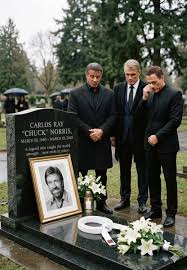
The cobblestones receive it.
The bronze Chuck Norris stands above it all
with his fist raised
in the stance he held for sixty years.
Ready.
Always ready.
The man passes beneath the legend.
The legend watches the man go.
And the inscription on the pedestal
says the only thing left to say:
His Legacy Remains.
Present tense.