“When The Warriors Stay Behind”
“When The Warriors Stay Behind”
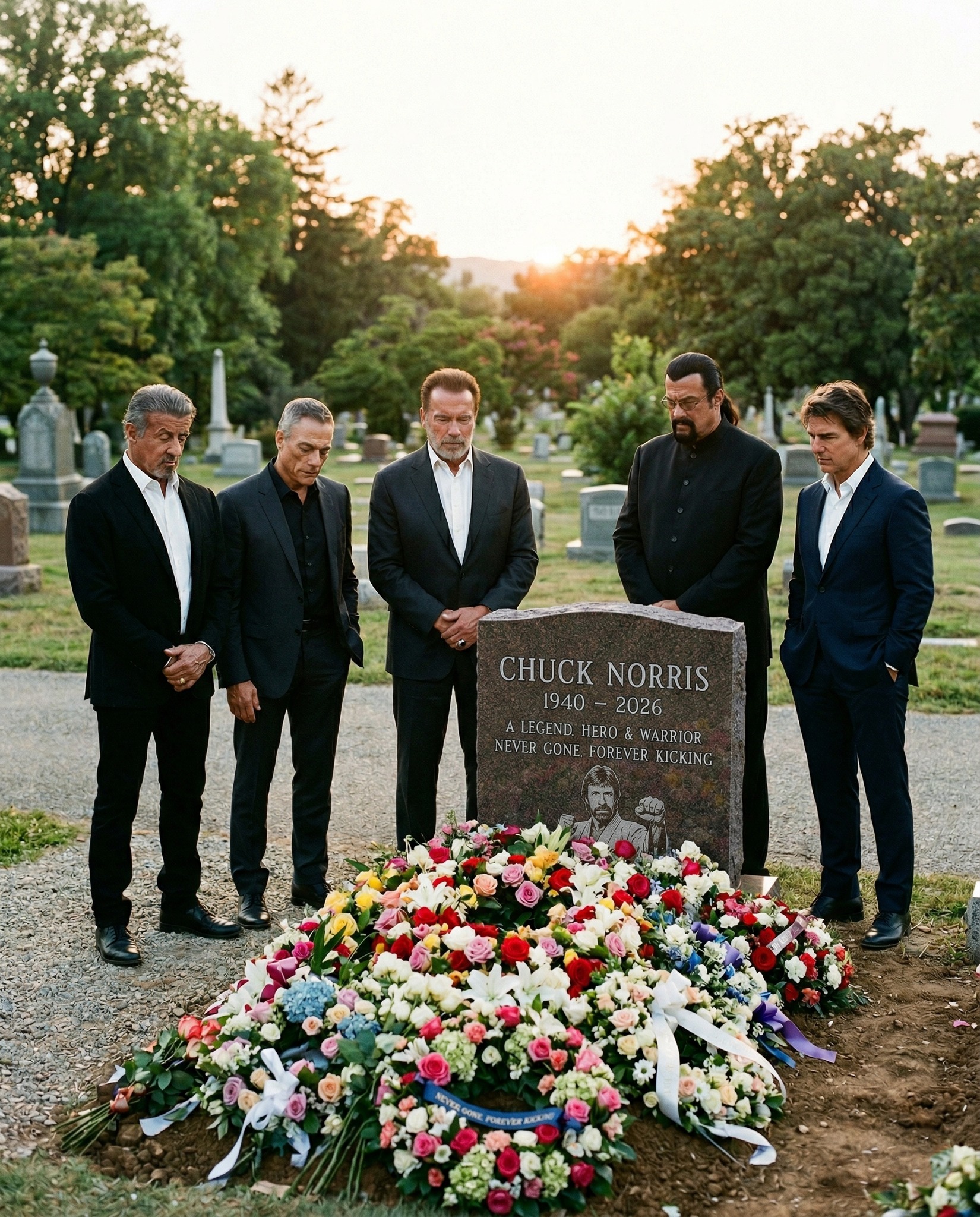
After the funeral ended and the world went home — five legends remained standing at the grave of Chuck Norris, and the setting sun witnessed what cameras were never meant to capture
The cars have left.
The mourners — the hundreds, the thousands who came to pay their respects in the proper way, with their tears and their flowers and their carefully chosen words — they have all gone home now. Back to their lives. Back to the ordinary world that continues, indifferently and relentlessly, even on the days when it should stop.
The cemetery is quiet.
The kind of quiet that only exists in the space after grief has been publicly performed and before it settles into the private, permanent form it will take for the rest of your life. The golden hour quiet. The moment when the sun drops low and turns everything it touches into something that looks almost too beautiful to be real — the grass, the stones, the flowers that cover the grave in a riot of color so vivid it seems almost defiant against the gravity of the moment.
And five men stand.
Sylvester Stallone. Jean-Claude Van Damme. Arnold Schwarzenegger. Steven Seagal. Tom Cruise.
They did not leave with the others.
They stayed.
There is no audience for this moment. No cameras on assignment. No publicists coordinating the optics. No one left to perform for, no narrative to manage, no image to protect.
Just five men in dark suits standing in the fading light of a California evening, looking down at a headstone that reads:
Chuck Norris. 1940 — 2026.
A Legend, Hero & Warrior.
Never Gone. Forever Kicking.
The inscription was chosen by people who loved him. And it is exactly right. Because Chuck Norris was never the kind of man who would accept Rest in Peace as his final word to the world. He would have wanted something with forward motion in it. Something that kept moving even after he stopped.
Forever Kicking.
Yes. That is Chuck Norris. That is precisely, completely, unmistakably Chuck Norris.
Think about who is standing at this grave and understand what it cost each of them to stay.
These are not soft men. These are not men who were taught to linger in grief, to stand in cemeteries in the golden hour with their hands clasped and their faces open. They were all, in their different ways, forged in traditions that valued stoicism — that understood strength as the management of emotion, the containment of what hurts so that the hurt doesn’t show and doesn’t slow you down.
And yet here they are. Staying. Not moving. Not managing anything.
Just standing with him one more time, because the alternative — walking away, getting in the car, re-entering the world without this final private moment — was simply not something any of them could do.
When men like this cannot walk away, you understand the size of what has been lost.
Sylvester Stallone stands on the left, slightly separate, the way he has always stood — the writer, the architect, the man who carries the weight of everyone else’s stories as well as his own. He and Chuck Norris were brothers in the truest sense the word allows outside of blood. They came from the same philosophy, the same stubborn faith in the idea that a man could will himself into being through sheer, sustained effort. They recognized each other on sight, the way mirrors recognize each other — because each saw in the other a reflection of his own deepest commitments.
Stallone has already knelt at this grave once, in a private moment that the world glimpsed in a photograph that broke the internet because of what it contained — not drama, not performance, but the raw, undefended grief of a man who had lost his brother. Today he stands. Because today is a different kind of grief. The public grief is done. What remains is the private reckoning — the beginning of the long work of learning to carry someone’s absence.
He stands and he stays. That is everything.
Jean-Claude Van Damme is here, and his presence means something specific.
He and Chuck Norris were not from the same tradition. Their paths through the action world ran parallel rather than converging — different studios, different styles, different decades of dominance. There was, for a time, the inevitable comparison that the industry imposes on any two men who occupy similar territory, the reductive either/or that misses the point entirely.
But Chuck Norris was beyond comparison. He was a category unto himself. And Van Damme — who has spent his own career navigating the gap between what the world wanted him to be and who he actually was — understood this completely. Understood it with the clarity of a man who has looked honestly at himself and at the legends around him and arrived at genuine humility.
He came today because some things transcend professional history. Because Chuck Norris was not a competitor — he was a standard. A measure of what was possible when discipline and integrity and faith were applied to a life without reservation.
Van Damme stands at this grave and pays his respects to the standard.
Arnold Schwarzenegger stands at the center — because Arnold always stands at the center, not through vanity but through the simple gravitational fact of who he is. The most improbable success story that American cinema ever produced. The man who bent reality through sheer force of will until it conformed to his vision of what was possible.
Arnold and Chuck were peers in the deepest sense — men who had independently arrived at the same understanding that a life was something you built, not something that happened to you. That the gap between where you started and where you ended was crossed not through luck or circumstance but through the daily, unglamorous, absolute commitment to becoming.
They respected each other with the complete respect that only one self-made person can extend to another. Not admiration from below — respect from alongside. The acknowledgment of equal architecture.
Arnold stands at the grave of his peer and his friend and the golden light falls across his face and for once — for this one moment — the great Austrian oak is simply still.
Steven Seagal is here.
This, perhaps, is the most quietly significant presence of all. Because Seagal and Norris came from the same martial arts world — the world where rank was earned through years of genuine practice and testing, where respect was not given but proven, where the hierarchy was established not by box office but by the mat.
In that world, Chuck Norris was royalty. Six-time undefeated world professional middleweight karate champion. A man who had tested himself against the best on the planet and prevailed, not once but repeatedly, with a consistency that eliminated the possibility of luck and confirmed the reality of mastery.
Seagal, himself a master of aikido, understood what that meant at a level that transcends civilian comprehension. He stood on the mat his whole life. He knows what it costs. He knows what it means to face an opponent who is genuinely better than you and keep coming back until you are no longer who you were.
He came today as one martial artist burying another. As one practitioner acknowledging a master. In the language of the dojo — with complete, unambiguous, earned respect.
And Tom Cruise.
The youngest energy in this gathering. The one who represents the bridge between the era these men built and the era that came after — the era of Mission: Impossible and IMAX and a different kind of physical commitment, the commitment of a man who does his own stunts not because the insurance allows it but because he believes, with a conviction that mirrors Chuck Norris’s own, that real matters.
Tom Cruise learned something from the generation of men standing beside him. He may not have made films with Chuck Norris. But he absorbed the philosophy — the understanding that you owe the audience your genuine self, your genuine effort, your genuine willingness to be hurt in the service of something true.
He stands at this grave as an inheritor paying his respects to the source.
The sun is going down behind the trees.
The flowers — so many flowers, red and white and yellow and blue, a whole summer’s worth of color gathered to honor one man — glow in the dying light like something that refuses to fade.
Five men stand in silence.
There are no words. There are no words adequate to this moment and none of them try to find any. Because they are all, each in his own way, from traditions that understand the eloquence of silence. The martial artist’s silence before the bow. The warrior’s silence before the battle. The brother’s silence before the grave.
They stand.
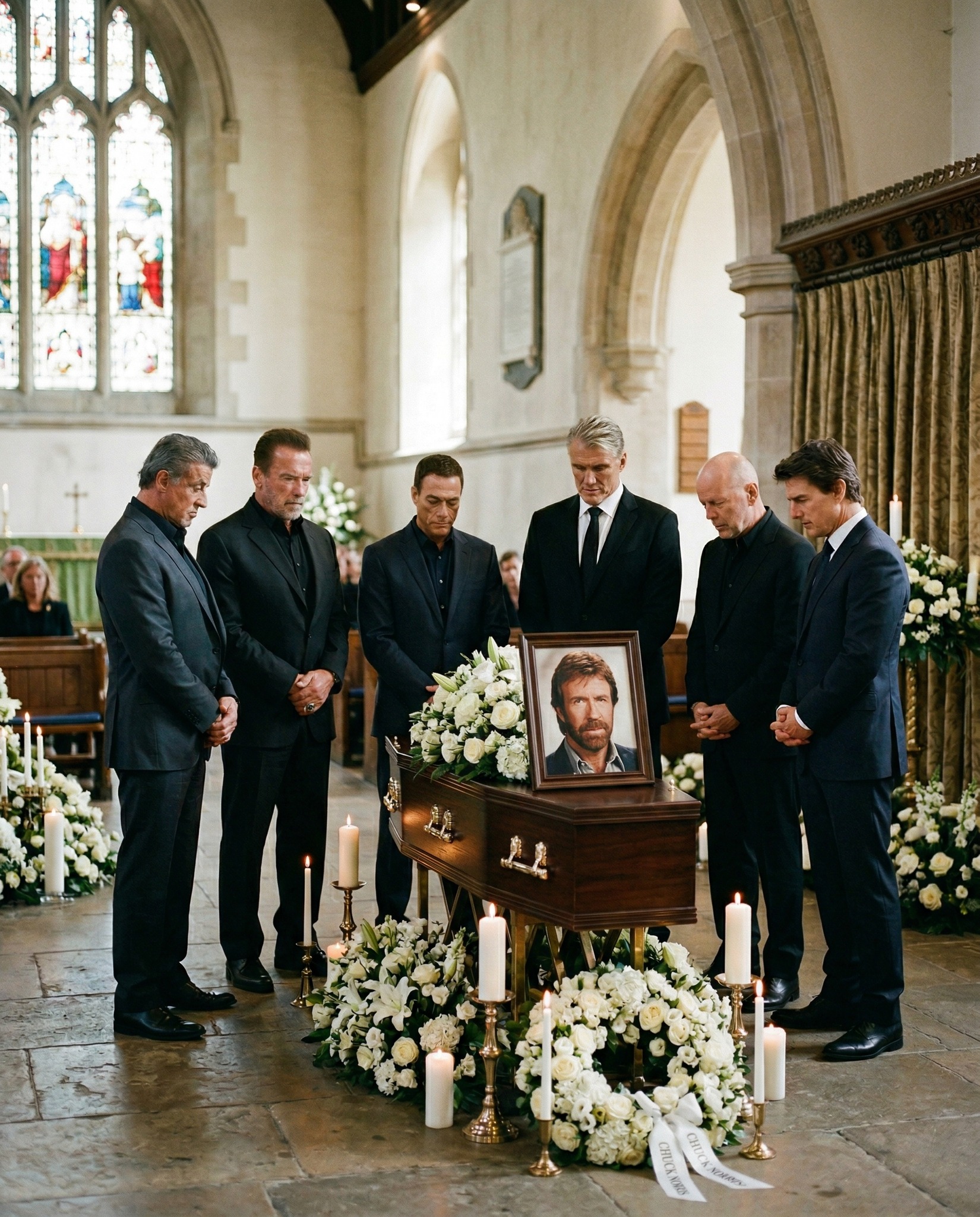
They stay.
And the inscription on the stone catches the last of the light:
Never Gone. Forever Kicking.
The world went home.
The legends stayed.
And Chuck Norris — who never needed an audience to be exactly who he was — rested in the quiet company of men who understood him completely.
The sun went down.
None of them moved.
Some goodbyes take all night.