“Until We Meet Again: Stallone Stands in the Sunset Light of the Most Beautiful Promise Ever Carved in Stone”
“Until We Meet Again: Stallone Stands in the Sunset Light of the Most Beautiful Promise Ever Carved in Stone”
Four words on a grave. Four words that change everything. Four words that transform mourning into anticipation and grief into the most tender form of faith — and Stallone standing before them with white roses, understanding exactly what they mean
The sun is setting.
Or rising. The specific quality of this light — the way it breaks through the storm clouds on the horizon with the specific, dramatic, completely unhurried authority of something that has decided to be present regardless of the weather around it — could be either. Dawn or dusk. The beginning or the end of the day.
And perhaps that ambiguity is exactly right.
Perhaps the image is not accidentally uncertain about which boundary of the day this light belongs to. Perhaps the light that falls across this cemetery — across the autumn trees in their final color, across the church spire visible in the mist, across the dark stone bearing the name and face of Chuck Norris, across the man in the black suit standing before it with white roses in his hand — perhaps this light is deliberately the light of both. Of completion and beginning. Of ending and the promise that lives inside the ending.
Until We Meet Again.
That is what the stone says. Not rest in peace only — though it says that too, in the specific, honest acknowledgment that the eighty-six years are complete and the body is at rest. But until we meet again. The specific, forward-looking phrase that transforms a grave from an ending into a pause. That says: this is not finished. This is interrupted. This is the interval between two parts of a story that is still being told.
Sylvester Stallone is standing before those four words with white roses in his hand and sunglasses on his face and everything in his posture that says:
I believe them.
I am holding you to them.
I will hold you to them until I can.
The Stone That Says the Impossible Thing
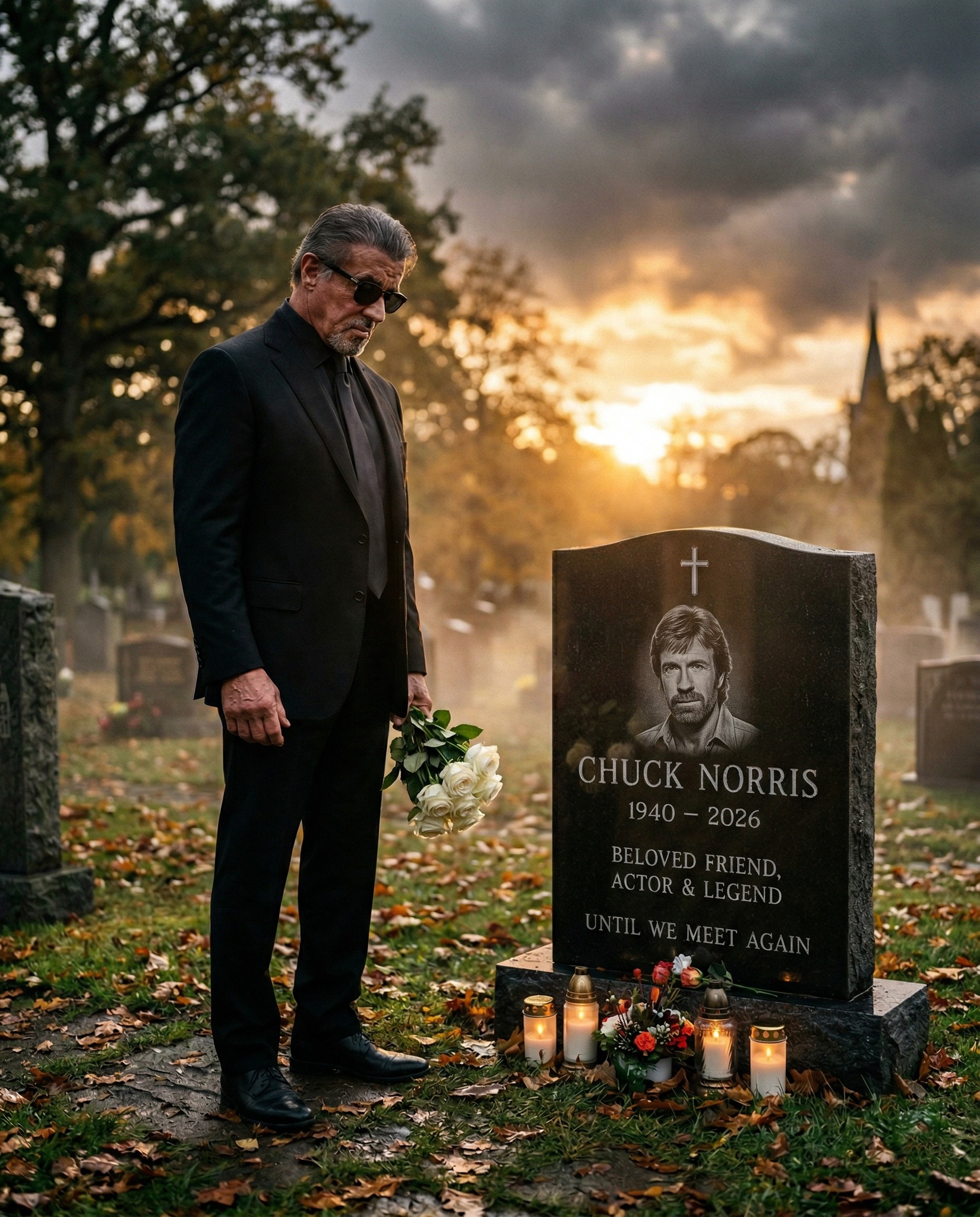
CHUCK NORRIS
1940 – 2026
BELOVED FRIEND, ACTOR & LEGEND
UNTIL WE MEET AGAIN
Read it in order. Understand what each line is doing.
CHUCK NORRIS — the name. The specific, irreplaceable name that belongs to one specific person and that carries, in its two syllables, everything that person built across eighty-six years. It is not simply a name anymore. It has become a word that means something beyond the person — a word that means discipline, integrity, warmth, the specific quality of someone who was exactly what they appeared to be and appeared to be extraordinary.
1940–2026 — the dates. The bracket that contains the whole life. Everything that happened between those two years — the birth in Oklahoma, the Air Force, the martial arts, the championships, the films, the television, the philanthropy, the faith, the family, the friendship with the man standing before this stone right now — all of it is contained within those two numbers and the dash between them.
BELOVED FRIEND, ACTOR & LEGEND — the three identities, in order of intimacy. Beloved Friend first — the private role, the personal relationship, the specific warmth of someone who was genuinely, reliably, completely a friend to the people who knew him. Then Actor — the professional identity, the work, the craft, the career. Then Legend — the public significance, the cultural presence, the thing his name became. The order says: the friend is more important than the legend. The personal is more important than the public. Even on the stone, even in the formal language of memorial inscription, the order of priority is right.
UNTIL WE MEET AGAIN — and then this. These four words at the bottom of the inscription. The last thing anyone reads. The final statement.
Until we meet again.
Not goodbye. Not farewell. Not any of the words that mark endings. The one phrase that is not an ending at all — that is, explicitly and intentionally, a see you later. A statement that what looks like departure is actually the interval before reunion. That the man in the stone is gone for now and will be found again. That the story is not over.
This inscription required faith to write. Not the performed faith of someone going through the motions of religious language. The real faith — the specific, living, completely functional conviction that until we meet again is not a comforting fiction but a literal statement of what is true. That Chuck Norris, who believed in something beyond the physical world with the same complete commitment he brought to everything, has gone to that beyond and is there and can be met again.
The cross at the top of the stone — simple, no inscription, the universal symbol of exactly this belief — anchors the entire stone in the theological reality that makes until we meet again possible to mean rather than simply to say.
Stallone in the Sunset
He is in a black suit. The formal mourning suit — the same suit, or one that functions the same way, as the white-roses-in-the-rain photograph. The deliberate choice of formality for the visit. The decision to dress with full respect for where he is going.
The sunglasses. Dark, covering his eyes, doing what sunglasses do at graves when the person wearing them has decided that the specific quality of what their eyes are expressing is private. The sunglasses are armor — not in the defensive sense, not as the armor of someone hiding from the world, but in the specific, honest sense of someone who is allowing themselves to be present at a grave in full suit and tie and white roses while maintaining some portion of the interior as their own.
He is a public man. He has been a public man for fifty years. The management of what the public sees is not vanity but survival — the practical necessity of someone who lives at the intersection of genuine private grief and genuine public recognition, who must navigate the specific difficulty of having private feelings in a public world.
The sunglasses say: I am here. I am present. Some of what this is costing me is mine.
The white roses in his hand — held loosely now, not with the two-handed formality of the other cemetery photographs, but with the relaxed grip of someone who has been here for a while and has settled into the visit. The roses slightly drooped from the holding, the petals still pure white against the dark of everything around them.
He is looking at the stone. His head is slightly down, his attention directed at the inscription, at the face in the medallion, at the four words at the bottom.
Until we meet again.
He is reading them. Or he has read them and is sitting with them. Holding the roses and the specific, complicated mixture of grief and faith that those four words produce in someone who believes them and is also standing in the present-tense reality of a cemetery in November with a friend in a stone.
The grief is real. The faith is real. They are not opposites. They coexist — the grief of the present absence and the faith of the future reunion, held simultaneously in one man in one cemetery on one autumn evening.
The Light That Frames Everything
The light behind the stone — breaking through the storm clouds, golden and dramatic, falling across the cemetery with the specific, warm quality of a sun that has fought through the grey to be present for this moment — is the image’s most direct theological statement.
It falls behind Chuck Norris’s stone. Not in front of it — behind it. As if the light is coming from the direction of wherever he is. As if what exists on the other side of the stone is not darkness but this: warmth, gold, the specific quality of light that falls when the sun finds its way through whatever has been obscuring it.
The church spire visible in the mist behind and above the stone — the specific architectural symbol of the faith that runs through the stone’s inscription — is illuminated by the same light. The cross at the top of the headstone glows in it.
Everything in this image is aligned: the stone and the cross and the spire and the light. All of them saying the same thing in different languages.
He went somewhere good.
The light is there.
You can see the light from here.
It comes from the direction of where he is.
And it is warm.
And it is real.
And until you can go to it yourself, you can stand in the edge of it.
The way Stallone is standing now.
In the sunset.
At the grave.
With the roses.
In the light that comes from where Chuck is.
What the Sunglasses Are Hiding
He has been here before. He will be here again. But this visit — the black suit, the white roses, the four words at the bottom of the inscription — this visit is different from the others in a way that is hard to name precisely.
It is more forward-looking. Less about the loss and more about the promise. Less about he is gone and more about until we meet again.
The sunglasses might be hiding the specific quality of emotion that until we meet again produces in someone who takes the words seriously — who looks at them and feels not only the grief of the current separation but the specific, complicated, entirely genuine warmth of a promise believed.
I will see you again.
I don’t know when.
I don’t know the specific mechanics of how.
But I believe the stone. I believe the cross. I believe the light that is coming from the direction of where you are.
I believe: until we meet again.
And the sunglasses keep the specific quality of that belief — that specifically private, completely genuine faith — from being fully visible to whoever is watching. Because some things are not for the watching world. Some things are only for the person and the stone and the light.
The grief is public enough. The love is public enough. The visits and the roses and the journals of loss that have accumulated across the months since March 2026 — those are public enough. This is private. This is the interior belief of a man who stands at his friend’s grave and reads the last line of the inscription and understands it as a promise rather than a consolation.
Until we meet again, Chuck.
I’m holding you to it.
A Final Evening
The sun continues to find its way through the clouds. The autumn leaves lie still around the base of the stone. The candles burn in the gathering dusk. The church spire rises in the mist. The cross at the top of the stone catches the last of the light.
And Stallone stands. In the black suit. With the white roses. In the sunglasses that keep some portion of this private.
Reading the stone.
Believing the stone.
Standing in the light that comes from where Chuck is.
Knowing that the four words at the bottom are not just words.
They are the appointment.
CHUCK NORRIS
1940 – 2026
Beloved Friend, Actor & Legend.
UNTIL WE MEET AGAIN.
The light is there.
The cross holds.
The faith is real.
And the man in the black suit with the white roses —
standing in the sunset,
reading the promise,
believing it,
holding the roses
that he will leave here
before he goes —
that man is coming back.
Again and again.
Until the again becomes the again he has been promised.
Until the meeting happens.
Until the stone is no longer the closest available thing.
Until then.
Until we meet again.
“I am the resurrection and the life. The one who believes in me will live, even though they die.”
— John 11:25
Chuck Norris believed.
The stone says so.
The cross says so.
The light says so.
And Stallone is standing in that light.
With white roses.
Believing it too.
Until they meet again.
Which they will.
Because the stone said so.
And the stone does not lie.