“My Friend: The Word on the Stone That Says Everything the Legend Cannot”
“My Friend: The Word on the Stone That Says Everything the Legend Cannot”
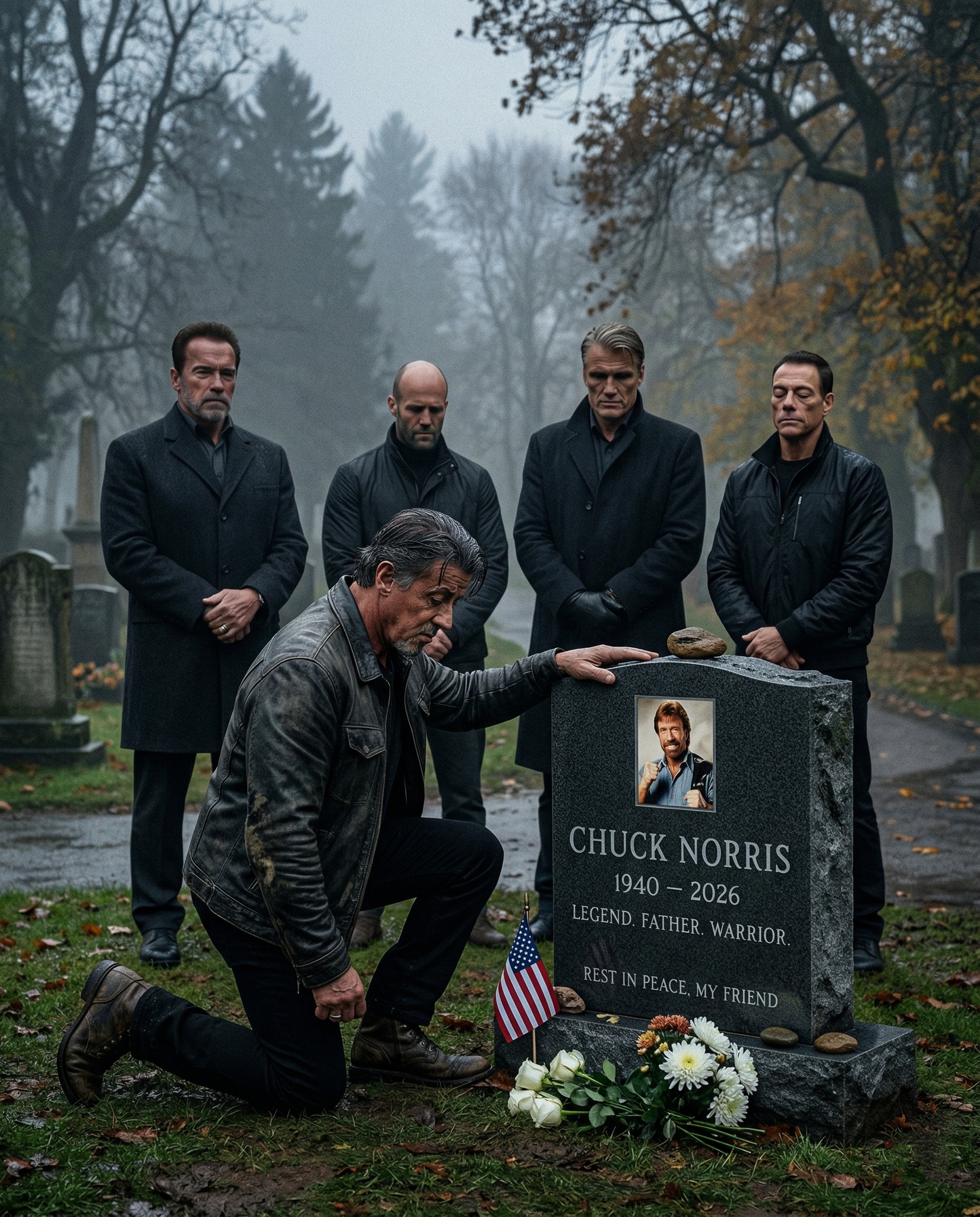
Stallone kneels alone in the rain before Chuck Norris’s grave while four brothers stand witness — and the inscription that breaks every heart is not Legend, not Father, not Warrior, but the last two words: My Friend
He is on both knees now.
Not one knee — the ceremonial kneel, the formal gesture of tribute. Both knees. In the wet grass of a misty autumn cemetery, in the cold that comes through denim and leather without apology, in the specific posture of a man who has stopped calculating how he appears and has simply arrived at the position his body required when the weight of this moment became too much to carry standing.
Both knees. His hand on the stone. His face close to the portrait. His silver hair catching the grey morning light. His worn leather jacket dark with the mist that has settled on everything in this cemetery — on the bare branches of the trees, on the other stones in their rows, on the four men standing behind him in their dark coats like a silent honor guard for the most private and most public grief happening simultaneously in front of them.
This is not performance.
You cannot perform this. You cannot arrange yourself into this configuration and make it look true — the two knees, the hand on the stone, the face at the level of the portrait, the specific curve of a man whose body has gone soft with grief in the way that strong bodies go soft when they have stopped requiring themselves to be strong. The body knows the difference between performed sorrow and actual devastation. And the body in this photograph has stopped performing anything.
This is simply what it looks like when Sylvester Stallone is at Chuck Norris’s grave and has run out of ways to stand upright in the presence of what the stone says.
The Stone and Its Final Words
CHUCK NORRIS
1940 – 2026
LEGEND. FATHER. WARRIOR.
REST IN PEACE, MY FRIEND
Read it again.
My Friend.
Not our friend — the collective tribute of a world that loved him. Not beloved friend — the formal memorial phrasing. My Friend. First person singular. The most intimate possible pronoun applied to the most essential human relationship.
My Friend.
Someone — perhaps Stallone himself, perhaps the family who received his counsel on what the stone should say, perhaps some collaborative decision made in the first raw days after the loss — chose these two words above all the available words. Chose them to conclude the inscription. Chose them to be the last thing anyone reads when they come to stand before this stone and try to understand what Chuck Norris was to the people who knew him.
Not Legend. Not Father. Not Warrior. Though he was all three, and all three are carved here in the stone above these final words.
My Friend.
Because at the end of everything — after the championships and the films and the television seasons and the internet mythology and the global recognition and all the rest of the extraordinary accumulation of a life lived at the highest possible level of commitment and integrity — what Chuck Norris was, most essentially and most lastingly, to the people who mattered most to him and to whom he mattered most, was:
A friend.
The real kind. The kind that shows up. The kind that calls. The kind whose presence in your life makes you better than you would have been without it — not through grand gestures or dramatic moments, but through the daily, unremarkable, completely reliable fact of being there.
The kind that you kneel for in a wet cemetery on a November morning, both knees in the grass, one hand on the stone, because standing is no longer available to you and you have stopped caring whether anyone can see that it isn’t.
The Portrait on the Stone
In the oval medallion above the inscription, Chuck Norris looks out from the granite with the expression that was always most completely his.
Not fierce — though he could be fierce. Not imposing — though his presence imposed itself on every room he entered simply by being the specific, fully realized, completely authentic person he was. The expression in the portrait is warm. Direct. The expression of someone who is paying complete attention to whoever is before him with the full, undivided, genuinely interested quality of attention that was his signature.
He is looking at Stallone.
Of course he is looking at Stallone. The stone faces the path, the portrait faces whoever comes — but in this specific arrangement, with Stallone kneeling directly before it, close enough to touch, his face at the level of the oval medallion — the portrait looks at him. At the silver hair and the wet leather jacket and the both-knees grief and the hand that will not leave the stone.
And the expression in the portrait is the expression of someone who sees all of it and receives it without judgment and offers back — across the impossible distance between the carved oval and the living face — the warmth that was always there. The warmth that was always him. The warmth that the stone cannot hold completely but that comes through anyway, because Chuck Norris’s warmth was always larger than whatever container the world provided for it.
He is seeing his friend.
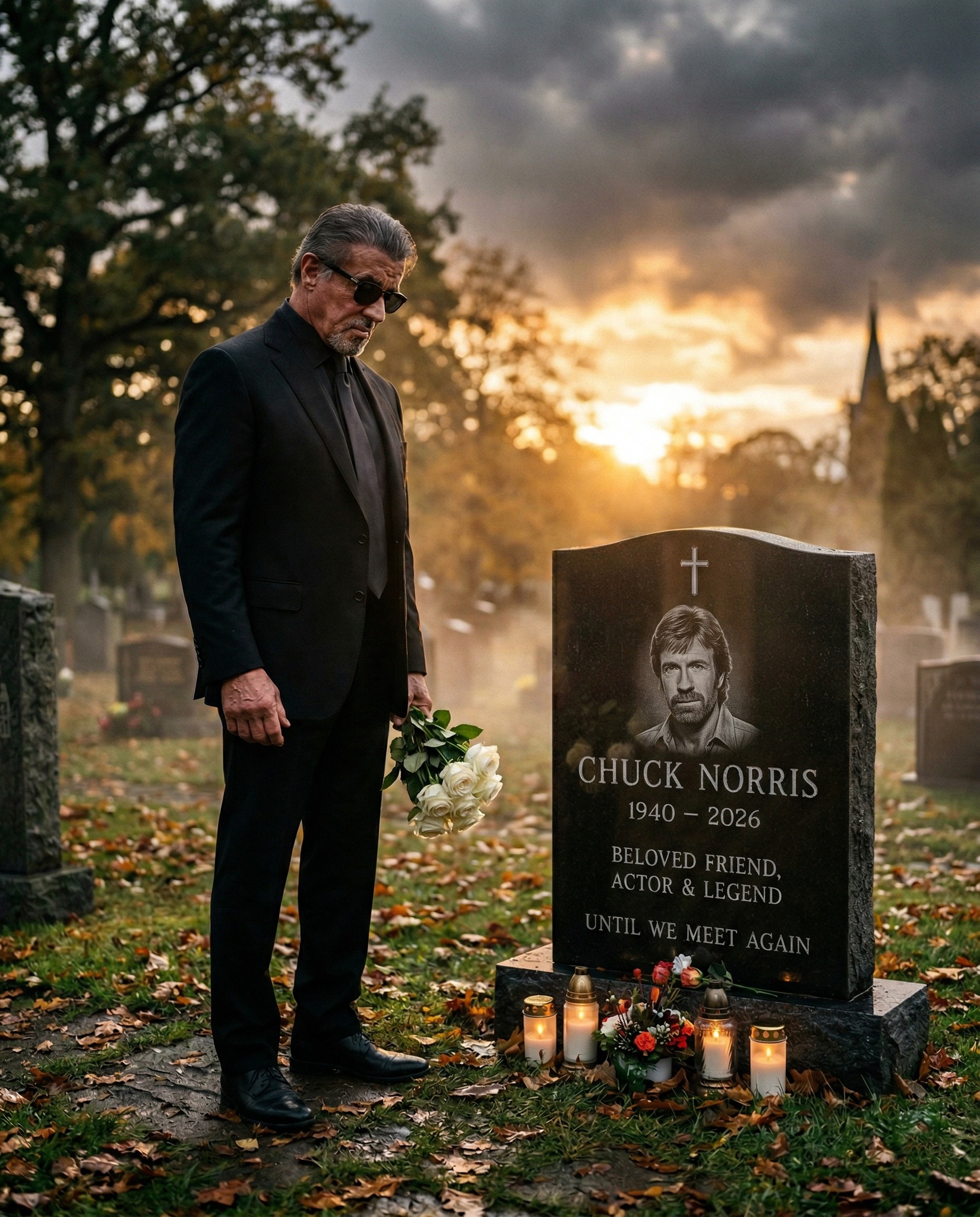
My Friend.
The stone says it to everyone who comes. But right now, in this grey morning, with Stallone on both knees in the grass — it is saying it specifically, personally, completely to him.
Rest in peace, my friend.
I see you. I know you came. I know what this cost you. I know you would have been here every day if you could.
Rest in peace, my friend.
The Four Who Stand
Behind Stallone, four men in dark coats stand in the specific arrangement of people who have accepted the role of witness — who understand that what is happening before them is not something they should interrupt or alleviate or redirect, but something they should simply be present to with the full quality of their attention.
Arnold Schwarzenegger on the left — his hands clasped before him, his face carrying the controlled expression of someone who is feeling something large and is managing it with the specific discipline that his whole life has been about: the application of will to difficulty, the refusal to let what is hard define you, the maintenance of form when the interior is in disarray. He is watching Stallone kneel. He is watching his brother grieve. And he is standing — being the standing witness, the upright presence, the reminder that the men around this grave are not going down even when the going down would be understandable.
Jason Statham beside him — present with the complete, undivided quality of someone who has nowhere else to be and no interest in being anywhere else. His hands at his sides, his face open with the honest, unmanaged expression of someone who is allowing himself to feel what this feels like rather than deciding in advance what the appropriate response should be. He is the youngest of the group. He will carry this the longest. He will be telling this story — the story of the day they all came to Chuck’s grave in the mist — for decades.
Dolph Lundgren behind — his height making him visible even in the middle distance, his presence completing the formation with the quiet solidity that has always been his. He came because Chuck deserved the coming. He will leave when the leaving is right. In between, he stands. This is what you do when someone you respected and admired and shared a world with is in the stone before you: you stand and you witness and you let the standing be the statement.
Jean-Claude Van Damme on the right — the specifically interior quality of his stillness communicating the depth of what he is feeling in the way that exterior stillness sometimes communicates interior richness. The man whose art was always about the body moving at its most precise and most beautiful is now completely still. The stillness is its own precision. Its own beauty. Its own complete expression of what this moment requires.
Four men standing. One man kneeling.
The standing men are the context for the kneeling man. They provide the frame within which his grief makes its full meaning visible. They are the ones who can hold the form while he goes down. They are the ones who will be there when he rises — and he will rise, because he always rises, because that is who he is and what he does — and who will walk out of this cemetery beside him when the visit is complete.
But right now, they stand. And he kneels. And the arrangement is exactly right.
The American Flag
At the base of the stone, small but vivid against the grey and the white of the flowers — an American flag.
Chuck Norris loved his country. This was not a performance of patriotism or a commercial calculation about audience demographics. It was the specific, genuine love of someone who served in the United States Air Force, who was shaped by the experience of military service, who carried throughout his life the values that his service instilled — the sense of something larger than individual interest that is worth defending, the understanding that the freedom to become what you are capable of becoming is not given but earned and maintained through the effort of people willing to put something before themselves.
The flag at his grave is not a decoration. It is a statement of who he was. Of the values he held. Of the specific, genuine, completely unperformed love of country that was part of the foundation on which everything else was built.
It stands in the grey morning, its colors bright against the mist. One more thing that refuses to be dimmed by the occasion.
Like the candles. Like the portrait. Like the inscription.
Like Chuck Norris himself, who was never dimmed by anything the world produced and is not dimmed now, even in the stone, even in the grey, even in the November mist of a cemetery that holds his remains but cannot quite contain his presence.
The Rain and the Leather
Stallone’s leather jacket is dark with moisture — the mist has settled into it over however long he has been here, however long he arrived before the four men joined him, whatever private time he spent alone with the stone before the gathering became a gathering.
He came early. He always comes early to these visits. He arrives before the occasion has fully organized itself — in the specific, private, completely genuine way of someone for whom the visit is not primarily a public act but a private one. Who needs the time alone with the stone before the others arrive. Who has something to say that is only for Chuck, that does not belong to the gathering or the photograph or the watching world.
The wet leather is the evidence of that time. The proof that he was here before the image began to be composed, before the four men arrived in their dark coats, before the occasion became something that would be documented and shared.
He was here in the rain. Alone. On both knees. With his hand on the stone.
And then the others came. And found him this way. And took their positions around him without asking him to change his position, without suggesting that both knees in the wet grass was perhaps more than the occasion required, without offering the easier posture of standing upright.
They simply stood around him. And let him be where he needed to be.
This is friendship too. This is the four men honoring the depth of Stallone’s specific grief — the grief that has always been his particularly, the grief of the person who has shown up at every grave and carried every loss and kept coming back — by allowing it its full expression without comment or correction.
He is on both knees. They stand around him. And this is right. This is exactly right.
A Final Reading of the Stone
LEGEND. FATHER. WARRIOR.
REST IN PEACE, MY FRIEND.
The first three words describe what he was to the world.
The last three words describe what he was to the people whose love matters most — not the love of millions of strangers who admired the legend, but the love of the specific, irreplaceable people who knew him from the inside. Who trained beside him. Who ate at his table. Who called him when they needed the voice that would say the right thing. Who stood at his grave in the rain and went down on both knees because the standing had become insufficient.
My Friend.
Two words. The whole thing. Everything the legend and the icon and the hero were in service of — the actual human being, the specific warm presence, the person who could be called my friend by the people who loved him most.
Chuck Norris was many things. He was Legend and Father and Warrior and all the rest.
But he was, most essentially and most lastingly:
My Friend.
CHUCK NORRIS
1940 – 2026
The mist settles.
The flag holds its color.
The portrait watches.
The four men stand.
And one man kneels —
both knees in the wet grass,
one hand on the stone,
his face close to the portrait,
his whole being present
to the two words that say everything:
My Friend.
“Greater love has no one than this: to lay down one’s life for one’s friends.”
— John 15:13
Chuck Norris laid down everything for the people he loved.
For his family. For his country. For his faith.
For his friends.
And they are here.
In the rain.
On both knees.
Still calling him what he was.
My Friend.