“I See You, Chuck — You Never Left the Sky Above Me”
“I See You, Chuck — You Never Left the Sky Above Me”
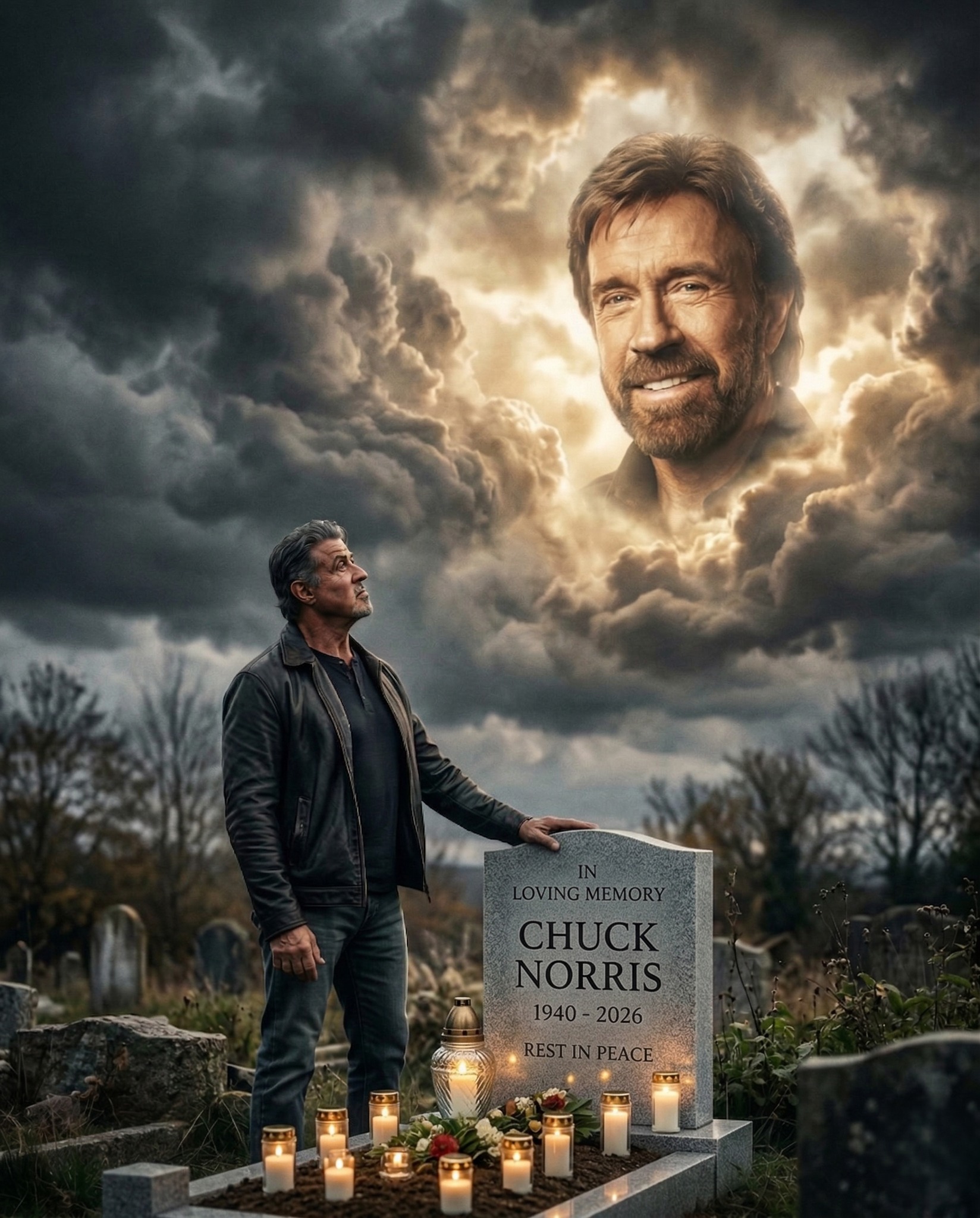
Stallone stands alone in the candlelight of a winter cemetery, his hand on the stone of his fallen brother, his eyes lifted to the heavens — and the heavens answer with the warmest smile they have
The candles are burning.
Count them. Nine, ten, perhaps more — arranged around the base of the headstone with the careful intention of someone who came prepared, who understood before arriving that the occasion required more than presence alone. That some visits demand the physical act of bringing light to a place where darkness has settled. That candles in a cemetery are not decoration but declaration: I was here. I brought warmth. I refused to let this be only cold stone and cold ground and the cold indifference of winter trees standing bare against a grey sky.
Sylvester Stallone brought the candles.
He arranged them in a circle around the grave of Chuck Norris — In Loving Memory, 1940–2026, Rest in Peace — with the flowers laid between them, red and white against the dark earth. And then he stood. One hand resting on the top of the grey granite headstone, the other hanging at his side, his face turned upward toward a sky that has responded to his looking in the most extraordinary possible way.
Because the sky has answered.
In the break of the storm clouds — in the specific, luminous, golden opening that the churning darkness has parted to reveal — the face of Chuck Norris looks down. Enormous. Warm. Smiling the smile that millions of people across half a century of his life and work have come to know as the signature of everything he was: the complete, undefended, utterly genuine warmth of a man who found the world more worthy of his warmth than his skepticism and chose, every single day of his eighty-six years, to lead with that warmth.
He is looking at Stallone.
And Stallone is looking back.
The Sky as Answer
There are moments when the natural world arranges itself in a way that feels like response. When the light falls at exactly the right angle, when the clouds break at exactly the right place, when the warmth arrives at exactly the moment when warmth is most needed — and the rational mind says: weather. Coincidence. The indifferent mechanics of atmosphere and light.
And the rest of you — the part below the rational mind, the part that exists in the chest and the throat and the place behind the eyes where the most essential things are felt rather than thought — says something different.
No.
Not coincidence.
He is there.
Look at the scale of what the sky has produced in this image. Chuck Norris fills the clouds — not as a small presence, not as a suggestion or a trick of light that could be read multiple ways, but as a face that dominates the upper third of the frame. Larger than the cemetery. Larger than the bare winter trees. Larger, in the specific visual grammar of this image, than the man standing at the grave — which is the right scale, because Chuck Norris always was larger than any single room or any single frame could adequately contain.
He is in the clouds. He is warm. He is smiling.
And the smile is directed specifically, precisely, with complete intentionality at the man below.
I see you, Sly.
I always see you.
You came again. You brought the candles. You stood at my stone in the winter cold with your hand on the granite and your face turned up to find me.
Here I am.
I am always here.
The Hand on the Stone
Look at Stallone’s right hand.
Flat against the top of the headstone. Palm down, fingers spread slightly, making the maximum possible contact with the cold grey granite that bears his friend’s name. The hand of a man who is holding on in the only way remaining — not to the person, because the person is no longer holdable in the conventional sense, but to the stone that stands in for the person, that carries the name and the dates and the formal acknowledgment that this was real, that he was here, that the eighty-six years happened.
This hand has appeared in so many photographs of this grief. At so many graves. Reaching toward what remains when what was most real has moved beyond reach. Maintaining physical contact with the available surface of people who are no longer available in any other way.
Rocky Balboa’s hands were famous for what they could do in a fight — for the punishment they could deliver and absorb, for the specific quality of toughness that defined the character. Sylvester Stallone’s hands, in these cemetery photographs, are famous for something else entirely. For the gentleness. For the specific, unhurried quality of someone who is not in a hurry to leave, who is staying in contact with the stone for as long as the stay makes sense, because this is the last form of closeness available and it is not nothing.
It is not nothing.
It is, in fact, everything.
Chuck Norris in the Sky — Who He Was
The face in the clouds shows him as he was in his prime — the beard, the warm eyes, the specific quality of his smile that was always more than social, that came from somewhere deep and genuine and completely undefended. This is not the eighty-six-year-old man who reached the end of his road in March 2026. This is Chuck Norris at the height of what he was — the martial arts champion, the action hero, the Texas Ranger, the man the internet turned into a legend because they recognized in him something that the ordinary categories of celebrity did not adequately describe.
He was, in the most direct and literal sense, the real thing.
In an era of manufactured celebrity and managed personas and the careful construction of public images by teams of professionals whose job is to ensure that the person being presented to the world is exactly the person the world finds most commercially appealing — Chuck Norris was simply himself. The public Chuck Norris and the private Chuck Norris were the same person, expressed through different contexts but not fundamentally different in their nature. What you saw was what there was. The toughness was real. The discipline was real. The faith was real. The warmth was real.
This is extraordinarily rare. It is the thing that the internet mythology — the thousands of Chuck Norris facts that spread virally across the early web with the enthusiasm of people who had found a way to say something they could not say directly — was really trying to say:
This one is genuine.
In a world full of performance, this one is not performing.
He is actually what he appears to be.
The face in the clouds carries this quality. Even in the composite image, even in the digital construction of a memorial photograph, the warmth is unmistakable. The genuineness is unmistakable. Chuck Norris does not know how to be inauthentic. He never learned. He never needed to.
The Cemetery in Winter
The landscape around Stallone and the grave is the landscape of winter — bare trees, grey sky, the specific quality of bare-branched desolation that winter produces. No leaves to soften the lines. No green to offer the eye relief from the grey and brown and the dark of the storm clouds.
And yet — the candles. Nine, ten flames burning in the cold air, making the space around the grave warm in the way that small flames always make spaces warm — not enough warmth to change the temperature, but enough to change the feeling. Enough to remind whoever is present that warmth exists and is available and has been brought specifically to this place for this person by someone who understood that the bringing of warmth is itself an act of love.
The flowers. Red and white against the dark earth — laid with care, arranged with intention, the specific choice of someone who considered what Chuck Norris deserved and arrived at: beauty. Simple, genuine, present beauty. Not the elaborate floral displays of official occasions but the real thing, the kind brought by someone who came because they needed to come rather than because the occasion required it.
And Stallone. Standing in all of this — the winter, the candles, the flowers, the stone — with his face turned up to the sky. Not looking at the grave. Looking beyond it. Looking toward whatever is above it. Looking with the specific quality of someone who has decided, perhaps rationally irrationally, that looking is not futile. That the looking might be answered.
It was.
What the Inscription Says
In Loving Memory.
Chuck Norris.
1940–2026.
Rest in Peace.
These words are simple. They are not the clever inscription from the other gravestone photographs — not the “Death once had a near-Chuck experience” that managed to be simultaneously funny and profound and completely characteristic. This stone says the simpler thing, the thing that all gravestones say in one form or another: he was here, he was loved, he is gone, we hope he rests.
But in the context of this image — with Stallone at the stone and Chuck Norris in the sky above it — the instruction to rest in peace acquires a different quality. Because the evidence of the sky suggests that he is not exactly resting. He is looking down. He is smiling with the full, warm, completely present smile of someone who is anything but absent. He is watching the man at his stone with the specific quality of attention that was always his — the direct, complete, undivided attention of someone for whom presence was not a performance but a practice.
Rest in Peace says: you are done. You have completed. You can stop.
The face in the clouds says: I have not stopped. I am still watching. I am still here.
Both are true. That is the mystery and the comfort of it.
The Conversation Only They Can Have
What does Stallone say to Chuck, standing at the stone in the winter cold with the candles burning and the clouds breaking apart above him to reveal that face?
He does not say it in words. The mouth is not moving. He is simply looking — simply being present in the grave-side way that is its own complete language, requiring no translation.
But the look says everything.
I came back.
I will keep coming back.
The world has continued in the way that worlds continue — requiring my attention, requiring my presence, requiring the forward movement that a life at seventy-nine still demands. But I keep finding my way back to this stone. To the specific place where the name carved in granite is the closest thing to you that the physical world still contains.
I look up because looking up is what I have. Because the sky is where the face appears when I look. Because I don’t know if you can see me down here at your stone but I choose to behave as if you can.
And every time I choose that —
every time I look up —
the sky opens.
And there you are.
Warm.
Smiling.
Still completely, entirely, impossibly yourself.
A Final Look
The storm is not over. The clouds are still dark at the edges, still moving, still carrying whatever weather they contain toward wherever they are going. The winter trees are still bare. The cold is still the cold.
But in the center of all that grey and dark — in the specific break that the clouds have made, in the golden warmth that pours through that opening — Chuck Norris looks down at his friend.
And his friend looks up.
And between them — across the distance that death creates and love refuses to accept as final — something passes that has no name in any language but that everyone who has ever stood at a grave and looked up recognizes immediately.
Connection.
Continuation.
The specific, stubborn, completely irrational and completely necessary insistence that what was real between two people does not end simply because one of them is no longer standing in the physical world.
Chuck Norris. 1940–2026.
In Loving Memory.
Rest in Peace.
He is resting.
He is also in the sky.
Smiling down at the man who keeps coming to his stone.
Watching.
Present.
Still, impossibly and perfectly and completely —
Chuck Norris.
“I’ve always found that anything worth achieving will always have obstacles in the way — and you’ve got to have that drive and determination to overcome those obstacles.”
— Chuck Norris
Even this one, Chuck.
Even the last one.
You overcame it.
You’re in the sky.
And Stallone is at your stone.
Looking up.
Finding you.
The way he always will.
Every single time he looks.