The Final Stand of a Titan: A Tribute to Chuck Norris (1940–2026)
The Final Stand of a Titan: A Tribute to Chuck Norris (1940–2026)
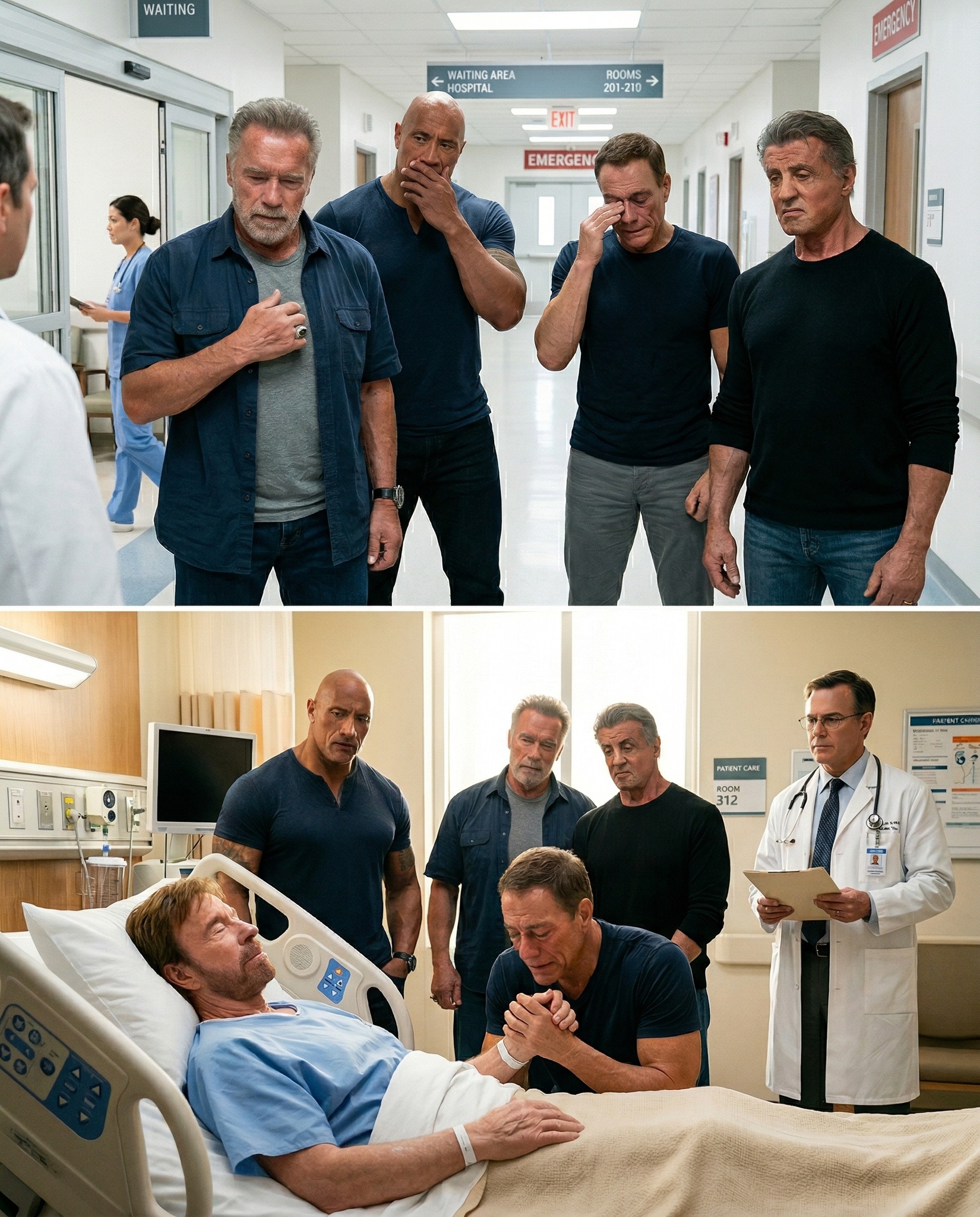
The sterile glow of the hospital corridor felt cold, an artificial brightness that failed to lift the heavy shroud of grief hanging over the hallway. Outside the room, four giants of the silver screen stood in a silence so profound it seemed to vibrate. Arnold Schwarzenegger, the unshakable oak, held his chest as if trying to steady a heart that had seen too many battles. Beside him, Dwayne Johnson, a man of modern iron, bowed his head with a hand over his mouth, the weight of the moment pressing down on his massive shoulders. Jean-Claude Van Damme did not try to hide the tears tracing paths down his face, while Sylvester Stallone stood with a jaw set in iron, his eyes clouded with a disbelief that no script could have prepared him for.
They had not gathered here as Hollywood icons or box-office rivals. They were there as brothers-in-arms, bound by decades of mutual respect for the man who had laid the very foundation they stood upon: Chuck Norris.
Entering the room, the world slowed to a crawl. The rhythmic cadence of medical monitors provided the only soundtrack to a scene that felt impossible. There lay the man who, for generations, had been the ultimate personification of invincibility. Chuck Norris appeared calm, his face weathered by the passage of time and a thousand untold stories. Though his physical form seemed fragile in the grip of his final hour, his presence remained a monumental force, filling the room with the quiet dignity of a warrior at rest.
Van Damme was the first to break the stillness. He knelt by the bedside, his hands—hands that had fought across continents—trembling as they clasped Chuck’s. He spoke no words; his grief was a silent prayer, a final salute to a mentor and a friend. Dwayne Johnson stood as a silent sentry at the foot of the bed, his usual charisma replaced by a profound humility. Schwarzenegger and Stallone shared a single, lingering look. No dialogue was needed. They were the architects of the action era, yet they knew they were losing the man who had designed the blueprint.
When the doctor finally spoke the words that would echo across the globe, the silence that followed was more deafening than any explosion. Chuck Norris was gone.
The loss felt like the end of an epoch. For these men, and for millions of fans across the planet, Chuck Norris was never just an actor. He was a cultural phenomenon, a living legend who transformed martial arts into a global language of strength and justice. From the rugged grit of Lone Wolf McQuade to the defiant heroism of Missing in Action and the high-stakes intensity of Delta Force, he became the ultimate symbol of the American spirit. For nearly a decade, he patrolled our screens as Cordell Walker in Walker, Texas Ranger, teaching a generation about honor, discipline, and the difference between right and wrong.
Even in his later years, his brief appearance in The Expendables 2 was enough to shift the energy of a film. He didn’t need to fight to prove his power; his legacy was etched into every frame of cinema history. He was the pioneer who bridged the gap between Eastern discipline and Western storytelling, opening doors for every action star who followed in his footsteps.
As the four legends eventually walked out of the hospital, the world outside continued its frantic pace. Traffic flowed and the sun continued to shine, oblivious to the fact that a pillar of the world had fallen. But within the hearts of those who knew him—and the millions who were inspired by him—the landscape had shifted forever.
A legend has passed into history, but his echo remains. It lives in every martial arts dojo, in every cinematic showdown, and in the timeless stories of a man who stood for something greater than himself. Chuck Norris was a force of nature, an icon of resilience, and though his physical journey has concluded, the legend of the man who could not be stopped will endure forever.