Trump Never Loosens His Red Tie in Public — Except for This One Time
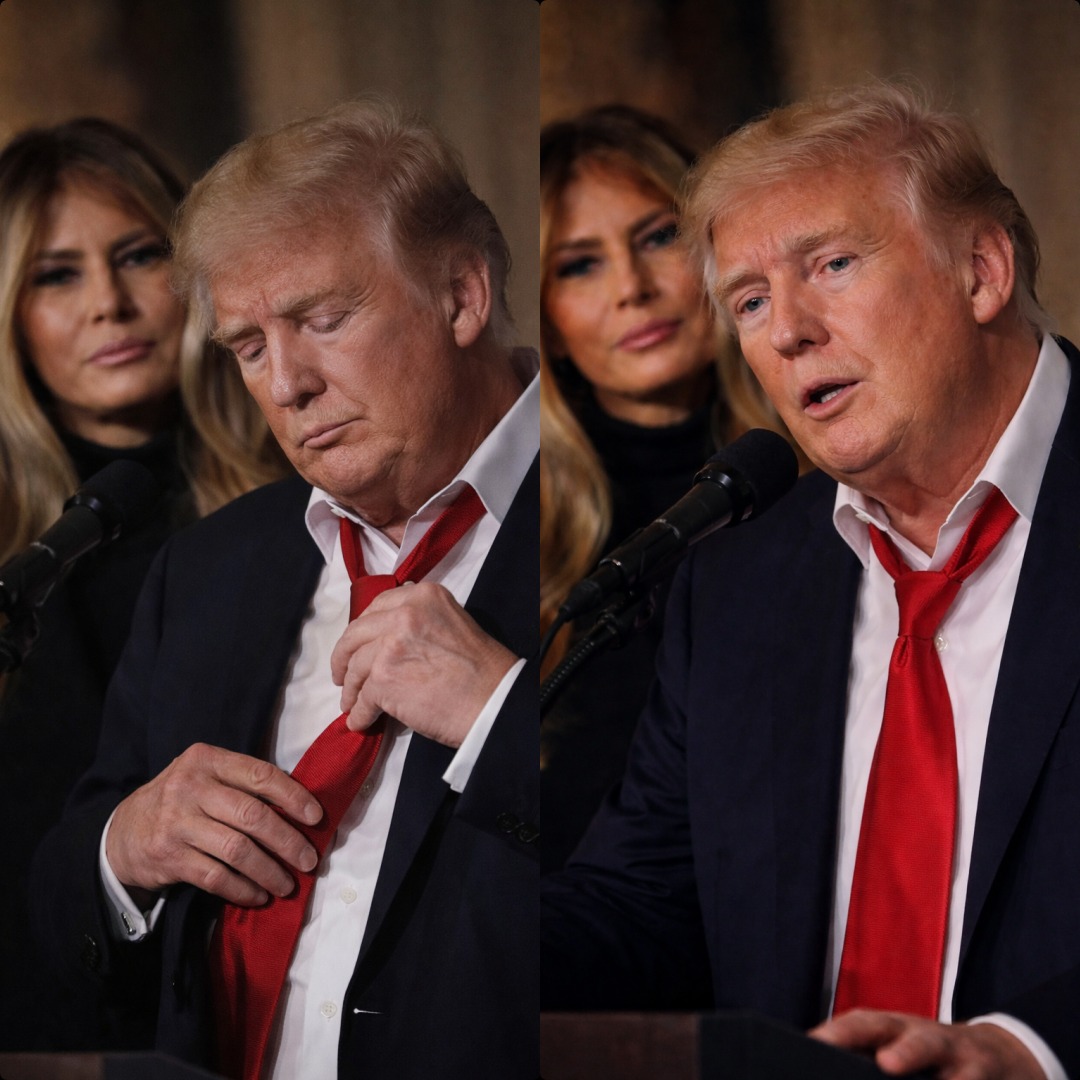
It’s a cold, almost surreal sight. The lights of Mar-a-Lago illuminate the stage, casting long shadows across the grand hall. The moment is poised with history—yet there is a shift, something that feels distinctly different. Donald Trump stands before a sea of expectant faces, as usual, commanding attention, ready to deliver his usual emphatic speech, the one he’s delivered countless times before. His suit is navy, sharp and crisply tailored. His tie, that signature red tie, is perfectly in place. It has always been more than just a piece of cloth. It’s a symbol, a representation of power, authority, and unyielding confidence. It’s been his armor, his public identity for decades.
But on this evening, in the last moments of the event, something happens that no one saw coming. It’s subtle, but it’s there, undeniable in its significance. As the crowd waits in silence, Trump steps to the microphone. He begins speaking softly, his voice less forceful than usual. The usual power and conviction are still present, but now they are tempered with something different—something more contemplative, almost introspective. As the crowd leans in, unsure of what they’re hearing, Trump does something that shakes the very foundation of his public persona.
He loosens his red tie.
At that moment, the room seems to collectively hold its breath. It’s not the dramatic end of a speech. It’s not the conclusion of a performance. No, this moment isn’t about the usual Trump we know—the man of force and fire, the one who commands a room and captures attention with his every word. This moment is about a shift, a vulnerability, and most importantly, an acknowledgment that even the strongest must, at times, surrender.
This wasn’t just the act of loosening a tie. It was the symbolic release of the armor he’d worn for so long, the red tie that had always been a fixture of his public identity. A symbol of strength, it now symbolized something else: the quiet acceptance that time had, at long last, caught up with him.
The Red Tie: A Legacy of Strength
To understand the magnitude of what occurred, it’s important to first recognize the significance of Trump’s red tie. For years, it has been the hallmark of his public persona. It’s bold, vibrant, and commanding—a statement that’s impossible to ignore. The red tie is more than just a fashion choice for Trump. It has become synonymous with his image, an emblem of his power, his bravado, and his unyielding confidence. It is perhaps the most recognizable element of his appearance—his personal symbol that communicates authority, control, and an unapologetic nature.
But it wasn’t always this way. Early on, the red tie may have been seen as just another part of his wardrobe, but over time, it became a tool, a visual cue to both his supporters and his critics alike. In political rallies, in speeches, and in interviews, that tie was a constant. It was part of his armor, designed to signal to the world that Donald Trump was a man of power, a man who would not be swayed or moved. His tie was the outward manifestation of a man who had never let his guard down, a man who stood tall and faced the world head-on.
For years, he had never loosened it in public. It had always been firmly in place, a physical barrier between him and the world, the one thing that remained unchanged in his ever-evolving narrative. But that night, as the words left his mouth and the crowd waited, something shifted in Trump. He stood there, just for a moment, with his tie undone. It was a silent admission that even the strongest among us have moments of vulnerability. That, despite all his bravado, he was human—just like everyone else.
The Moment of Vulnerability
Trump had spent a lifetime building an empire of strength, an empire that was built on a foundation of unrelenting confidence and audacity. For so many years, he had been a symbol of unflinching power, someone who would never allow himself to be seen as weak. His public persona, reinforced by the red tie and his commanding presence, was one that suggested he was untouchable. He projected an image of someone who could face anything, someone who would always rise to the occasion, no matter the obstacle.
But on that evening at Mar-a-Lago, as he stood before the microphone and looked out at the crowd, it became clear that even Trump couldn’t outrun time. The vulnerability was there, hanging in the air like a heavy mist. It wasn’t something he had been forced into, but rather something he had finally accepted. Time had caught up with him. The man who had built a career out of defying the odds, who had never shied away from a fight, was finally showing the world that even he could not escape the inevitable.
When Trump loosened his red tie, it wasn’t a grand gesture. There were no tears, no dramatic confessions. It was just a small, almost imperceptible act—a quiet moment of self-awareness. Yet, in that brief instant, everything changed. The audience who had always seen him as a force of nature, an unshakeable presence, now saw a different side of him. They saw a man who had lived through decades of triumphs and failures, a man who had fought relentlessly, and a man who had finally accepted that he, too, was subject to the passage of time.
It was the kind of moment that doesn’t need words. The tie, once a symbol of invincibility, now hung loosely, a visual cue that Trump was no longer the impenetrable figure he had once been. He was simply a man, standing before the world, and for the first time in his public life, he was allowing himself to be seen not as the persona he had built, but as the person he truly was.
The Crowd’s Silent Response
As the minutes passed, there was no applause, no cheering, nothing to signal that the crowd had fully grasped the weight of the moment. It wasn’t because they hadn’t understood—it was because the room was suspended in a strange kind of reverence. Trump’s gesture had created an unexpected stillness, a pause that felt like it stretched beyond the confines of that room. The crowd was not waiting for a conclusion. They were waiting for the air to settle, for the significance of what had just happened to become clear.
In that silence, the power of the moment was undeniable. For once, the room wasn’t captivated by his words or his rhetoric. They weren’t caught up in the usual showmanship. Instead, they were witnessing something far more intimate. The man who had built his life on force and bravado had, for the first time, allowed himself to be vulnerable. And in that quiet vulnerability, there was strength.
Even Melania, standing just behind him, seemed to sense the gravity of the moment. Her presence, as always, was composed and graceful, but there was something different in her gaze. She, too, seemed to understand the significance of what had just happened. She didn’t need to speak, didn’t need to acknowledge it with applause or words. She simply stood by, offering quiet support, as her husband took a moment for himself.
The Ties That Bind
What does it mean when someone like Trump, a man known for his relentless public persona, chooses to loosen his tie? On the surface, it might seem like a small gesture, but it’s more than that. It’s a symbolic act, one that carries with it layers of meaning. It’s the unraveling of the very armor he has worn for decades, the slow release of the pressure he has carried all these years.
For Trump, the red tie was more than just a piece of clothing. It was a marker of his identity, a part of his public armor that protected him from the world. But by loosening it, he made a choice to let go of that armor, even if just for a moment. He allowed himself to be vulnerable, to be human.
It wasn’t a moment of weakness—it was a moment of reflection. A realization that, even for someone as powerful and influential as Trump, time eventually catches up. The world had always seen him as a figure of strength, but in that fleeting instant, he let go of that image. He allowed himself to be just a man, standing before the world, acknowledging the years and the experiences that had shaped him.
A Man and His Legacy
In the end, Trump’s gesture wasn’t about the tie. It wasn’t about his suit, his public persona, or the role he had played in the public eye for so long. It was about the quiet acknowledgment of something deeper—the recognition that, despite all his accomplishments and his decades of dominance, he was, in the end, just like everyone else. He was subject to the same passage of time, the same challenges, and the same human experiences.
As the evening came to a close and the crowd began to disperse, it was clear that the impact of that moment would linger far longer than any of Trump’s speeches. The tie had been loosened, but the significance of that act would resonate in ways words never could. For the first time in his public life, Donald Trump had allowed himself to be seen as human.
And in that brief moment, he had shown the world that even the strongest among us can be vulnerable. Even the most powerful can, at times, acknowledge their limitations. Time had caught up with Trump, but in loosening his red tie, he had found a different kind of strength. One that didn’t rely on bravado or force. One that didn’t need to be loud. It was a quiet strength, a strength that came from accepting the inevitable, and from allowing oneself to be real, to be vulnerable, and to be human.
As the night ended, there were no grand speeches or loud applause. Just a quiet understanding that even the most powerful man in the room had, for once, let go. Let go of the tie, let go of the persona, and allowed himself to be exactly who he was. And that, in itself, was more powerful than any speech or performance he could have given.