The Hidden 1981 Frame That Captured the Final Secret of Two Irreplaceable Hollywood Giants
The Hidden 1981 Frame That Captured the Final Secret of Two Irreplaceable Hollywood Giants
There is a rare kind of truth that only raw, outdoor cinema can capture. A studio can manufacture an atmosphere and a soundstage can imitate the weather, but out on a real hillside, under an open sky, there is nowhere for a performer to hide. The world becomes too honest for mere performance. That is exactly what makes a single, forgotten frame from the 1981 film An Eye for an Eye feel so hauntingly alive decades later.
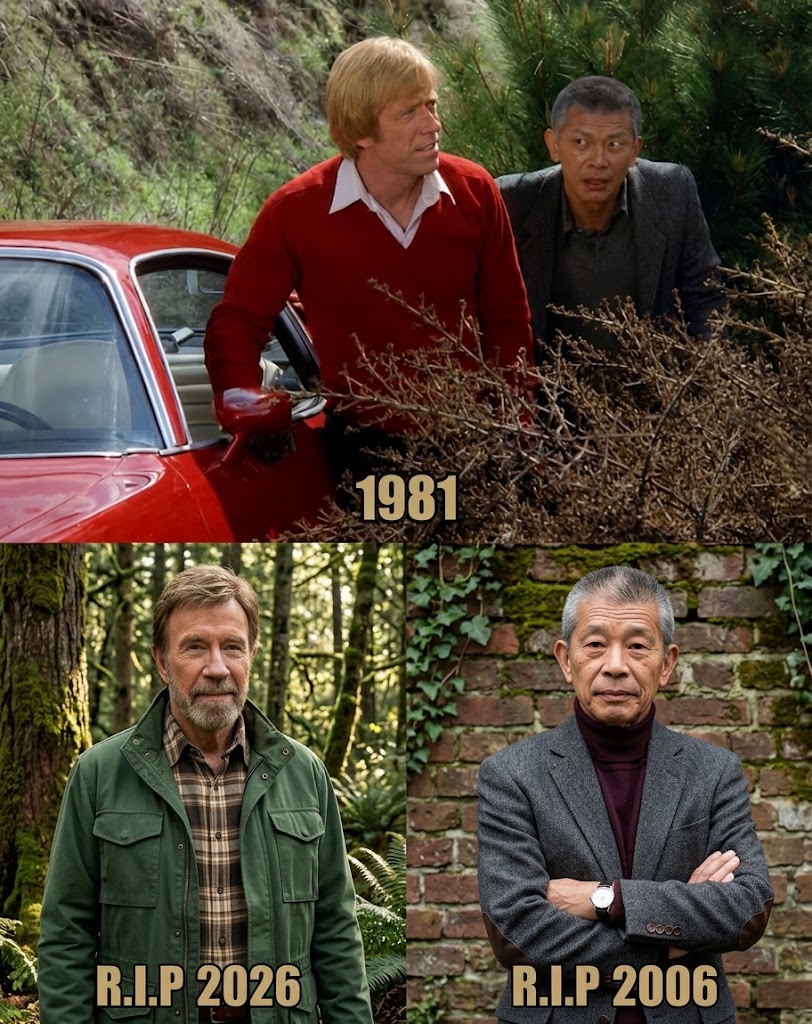
The image shows two men crouching beside a red sports car hidden behind brush on a California hillside. They are alert, focused, and completely committed to the scene. One is tall, blond, and broad-shouldered; the other is compact, darker, and quieter in appearance. They are opposites in every visible way, yet this contrast is precisely where the magic lives. No one watching them in that ordinary moment could have suspected that this frame held the final secret of two legends who would forever remain irreplaceable in Hollywood.
On the left is Chuck Norris as Sean Kane. At forty-one years old, Norris stood right at the threshold of the decade that would transform him into a defining global action icon. The blockbusters and the legendary television runs still lay ahead, yet his trademark controlled physicality and calm watchfulness were already fully formed. What made Norris unusual in Hollywood was the absolute absence of separation between the public figure and the private man. The same discipline, faith, and quiet certainty people saw on screen existed in the man himself. Audiences trusted him because he appeared incapable of pretending to be someone he was not.
Beside him sits Mako, born Makoto Iwamatsu, one of the most important and revolutionary figures in Asian-American entertainment history. His presence in the frame carries a depth of struggle that most audiences never fully realized. Separated from his parents as a child in Japan during World War II, he later reunited with them in New York, served in the United States Army, and discovered acting. Facing a Hollywood that offered Asian actors nothing but stereotypes, Mako co-founded the East West Players in 1965—the first Asian-American theater company in the United States. He dedicated his life to proving that Asian-American actors possessed undeniable talent, earning Academy Award and Tony nominations, and voicing beloved characters like Uncle Iroh in Avatar: The Last Airbender.
The passage of time eventually claimed both masters. Mako passed away in 2006 at the age of seventy-two after a battle with esophageal cancer. Chuck Norris followed twenty years later, passing peacefully in Hawaii on March 19, 2026, surrounded by family and remembered as a man of unwavering faith.
Now, only this old 1981 film frame remains. The hillside has changed, the red car is gone, and the film set disappeared long ago. Yet the two men beside it still endure, preserved in time, reminding the world what real substance looks like when the cameras stop rolling.