Born Identical, Lived Differently: How Four Michigan Sisters Became a Landmark in Schizophrenia Research
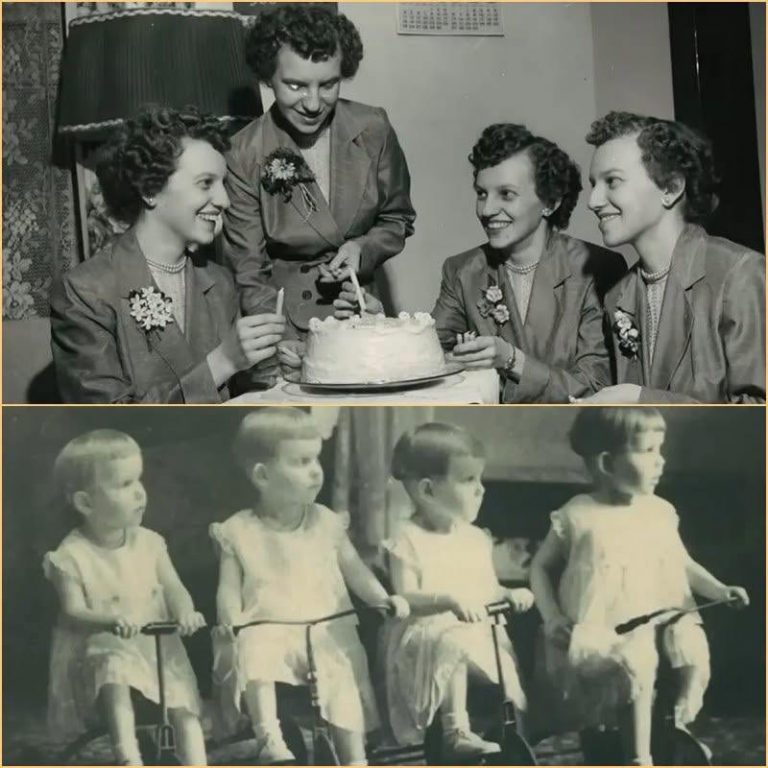
On May 19, 1930, four baby girls arrived within roughly ten minutes of one another at Edward W. Sparrow Hospital in Lansing, Michigan.
Their parents, Carl and Sadie Morlock, had expected one child. Instead, they suddenly found themselves caring for identical quadruplets whose combined weight was less than 15 pounds. At a time when premature newborns faced far greater dangers than they do today, even their survival was uncertain.
The remarkable birth quickly became much more than a private family event.
Crowds gathered outside the hospital. Newspapers reported on the babies. Thousands of strangers sent letters, gifts, advice and suggestions for what the four girls should be called.
The sisters had entered the world as a national curiosity. Decades later, however, they would attract attention for a far more serious reason—one that would place their lives at the center of an influential investigation into schizophrenia and the complicated relationship between genetics and environment.
Four Girls Who Became Famous Before They Knew It
Sadie already had names in mind for her daughters: Jean, Jane, June and Joan.
Public fascination with the babies soon influenced even that decision.
A local newspaper organized a naming contest, drawing thousands of suggestions. The winning names—Edna, Wilma, Sarah and Helen—were proposed by the daughter of the doctor who delivered the babies. Together, their first initials reflected the name Edward W. Sparrow Hospital, while the girls were given middle initials A, B, C and D according to birth order.
It was a playful celebration of an extraordinary birth, but it also foreshadowed something that would follow the sisters for years.
They were rarely seen simply as four separate children. To the public, they were the quadruplets.
Their identical appearance became their defining feature. They were dressed alike, photographed together and repeatedly compared with one another. People wanted to see how similar they were, while scientists were intrigued by what four genetically identical children might reveal about human development.
Growing up during the Great Depression, the sisters received attention that most children could never imagine. Yet the fascination came with an unusual pressure: their identities were often viewed collectively before they had much opportunity to develop them individually.
Their Lives Presented Scientists With a Rare Question
As the girls became adults, the medical significance of their family became increasingly apparent.
All four sisters developed schizophrenia.
At the time, researchers were still struggling to understand why the condition emerged. Genetics appeared to matter, but doctors also suspected that childhood experiences, stress, family relationships and environmental influences could shape a person’s risk and the way the illness developed.
The four sisters presented an exceptionally rare opportunity to examine those questions.
They shared essentially the same genetic starting point. If their symptoms and lives were also identical, genetics might appear overwhelmingly powerful. If their experiences differed despite their shared biology, scientists would have to look beyond genes alone.
When the sisters were in their twenties, they became the subjects of an extensive psychiatric research project conducted near Washington, D.C.
Doctors, psychologists and social workers examined nearly every aspect of their lives. Researchers studied their personalities, medical histories, symptoms, childhood experiences and relationships within the family.
The investigation continued for years and eventually produced hundreds of pages of observations.
Becoming the “Genain” Quadruplets
To protect the women’s identities, researchers replaced their family name with a pseudonym.
They became known in psychiatric literature as the Genain quadruplets.
According to the account, the name came from Greek roots and was interpreted as meaning something similar to “dire birth,” reflecting the extraordinary nature researchers attached to their case.
But perhaps the most important finding was not how much the sisters had in common.
It was how much they did not.
Although all four developed schizophrenia, their experiences were not identical. Their personalities differed. Their symptoms varied. The severity and nature of their struggles were not exactly the same.
Four women with virtually the same genetic inheritance had not followed four perfectly matching paths.
That difference carried enormous significance.
It suggested that biology alone could not provide a complete explanation for mental illness. Genetics might create vulnerability, but environment, stress, relationships and individual experiences could influence how that vulnerability appeared in a person’s life.
A More Complicated Understanding of Mental Illness
The sisters’ case became part of a broader shift away from attempts to explain schizophrenia through one simple cause.
Their lives instead illustrated interaction.
Genes mattered, but genes existed within families, childhoods, relationships and changing environments. People with similar biology could still respond differently to the world around them, just as similar experiences could affect individuals in very different ways.
For psychiatry, the Genain study became a striking example of why researchers needed to examine both nature and nurture rather than treating them as competing explanations.
Yet the scientific importance of the study came with a human reality that could easily disappear behind clinical reports.
Edna, Wilma, Sarah and Helen were not merely subjects in an unusually valuable natural experiment.
They were four women living with a serious illness while carrying a public identity that had been placed on them from infancy. Their unusual birth made them famous as babies. Their mental health struggles later made them valuable to researchers.
In both cases, other people were intensely interested in what made them unusual.
The Human Beings Behind the Case Study
Their story also became connected to larger questions about how medical research should treat the people whose lives make scientific discovery possible.
Research standards in earlier decades differed significantly from modern expectations. Today, medical ethics places strong emphasis on informed consent, privacy, dignity and respect for research participants.
The sisters’ experience underscores why those principles matter.
A person can provide scientists with extraordinary information while still being more than a diagnosis. A patient described across hundreds of pages of medical observations still has an identity beyond symptoms, test results and family history.
That distinction is particularly important in the Genain story because individuality was something the sisters had struggled to possess publicly from the beginning.
First, the world saw four matching babies.
Later, researchers saw four genetically identical patients.
But beneath both labels were four separate people.
Four Identical Beginnings, Four Different Lives
The sisters first captured attention because their birth seemed almost impossible: four identical daughters arriving within minutes, each tiny and vulnerable, surviving despite the uncertainty surrounding them.
Their lasting importance emerged much later.
Their lives helped illustrate one of the most enduring lessons in the study of mental health—that even extraordinary genetic similarity does not make human beings interchangeable.
Biology influences a life, but it does not write every chapter by itself.
Experiences, relationships, stress and environment become part of the story as well.
That may be the most powerful legacy of the four sisters once known mainly for their identical faces. They entered the world together and shared an astonishing amount of biology, yet their lives and illnesses still unfolded differently.
The Genain quadruplets ultimately became remembered not simply because four sisters shared the same diagnosis, but because their differences helped researchers understand just how complicated the human mind can be.