“ONLY THREE BEERS”: GRANDPA’S ACCOUNT COLLIDES WITH 0.16 BAC AFTER BOAT CRASH CLAIMED HIS TWO GRANDCHILDREN
“ONLY THREE BEERS”: GRANDPA’S ACCOUNT COLLIDES WITH 0.16 BAC AFTER BOAT CRASH CLAIMED HIS TWO GRANDCHILDREN
BARNEGAT BAY, N.J. — Stephen Schneider says he drank just three beers during a family dinner.
But prosecutors say a later blood test told a dramatically different story.
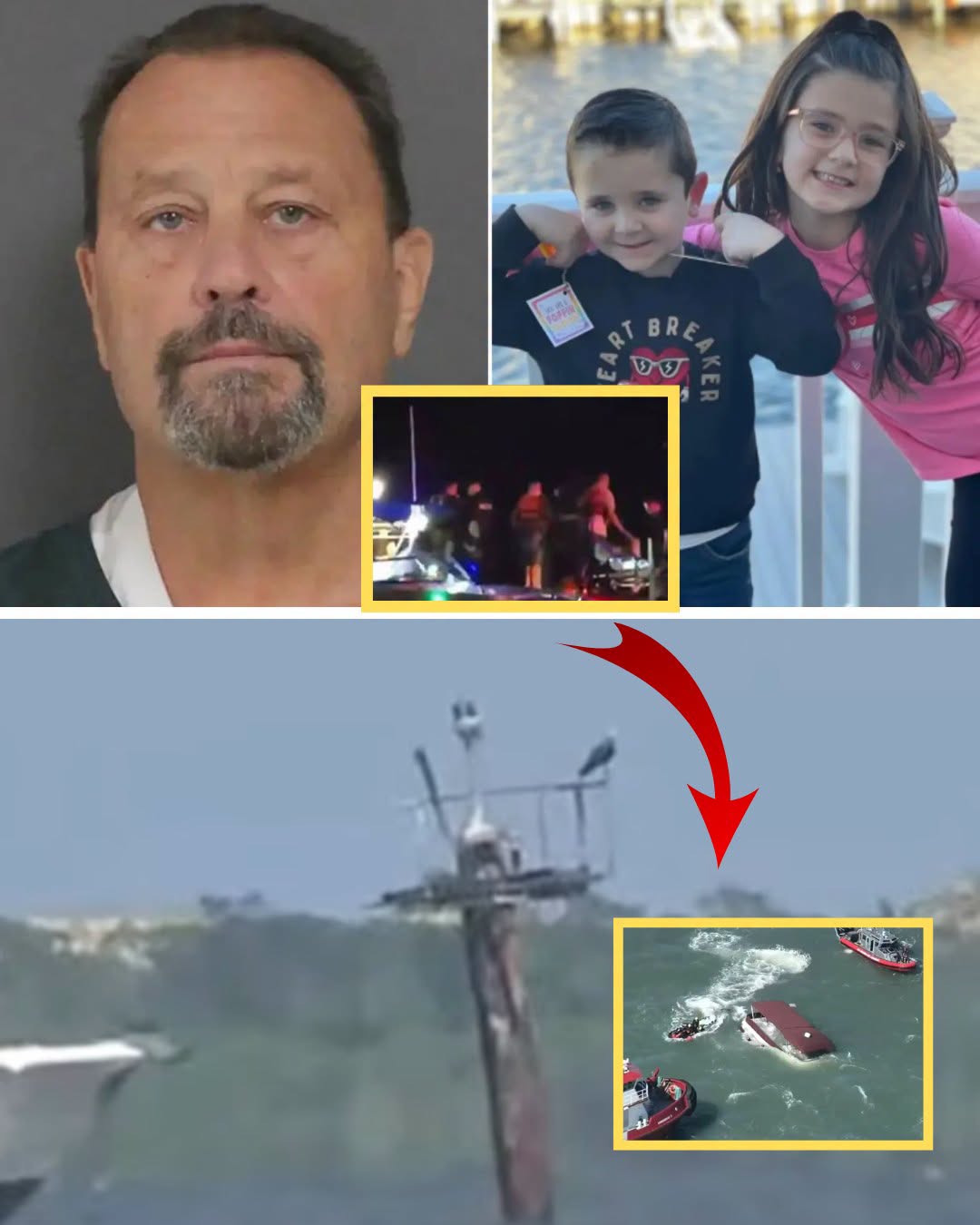
The 64-year-old New Jersey grandfather is facing serious charges after his boat struck a channel marker on Barnegat Bay, sending his two young grandchildren into the water.
The children, 9-year-old Mya Bella Golabek and 7-year-old Sigmund “Siggy” Paul Golabek, did not survive.
Now, Schneider’s reported statement that he consumed only three beers before taking the helm is emerging as a major point of contention in the case.
 THE FAMILY DINNER THAT ENDED IN TRAGEDY
The evening of July 19 began as a family gathering.
According to court documents, Schneider, his wife Laurie, their daughter, son-in-law and grandchildren met for dinner at MJ’s Restaurant Bar & Grill in Bayville, New Jersey.
Schneider later told investigators that he consumed three beers over approximately two hours.
The children had arrived at the restaurant with their parents on a separate boat.
After dinner, the youngsters wanted to return to their grandparents’ nearby waterfront home.
They ended up aboard Schneider’s roughly 28-foot Tidewater Custom 280.
Both children were wearing life jackets.
Then, shortly after 9 p.m., the short trip home took a devastating turn.
 “I SAW IT AT THE LAST SECOND”
According to court documents, Schneider told investigators he was traveling at approximately 20 mph when the boat approached an Intracoastal Waterway channel marker.
He reportedly said he saw the marker only at the last moment.
The boat struck Channel Marker No. 39.
The impact sent both children from the front of the vessel into the dark water.
The family immediately began searching for them.
Emergency crews were called as relatives desperately tried to locate the children.
According to reports, Schneider entered the water while the family searched.
Both children were eventually recovered and CPR was performed.
They were transported to a hospital, where they were pronounced dead.
THEN CAME THE BLOOD TEST
The case took another significant turn when investigators obtained a blood sample from Schneider.
The reported result was a 0.16% blood alcohol concentration.
That is approximately twice New Jersey’s 0.08% legal limit for operating a vessel.
The number immediately raised questions about Schneider’s earlier account that he had consumed only three beers during dinner.
That discrepancy is now one of the most closely watched pieces of evidence in the prosecution’s case.
ABC7 reported that Schneider told police he had consumed three beers over two hours before the crash.
THREE BEERS VS. 0.16
The contrast is stark.
On one side is Schneider’s account:
Three beers over two hours.
On the other is the toxicology result:
0.16% BAC.
But the two figures cannot simply be treated as proof of what happened at the exact moment of impact.
The blood sample was collected later, and defense attorneys are expected to scrutinize the timing of the test, the testing procedure and how the result should be interpreted.
That could become an important part of the upcoming legal battle.
THE DEFENSE IS NOT FOCUSING ONLY ON ALCOHOL
Schneider’s attorneys have already signaled that they intend to examine other circumstances surrounding the crash.
One area of interest is the channel marker itself.
The defense has questioned the nighttime visibility of the marker and whether lighting or other physical conditions contributed to Schneider’s failure to avoid it.
Police have said the marker’s lights were functioning properly, according to local reporting.
That creates another potential courtroom dispute:
Was the collision caused solely by Schneider’s alleged impairment, or were visibility and navigational conditions also factors?
The defense is expected to challenge the prosecution’s interpretation of the evidence as the case moves forward.
PROSECUTORS HAVE SERIOUS CHARGES ON THE TABLE
Schneider has been charged with two counts of reckless vessel homicide, along with charges related to operating a vessel under the influence and reckless operation.
The allegations are serious, but Schneider remains entitled to the presumption of innocence unless proven guilty in court.
His attorney has also emphasized Schneider’s relationship with his family.
During a court hearing, the father of the two children reportedly asked the judge to release Schneider, describing him as a loving grandfather and important member of the family.
A judge ultimately granted his release over the prosecution’s objection.
A GRANDFATHER, A FAMILY AND TWO CHILDREN
The legal arguments now unfolding cannot erase what happened on Barnegat Bay.
Mya was 9.
Sigmund was 7.
They had been spending time with their family and were on their grandparents’ boat for what was supposed to be a short ride home.
Instead, a nighttime collision changed the family forever.
And now the case has become a battle over evidence:
The blood test.
The three-beer statement.
The channel marker.
The visibility.
The boat’s speed.
And what Schneider could see from the helm.
THE QUESTION THAT COULD DEFINE THE CASE
For prosecutors, the 0.16 BAC is a critical piece of evidence supporting their claim that Schneider was seriously impaired while operating the vessel.
For the defense, the case may ultimately be about more than alcohol.
Their challenge is expected to examine whether the toxicology evidence accurately establishes Schneider’s condition at the moment of impact and whether environmental or navigational factors also contributed to the collision.
The court will ultimately have to weigh those competing explanations.
For now, there is no final verdict.
But one question already hangs over the case:
How did “only three beers” become a 0.16 BAC — and what does that number actually prove about the tragic moments before the boat struck the marker?
That question could become one of the most important battles when Stephen Schneider’s case moves forward.