🚨 WADE WILSON: THE CHILLING CONFESSION — AND THE DISTURBING FAME THAT FOLLOWED HIM TO DEATH ROW
🚨 WADE WILSON: THE CHILLING CONFESSION — AND THE DISTURBING FAME THAT FOLLOWED HIM TO DEATH ROW
He was convicted of murdering two women in Florida.
He was sentenced to death.
And then something happened that few people would have expected.
Instead of disappearing from public attention, Wade Wilson became an internet obsession.
Women sent him letters.
Supporters contacted him from outside prison.
Some reportedly sent photographs.
Others publicly defended him.
And as documentaries brought his case to millions of viewers, the man known online as the “Deadpool Killer” became the center of a disturbing true-crime fandom.
But behind the viral photographs, tattoos and social-media fascination is something much darker:
Two women lost their lives.
And the details Wilson gave investigators about what happened remain among the most disturbing parts of the case.
THE DAY TWO WOMEN WERE KILLED
On October 7, 2019, Wilson killed Kristine Melton, 35, and Diane Ruiz, 43, in Cape Coral, Florida.
According to evidence presented in court, Wilson met Melton at a Fort Myers bar before going with her to her home.
Prosecutors said that after Melton’s friend left, Wilson strangled her while she was in bed.
He then took her vehicle.
Later that same day, Wilson encountered Ruiz, who was walking to work.
Authorities said he persuaded her to get into the vehicle before attacking her.
The violence that followed was extraordinarily brutal.
Wilson later described the attack to investigators in graphic terms, including a statement that he had run over Ruiz repeatedly until she “looked like spaghetti.”
That statement became one of the most widely repeated details from the case.
But the quote is not the only disturbing thing about the investigation.
Wilson also made statements indicating that killing had become an obsession for him.
His own words became important evidence as investigators reconstructed what happened that day.
THE CALL THAT HELPED END THE SEARCH
One of the major breaks in the investigation came after Wilson contacted his biological father, Steven Testasecca.
According to reporting on the case, Testasecca became alarmed by what Wilson told him and cooperated with authorities.
The information helped investigators move toward Wilson.
Eventually, police arrested him.
The case would later become a capital murder prosecution.
And years later, those same confessions would become part of the material that made Wilson infamous far beyond Florida.
THE COURTROOM VERDICT
In June 2024, a Lee County jury found Wilson guilty of two counts of first-degree murder.
The case then moved into the penalty phase.
Under Florida’s death-penalty law at the time, a unanimous jury recommendation was no longer required.
The jury voted 9–3 in favor of death for Melton’s murder and 10–2 for Ruiz’s murder.
Judge Nicholas Thompson subsequently imposed two death sentences.
Wilson was transferred to Florida’s death row, where he remains.
But the sentence did not end the legal story.
It started another one.
THEN THE PHOTOGRAPHS WENT VIRAL
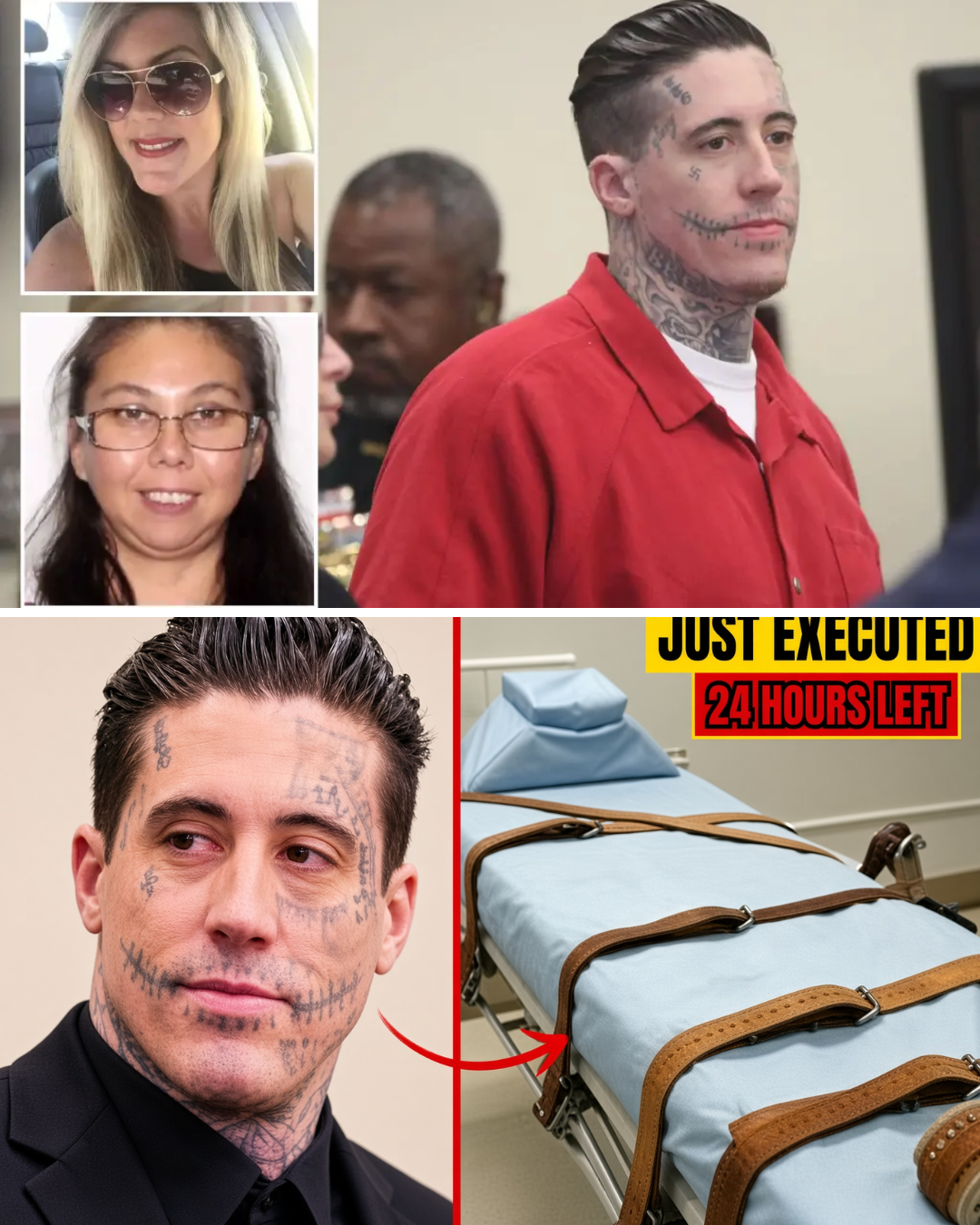
Wilson’s appearance became a major part of the online fascination surrounding his case.
His face was covered with tattoos, including the word “KILLER” and other symbols.
The contrast between his appearance and the brutality of the crimes became a recurring theme across social media.
Soon, photographs of Wilson were circulating far beyond traditional true-crime communities.
And some women began openly expressing attraction toward him.
Letters were sent.
Messages arrived.
Some supporters reportedly treated him as a romantic figure rather than a convicted double murderer.
According to reporting, Wilson received thousands of messages while incarcerated, including inappropriate photographs.
That phenomenon became one of the strangest chapters of the entire case.
WHY WOULD ANYONE WRITE TO A CONVICTED KILLER?
Psychologists and researchers who study true-crime fandom have discussed phenomena such as hybristophilia — attraction to people who have committed crimes.
But there is no single explanation for why individuals become fascinated with notorious offenders.
For some people, it may be the attraction of danger.
For others, the mystery surrounding a criminal case can create an intense parasocial connection.
And in the age of TikTok, Netflix and streaming documentaries, photographs of notorious criminals can be transformed into viral content within hours.
Wilson’s case demonstrates how quickly that transformation can happen.
A convicted killer becomes a photograph.
The photograph becomes a meme.
The meme becomes a fandom.
And eventually, the victims can disappear from the center of the story.
THE DOCUMENTARIES BROUGHT HIM BACK
The fascination did not disappear after sentencing.
In 2026, Wilson’s case received renewed attention through true-crime productions, including Paramount+’s Handsome Devil: Charming Killer and Netflix’s Worst Ex Ever, which featured the case in its second season.
PEOPLE reported in May 2026 that Wilson remained on Florida’s death row and was serving two death sentences.
The renewed exposure introduced the case to an entirely new audience.
People who had never heard the names Kristine Melton or Diane Ruiz suddenly knew the name Wade Wilson.
And that created a troubling imbalance.
The killer became the recognizable face of the story.
The women he killed became names mentioned alongside him.
THERE IS STILL NO EXECUTION DATE
Despite the attention surrounding the case, Wilson has not simply been waiting for an execution.
His attorneys have pursued appeals challenging his death sentences.
In February 2026, his lawyers appeared before the Florida Supreme Court and raised challenges concerning the legality of the death sentences. Court TV reported that the defense intended to continue pursuing the case, potentially to the U.S. Supreme Court.
A Florida Supreme Court case record confirms that Wilson’s direct appeal involves multiple challenges to his death sentences.
So despite the viral headlines, there is currently no simple countdown clock.
No execution date has been publicly scheduled.
Wilson remains on death row while his legal proceedings continue.
BUT THE STRANGEST PART MAY BE WHAT HAPPENED AFTER THE VERDICT
The most disturbing question surrounding the Wade Wilson phenomenon may have nothing to do with his appeals.
It may be this:
Why did his notoriety make him more attractive to some people?
The more details emerged about the murders, the more notorious he became.
The more notorious he became, the more photographs circulated.
And the more photographs circulated, the larger his online audience became.
It created a bizarre cycle in which notoriety itself became a form of attention.
Some supporters even wrote to judges pleading for mercy during the sentencing process. The New York Post previously reported on letters sent on Wilson’s behalf before he was sentenced to death.
That is what makes this case so unusual.
Most murder cases end with the killer disappearing from public view.
This one did not.
THE VICTIMS SHOULD NOT DISAPPEAR
Kristine Melton was 35.
Diane Ruiz was 43.
They were mothers, daughters, friends and members of their communities.
Their deaths became the foundation of a story that eventually turned into a massive true-crime spectacle.
But the spectacle can easily obscure the original tragedy.
Behind every viral photograph of Wilson is a crime.
Behind every letter sent to him is a victim.
Behind every documentary episode is a family that has had to live with the consequences of what happened.
And behind every social-media debate about Wilson’s appearance, tattoos or romantic appeal is the fact that two women never came home.
THE CASE IS NOT OVER
Wilson remains on Florida’s death row.
His convictions stand.
His death sentences stand unless changed through the appeals process.
And there is still no execution date.
The legal battle continues while the internet continues to debate the man himself.
But perhaps the most important question is not when Wade Wilson will die.
It is why a convicted double murderer became such a compelling figure to thousands of strangers in the first place.
Because the strangest part of the Wade Wilson story isn’t that the internet remembers him.
It is that some people appear to remember him more vividly than the women whose lives ended because of him.
And that may be the most uncomfortable legacy of the “Deadpool Killer” phenomenon.