He Told Me I Didn’t Belong Among the Important Guests—Until a Four-Star General Walked Straight Toward Me
My father sent me to the very last row of his retirement ceremony because, according to him, I didn’t belong beside the important guests.
I had come straight from duty just to watch Colonel Thomas Carter close out thirty years in the United States Army.
But before I could take the empty chair marked FAMILY, my father stepped directly into my path.
“Emily.”
His voice was low enough that the surrounding guests couldn’t hear.
“You’re not sitting here.”
I looked past him.
There was an empty chair beside my mother.
The card resting on it clearly marked the entire section for family members.
“I thought this was the family section.”
Dad adjusted the front of his dress uniform.
Then glanced toward the entrance, where several senior officers were beginning to arrive.
“There are important guests here today.”
He paused.
“Please sit in general seating.”
For a second, I thought I had misunderstood him.
I hadn’t.
My younger brother Ryan stood nearby in his formal Army uniform.
He gave me the kind of smile people use when they’re trying to make humiliation sound reasonable.
“Come on, Em.”
He nodded toward the rows farther back.
“Just sit with the regular guests.”
Regular guests.
I looked at him.
Then at Dad.
Finally, I looked toward Mom.
For one brief second, I waited for her to say something.
Anything.
That I was his daughter.
That there was an empty chair.
That I had every right to sit with my own family at my father’s retirement ceremony.
Mom simply lowered her eyes to the program in her hands.
That told me everything.
I nodded once.
“Okay.”
No argument.
No scene.
I turned around and walked toward the back of the hall.
Past the reserved rows.
Past senior officers and their spouses.
Past family friends who had known me since childhood.
All the way to the final row.
Behind me, I could almost feel my family relaxing.
To them, my career had always been strangely vague.
Quiet.
Not impressive enough to discuss at dinners.
Ryan was different.
Ryan wore his ambition where everyone could see it.
My parents understood his career.
His promotions made sense to them.
His accomplishments could be explained to friends.
Mine rarely could.
So somewhere along the way, they had apparently decided it hadn’t amounted to much.
I took the last available seat.
A gray-haired man sat beside me.
He gave me a polite glance.
Then looked again.
His eyes dropped toward my uniform.
Specifically, toward the insignia.
His posture changed instantly.
He sat straighter.
Then turned toward me with a completely different expression.
I knew that look.
Before he could say anything, I gave him a small shake of my head.
Please don’t.
He understood.
He faced forward again.
But every few seconds, I noticed him glancing toward me.
The ceremony began.
My father sat proudly in the front row beside Mom and Ryan.
He looked happy.
This was his day.
Thirty years of service.
Three decades of assignments, promotions, deployments, commendations, and sacrifice.
Despite everything, I was proud of him.
That was why I had come.
Then the doors opened.
Everyone rose.
Four-star General William Mercer entered the hall.
The room seemed to change around him.
Dad straightened immediately.
Even from the back row, I could see the satisfaction in his face.
A four-star general had personally come to preside over his retirement.
To Dad, that probably meant more than any gift we could have given him.
General Mercer took the stage.
The ceremony proceeded exactly as expected.
Awards.
Stories.
Applause.
Remarks about Dad’s decades of service.
Then, halfway through his speech, General Mercer stopped.
Not dramatically.
He simply stopped reading.
His eyes moved away from the prepared remarks.
Then toward the family section.
He scanned the first row.
His expression changed.
He looked again.
Then leaned toward the microphone.
“Where is Commander Carter?”
The hall became noticeably quieter.
My father’s smile faltered.
General Mercer looked across the reserved seating once more.
“Commander Emily Carter?”
This time, complete silence followed.
Dad glanced toward Mom.
Mom looked at Ryan.
Ryan turned his head toward the VIP section, obviously expecting to find someone there.
My father began searching the front rows.
Confusion replaced pride on his face.
I stayed where I was.
At the very back.
The gray-haired man beside me looked down, apparently fighting the urge to react.
Then General Mercer’s eyes traveled farther across the hall.
Past the officers.
Past the families.
Past the reserved seating.
Until he found me.
His expression changed immediately.
I knew the moment he recognized me.
General Mercer stepped away from the microphone.
Then he walked down from the stage.
A murmur moved through the room.
Dad half-rose from his chair, perhaps assuming the general was coming toward him.
Mercer walked straight past him.
He didn’t stop.
Didn’t say a word.
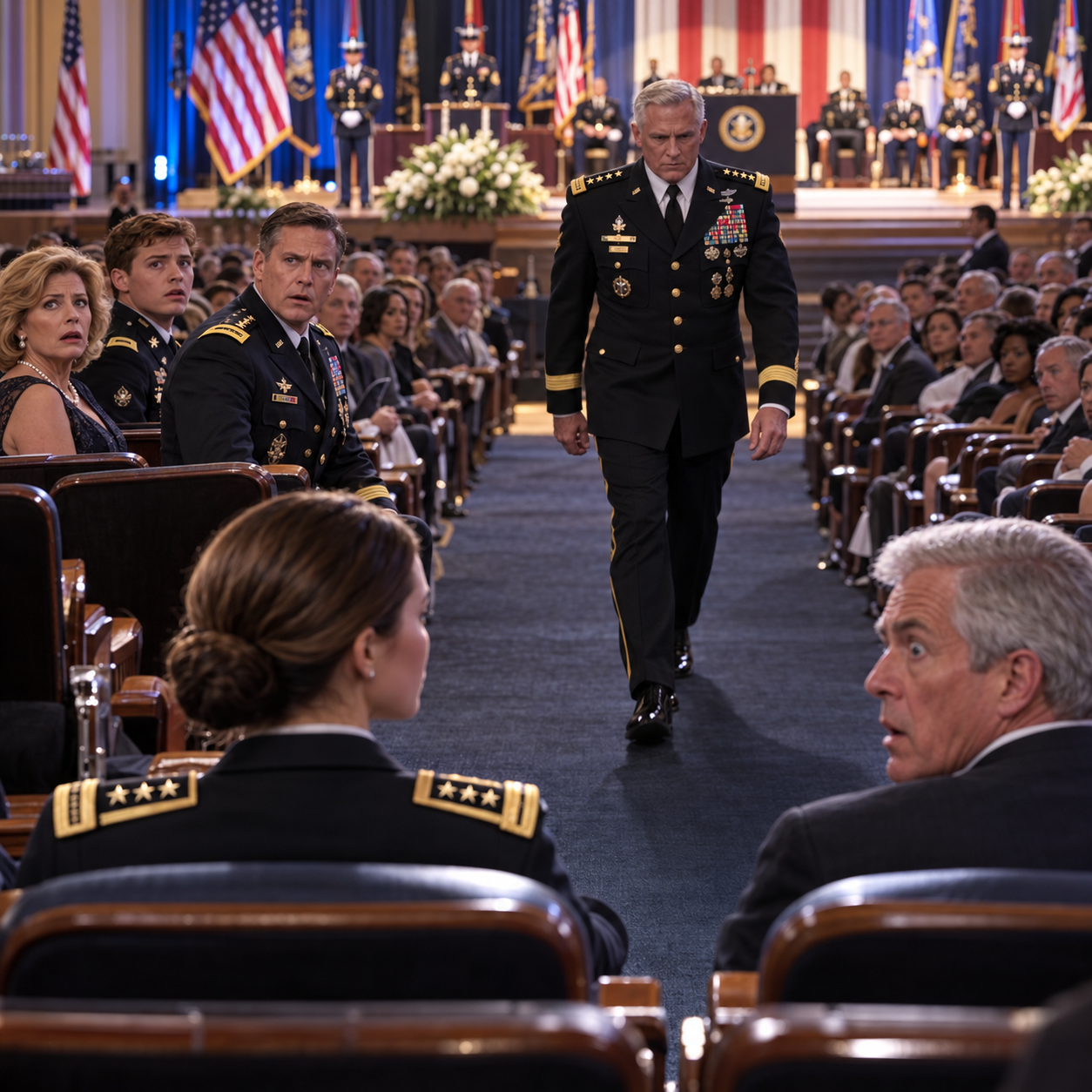
Instead, the four-star general continued down the center aisle.
Past the VIP guests.
Past the family section where I had been told I didn’t belong.
And headed directly toward the last row.
Toward me.
PART 2 — THE GENERAL WHO KNEW MY NAME
There are moments in life when the noise around you disappears, not because the world has become quiet, but because something inside you has stopped listening.
That was how I felt watching General William Mercer approach.
His polished shoes made almost no sound against the carpet. The military audience remained standing, uncertain whether protocol required them to remain at attention or whether they were witnessing some unexpected addition to the ceremony.
My father was still half out of his chair.
Ryan had turned completely around.
My mother was staring at me.
For once, nobody in my family appeared to have anything to say.
The general stopped directly in front of my seat.
I stood.
“Sir.”
He looked at me for a moment, and something in his expression softened.
“Emily.”
Just my name.
Not my title.
Not my assignment.
My name, spoken with the familiarity of a man who had known me through some of the hardest days of my career.
“It’s good to see you,” he said.
“You too, General.”
He glanced toward the stage.
Then back at me.
“I was told you’d be seated with your family.”
I could have answered in a dozen ways.
I could have pointed toward the front row.
I could have repeated my father’s words about important guests.
I could have allowed thirty years of quiet resentment to spill out in front of three hundred people.
Instead, I said, “There was a seating misunderstanding, sir.”
Mercer studied my face.
He had always been unusually good at recognizing when I was protecting somebody.
“Was there?”
“Yes, sir.”
For a moment, I thought he would challenge the answer.
Then he nodded.
“Very well.”
He extended his hand.
I shook it.
The gray-haired gentleman beside me rose so abruptly that his program fell to the floor.
“General Mercer.”
Mercer turned.
“Sergeant Major Bennett.”
The two men shook hands.
“I see you’ve found good company,” Mercer said.
Bennett gave a restrained smile.
“Some of the best, sir.”
I almost laughed.
Of all the seats in that enormous hall, I had somehow chosen the one beside retired Command Sergeant Major Harold Bennett, a man who had spent much of his career supervising special operations support units.
We had crossed paths years earlier.
He knew considerably more about my career than my family did.
Mercer turned back to me.
“Commander, would you accompany me?”
I hesitated.
“Sir, this is my father’s ceremony.”
“And I intend to finish it.”
He paused.
“But there is something I need you to hear.”
I looked toward the front.
Dad’s face had lost all its color.
Ryan’s eyes moved between my uniform and the general’s shoulder insignia.
Mom sat rigidly with the ceremony program pressed against her knees.
I followed Mercer into the aisle.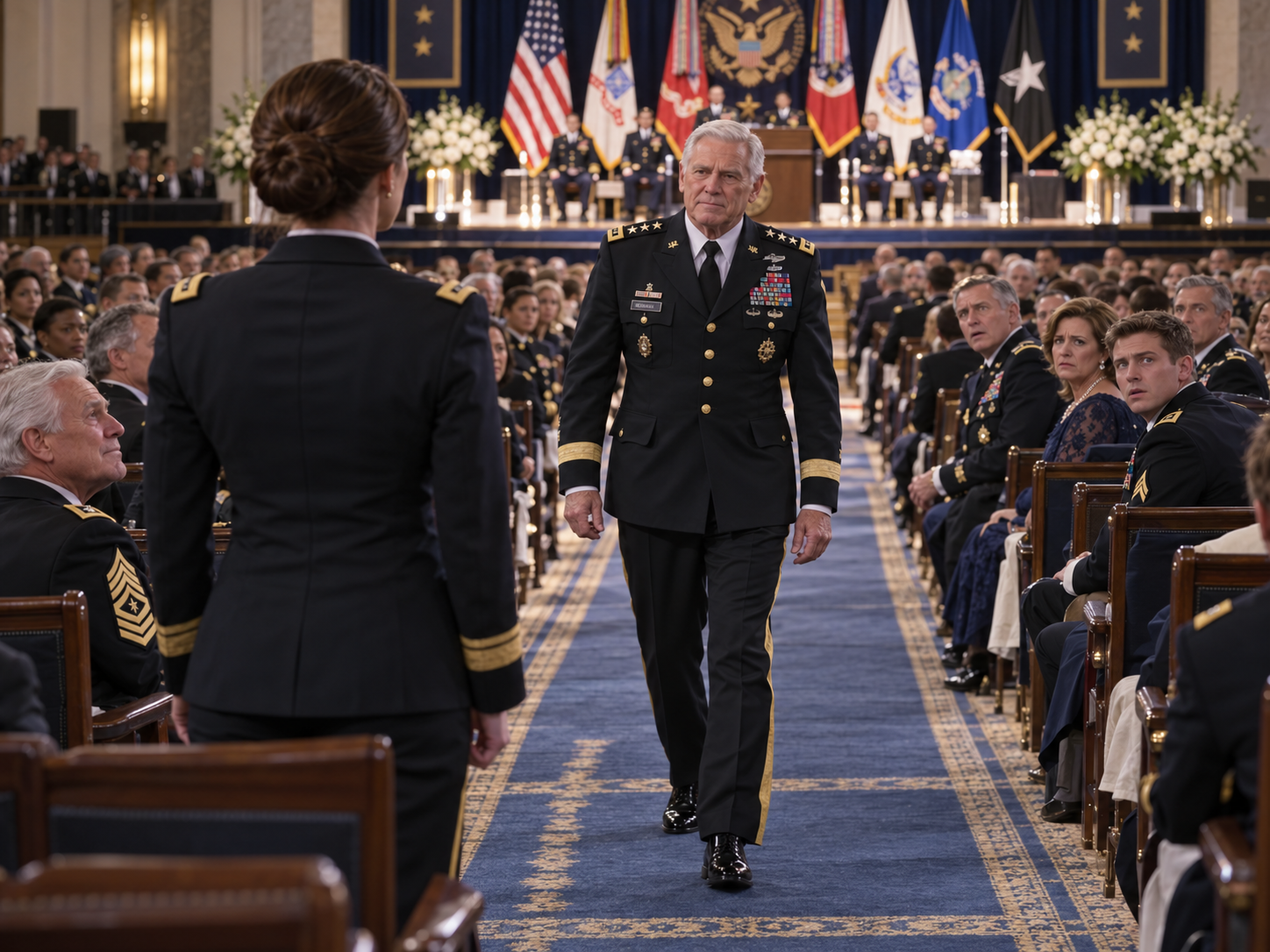
Nobody spoke as we walked.
I had stood in rooms where major operational decisions were being made. I had briefed generals, diplomats, and commanders whose names appeared regularly in military publications.
But walking past my family that afternoon was somehow harder.
My father stared straight ahead as we approached.
When Mercer reached the first row, he finally stopped.
“Colonel Carter.”
Dad stood fully.
“General.”
Mercer gestured toward me.
“I believe you know Commander Carter.”
My father swallowed.
“Of course, sir. She’s my daughter.”
“Yes,” Mercer replied. “She is.”
There was something in the way he emphasized those words that made my father’s shoulders tighten.
Mercer looked toward the empty chair beside my mother.
“Is that seat available?”
Dad glanced at it.
“Yes, General.”
“Then I suggest we use it.”
My father immediately stepped aside.
I sat down beside Mom.
Her fingers trembled slightly as she folded the program.
“Emily,” she whispered.
I kept my eyes forward.
“Not now, Mom.”
Mercer returned to the stage.
He adjusted the microphone and looked out over the audience.
“Ladies and gentlemen, I apologize for the interruption.”
A nervous chuckle moved through the hall.
“I was looking for someone whose presence is important to me personally.”
He glanced toward our row.
“Commander Emily Carter recently returned from an overseas assignment. I wasn’t certain she would be able to attend today.”
Ryan leaned slightly toward me.
“Commander?” he whispered.
I didn’t answer.
His eyes dropped toward the insignia on my uniform.
For most of my adult life, Ryan had treated military service as a competition between us.
He knew the assignments he wanted.
He knew the career path he believed would eventually lead him to command.
He knew how to speak about promotion boards, career milestones, and senior leadership with the confidence of someone who expected the world to reward ambition.
What he had never bothered to learn was the difference between his sister’s Army career and his sister’s current assignment.
I was an Army colonel serving as commander of a joint task force.
The title Mercer used wasn’t a Navy rank.
It was the position I held.
And unlike the career accomplishments Ryan proudly displayed, much of the work my organization performed could not be discussed publicly.
Mercer returned to his prepared remarks.
He spoke about my father’s leadership during deployments, the sacrifices of military families, and the importance of institutional integrity.
My father gradually relaxed.
He even smiled when Mercer recalled an old field exercise in Germany.
Then the general closed his folder.
“I want to finish by speaking about something that isn’t written in these remarks.”
The room settled.
“Military service often requires families to accept absences they cannot explain and responsibilities they may never fully understand.”
His gaze moved toward me.
“Sometimes the people carrying those responsibilities are sitting much closer than we realize.”
I felt my stomach tighten.
Mercer continued.
“Colonel Thomas Carter has given thirty years to the Army. That’s worthy of recognition. But I also want to acknowledge that his family has contributed to the nation’s service in ways extending beyond his own career.”
My father looked pleased again.
He apparently assumed the general was referring to Ryan.
Mercer smiled faintly.
“His son, Captain Ryan Carter, continues the family’s tradition of Army service.”
Ryan straightened.
Several people applauded.
Then Mercer said, “And his daughter, Colonel Emily Carter, currently commands a joint military task force whose personnel have recently completed a demanding humanitarian evacuation and recovery operation.”
The applause faltered.
Not because the achievement was unimportant.
Because the audience was suddenly trying to reconcile two facts.
A senior commander had just been introduced.
And that commander had arrived from the last row.
Mercer continued carefully, revealing nothing operationally sensitive.
“Her team coordinated with allied personnel and civilian agencies to bring more than four hundred people to safety during a rapidly deteriorating regional crisis.”
He paused.
“Because of the nature of their work, the people who made that operation possible will never receive the public recognition they deserve.”
I stared at my hands.
I hadn’t expected this.
I certainly hadn’t wanted it.
Mercer looked directly at me.
“But I can say this much. Colonel Carter led with extraordinary judgment, courage, and compassion under conditions most people will never encounter.”
The audience erupted into applause.
I remained seated until Mercer gestured for me to stand.
When I did, the applause grew louder.
My father’s mouth hung slightly open.
Ryan didn’t clap.
Mom did.
Her hands moved slowly at first, then faster, and I saw tears gathering along her lower eyelids.
For several seconds, I stood beside the family who had sent me away.
Then I sat down.
Mercer finished his remarks and formally recognized my father’s retirement.
The ceremony resumed.
A flag was presented.
A certificate was read.
The audience rose for the final honors.
I clapped for my father.
I meant it.
Whatever had happened between us did not erase his decades of service.
But something had changed.
Not because a general had spoken my name.
Because my family had suddenly been forced to see that the version of me they had carried for years was incomplete.
And perhaps because, for the first time, they understood how little effort they had made to discover the rest.
After the ceremony, photographers gathered around the stage.
My father posed with General Mercer.
Ryan stood beside him.
Mom adjusted her jacket and tried to smile.
I stayed near the edge of the reception area, hoping to leave quietly.
That plan lasted less than three minutes.
“Emily.”
Dad stood behind me.
I turned.
He had removed his ceremonial cap and was holding it tightly against his side.
“Why didn’t you tell us?”
There it was.
Not congratulations.
Not an apology.
An accusation.
“Tell you what?”
“That you were a colonel. That you commanded something important.”
“I told you about my promotion.”
“When?”
“Fourteen months ago.”
He frowned.
“I don’t remember that.”
“I sent you the announcement.”
Ryan appeared beside him.
“You said you’d received a new assignment.”
“I also said I’d been promoted.”
Dad shook his head.
“You know how vague you always are about work.”
I looked at him.
“For years, I’ve told you everything I’m permitted to tell you.”
“Then why didn’t you explain it better?”
“Because every time I tried, you changed the subject to Ryan.”
Silence.
Mom approached from behind them.
“Emily, please. People are watching.”
I laughed once.
It wasn’t a happy sound.
“Yes, Mom. They are.”
Dad glanced toward several officers nearby.
“Let’s not do this here.”
“You started it here.”
His expression hardened.
“I didn’t start anything.”
“You told me I didn’t belong in the family section.”
He looked uncomfortable.
“That was a misunderstanding.”
“No.”
My voice remained quiet.
“You saw an empty chair beside Mom. You looked at me. And you told me there were important people coming.”
Ryan folded his arms.
“Dad was under a lot of pressure.”
I turned toward him.
“You told me to sit with the regular guests.”
“Come on, Emily. It wasn’t that serious.”
“Then why couldn’t I sit beside my mother?”
Neither of them answered.
Behind us, someone cleared his throat.
General Mercer stood a few feet away.
“I hope I’m not interrupting.”
My father immediately straightened.
“Not at all, sir.”
Mercer looked at each of us.
“I came to congratulate Colonel Carter once more.”
“Thank you, General,” Dad said.
Then Mercer turned toward me.
“Emily, I need to speak with you before you leave.”
“Of course, sir.”
He hesitated.
“Privately.”
I followed him toward a small conference room adjoining the reception hall.
The instant the door closed, his formal expression disappeared.
“Are you all right?”
I exhaled.
“I’ve had better afternoons.”
“I suspected as much.”
He gestured toward a chair.
I sat.
Mercer remained standing near the window.
“I wasn’t trying to embarrass your father.”
“I know.”
“I also wasn’t going to pretend I hadn’t seen you sitting in the back.”
I managed a small smile.
“That’s what I was afraid of.”
He smiled back.
Then the expression faded.
“Emily, there’s another reason I wanted to speak with you.”
Something in his voice made me straighten.
He reached into his folder and removed a sealed envelope.
Across the front was my name.
Not handwritten.
Officially typed.
COLONEL EMILY CARTER.
“I had intended to discuss this with you next week,” he said. “But after what happened today, I think you deserve to know sooner.”
I stared at the envelope.
“Sir?”
He placed it on the table.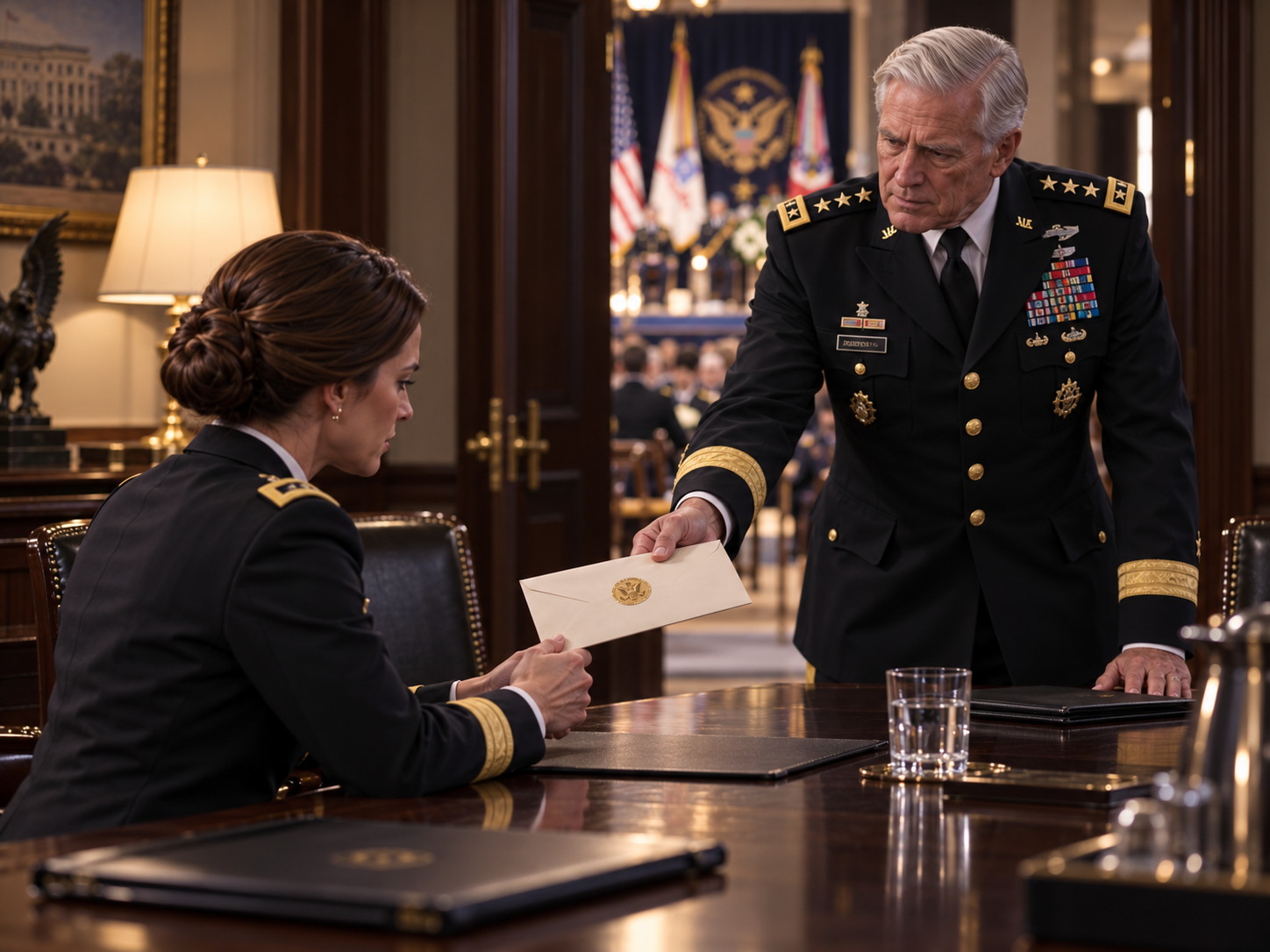
“The review into Operation Havenbridge has expanded.”
My chest tightened.
Operation Havenbridge.
The evacuation mission Mercer had mentioned.
Four hundred and seventeen civilians extracted from a collapsing security environment.
Eleven military personnel injured.
Two aircraft damaged.
And one decision that had followed me home like a shadow.
“Expanded how?”
Mercer pulled out the opposite chair.
“The oversight office received evidence that someone altered the original operational risk assessment before your team deployed.”
I went completely still.
“That assessment came through the regional coordination office.”
“Yes.”
“My father worked in that office.”
Mercer nodded.
“I know.”
For a moment, neither of us spoke.
Then he said the words that turned the afternoon from painful into something far worse.
“Emily, your father’s name is on the authorization record.”
PART 3 — THE FILE THAT SHOULD NEVER HAVE CHANGED
For the first time that day, I forgot about the empty chair.
I forgot about Ryan’s expression, my mother’s silence, and the humiliation of being sent to the back of the hall.
All I could see was the envelope resting between us.
“General, are you saying my father falsified an operational assessment?”
“No.”
Mercer’s response was immediate.
“I’m saying his credentials appear in an approval chain for a document that was altered. That’s not the same thing.”
I absorbed the distinction.
In my line of work, those differences mattered.
An access record could establish that an account had been used.
It could not, by itself, establish who had been sitting at the keyboard.
“What was changed?”
Mercer opened the folder.
“The extraction corridor risk classification.”
My pulse quickened.
During Havenbridge, my task force had been directed toward a secondary evacuation route outside the primary secured perimeter.
The route had been designated acceptable for limited movement.
When our advance team reached it, they discovered that a major access road was unusable and armed groups had moved into the surrounding area.
We adjusted.
We established an alternate corridor.
We coordinated additional air support.
And we spent eighteen hours trying to bring everyone out.
Captain Daniel Reeves, my deputy operations officer, had nearly died when a convoy vehicle overturned during the rerouting effort.
He survived.
But he would never regain full movement in his left hand.
I remembered holding his wrist while medics worked around us.
I remembered him asking whether the civilians had made it out.
I remembered promising him I would find out why the initial information had been wrong.
I had kept that promise.
For months, I had asked questions.
The original assessment was missing supporting attachments.
The updated version contained a timestamp inconsistent with the briefing schedule.
And one line—the line rating the road accessible—had appeared in the final report without a matching field observation.
I’d filed my concerns through the appropriate channels.
An initial review had concluded that the discrepancy was likely an administrative error.
Apparently, someone had looked again.
“The updated document lowered the risk rating,” Mercer said. “It also removed a warning about access restrictions.”
I stared at him.
“Who submitted the change?”
“The account belonged to Major Ryan Carter.”
I felt as though the floor had shifted.
“Ryan?”
Mercer nodded.
“His credentials were used to submit the revised assessment. Your father’s approval credentials appear later in the chain.”
I leaned back.
Ryan had served temporarily in the regional coordination office while completing a staff assignment.
I knew that.
What I hadn’t known was that he’d been involved in the documents supporting Havenbridge.
I looked down at my hands.
They were perfectly steady.
That frightened me more than trembling would have.
“Does Ryan know?”
“The investigators have not yet interviewed him formally.”
“Does my father?”
“We haven’t determined what he knows.”
I looked up.
“Then we need to be careful.”
Mercer nodded.
“Exactly.”
He closed the folder.
“You are not being asked to investigate your family.”
“Good.”
“Because you won’t.”
“I understand.”
“You’ll be interviewed as the operational commander. Your concerns have already been preserved. You will not access the review materials beyond those properly provided to you.”
I nodded.
He studied me.
“And Emily?”
“Yes, sir?”
“Whatever this becomes, don’t carry it alone.”
I looked toward the closed door.
“I’ve been doing that for a long time.”
His expression softened.
“I know.”
When I returned to the reception, the room seemed painfully ordinary.
Servers carried trays of drinks.
Music played softly near the windows.
My father was laughing with an old colleague.
Ryan stood beside a table decorated with photographs from our childhood.
There was one of him at his first promotion ceremony.
Another showed him standing beside Dad in uniform.
A third showed the two of them at a military ball.
I searched the display.
There was exactly one photograph of me.
I was seventeen, holding a high school graduation certificate.
That was the final version of me my family had apparently thought worth displaying.
Mom appeared beside me.
“I tried to find a more recent picture of you,” she said.
I glanced at her.
“You have several.”
“They were mostly work pictures.”
“Yes.”
“I didn’t know which ones were appropriate.”
I looked at the photograph of seventeen-year-old me.
“You could have asked.”
Her face changed.
“I suppose I could have.”
She waited.
Then she touched my arm.
“Your father didn’t mean to hurt you.”
I closed my eyes briefly.
“Mom, do you know how many times you’ve said that to me?”
She withdrew her hand.
“I don’t know.”
“I do.”
She stared at me.
“Every time he did.”
Her lips parted.
Nothing came out.
For years, my mother had been the person who translated my father’s behavior into something easier to forgive.
He wasn’t dismissing me.
He was tired.
He wasn’t comparing me to Ryan.
He was proud of both of us in different ways.
He wasn’t ignoring my accomplishments.
He simply didn’t understand my assignments.
And when those explanations failed, she resorted to the one that had governed our family for as long as I could remember.
Don’t make things harder than they need to be.
I had obeyed that rule for most of my life.
I was finished obeying it now.
“I’m leaving,” I said.
Her expression crumpled.
“Before dinner?”
“Yes.”
“We reserved a table.”
“For how many?”
She hesitated.
“Eight.”
“Who was invited?”
“Your father, me, Ryan, his fiancée, General Mercer, Colonel Hayes and his wife, and—”
She stopped.
Eight.
She had already named eight people.
I smiled sadly.
“That’s all right, Mom.”
“Emily—”
“Enjoy dinner.”
I picked up my overnight bag and walked toward the exit.
I had almost reached the doors when Ryan called after me.
“Em!”
I stopped.
He approached quickly, his polished shoes striking the marble.
“Are you seriously leaving?”
“Yes.”
“Dad’s upset.”
“Then perhaps he should ask himself why.”
Ryan looked around to make sure nobody was listening.
“Look, I know today wasn’t perfect.”
I studied him.
“You don’t say.”
“But you didn’t have to make everyone look bad.”
I almost laughed.
“I didn’t do anything.”
“The general practically gave you a personal introduction.”
“That was his decision.”
“You could have stopped him.”
“I tried.”
Ryan’s jaw tightened.
“You always do this.”
“Do what?”
“Act like you’re above the rest of us.”
I stared at him.
He wasn’t joking.
He genuinely believed that my quiet career, my absences, and my unwillingness to compare accomplishments were evidence of arrogance.
“Ryan, I spent today trying not to embarrass Dad.”
“Then why tell everyone you’re some important commander?”
“I didn’t.”
He crossed his arms.
“Fine. Whatever.”
Then his voice changed.
Lower.
More cautious.
“Did Mercer say anything else to you?”
My heart gave a slow, heavy beat.
“About what?”
Ryan looked toward the reception hall.
“Anything about the overseas operation?”
I kept my expression neutral.
“Why would he?”
He shrugged too quickly.
“No reason. I just heard there were some questions about paperwork.”
“What paperwork?”
“Nothing important.”
I waited.
His eyes narrowed.
“Don’t interrogate me, Emily.”
“I’m asking a question.”
“And I’m telling you it doesn’t concern you.”
I looked at him for several seconds.
Then said, “Be careful, Ryan.”
He gave a humorless laugh.
“Is that supposed to be a threat?”
“No.”
I picked up my bag.
“It’s advice.”
That evening, I checked into a hotel twenty minutes from the base.
I had originally planned to stay at my parents’ house.
Mom had prepared the guest room.
Dad had told me the family dinner would be the highlight of the weekend.
Now I wanted nothing more than silence.
Instead, at 9:14 p.m., someone knocked on my door.
I looked through the peephole.
My mother stood outside.
She was still wearing the navy-blue dress she’d chosen for the retirement ceremony.
Her makeup had faded around her eyes.
I opened the door.
“Mom?”
She held up a small paper bag.
“I brought you dinner.”
I stepped aside.
She entered and placed the bag on the desk.
For several moments, neither of us spoke.
Then she looked at me.
“Your father is furious.”
I sighed.
“That’s unfortunate.”
“He says you humiliated him.”
“Mom—”
“I know.”
The firmness in her voice surprised me.
She lowered herself into the chair beside the desk.
“I know what he did.”
I stood quietly.
“He told everyone you had insisted on sitting in the back because you didn’t want attention.”
I felt something cold settle in my chest.
“He said that?”
“Yes.”
“And you believed him?”
She looked up.
“No.”
The answer came so quickly that I didn’t know what to say.
“I was standing right there, Emily. I heard him tell you to move.”
I sat on the edge of the bed.
Mom twisted her wedding ring.
“When we got to dinner, he started talking about how your work had become secretive and how difficult you were about explaining it.”
She paused.
“General Mercer wasn’t there.”
“He had another commitment.”
“Yes. Your father was disappointed.”
I almost smiled.
Mom looked at me.
“Then Ryan said you had probably exaggerated the whole thing.”
I stared at her.
“And?”
“And I told him to stop.”
That surprised me.
She swallowed.
“For the first time in a very long time, I told both of them to stop.”
I didn’t move.
Mom looked down at her hands.
“I should have done it years ago.”
The hotel air conditioner hummed softly.
Outside, a car alarm sounded and stopped.
Finally, I asked, “Why didn’t you?”
She took a breath.
“Because your father has always needed to feel like the strongest person in the room.”
I said nothing.
“When Ryan followed in his footsteps, it made sense to him. Ryan wanted the same things. The same recognition. The same kind of success.”
“And me?”
She looked at me with unbearable sadness.
“You wanted something he couldn’t control.”
I felt the words settle somewhere deep inside me.
“You weren’t interested in impressing him,” she continued. “You wanted to serve. To do the work. To be useful.”
I thought about the seventeen-year-old girl in that photograph.
The one who had entered college with an Army scholarship and a stubborn determination to become an officer.
The one whose father had told her she should consider a less demanding career because she might eventually want a family.
The one who had graduated near the top of her commissioning class, only to have him ask whether Ryan might one day surpass her.
I’d spent years trying to earn approval from someone who seemed to move the finish line every time I got close.
Mom opened her purse.
“I brought something else.”
She removed a folded piece of paper.
It was an old letter.
The edges had yellowed.
I recognized the handwriting immediately.
My father’s.
“What is that?”
“Something he wrote after your first deployment.”
I unfolded it.
The letter was dated almost sixteen years earlier.
It wasn’t addressed to me.
It was addressed to an Army colleague.
And halfway down the page, I found a sentence that made my throat tighten.
Emily has become the kind of officer I always hoped to be. I don’t know how to tell her that without sounding as though I’m trying to take credit for it.
I read the sentence twice.
Then a third time.
Mom watched me.
“He was proud of you,” she whispered.
I folded the paper carefully.
“Then why didn’t he say it?”
Tears slid down her cheeks.
“I don’t know.”
I stared at the letter.
Part of me wanted it to change everything.
To prove my father loved me.
To explain the years of distance.
But a private compliment written sixteen years ago could not erase a lifetime of public dismissal.
I placed the paper on the desk.
“Mom, being proud of someone in secret doesn’t help when you humiliate them in public.”
She nodded slowly.
“I know.”
We sat together for a long time.
Eventually, she asked whether she could stay until I finished eating.
I said yes.
It was a small thing.
But it was the first time in years that being with my mother didn’t feel like preparing for another disappointment.
At 11:36 p.m., my phone vibrated.
Unknown number.
One message.
You need to stop asking questions about Havenbridge. Your brother wasn’t the only person involved.
I stared at the screen.
Mom noticed my expression.
“What is it?”
I turned the phone facedown.
“Something from work.”
The phone vibrated again.
A second message appeared.
Ask your father what happened to the original assessment. Ask him why he ordered it destroyed.
I felt the blood drain from my face.
Because suddenly, the humiliation at the retirement ceremony no longer felt like the worst thing my father might have done.
It felt like the smallest.
PART 4 — THE TRUTH BEHIND THIRTY YEARS OF HONOR
I didn’t sleep that night.
At 6:00 a.m., I called the designated investigator and reported both messages.
By 7:30, my phone had been examined by an authorized digital forensic specialist, and the messages had been preserved.
I knew better than to launch my own investigation.
I also knew the sender had chosen those words for a reason.
Your brother wasn’t the only person involved.
Ask your father.
The implications were ugly.
And they were personal.
At 8:45, I received a call from General Mercer.
“Emily.”
“Sir.”
“I understand you received something overnight.”
“Yes.”
“Thank you for reporting it immediately.”
“Do we know who sent it?”
“Not yet.”
I heard papers moving on his end.
“Listen carefully. There may be pressure on you from several directions over the coming days.”
“Understood.”
“You are to continue cooperating with the investigators and avoid discussing the review with potential witnesses.”
“Yes, sir.”
He paused.
“And don’t confuse loyalty with silence.”
I looked toward the window.
The morning sunlight had begun to spread across the hotel parking lot.
“I won’t.”
My father called at 10:17.
I let it ring.
He called again.
Then Ryan.
Then Dad a third time.
Finally, a text arrived.
We need to discuss yesterday. Come to the house at noon.
I stared at the message.
Then wrote back:
I am willing to discuss what happened at the ceremony. I won’t discuss any ongoing official review.
His response came almost immediately.
Stop talking like a lawyer. I’m your father.
I didn’t reply.
Ten minutes later, another message arrived.
Your mother is upset. Don’t make this worse.
That one hurt.
Not because I believed I had done something wrong.
Because he’d found a way to make my mother’s pain another responsibility I was supposed to carry.
I called her directly.
She answered on the second ring.
“Emily?”
“Are you okay?”
A pause.
“Yes.”
“Dad says you’re upset.”
“I am.”
“About me?”
“No, sweetheart.”
Her voice trembled.
“About what I’ve allowed this family to become.”
I agreed to meet my parents that afternoon, but only after informing the appropriate office of the contact and making clear that I would not discuss the investigation.
When I arrived, Dad was waiting on the front porch.
He wore civilian clothes.
A gray polo shirt.
Khaki trousers.
Without his uniform, he looked smaller.
Not physically.
He was still a tall man with broad shoulders and a straight back.
But something about the absence of rank seemed to unsettle him.
“Emily.”
“Dad.”
He held the door open.
Inside, Ryan sat at the dining table.
Mom stood by the kitchen counter.
I stopped in the doorway.
“I thought this was a conversation between us.”
Dad frowned.
“Ryan is family.”
“So am I.”
He looked away.
Mom set down a glass.
“Thomas, perhaps we should let Emily speak first.”
My father ignored her.
“Sit down.”
I remained standing.
“I have something to say before we begin.”
Ryan rolled his eyes.
“Here we go.”
I looked directly at him.
“Yesterday was Dad’s retirement ceremony. I came because I love him and because I respect the service he gave this country.”
Dad’s expression softened slightly.
“But when I arrived, I was told I didn’t belong beside my own family. That wasn’t a misunderstanding. It was a decision.”
My father opened his mouth.
I raised one hand.
“Please let me finish.”
He closed it.
“I’ve spent years minimizing my own accomplishments so Ryan could feel celebrated. I’ve changed subjects at family dinners when people asked about my work. I’ve stopped sharing news because it was either ignored or compared to something my brother had done.”
Ryan laughed bitterly.
“You really think everything is about you.”
“No,” I answered. “That’s exactly the problem. I spent years believing nothing could be.”
Mom sat down.
My father stared at the table.
“I don’t need a public apology,” I continued. “I need you to stop treating me as though loving this family requires making myself smaller.”
Silence followed.
Then Dad said, “You embarrassed me in front of a four-star general.”
I felt the last thread of hope inside me tighten.
“Dad, I didn’t invite him to the back row.”
“You knew he was going to recognize you.”
“No. I didn’t.”
“You could have warned me.”
“About my rank? My position? My career?”
His jaw worked.
“You have no idea what it took for me to build my reputation.”
I looked at him for a long moment.
Then said, “I know exactly what it takes to build a reputation. I also know it shouldn’t depend on pretending your daughter is less accomplished than she is.”
Ryan stood abruptly.
“This is ridiculous.”
He shoved his chair backward.
“You’ve always thought your deployments made you special.”
I turned.
“My deployments didn’t make me special.”
“Then stop acting like they did.”
“They made me responsible for people who trusted me.”
Something in his face changed.
For a second, the anger slipped.
And underneath it, I saw fear.
I remembered the messages.
The investigation.
The altered assessment.
I forced myself not to ask the questions burning inside me.
Ryan looked at Dad.
“I told you this was pointless.”
Then he headed toward the hallway.
Dad called after him.
“Ryan.”
My brother stopped.
“What?”
“Stay.”
Ryan turned slowly.
Something passed between them.
Not affection.
Not understanding.
A warning.
I recognized it immediately.
My father noticed me watching.
“What?”
“Nothing,” I said.
Ryan left anyway.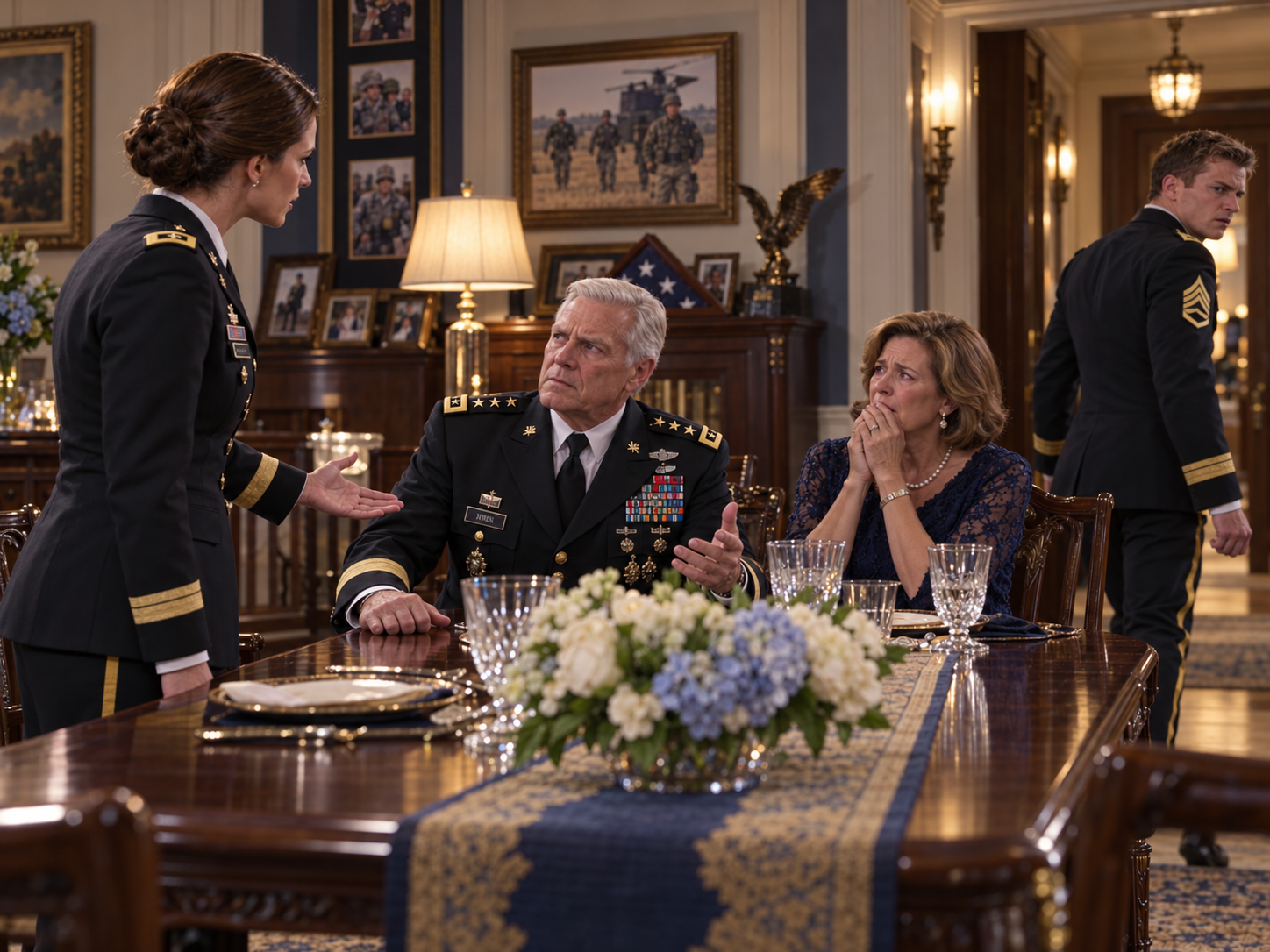
A moment later, the front door slammed.
Mom began crying silently.
Dad sank into his chair.
For the first time, I saw exhaustion beneath his anger.
“Emily,” he said quietly, “I didn’t know Mercer would do that.”
“I know.”
“I thought you were still in a staff position.”
“I haven’t been in a purely staff assignment for years.”
He rubbed his forehead.
“You never tell us anything.”
I took a slow breath.
“Dad, do you remember my promotion ceremony?”
He looked confused.
“Which one?”
“The one at Fort Liberty.”
He frowned.
“I couldn’t attend.”
“You said Ryan had a training event.”
“He did.”
“The event was canceled three days earlier.”
He looked up.
I continued.
“Mom told me you decided to take him fishing instead.”
His face changed.
“I don’t remember that.”
“I do.”
The room became very quiet.
“I remember standing beside my commanding officer while his family took photographs. I remember looking at an empty row of chairs. And I remember telling myself that you were probably busy.”
Dad lowered his eyes.
“I wasn’t trying to hurt you.”
“No,” I said softly. “You just weren’t trying very hard not to.”
He didn’t answer.
For a moment, I thought the conversation might finally become honest.
Then he said something that made the air leave my lungs.
“Ryan needed me more.”
I stared at him.
He looked almost relieved to have said it.
“He struggled early in his career. He needed encouragement. You were always fine on your own.”
My voice came out barely above a whisper.
“Did you ever consider that I only looked fine because nobody came when I needed them?”
My mother covered her mouth.
Dad stared at me.
I had never told him about the nights after my first deployment when I couldn’t sleep.
Or the friend I had lost overseas.
Or the injury I’d concealed because I couldn’t bear another conversation about how demanding my chosen career had become.
I hadn’t told him about the military family support counselor who sat with me for hours after I finally admitted I was struggling.
I had learned to be strong.
But strength had gradually become the excuse everyone used for leaving me alone.
Dad’s eyes filled.
For the first time that afternoon, he seemed genuinely unable to speak.
I stood.
“I need to go.”
Mom rose too.
“Emily—”
I hugged her.
Then I looked at Dad.
“I still love you.”
His face twisted.
“But I won’t keep paying for that love with pieces of myself.”
I left before he could answer.
The following Monday, the official review moved forward.
I was interviewed for nearly six hours.
The investigators examined the operational timeline, the reports submitted before Havenbridge, and the decisions my team had made after discovering the corridor was compromised.
They asked about the warnings.
The route classification.
The missing attachments.
I answered every question.
When they asked whether I suspected my brother or father, I gave them the same answer I would have given if their names had belonged to strangers.
“I have concerns about the records. I don’t have firsthand knowledge of who altered them.”
It was the truth.
It was also the hardest truth I’d ever spoken.
Two days later, Major Ryan Carter was temporarily removed from duties involving operational planning while the investigation continued.
Three days after that, investigators interviewed my father.
By Friday, the anonymous messages had been traced to a former civilian records supervisor named Rebecca Shaw.
She had worked in the regional coordination office during Havenbridge.
She had not sent the messages to intimidate me.
She had sent them because she was afraid.
Afraid that the files she had preserved would disappear.
Afraid that speaking openly would destroy her career.
And afraid that the truth would never emerge unless someone important paid attention.
Through her attorney, Rebecca voluntarily provided investigators with archived correspondence, metadata, and a copy of the original risk assessment.
Those materials changed everything.
The original report had warned that the secondary evacuation route was unsafe.
A revised version had lowered the risk rating.
Ryan’s account had been used to submit the altered version.
But the document history showed something else.
The revision had been prepared after a senior officer requested changes designed to make the evacuation plan appear operationally feasible without additional support.
That officer was Brigadier General Nathaniel Cross.
A man my father had served with for nearly fifteen years.
A man who had sat in the front row at the retirement ceremony.
A man whose career depended on the operation being presented as properly planned.
The investigation established that Cross had pressed the planning staff to remove inconvenient warnings.
Ryan had complied.
My father had reviewed the final authorization package and approved it despite concerns raised by another officer.
And when an internal discrepancy was discovered weeks later, Dad had directed staff to follow the approved records-retention process in a way that resulted in the original working copies being removed from the local office.
The investigators were examining whether that direction had been intended to conceal the earlier changes.
The person who ultimately preserved the original document was Rebecca.
She had retained a copy within an authorized audit repository before the local files were cleared.
It was the document that had allowed investigators to reconstruct the sequence.
As the inquiry widened, Cross was relieved of supervisory responsibilities pending its outcome.
The Army initiated administrative proceedings concerning Ryan’s conduct.
My father’s retirement didn’t shield him from questions about decisions made while he was still serving.
I watched the process unfold from a distance.
It was painful.
And it was necessary.
Then came the call that frightened me more than any official interview.
Captain Daniel Reeves.
The man injured during Havenbridge.
“Ma’am,” he said when I answered.
“Daniel.”
“I heard they’ve found something.”
I closed my eyes.
“There’s an ongoing review.”
“I know you can’t talk about it.”
His voice trembled.
“I just need to ask you one thing.”
“Go ahead.”
“When you sent us down that road, did you know it wasn’t safe?”
The question struck like a physical blow.
I remembered the convoy.
The broken windshield.
The dust.
The scream of the warning radio.
“No,” I whispered.
“I didn’t know.”
Silence.
Then Daniel exhaled shakily.
“I knew that.”
I covered my eyes.
“I’ve just been wondering if there was something we missed,” he said.
“We all have.”
He paused.
“My wife says I need to stop blaming myself.”
“She sounds wise.”
“She usually is.”
A faint laugh.
Then he said, “I don’t regret being there, Colonel. We got those people out.”
Tears slid down my face.
“Yes,” I said.
“We did.”
He hesitated.
“Don’t let them turn what happened into something meaningless.”
I looked toward the afternoon sunlight streaming across my desk.
“I won’t.”
That evening, my father appeared outside my apartment.
I hadn’t invited him.
When I opened the door, he looked ten years older than he had at his ceremony.
He held a small cardboard box.
“Can we talk?”
I hesitated.
Then stepped aside.
He placed the box on my kitchen table.
Inside were photographs.
Letters.
Old certificates.
My first commission.
My first deployment photograph.
A newspaper clipping about a humanitarian mission I’d participated in years earlier.
I stared at them.
“Where did you get these?”
Dad looked down.
“I kept them.”
I turned toward him.
“All of them?”
He nodded.
“Since you were eighteen.”
I lifted a photograph of myself in uniform, standing outside a military hospital.
On the back, in my father’s handwriting, were five words.
My girl. Stronger than me.
My throat tightened.
“Why did you hide them?”
Dad sat heavily.
“Because I didn’t know how to be your father once you stopped needing my permission.”
I didn’t speak.
He rubbed his hands together.
“Ryan wanted my advice. He wanted my contacts. He wanted my approval.”
“And I didn’t?”
“You wanted it,” Dad whispered. “But you never asked me to make decisions for you.”
I stared at him.
He continued.
“When your career took you into work I couldn’t understand, I told myself it wasn’t important to me. That was easier than admitting you’d gone somewhere I couldn’t follow.”
I set down the photograph.
“Dad, I never needed you to understand every assignment.”
He looked at me.
“I know.”
“I needed you to be happy for me.”
He began crying.
I’d seen my father cry exactly once before.
At my grandfather’s funeral.
Now he sat in my kitchen with his shoulders shaking, surrounded by all the evidence that he’d known who I was and somehow failed to tell me.
I wanted to comfort him.
I wanted to tell him everything would be fine.
But I had learned something painful that week.
Sometimes love meant refusing to rescue people from the consequences of their choices.
“Dad,” I said quietly, “you need to tell the truth about Havenbridge.”
He went still.
I held his gaze.
“I am not asking you what happened. The investigators will establish that. And I won’t discuss the evidence with you.”
He nodded slowly.
“But whatever you know, you need to be honest.”
His eyes filled again.
“I was afraid.”
“Of what?”
“Of losing everything I’d spent thirty years building.”
I sat opposite him.
“And now?”
He looked at the photographs.
“Now I’m afraid I’ve already lost the things that mattered more.”
I reached across the table.
For a moment, neither of us moved.
Then he took my hand.
But the next morning, just as I began to believe my father might finally choose accountability, I received news that Ryan had accused me of deliberately using my position to destroy his career.
And he had submitted a formal complaint.
PART 5 — THE FRONT ROW WAS NEVER THE POINT
The complaint arrived through official channels on a rainy Tuesday morning.
I read it once.
Then again.
Ryan alleged that I had improperly influenced senior leadership, encouraged investigators to target him, and exploited the retirement ceremony to publicly undermine his reputation.
He also claimed that the publicity surrounding my recognition had created an appearance of favoritism.
I sat at my desk with the document open.
For several minutes, I felt nothing.
Then I felt tired.
Not angry.
Not frightened.
Just profoundly tired of being asked to make myself smaller so my brother could feel secure.
I forwarded the complaint to my legal adviser and followed the established process.
I did not call Ryan.
I did not call my father.
I did not attempt to explain myself to relatives who had already begun sending messages asking why I was trying to destroy the family.
Instead, I continued my work.
Because I had learned long ago that the loudest accusation in the room wasn’t necessarily the most important thing happening inside it.
The review of Ryan’s complaint began separately from the Havenbridge investigation.
Investigators examined communications, the sequence of reporting, and whether I had exercised inappropriate influence.
My original concerns about the operational records had been documented months before my father’s retirement.
My formal role in the review remained limited to that of an operational witness.
The complaint found no substantiated evidence that I had directed the investigation or used my command position against Ryan.
But the damage within our family was already spreading.
An aunt I hadn’t spoken to in years called to tell me my father was devastated.
A cousin suggested that I should withdraw my concerns to preserve the family’s reputation.
An old family friend asked whether I understood how difficult it was for a young officer to recover from a professional setback.
I listened.
Then I began responding with a single sentence.
“The investigation is not about family loyalty. It’s about the integrity of military records and the safety of the people who relied on them.”
Some people stopped calling.
Others became angry.
For the first time in my life, I let them.
Six weeks later, the central findings of the Havenbridge inquiry were released through the appropriate military channels.
The report identified serious failures in risk documentation, supervisory oversight, and the approval process.
Cross had applied improper pressure to alter the risk assessment.
Ryan had knowingly submitted a version that omitted material warnings.
My father had approved the package despite documented objections and had subsequently failed to ensure the original records were preserved in the local office.
The military authorities referred the relevant matters for further legal and administrative action.
The process would take time.
There would be hearings.
Opportunities for the officers involved to respond.
Decisions about accountability, records, and professional consequences.
But one fact was no longer in dispute.
The warning about the evacuation route had existed.
And it should not have been removed.
When I received the findings, I didn’t feel triumphant.
I thought about Daniel Reeves.
About the civilians who had spent those eighteen hours waiting for rescue.
About the young specialist who had cried after discovering an elderly woman trapped in a disabled vehicle.
About the exhaustion in the eyes of my team when our final aircraft landed.
We had made it home.
But we could never recover those hours.
Or erase what the false assessment had cost.
That afternoon, General Mercer called.
“The findings are difficult,” he said.
“Yes, sir.”
“How are you holding up?”
I looked at the report on my desk.
“I don’t know.”
He was silent for a moment.
Then said, “That’s an acceptable answer.”
I managed a small laugh.
He continued.
“Your decisions during Havenbridge were reviewed. The operational assessment confirms that once the threat became known, your team acted appropriately and took reasonable measures to protect the evacuees.”
I closed my eyes.
I’d known that.
My officers had known it.
But hearing the conclusion aloud relieved a weight I’d been carrying for months.
“Thank you, sir.”
“There’s something else.”
I waited.
“The recovery organization supporting Captain Reeves and the other injured personnel is establishing a program to help service members and their families during rehabilitation.”
“That sounds worthwhile.”
“They’ve asked whether you’d be willing to participate.”
I thought about Daniel.
His wife.
His two little girls.
The photographs he’d sent me of his attempts to learn how to tie their shoelaces with limited use of one hand.
“I’d be honored.”
“Good.”
Mercer paused.
“Emily, the military gives us ranks, positions, and responsibilities. It doesn’t guarantee we’ll understand the people closest to us.”
I looked toward the photograph of my father that sat on my bookshelf.
“I’m beginning to understand that.”
My father wrote me a letter two weeks later.
Not a text.
Not an email.
Four pages, handwritten.
He acknowledged that he’d approved a document despite concerns he should have taken seriously.
He described how his friendship with Cross had influenced his judgment.
He admitted that protecting the reputation of their office had become more important to him than confronting the possibility that something had gone wrong.
He did not ask me to defend him.
He did not ask me to change my statement.
He wrote that he would cooperate with the remaining proceedings and accept the outcome.
Then, on the final page, he wrote about us.
Emily, I spent thirty years teaching soldiers that leadership means taking responsibility when things go wrong. Somehow, when it came to my own family, I forgot to live by the standard I expected from others.
I stopped reading.
Tears blurred the words.
A moment later, I continued.
I treated your independence as rejection. I treated your success as something I could not understand, and therefore something I did not need to celebrate.
I was wrong.
You did not embarrass me at my retirement ceremony. I embarrassed myself when I looked at my daughter and decided other people were more important.
I pressed the letter against my chest.
For years, I’d imagined hearing those words.
I had imagined how satisfying it would feel.
Instead, I cried.
Because sometimes receiving an apology doesn’t erase the hurt.
It simply gives the hurt somewhere to go.
My father ended the letter with a request.
Not for forgiveness.
Not for another chance to explain.
He asked whether, someday, I would allow him to attend an event in my life as my father rather than as a retired Army officer.
I set the letter beside the photographs he’d brought to my apartment.
Then I called him.
He answered immediately.
“Emily?”
“Hi, Dad.”
For several seconds, neither of us spoke.
Then he whispered, “Did you get my letter?”
“Yes.”
“I meant every word.”
“I know.”
He exhaled shakily.
“Can you forgive me?”
I looked toward the window.
Rain moved softly across the glass.
“I want to,” I said.
His breath caught.
“But I need time.”
“I understand.”
“And I need things to change.”
“They will.”
“Dad, don’t promise me something because you’re afraid of losing me.”
He was quiet.
Then he said, “You’re right.”
We spoke for nearly an hour.
Not about medals.
Not about command.
Not about who had disappointed whom.
We talked about ordinary things.
The dog he’d begun walking every morning.
Mom’s plan to start volunteering at the library.
The old fishing cabin my grandfather had loved.
It was awkward.
Sometimes painfully so.
But it was real.
And when we hung up, I realized we had managed an entire conversation without once mentioning Ryan’s career.
Ryan and I did not speak for almost four months.
During that time, he faced administrative action arising from the Havenbridge findings.
His complaint against me had been closed without substantiation.
His involvement in the altered assessment remained a matter of official record.
He lost his planning position.
His prospects for continued service became uncertain.
And for the first time in his adult life, the familiar structure of praise and expectation that had surrounded him began to disappear.
I didn’t celebrate that.
I knew how much military service had meant to him.
I also knew that loving someone did not mean protecting them from accountability.
One evening, Mom called.
“Your brother wants to see you.”
I stared at my phone.
“Why?”
“He says there’s something he needs to tell you.”
I hesitated.
“Mom, I’m not going to discuss the investigation.”
“He knows.”
I looked down at the open book in my lap.
“Then he can call me.”
“He doesn’t think you’ll answer.”
“He hasn’t tried.”
There was a long pause.
Then Mom said quietly, “He’s ashamed.”
I closed my eyes.
For years, Ryan had used confidence as armor.
He mocked uncertainty.
Dismissed hesitation.
Turned every conversation into a contest.
I’d sometimes wondered whether he truly believed he was better than everyone around him or whether he was terrified someone might discover he wasn’t.
Now I had my answer.
“Tell him he can call,” I said.
He called the next evening.
“Hey, Em.”
His voice sounded unfamiliar.
“Hi, Ryan.”
Silence.
Then he said, “I owe you an apology.”
I leaned back.
“I’m listening.”
He exhaled.
“I treated you badly.”
“Yes.”
“For a long time.”
“Yes.”
He gave a small, pained laugh.
“I guess you’re not going to make this easy.”
“No.”
Another silence.
Then he said, “Good.”
I waited.
“I spent my entire life trying to be Dad.”
His voice cracked.
“When I wasn’t as good as I thought I should be, I took it out on you because you seemed to make everything look effortless.”
I stared at the ceiling.
“Nothing was effortless, Ryan.”
“I know that now.”
“You never asked.”
“I know.”
He paused.
“And when I made a terrible decision during Havenbridge, I kept telling myself I was just following instructions. Then things went wrong, and I was afraid.”
His breathing grew uneven.
“I was afraid that if people knew what I’d done, I’d become the disappointment you always seemed to survive being.”
I felt tears burn behind my eyes.
He continued.
“Then Mercer recognized you, and everyone looked at you like you were everything I was supposed to be.”
“Ryan—”
“And instead of being proud of you, I hated you for it.”
I covered my mouth.
He began crying.
Not quietly.
Not elegantly.
Like someone who had finally run out of places to hide.
“I’m sorry, Em.”
I waited until he could breathe again.
“Ryan, you hurt me.”
“I know.”
“You made me feel unwelcome in my own family.”
“I know.”
“And your choices affected people who trusted the reports your office produced.”
His voice dropped.
“I know that too.”
I swallowed.
“I love you. But I can’t make those things disappear.”
“I’m not asking you to.”
For the first time, I believed him.
We talked for another twenty minutes.
When we hung up, nothing was magically repaired.
Trust was not restored by one conversation.
But the conversation was a beginning.
And beginnings matter.
The following spring, I stood outside a rehabilitation center in North Carolina, staring at a banner stretched across the entrance.
HAVENBRIDGE SERVICE AND FAMILY RECOVERY INITIATIVE
The program had been created to provide rehabilitation support, peer mentorship, and family assistance for personnel injured during difficult overseas missions.
Captain Daniel Reeves had helped design it.
So had his wife, Sarah.
They’d invited me to speak at the opening.
I had accepted on one condition.
The event would focus on the people receiving support.
Not on me.
Daniel had laughed when I told him.
“Ma’am, you realize that’s exactly what makes people want you to speak.”
I had threatened to cancel.
He’d laughed harder.
Now, as I adjusted my uniform jacket outside the auditorium, I heard footsteps behind me.
“Emily?”
I turned.
My father stood several feet away.
He wore a dark suit.
No medals.
No military decorations.
No visible symbol of his rank.
Just a father who looked nervous.
Mom stood beside him.
She smiled through tears.
For a moment, I couldn’t move.
“You came.”
Dad nodded.
“You invited us.”
I’d almost forgotten sending the invitation.
It had taken me three days to decide.
I knew having him there might bring back painful memories.
I knew some of the people attending had been affected by failures connected to the planning process he’d overseen.
But I also knew he had acknowledged those failures, cooperated with the proceedings, and begun the difficult work of accepting responsibility.
His administrative case had concluded with a formal finding of misconduct and corrective action affecting his retirement record.
The outcome had cost him professional recognition he’d spent decades pursuing.
He had not appealed for sympathy.
He’d begun volunteering with a community organization supporting military families, working in roles that required no rank and offered little visibility.
I hadn’t known whether those changes would last.
But they had.
And gradually, cautiously, I’d allowed him back into my life.
“You didn’t have to come,” I said.
Dad looked at me.
“Yes,” he replied softly. “I did.”
Mom hugged me.
Then Dad stepped forward.
He hesitated.
I opened my arms.
He held me for a long time.
“I love you, Emily,” he whispered.
I closed my eyes.
“I love you too, Dad.”
When we separated, he looked toward the auditorium.
“Where should we sit?”
The question nearly broke my heart.
Because I recognized the fear behind it.
He wasn’t asking about comfort.
He wasn’t asking about visibility.
He was asking whether he still belonged.
I smiled.
“Come with me.”
Inside, the auditorium was filling with service members, families, medical professionals, and community volunteers.
Near the front, two seats had been reserved.
I led my parents toward them.
Dad stopped when he saw the cards.
FAMILY OF COLONEL EMILY CARTER
He stared.
Then looked at me.
“Emily…”
I touched his arm.
“You’re my family.”
His eyes filled.
“But I want you to understand something.”
He nodded.
“These seats aren’t important because they’re in the front.”
He swallowed.
“They’re important because I chose to save them for you.”
He covered his face with one hand.
Mom began crying again.
I smiled through my own tears.
“Now sit down before you make me ruin my makeup.”
Dad laughed.
A real laugh.
One I hadn’t heard in years.
He sat beside Mom.
And for the first time I could remember, nobody in my family appeared concerned about who else might be watching.
The auditorium lights dimmed.
Daniel Reeves walked onto the stage to introduce the program.
His left hand remained partially impaired, but he had spent months learning new ways to perform everyday tasks.
He looked strong.
Happy.
Alive.
His wife sat in the front row with their daughters.
When Daniel mentioned the families whose sacrifices had made the initiative possible, the audience stood and applauded.
Then he introduced me.
“Ladies and gentlemen, Colonel Emily Carter.”
I approached the microphone.
I had spoken before large military audiences.
I had delivered operational briefings under pressure.
I had stood before senior commanders and explained decisions that carried enormous consequences.
But that afternoon, when I looked into the audience and saw my father sitting beside my mother, I had to pause.
I unfolded my prepared remarks.
Then folded them again.
“I was going to give a speech about leadership,” I began.
A few people smiled.
“But the last year has taught me that leadership isn’t always found where we expect it.”
I looked toward Daniel.
“Sometimes it belongs to the soldier who asks whether everyone else is safe before asking about his own injuries.”
Daniel lowered his head.
“Sometimes it belongs to the spouse who refuses to let someone face recovery alone.”
Sarah squeezed her husband’s hand.
“And sometimes,” I continued, “it belongs to a person who discovers they’ve been wrong and chooses accountability instead of excuses.”
My eyes moved toward my father.
He was crying openly.
I took a breath.
“For much of my life, I believed recognition was something I had to earn by becoming impossible to overlook.”
The auditorium grew still.
“I thought that if I worked hard enough, served long enough, and achieved enough, eventually everyone I loved would understand my worth.”
I paused.
“But worth doesn’t come from a title.”
My voice steadied.
“It doesn’t come from a uniform, a promotion, or a seat in the front row.”
I looked around the room.
“It comes from the way we treat people when no one important is watching.”
Nobody moved.
“That is what this program represents. The promise that service does not end when the mission ends. That injuries deserve care. That families deserve support. And that every person who has carried a burden deserves to know they are not carrying it alone.”
I looked toward Daniel.
“We cannot change what happened during Havenbridge. But we can decide what we build from it.”
I smiled.
“And today, we’re building something worth protecting.”
The applause began slowly.
Then grew.
People rose.
Daniel stood beside his wife.
His daughters clapped enthusiastically.
And my father stood in the front row, applauding with tears running down his face.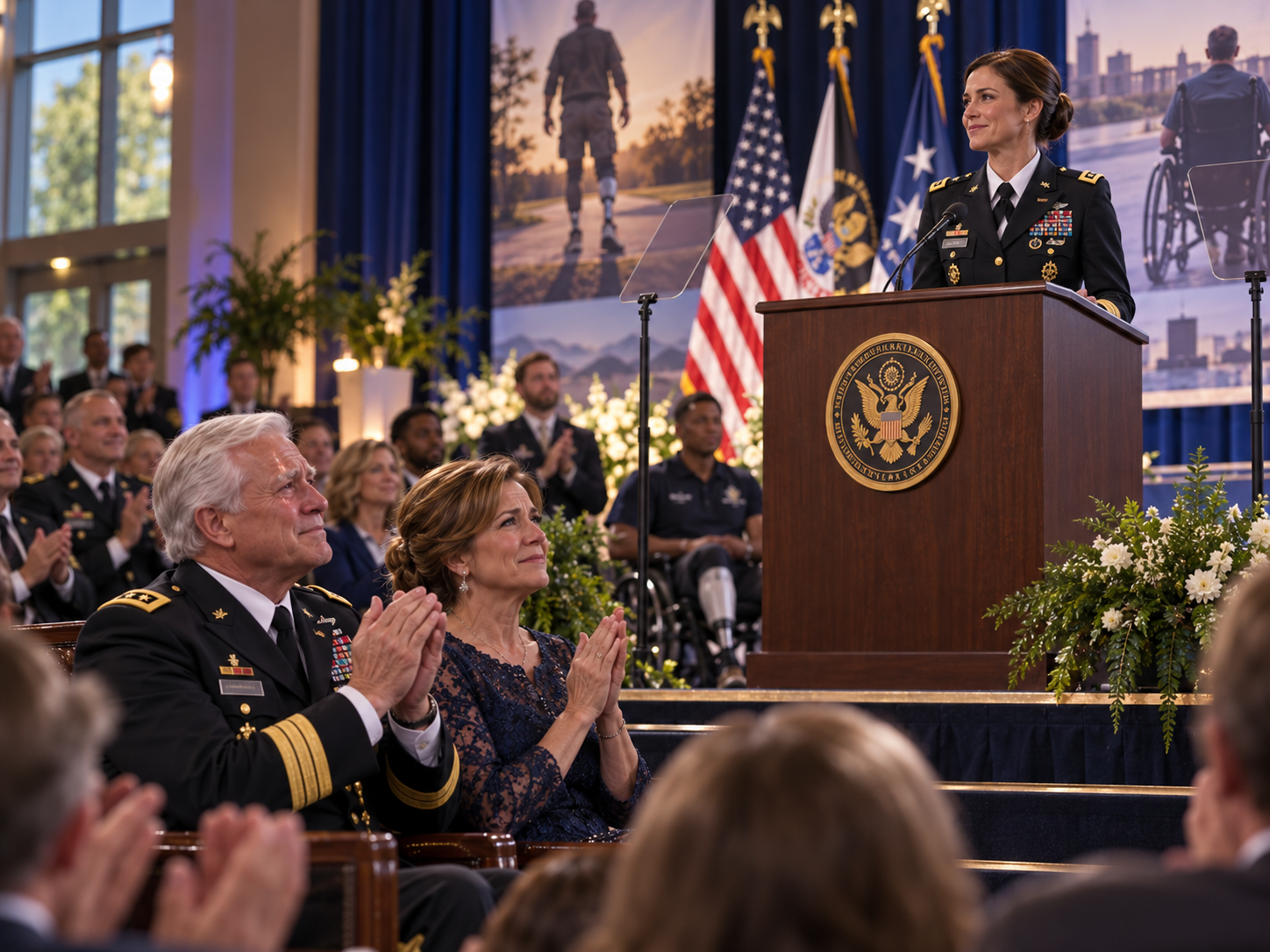
Not because I had outranked him.
Not because a general had recognized me.
Not because the world finally understood something he had failed to see.
But because, for the first time, he was simply proud to be my father.
After the ceremony, the afternoon unfolded into a series of small, extraordinary moments.
Daniel introduced my parents to his family.
Sarah showed Mom photographs of the rehabilitation program.
My father spoke quietly with several veterans about the importance of accurate planning and the responsibility commanders carried when reviewing operational information.
He did not conceal the mistakes he’d made.
He did not try to make himself the center of the conversation.
He listened.
That mattered more than anything he could have said from a stage.
Later, as guests began leaving, I found him standing near a window overlooking the courtyard.
“Dad?”
He turned.
“Emily.”
He smiled.
“You were wonderful.”
“Thank you.”
He looked toward the stage.
“Can I tell you something?”
“Of course.”
He took a slow breath.
“On the day of my retirement, when General Mercer walked past me and went to the back row, I was angry.”
I nodded.
“I know.”
“I thought he was taking something away from me.”
He looked at his hands.
“My moment. My recognition. My importance.”
He shook his head.
“But he wasn’t.”
I waited.
“He was showing me something I’d refused to see.”
Tears gathered in his eyes.
“My daughter had come all that way to celebrate me. And instead of being grateful, I made her feel like a stranger.”
I stepped closer.
“Dad—”
He raised one hand gently.
“Please. Let me finish.”
I nodded.
“I spent thirty years learning how to lead soldiers. But I never learned how to stand beside a daughter who didn’t need me to lead her.”
His voice broke.
“I’m sorry I made you feel you had to earn your place in this family.”
I felt tears slide down my cheeks.
He continued.
“You never did.”
I took his hand.
For a moment, we stood without speaking.
Then I said, “I didn’t need you to be a general, Dad.”
He gave a watery smile.
“I know.”
“I just needed you to be my father.”
He pulled me into his arms.
And this time, the embrace didn’t feel like a promise that everything would suddenly be perfect.
It felt like something better.
Two people accepting the truth of what had happened.
And choosing to build something different.
Several months later, our family gathered for Thanksgiving.
It was the first holiday we’d spent together without pretending the previous year hadn’t happened.
Ryan arrived early.
He’d left active service after the conclusion of his administrative proceedings and begun working toward a civilian career in emergency management.
He was quieter now.
More thoughtful.
He still struggled with disappointment.
But he had started therapy, accepted responsibility for his decisions, and begun the long process of deciding who he wanted to become without his father’s expectations defining him.
When I entered the house, he stood in the kitchen holding a ridiculous apron that read GRILL SERGEANT.
I laughed.
“Seriously?”
He grinned.
“Dad bought it.”
“Of course he did.”
He stepped forward.
Then hesitated.
I hugged him.
“Good to see you, little brother.”
He held on a second longer than usual.
“Good to see you too, Em.”
During dinner, Dad asked about my work.
Not to compare it with Ryan’s.
Not to impress guests.
Just because he wanted to know.
I told him about the people I could discuss.
The younger officers I was mentoring.
The families supported through the rehabilitation initiative.
The ordinary frustrations of leadership.
He listened.
Actually listened.
When Ryan spoke about his studies, I asked questions too.
And for the first time, there was no scoreboard at our table.
No invisible contest.
No need for one person to become smaller so another could feel important.
After dinner, Mom brought out a box of family photographs.
We spent hours looking through them.
There were embarrassing childhood pictures.
Old holiday photographs.
Dad’s first promotion.
My graduation.
Ryan’s commission.
And new photographs from the rehabilitation program.
Mom had begun organizing them into albums.
Not by rank.
Not by achievement.
By year.
By memory.
By family.
As the evening grew late, I noticed something hanging on the wall above the fireplace.
It was a framed photograph from the opening of the Havenbridge initiative.
In it, I stood onstage beside Daniel Reeves.
My mother was smiling in the audience.
My father was applauding.
Beneath the photograph was a small engraved plaque.
I stepped closer.
The words were simple.
OUR DAUGHTER, EMILY.
Nothing else.
No rank.
No title.
No list of accomplishments.
I stared at it.
Dad approached quietly.
“I hope that’s okay.”
I turned toward him.
“It’s perfect.”
He smiled.
“I thought about putting your rank on it.”
I laughed.
“I’m glad you didn’t.”
He glanced at the photograph.
“I figured you already know what you’ve accomplished.”
He looked at me.
“I wanted you to know who you are to us.”
I took his hand.
And in that moment, I finally understood something I had spent my entire adult life trying to learn.
I hadn’t been fighting for a chair at a retirement ceremony.
I hadn’t even been fighting for recognition.
I had been fighting for the right to belong without having to prove I was worthy.
The little girl who had once waited for her father to say he was proud of her had grown into a woman capable of leading hundreds through danger.
She had survived fear, loss, and disappointment.
She had built a life of meaning.
But somewhere inside her, that little girl had kept waiting.
Waiting for a place at the table.
Waiting to be seen.
Waiting for someone to say she mattered.
And now, standing in my parents’ living room with my father holding my hand, I realized I no longer needed to wait.
I had always mattered.
Even when they failed to see it.
Even when they sent me to the back.
Even when they confused visibility with value.
And the beautiful thing was that my family was finally learning it too.
The following year, I attended another military retirement ceremony.
This time, it was for Command Sergeant Major Harold Bennett.
The gray-haired man who had sat beside me in the final row.
When I arrived, he greeted me with a wide smile.
“Colonel Carter.”
“Sergeant Major.”
He laughed.
“Still causing trouble at retirement ceremonies?”
“Only when absolutely necessary.”
His eyes sparkled.
“Good. Keeps people honest.”
He guided me into the auditorium.
At the entrance, a young soldier was arguing softly with an event volunteer.
She looked nervous.
Perhaps twenty-five.
Her uniform was neatly pressed, but she kept glancing toward the reserved seating.
“I’m sorry,” the volunteer told her. “Those seats are for distinguished guests.”
The soldier nodded.
“Understood.”
She started toward the rear.
I watched her go.
Then looked at Bennett.
He knew what I was thinking.
A slow smile crossed his face.
I approached the soldier.
“Excuse me.”
She turned immediately.
“Ma’am.”
“Are you here for Sergeant Major Bennett?”
“Yes, ma’am. He was my first senior enlisted mentor.”
“Then you’re exactly where you should be.”
I gestured toward the front.
“Come sit with us.”
She hesitated.
“But the reserved seats—”
Bennett appeared beside me.
“Are for the people who matter to me,” he said.
The young soldier looked stunned.
He grinned.
“And that includes you.”
We walked together toward the front row.
No announcement.
No dramatic entrance.
No four-star general descending from a stage.
Just three soldiers finding their seats.
As I sat down, my phone vibrated.
A message from Dad.
Proud of you, sweetheart. Hope you have a wonderful day. Love, Dad.
I smiled.
Then typed back:
Love you too, Dad.
I put the phone away as the ceremony began.
For a brief moment, I remembered the last row of my father’s retirement ceremony.
The empty family chair.
The humiliation.
The sound of General Mercer’s footsteps coming down the aisle.
Everything that had changed since then.
I looked toward the young soldier seated beside me.
She was smiling.
And I realized the most important lesson of that painful afternoon had nothing to do with the recognition I’d received.
It was about the recognition we choose to give others.
A person’s worth does not change because someone refuses to save them a seat.
And sometimes the greatest act of leadership is simply making room for someone who has been told they don’t belong.
I settled into my chair.
The music began.
And for the first time in a very long while, I wasn’t thinking about where I had been seated.
I was exactly where I wanted to be.
THE END.