The K9 Broke Free and Charged a Shackled Prisoner—But What He Did Next Left 500 People Speechless
PART 1 — The Dog Who Refused to Obey
Everyone thought Titan was about to tear the prisoner apart.
The decorated police K9 had suddenly broken free during a memorial ceremony attended by more than five hundred people.
He ignored every command I shouted.
He raced through the crowd, leaped over a retaining wall, and headed straight for a shackled inmate in an orange jumpsuit.
A corrections officer raised his shotgun.
Other officers reached for their weapons.
I screamed for them not to shoot.
But Titan wouldn’t stop.
And when he finally reached Inmate Number 34, something happened that nobody expected.
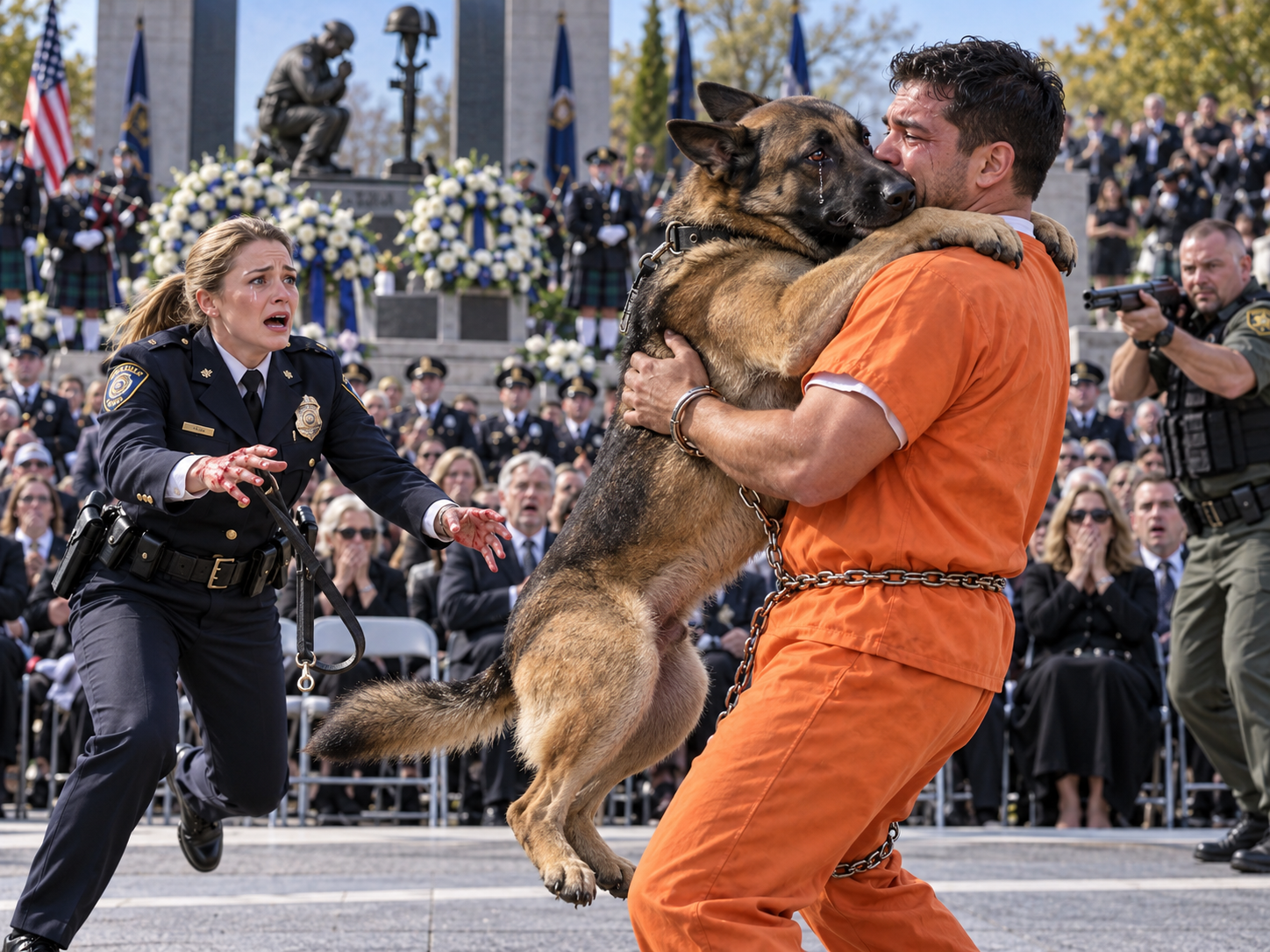
Instead of attacking, the ninety-five-pound K9 threw his front paws around the prisoner’s neck.
Then he began to cry.
My name is Officer Miller.
For three years, Titan had been my partner.
He was a ninety-five-pound Belgian Malinois–German Shepherd mix, strong, intelligent, and extraordinarily disciplined.
We had worked together through situations that would have frightened most people.
Gunfire.
Sirens.
Dangerous raids.
Crowded streets.
Confusion.
Chaos.
Titan had been trained to maintain his focus through all of it.
He obeyed commands without hesitation.
When I told him to stop, he stopped.
When I ordered him to stay beside me, he remained there.
And when circumstances turned dangerous, I trusted him with my life.
In three years, he’d never given me a reason to question that trust.
Until the afternoon of the Annual Fallen Officers Memorial Ceremony.
The plaza was filled with people paying their respects.
Bagpipes echoed across the open space.
Families of fallen officers sat quietly in rows of folding chairs.
Some held photographs.
Others watched the ceremony with tears in their eyes.
The mayor attended.
So did city officials and ranking police officers.
The front section was occupied by dignitaries and families who had gathered to remember the men and women who had died in service.
More than five hundred people surrounded the memorial grounds.
Titan stood beside me.
His posture was relaxed but attentive.
His ears moved occasionally as he monitored the sounds around us.
I held his leash loosely.
There was no reason to expect trouble.
He had been around crowds countless times before.
And he knew exactly what was expected of him.
Then, without warning, everything changed.
Titan’s head lifted.
His ears flattened.
The muscles beneath his coat tightened so suddenly that I felt the change through the leash.
He was staring across the park.
Not at the bagpipers.
Not at the crowd.
Not toward the memorial stage.
Something farther away had captured his complete attention.
I looked down.
“Titan?”
He didn’t look at me.
His body became rigid.
Then he lunged.
Hard.
The leash jerked against my hands.
“Titan, heel!”
He kept pulling.
I tightened my grip.
“Titan, halt!”
Nothing.
He ignored me completely.
My stomach dropped.
Titan had never disregarded my commands like that.
Not during training.
Not during actual operations.
Not even when surrounded by noise and confusion.
But now, in the middle of a memorial ceremony, my usually disciplined partner was behaving as though he could hear nothing except whatever was calling him across the park.
I followed his gaze.
About fifty yards away, six prisoners from the county correctional facility were being escorted along the edge of the grounds.
Corrections officers walked with them.
The prisoners wore orange jumpsuits.
Their movements were restricted by steel restraints.
At first, I assumed Titan had reacted to the group.
But then I realized something strange.
He wasn’t watching all six inmates.
He was focused on only one.
The third man in line.
Inmate Number 34.
He was tall and broad-shouldered.
Steel restraints secured his wrists and ankles.
His orange jumpsuit stood out against the muted colors of the memorial crowd.
As Titan pulled harder, the prisoner turned his head.
He saw the dog.
And stopped moving.
Completely.
For a moment, the two seemed locked on each other.
Then a corrections guard noticed what was happening.
“Get that dog back!”
I tried.
God knows I tried.
Titan’s strength was extraordinary.
He dragged forward with a force I’d never felt from him before.
The leash cut painfully across my palms.
I planted my boots against the ground.
“Titan! Stop!”
He didn’t obey.
The prisoners’ escort began reacting.
One guard moved toward the man in orange.
Another reached for his weapon.
Then I saw a corrections officer raise a shotgun.
My blood went cold.
“Don’t shoot!”
Titan surged again.
I lost my footing.
My boots slipped against the ground.
The leash tore through my hands, burning the skin until my palms were bloody.
Then it was gone.
Titan was loose.
He accelerated across the grass.
People screamed.
Several attendees jumped away from his path.
Officers scattered, trying to determine whether the dog was attacking or pursuing a threat.
Someone shouted another command.
Titan ignored it.
I started running.
“Titan! Come back!”
He didn’t slow down.
The corrections guard brought his shotgun into position.
I heard the unmistakable sound of a round being chambered.
“NO!”
My voice broke as I shouted.
I knew what the officer was seeing.
A large police dog charging directly toward a restrained prisoner.
A dog that wasn’t responding to commands.
A potential attack unfolding in front of hundreds of witnesses.
But Titan wasn’t simply a police dog to me.
He was my partner.
For three years, we’d depended on each other.
He had protected me.
I’d protected him.
And now I was running after him, terrified that I was about to watch him be shot.
The guard hesitated.
It couldn’t have lasted more than an instant.
But that hesitation changed everything.
Titan raced past him.
He didn’t turn toward the raised shotgun.
Didn’t threaten the guard.
Didn’t even appear to notice him.
His attention remained fixed on Inmate Number 34.
I was still running when Titan reached the low retaining wall.
He didn’t slow.
He gathered himself and jumped.
His powerful body cleared the barrier.
Then he launched himself toward the tall prisoner.
I saw the inmate standing motionless, wrists and ankles restrained.
I saw Titan flying through the air.
And I braced myself for the worst.
I was certain I was about to witness an attack that could end with both my partner and the prisoner dead.
But Titan wasn’t charging at the man’s throat to bite him.
He wasn’t preparing to drag him down.
When he reached Inmate 34, his front paws rose and wrapped around the man’s neck.
And the sound that came from my partner was nothing like the growl I’d feared.
Titan began to cry.
PART 2 — The Man Titan Never Forgot
At first, I couldn’t understand what I was seeing.
Titan’s powerful shoulders trembled as he pressed himself against the prisoner’s chest. His tail swept wildly from side to side, and his ears lay flat against his head.
He made a sound I had never heard from him before.
Not a bark.
Not a warning.
Something softer, almost desperate, as though four years of longing had suddenly escaped from somewhere deep inside him.
The prisoner staggered backward under Titan’s weight.
With his wrists cuffed to a chain around his waist, he couldn’t catch the dog properly. He bent forward instead, lowering his face into the thick fur around Titan’s neck.
And then I heard him speak.
“Easy, big guy. Easy.”
His voice was barely audible beneath the shouts around us.
Titan responded by pressing closer.
The man’s knees buckled.
He sank onto the pavement, his restraints scraping against the concrete.
“Oh, buddy,” he whispered. “Oh, my beautiful boy.”
Then he began to sob.
I stopped a few feet away.
Around us, the ceremony had dissolved into confusion. Hundreds of people stood frozen between the memorial plaza and the police barricades. Cell phones were raised. Several officers approached cautiously, their hands still near their weapons.
But the prisoner seemed unaware of any of them.
His whole world had narrowed to the dog trembling against him.
“I thought you were gone,” he said.
Titan whined and buried his muzzle beneath the man’s chin.
“I thought I’d never see you again.”
Something tightened in my chest.
For three years, I’d slept with Titan curled beside my bed. I’d fed him, trained him, carried him through injuries, and trusted him during some of the most dangerous moments of my career.
I knew his habits.
His moods.
The peculiar way he tilted his head whenever someone opened a bag of potato chips.
Yet I was watching him recognize someone with an intensity I had never witnessed.
Someone who clearly belonged to a part of his life I knew nothing about.
“Officer Miller!”
Captain Richard Voss was pushing through the gathering crowd.
His expression was furious.
“Get your dog under control!”
I stepped toward Titan.
“Titan, come.”
For the first time since he’d broken free, his ears moved toward my voice.
But he didn’t leave the prisoner.
Instead, he shifted his body sideways, positioning himself protectively between the kneeling man and the approaching officers.
That frightened me more than his initial disobedience.
Titan had been trained to protect me.
Not convicted prisoners.
“Titan,” I said quietly, “it’s okay.”
The prisoner’s head lifted.
He looked at me through eyes reddened with tears.
“His name is Titan?”
“Yes.”
A faint, broken smile crossed his face.
“Of course it is.”
Captain Voss stopped abruptly.
For one second, his expression changed.
It wasn’t anger anymore.
It was recognition.
Then he looked at the prisoner’s face, and all the color seemed to drain from his own.
“Reyes?”
The prisoner slowly raised his head.
“Hello, Captain.”
A muscle twitched in Voss’s jaw.
I looked between them.
“You know him?”
Voss recovered quickly.
“Officer Miller, retrieve your animal. Now.”
“Sir, he’s not attacking.”
“I can see that.”
“Then what’s happening?”
“That isn’t your concern.”
The prisoner’s smile disappeared.
“Still giving orders, Richard?”
Voss took a step forward.
“Keep your mouth shut.”
A corrections officer seized the prisoner’s shoulder.
“On your feet!”
Titan growled.
It was a low, controlled warning.
Every officer nearby stiffened.
I moved immediately between them.
“Back away from the dog. Give me a second.”
The guard hesitated.
I crouched beside Titan, ignoring the blood still running down my palms.
“Hey, partner.”
Titan glanced toward me.
“It’s me. You’re okay.”
I placed my hand against his shoulder.
His muscles were trembling.
Not with aggression.
With excitement and distress.
The prisoner watched us quietly.
Then he said something that changed everything.
“Try telling him, ‘Home base.’”
I turned.
“What?”
“Just say it. Softly.”
I hesitated.
It wasn’t one of Titan’s official commands.
But there was something in the man’s expression that made me listen.
“Titan,” I whispered. “Home base.”
The effect was immediate.
Titan lowered his paws, sat on his haunches, and leaned his entire body against the prisoner.
He stayed there, breathing hard, his eyes never leaving the man’s face.
I stared.
“How did you know that?”
The prisoner swallowed.
“Because I taught him.”
Behind me, Captain Voss said sharply, “That’s enough.”
But I barely heard him.
The prisoner extended his restrained hands as far as the chains permitted and scratched the place behind Titan’s left ear.
Titan closed his eyes.
“He was nine weeks old when I brought him home,” the man said. “Wouldn’t sleep anywhere except inside one of my boots. Ate half a kitchen chair when he was six months old.”
My mouth went dry.
Titan had a thin white scar above his right shoulder.
I’d been told he’d received it during a training accident.
The prisoner touched the scar without looking.
“He got this pulling me out of a collapsed doorway.”
I stared at his fingers.
“How do you know about that?”
“Because I was the one trapped inside.”
A woman in the crowd gasped.
Someone whispered, “Who is he?”
The prisoner looked down at the orange fabric covering his chest.
“My name is Daniel Reyes.”
I knew that name.
Not immediately.
But something stirred in my memory.
A photograph in an old department newsletter.
A newspaper headline.
A story spoken about in lowered voices during my first year on the force.
Daniel Reyes.
Former police officer.
Convicted felon.
The man accused of setting the fire that killed Sergeant Thomas Whitaker.
The same Sergeant Whitaker whose name was engraved on the memorial behind us.
My stomach turned.
I looked toward the granite wall.
There it was, carved among thirty-eight other names.
SERGEANT THOMAS E. WHITAKER — END OF WATCH, MAY 17.
I slowly turned back.
“You’re that Daniel Reyes?”
His expression changed.
“Yes.”
“You were Whitaker’s partner.”
He nodded once.
“And you’re serving a sentence for his death.”
Daniel looked down at Titan.
“That’s what the court decided.”
Captain Voss stepped forward.
“Get him moving.”
Two corrections officers grabbed Daniel’s arms.
Titan sprang to his feet.
“Easy!” I shouted.
The dog froze, but his body remained tense.
Daniel looked straight at me.
“Officer Miller, please.”
There was nothing threatening in his voice.
Only exhaustion.
“Don’t let them hurt him because of me.”
The simplicity of the request stunned me.
He wasn’t asking me to remove his shackles.
He wasn’t asking for help escaping.
He was asking me to protect the dog.
“Titan won’t be hurt,” I promised.
Daniel exhaled shakily.
“Thank you.”
The officers pulled him upright.
Titan tried to follow.
I caught his collar.
The dog let out a heartbreaking whine.
Daniel took one step, then turned back.
“Hey, big guy.”
Titan’s ears rose.
“Remember our promise?”
Something about those words made the prisoner struggle to keep his composure.
“You stay brave for me.”
Then Daniel allowed the officers to lead him away.
Titan watched until the orange jumpsuit disappeared behind the corrections van.
Only then did he turn toward me.
He pressed his head against my bloody hands.
And for the first time in three years, I wondered whether I had ever truly known my own partner.
By evening, the video had spread across the city.
Within hours, millions of people would see Titan leap toward Daniel Reyes and embrace him.
Most watched the footage with tears in their eyes.
Some called it proof that animals never forget love.
Others asked why a decorated police K9 would recognize a convicted killer.
I was asking a different question.
Why had nobody told me Titan belonged to Daniel Reyes before he became mine?
At the precinct, the answer proved unusually difficult to find.
Titan’s transfer file was thin.
Too thin.
The paperwork listed him as a department-owned canine reassigned to me after a medical evaluation and a period of retraining.
The previous handler section was blank.
There was no photograph of his original officer.
No training history from his first years.
Not even the usual veterinary records documenting his early service.
I checked the electronic archive.
A message appeared.
Record unavailable. Administrative restriction.
I tried again.
Same result.
“Something wrong?”
I looked up.
Sergeant Elena Brooks stood in the doorway carrying two cups of coffee.
She had been on the force for twenty-one years, long enough to know when trouble was approaching before anyone else noticed.
“Did you know Titan used to belong to Daniel Reyes?” I asked.
Her hand stopped halfway toward the desk.
For a moment, she said nothing.
Then she closed the door.
“Where did you hear that?”
“From Reyes himself. At the ceremony.”
Brooks set down the coffee.
“Kate, listen carefully.”
She almost never used my first name at work.
That alone made me uneasy.
“Whatever happened today, you need to be careful how far you take it.”
I stared at her.
“Why?”
She pulled out a chair but didn’t sit.
“Because Daniel Reyes was one of the best officers this department ever had.”
I frowned.
“He was convicted of killing his partner.”
“Yes,” Brooks said quietly. “He was.”
She looked toward the closed door.
“But not everyone believed he did it.”
I waited.
Brooks finally lowered herself into the chair.
“Four years ago, Daniel and Thomas Whitaker were investigating a suspected evidence-trafficking operation. Drugs, confiscated money, missing firearms. Property that was supposed to be locked away kept disappearing.”
“Who were they investigating?”
“That was never made public.”
“Why not?”
“Because the investigation ended the night Whitaker died.”
She took a slow breath.
“There was a fire at an old municipal storage building. Whitaker was inside. Reyes survived. The prosecutors said Reyes started the fire to destroy evidence after Whitaker discovered he’d been stealing from the department.”
“Was there proof?”
“There was a witness. There were access logs. There was an accelerant report. And there was a statement Reyes allegedly made.”
“Allegedly?”
Brooks stared at her coffee.
“Daniel said someone altered his statement.”
A chill passed through me.
“And Titan?”
Her expression softened.
“That dog was Daniel’s whole world. After his wife died, Titan was practically the only family he had left.”
I glanced toward the kennel area.
Titan lay quietly behind the glass, his head resting on his paws.
“Why wasn’t that in his file?”
Brooks didn’t answer.
“Sergeant?”
She looked at me with an expression I would remember for years.
“Because someone wanted you to believe Titan’s life began the day you became his handler.”
Before I could speak, her phone vibrated.
She glanced at the screen.
Her face changed.
“What is it?”
She stood.
“Captain Voss wants to see you.”
“Now?”
“Yes.”
She picked up her coffee but left mine untouched.
“And Kate?”
I looked at her.
“Whatever he asks, don’t lie.”
Then she added something that made the room feel suddenly colder.
“But don’t assume he’s telling you the truth, either.”
Captain Voss was waiting in his office.
A folder rested on his desk.
He didn’t invite me to sit.
“Your dog created a serious security incident today.”
“Yes, sir.”
“A corrections officer nearly discharged a weapon in front of five hundred civilians.”
“I understand.”
“The department is receiving calls from reporters, city officials, and attorneys.”
I remained silent.
Voss leaned back.
“Titan will be temporarily removed from operational duty pending a behavioral evaluation.”
My heart sank.
“Sir, he wasn’t aggressive.”
“He broke free and disobeyed direct commands.”
“Yes, but—”
“There’s no discussion.”
I clenched my injured hands.
“Understood.”
Voss studied me.
“Have you spoken to anyone about Reyes?”
I remembered Brooks’s warning.
“Only officers who witnessed the incident.”
“Good. Keep it that way.”
He pushed the folder across the desk.
“Sign this.”
I opened it.
The document described Titan’s behavior as an uncontrolled attempt to make physical contact with a secured inmate, creating an imminent threat of serious bodily injury.
I read the sentence twice.
“That isn’t what happened.”
Voss’s expression hardened.
“Excuse me?”
“Titan didn’t try to injure Reyes. The entire crowd saw him embrace the man.”
“Officer Miller, you are not qualified to determine what an animal intended.”
“I am his handler.”
“And I am your commanding officer.”
Silence settled between us.
I looked again at the document.
The final paragraph recommended permanent retirement from law enforcement service if the upcoming evaluation identified additional signs of unpredictable behavior.
My throat tightened.
“Permanent retirement?”
“Possibly.”
“Where would he go?”
“That would be determined later.”
I knew exactly what those words could mean.
Titan was not a household pet in the department’s eyes.
He was police property.
A working asset.
And if someone decided he was too dangerous to place in a home, retirement could become something much worse.
I closed the folder.
“I won’t sign a statement saying he attempted an attack.”
Voss stared at me.
“Choose your next words carefully.”
“I will provide an accurate account of what happened. Nothing more.”
He stood.
“Then you’re relieved of duty until further notice.”
For several seconds, I couldn’t move.
“Sir—”
“Turn in your badge and department firearm.”
I felt the blood drain from my face.
Voss walked toward the door and opened it.
“This meeting is over.”
I gathered my belongings mechanically.
At the doorway, I stopped.
“Captain?”
He looked at me impatiently.
“Did Titan belong to Daniel Reyes before he belonged to me?”
Voss didn’t blink.
“That information is irrelevant.”
“Then why was it removed from his file?”
His expression changed.
Only slightly.
But enough.
“Go home, Officer Miller.”
I took one last look at him.
Then I walked out.
It was almost midnight when I returned to my apartment.
Titan wasn’t with me.
For the first time in three years, his bed beside my bedroom door was empty.
His food bowl stood beneath the kitchen counter.
A half-chewed rubber ball lay near the couch.
I picked it up.
And sat on the floor.
I had faced armed suspects without trembling. I’d walked into buildings knowing I might not walk out again.
But that night, alone in my apartment, I cried.
Because somewhere behind the department’s locked kennel doors, Titan was waiting for me.
And I couldn’t tell him why I hadn’t come back.
My phone rang at 12:17 a.m.
Unknown number.
I almost ignored it.
Then I answered.
“Officer Miller?”
A woman’s voice.
“Yes?”
“My name is Sarah Whitaker.”
I sat upright.
“Whitaker?”
“Thomas Whitaker was my husband.”
I couldn’t speak.
The widow of the officer Daniel Reyes had supposedly killed was calling me in the middle of the night.
“I saw the video,” she said.
“I’m sorry about what happened at the memorial.”
“Don’t apologize.”
Her voice shook.
“Please, Officer Miller. There’s something I need you to know.”
I gripped the phone.
“What is it?”
“Daniel Reyes did not kill my husband.”
The room seemed to tilt.
“Mrs. Whitaker—”
“I’ve spent four years trying to prove it.”
I could hear her breathing on the other end of the line.
“And after what happened today, I think someone is going to try to bury the truth again.”
I looked at Titan’s empty bed.
“Why are you telling me this?”
“Because Thomas left something behind.”
A pause.
“Something that could explain why he died.”
My pulse quickened.
“Have you taken it to the police?”
“Yes.”
“What happened?”
She began to cry.
“They told me to forget about it.”
I waited.
Then she spoke the words that would change both our lives.
“Officer Miller, the last person my husband called before he died was Captain Richard Voss.”
PART 3 — The Secret Behind the Memorial Wall
For several seconds, I couldn’t answer.
Captain Richard Voss.
The man who had suspended me.
The man who wanted Titan classified as dangerous.
The man who had ordered me to stay away from Daniel Reyes.
And now the widow of a murdered police sergeant was telling me that Voss had been the last person her husband called before he died.
“Are you certain?” I asked.
“Thomas’s phone records show a call lasting four minutes and nineteen seconds. It ended less than half an hour before the fire.”
“Did investigators know?”
“They had the records.”
“Then surely they questioned Voss.”
“They did.” Sarah’s voice became bitter. “He said Thomas called to discuss a routine assignment.”
“Was it routine?”
“No.”
“How do you know?”
“Because Thomas called me afterward.”
I stood and began pacing.
“What did he say?”
She hesitated.
“He told me he’d discovered something terrible. He said Daniel was helping him collect proof. And he said if anything happened to either of them, I should remember one thing.”
“What thing?”
Sarah’s voice broke.
“Follow the missing dogs.”
I stopped walking.
“The dogs?”
“I didn’t understand it then. I still don’t understand it completely.”
I looked toward Titan’s empty bed.
“Sarah, I need to see you.”
“I know.”
“Do you have anything Thomas left behind?”
“Yes.”
“What?”
“A letter.”
I closed my eyes.
“Where is it?”
“In a place nobody from the department can reach.”
“Good. Keep it there.”
She went quiet.
Then she whispered, “Officer Miller, there is one more thing.”
“What?”
“Three days after Thomas died, Daniel was arrested. Before they took him away, he called me from the station.”
“What did he say?”
“He told me that if I ever saw Titan again, I should never let Captain Voss take him.”
I stared into the darkness.
Titan.
The dog at the center of all of this.
The dog who had just risked his life to reach a man everyone believed was a murderer.
Suddenly, his strange behavior at the memorial didn’t feel like the beginning of the story.
It felt like the first crack in a wall someone had spent four years building.
Sarah Whitaker lived in a modest white house on the northern edge of the city.
When she opened the door the following morning, I immediately recognized her from the memorial ceremony.
She had been sitting in the front row.
A small photograph of her husband rested against her lap.
Now, without the formal black dress and carefully composed expression, she looked exhausted.
She was probably in her early forties, but grief had left its marks around her eyes.
“Thank you for coming,” she said.
Her hands trembled as she closed the door.
Inside, the house was filled with photographs.
Thomas wearing his police uniform.
Thomas holding a fishing rod beside a laughing teenage boy.
Thomas and Sarah standing beneath a flowering tree on their wedding day.
And on a bookshelf, almost hidden behind a framed family portrait, sat a photograph that made me stop.
Thomas Whitaker.
Daniel Reyes.
And Titan.
All three stood beside a department patrol vehicle.
Daniel was smiling.
Titan, much younger then, sat proudly between the two officers.
I lifted the photograph.
“When was this taken?”
“About five years ago.”
“They looked happy.”
“They were.”
Sarah stood beside me.
“Thomas used to say Daniel was the brother he’d chosen.”
I stared at the younger version of the prisoner I’d seen the day before.
There were no chains.
No orange jumpsuit.
Just a man with a bright smile and a dog looking up at him with absolute devotion.
“What happened to them?”
Sarah sat down.
“Thomas and Daniel were assigned to a joint operation involving stolen narcotics. At first they thought they were dealing with a small group of corrupt evidence technicians.”
She folded her hands tightly.
“Then the numbers stopped making sense.”
“What numbers?”
“Seized cash. Vehicles. Guns. Property listed for destruction but never actually destroyed.”
I sat opposite her.
“They believed someone was stealing evidence?”
“More than that. Thomas said someone had created an entire system for moving confiscated property through fake disposal contracts.”
“Inside the department?”
“Yes.”
I thought about the size of such an operation.
It would require access to evidence rooms, disposal schedules, transport manifests, and accounting records.
Not something one dishonest employee could easily conceal for years.
“Did he suspect anyone?”
Sarah looked toward the window.
“He stopped telling me names after someone broke into our garage.”
I leaned forward.
“What?”
“Nothing was stolen. But Thomas found the storage cabinets opened and the paperwork inside scattered across the floor.”
“Did he report it?”
“He said he did.”
“And?”
“Nothing happened.”
Sarah stood and crossed the room to a wooden cabinet.
From behind a row of books, she removed an old metal biscuit tin.
Inside were three envelopes and a small black notebook.
“This is what he left.”
I carefully opened the notebook.
Thomas’s handwriting filled the pages.
Dates.
Vehicle registration numbers.
Storage unit references.
Initials.
And a series of repeated entries:
Unit 6.
Canine transport.
Transfer authorized.
I looked up.
“Why would evidence disposal involve canine transport?”
Sarah shook her head.
“I don’t know.”
I turned another page.
There was a number written in blue ink.
K9-17.
Titan’s former identification number.
My breath caught.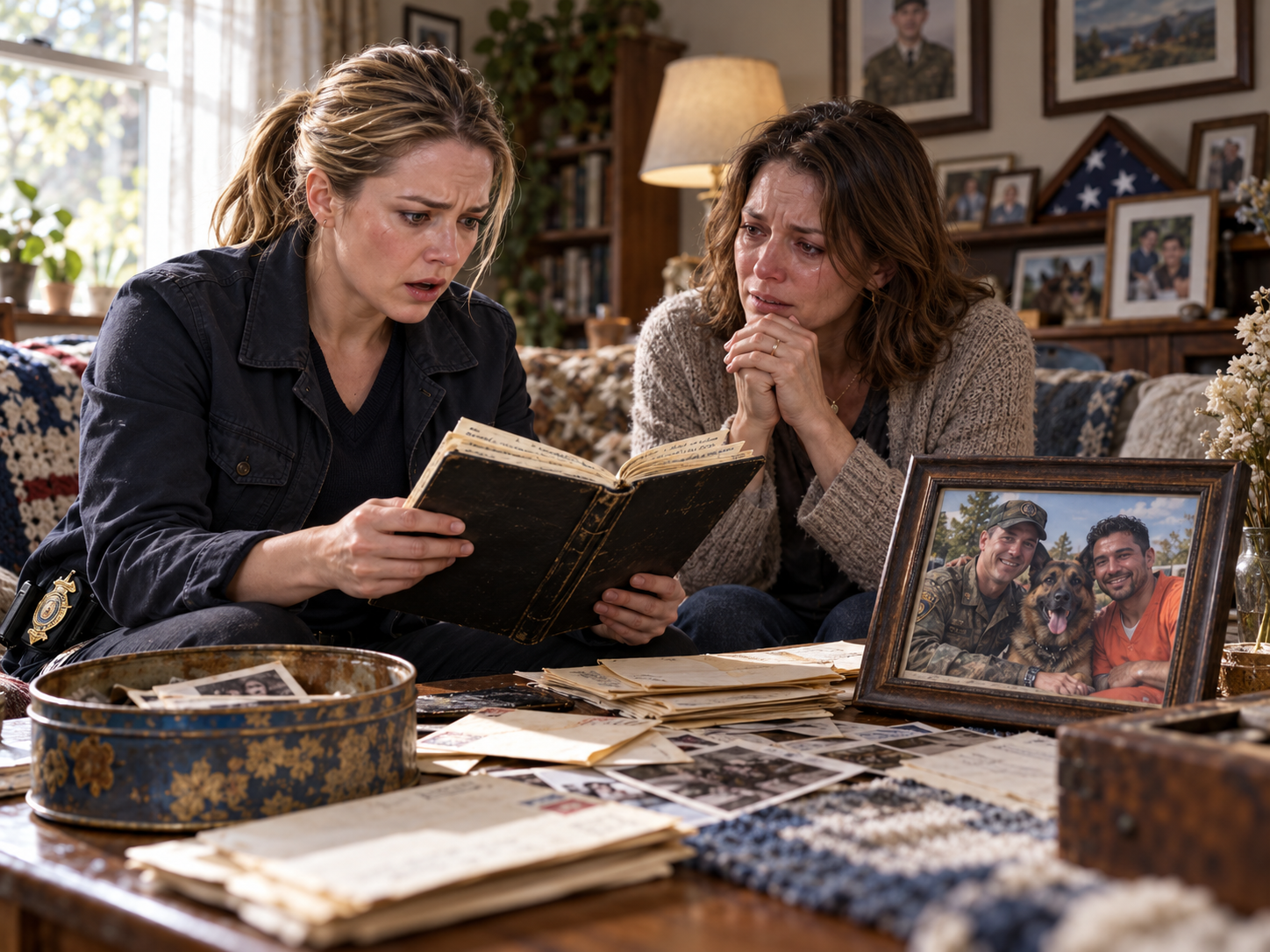
“Sarah.”
She leaned toward me.
“What?”
“This is Titan.”
Her face went pale.
I flipped through the remaining pages.
K9-17 appeared four times.
Beside the last entry, Thomas had written:
If they know what Titan found, they’ll destroy everything.
I stared at those words.
“What did Titan find?”
Sarah clasped her hands over her mouth.
“I wish I knew.”
One envelope contained photographs of an old warehouse complex.
Another held copies of inventory discrepancies.
The third contained a short handwritten letter.
I unfolded it.
Sarah,
If you’re reading this because something has happened to me, please don’t blame Daniel. Whatever they say, he stood beside me when everyone else turned away.
There are things I’ve discovered that I cannot safely explain in writing. Daniel knows some of them. Titan may know the rest.
Protect our son. Trust Daniel.
And remember that the truth doesn’t stop being the truth just because powerful people agree to deny it.
I love you.
Tom.
Sarah watched me read.
“He wrote that two nights before he died.”
My eyes burned.
“Why didn’t you show this to Daniel’s attorney?”
“I did.”
“And?”
“The defense tried to introduce it. The judge ruled portions of it inadmissible because Thomas wasn’t available for cross-examination. The prosecution called it speculation.”
She picked up the notebook.
“The inventory records weren’t enough by themselves. And the warehouse where Thomas took those pictures was destroyed in the fire.”
I looked at the dates.
Thomas had been collecting evidence for months.
Then he was dead.
Daniel was imprisoned.
And Titan’s early records had disappeared.
Someone had eliminated almost every remaining link to the investigation.
Almost.
“Sarah, do you still have Daniel’s attorney’s number?”
She nodded.
“Her name is Olivia Grant.”
“Call her.”
“Why?”
“Because we’re going to find out what K9-17 discovered.”
Olivia Grant was not what I expected.
She was in her late thirties, wore an inexpensive navy suit, and had the focused expression of someone who had spent years arguing with people who refused to listen.
We met at her office that afternoon.
The walls were covered with case files and newspaper clippings.
Daniel Reyes’s photograph occupied the center of a large bulletin board.
Next to it was a handwritten sentence.
Conviction is not the same as truth.
Olivia studied my suspended-duty notice.
“Voss moved quickly.”
“He wanted me to sign a false statement about Titan.”
“Did you?”
“No.”
“Good.”
She set the paper aside.
“Daniel told me about Titan for years. I thought I understood how much that dog meant to him.”
She glanced toward the photograph on the wall.
“Then I saw the video.”
“What did Daniel say after they took him away?”
“Not much. He’s been placed in temporary segregation while the facility reviews the incident.”
“Segregation? He didn’t do anything.”
“I agree. But an investigation into a security incident can provide a convenient reason to restrict communication.”
A cold weight settled in my stomach.
“Can you speak to him?”
“I’ve requested an attorney visit.”
“Will they allow it?”
“They have to provide reasonable access to counsel. But they can make the process difficult.”
She opened a thick file.
“Let’s start with what the prosecution claimed.”
The original case against Daniel rested on four important pieces of evidence.
First, his access card had supposedly been used to enter the municipal warehouse shortly before the fire.
Second, traces of an accelerant were found on a jacket recovered from his patrol vehicle.
Third, a department accountant claimed Daniel had been involved in unauthorized evidence transfers.
And fourth, an edited interview transcript appeared to show him admitting that he had argued with Whitaker over missing property.
“Daniel denied the allegations,” Olivia explained. “He said his access card disappeared two days before the fire. He insisted someone planted the jacket and altered the transcript.”
“Was there any physical evidence placing him at the ignition point?”
“No fingerprints or DNA tying him directly to the accelerant. But the prosecution argued the circumstantial evidence was overwhelming.”
“What happened to Titan that night?”
Olivia looked up.
“That’s one of the strangest parts.”
She removed another photograph from the file.
It showed Daniel outside the burning warehouse.
His face was blackened with soot.
Blood streaked his forehead.
Titan stood beside him, his coat scorched along one shoulder.
“Daniel entered the building after the fire started,” she said. “He was trying to reach Thomas.”
“What happened?”
“Part of the ceiling collapsed. Titan pulled him out.”
I remembered Daniel touching the scar above Titan’s shoulder.
“He told me.”
“Daniel suffered smoke inhalation and a fractured wrist. Titan needed emergency veterinary care.”
“And the prosecution said Daniel started the fire anyway?”
“They argued he returned to rescue Whitaker after realizing what he’d done.”
I stared at the photograph.
Daniel was kneeling beside Titan, holding the dog despite the blood running down his own arm.
Something about that picture didn’t resemble guilt.
It resembled devastation.
“Were there cameras?”
“Most were destroyed. One exterior recording survived, but the prosecution said it showed nothing useful.”
“Can I see it?”
Olivia hesitated.
Then she turned her computer toward me.
The footage was grainy.
A loading dock appeared in the distance.
A vehicle entered.
The timestamp read 9:41 p.m.
The vehicle stopped near a service entrance.
Someone climbed out.
A tall figure in a dark jacket.
He disappeared into the building.
Three minutes later, the camera feed flickered.
Then blackness.
“That’s it?” I asked.
“Yes.”
“Can you replay the beginning?”
She did.
I leaned closer.
“Pause there.”
The figure was stepping away from the vehicle.
His face was obscured by the angle.
But something was visible near his left hip.
A small, bright reflective strip.
My heart began beating faster.
“Do we know what kind of vehicle that is?”
“The state argued it was a department utility SUV. The plate wasn’t readable.”
I studied the shape.
The roofline.
The rear quarter window.
The side-mounted equipment box.
I’d seen vehicles like it before.
Not in regular patrol.
In the department’s special operations fleet.
I turned to Olivia.
“Can you obtain the original recording?”
“This is a copy of what was provided to the defense.”
“I need the original resolution if it still exists.”
“Why?”
“Because that vehicle might tell us who was inside the warehouse before it burned.”
Olivia studied my expression.
“You recognize it.”
“Not enough to identify a driver. But enough to know where we should start looking.”
She leaned back.
“Kate, I need you to understand something. If you’re right, this isn’t just about one questionable conviction.”
“I know.”
“It could implicate senior officers.”
“I know.”
“And Voss may already know you’ve spoken to Sarah.”
I looked at the photograph of Daniel and Titan.
“Then we need to move before he does.”
That evening, I returned to my apartment to find my front door unlocked.
I was certain I’d locked it.
I stood motionless in the hallway.
The narrow gap between the door and its frame seemed suddenly enormous.
My hand moved instinctively toward my hip.
No firearm.
No badge.
Voss had taken both.
I stepped back and called the police.
Two patrol officers arrived within minutes.
Together, we entered the apartment.
Nothing obvious had been stolen.
My television remained.
My wallet sat on the kitchen counter.
The laptop I’d left on my desk was still there.
But Titan’s training binder was missing.
So was the small USB drive where I kept copies of his medical records and certification videos.
One officer photographed the disturbed drawer.
The other asked whether I’d recently had an argument with anyone.
I nearly laughed.
Instead, I gave him the facts.
When they left, I installed a temporary door alarm and sat at my kitchen table.
Someone had entered my home looking for information about Titan.
The thought made my skin crawl.
I called Olivia.
“Someone broke into my apartment.”
Her voice sharpened.
“Are you hurt?”
“No.”
“Did you report it?”
“Yes.”
“What did they take?”
“Titan’s training records.”
A long silence.
Then Olivia said, “I’m contacting an investigator outside the department.”
“Who?”
“Special Agent Marcus Hale. State Bureau of Investigation. He reviewed Daniel’s case two years ago, but the inquiry went nowhere.”
“Why?”
“He couldn’t obtain enough independent evidence to reopen it.”
I looked toward the empty dog bed.
“Maybe now he can.”
The next morning, I received an unexpected visitor.
Sergeant Brooks stood outside my apartment carrying a large cardboard box.
She looked as though she hadn’t slept.
“I shouldn’t be here,” she said.
“Then why are you?”
She walked inside and placed the box on my table.
“Because I watched that dog cry yesterday.”
I opened it.
Inside were training photographs, early veterinary reports, canine certification records, and an old folder marked:
REYES, DANIEL — K9 UNIT 17.
I looked up.
“Where did you get these?”
“I made copies before Voss ordered the archive sealed four years ago.”
My mouth fell open.
“You knew?”
“I knew the records were being restricted. I didn’t know why. Not then.”
“Why didn’t you come forward?”
Brooks looked ashamed.
“Because I was afraid.”
She sank into a chair.
“My husband had just suffered a stroke. I was paying for his rehabilitation. Voss told me that anyone questioning the evidence in Reyes’s case could be investigated for interfering with a homicide prosecution.”
She wiped her face.
“I convinced myself I was protecting my family.”
I sat beside her.
“You can still help.”
She shook her head.
“Kate, I’ve spent four years wondering whether I could have changed what happened to Daniel.”
I placed a hand over hers.
“Then help change what happens next.”
She nodded.
Inside the folder was a veterinary report dated two days after the fire.
Titan had sustained a deep cut above his right shoulder, smoke irritation, and minor burns to his paws.
But the attached behavioral assessment contained something peculiar.
Subject demonstrates protective response when approached by unidentified male associated with warehouse incident.
I frowned.
“Unidentified male?”
Brooks leaned closer.
“Read the next line.”
Handler reports subject repeatedly reacting to odor retained on recovered fabric sample.
My pulse quickened.
“Fabric sample?”
She pointed to a handwritten notation.
Item transferred to Evidence Room B, locker 17.
I looked at her.
“Was the item ever tested?”
“I don’t know.”
“Where is it now?”
“That’s the problem.”
She took another document from the box.
A property transfer form.
The fabric sample had been removed from the evidence room four days after the fire.
Authorized by Captain Richard Voss.
The destination was listed as the canine training facility.
But there was no receipt confirming it ever arrived.
I looked up slowly.
“Voss took something Titan reacted to.”
Brooks nodded.
“And nobody knows what it was.”
I turned the page.
At the bottom, in different handwriting, someone had added a single sentence.
Officer Reyes requested sample be preserved for identification. Request denied.
I stared at those words.
Daniel hadn’t simply been trying to defend himself.
He had known that Titan might be able to identify someone connected to the fire.
Someone whose scent had been preserved on a piece of fabric.
Someone Captain Voss apparently didn’t want anyone to find.
Before I could say anything, Brooks’s phone rang.
She looked at the screen.
Her face went white.
“It’s the kennel supervisor.”
She answered.
I watched her expression change from concern to alarm.
“What do you mean he’s being transferred?”
A pause.
“Under whose authority?”
She closed her eyes.
Then she looked directly at me.
“Kate.”
I stood.
“What?”
“Titan’s being removed from the department kennel.”
“Where are they taking him?”
Her voice was barely a whisper.
“Voss has ordered him transported to an outside facility for an emergency behavioral assessment. No one will tell the kennel supervisor which facility.”
PART 4 — The Last Command
I was already reaching for my car keys when Brooks caught my arm.
“Kate, think carefully.”
“They’re taking Titan somewhere nobody will identify.”
“I know.”
“What exactly am I supposed to think about?”
“The fact that you’re suspended. You can’t walk into a secured kennel and demand they release him.”
I stopped.
She was right.
Every instinct I possessed told me to run to the facility, put myself between Titan and whoever had come for him, and refuse to move.
But if Voss wanted to make me look unstable, doing that would give him exactly what he needed.
I forced myself to breathe.
“Call the supervisor back. Ask for the written transfer order, the transport company’s name, and the receiving veterinarian.”
Brooks nodded.
“And you?”
“I’m calling Olivia.”
Ten minutes later, Olivia put me on a conference call with Special Agent Marcus Hale.
His voice was calm, direct, and unmistakably serious.
“Officer Miller, I need you to tell me exactly what you know.”
I explained the memorial incident.
The missing records.
The break-in.
The old evidence transfer form.
Then I told him about the order to move Titan.
When I finished, Hale was silent.
Finally, he asked, “Do you have the original document showing Voss authorized the transfer of the fabric sample?”
“Brooks has a contemporaneous copy.”
“Preserve it. Do not alter or annotate it. I’ll arrange to receive a forensic copy and interview her formally.”
“What about Titan?”
“I can contact the department’s legal counsel and the county attorney. We may be able to delay the transfer long enough to determine whether it’s legitimate.”
“May be able to?”
“I’m not going to promise you authority I don’t have, Officer Miller.”
I closed my eyes.
At least he was being truthful.
“Please,” I said. “He’s in danger.”
Hale’s voice softened.
“I understand. But I need you to let us establish the facts without giving Captain Voss grounds to accuse you of interfering.”
Then he added, “And stay away from the kennel until I call you.”
The call came forty-three minutes later.
The department’s attorney had requested a temporary hold on Titan’s transfer pending review of the conflicting paperwork.
An independent veterinarian would evaluate Titan at the existing facility.
For the moment, he was safe.
I sank onto the couch.
My relief lasted less than a minute.
Because Hale had another piece of news.
“Captain Voss submitted a report at eight this morning,” he said.
“What kind of report?”
“An internal allegation that you unlawfully accessed restricted department files relating to Daniel Reyes.”
I stared at the phone.
“Those files were provided to me by another officer.”
“Which is one reason I want everyone to stop making informal disclosures and start giving statements through counsel.”
“Am I being arrested?”
“No. But the allegation could complicate your employment situation.”
I rubbed my forehead.
“So Voss gets to accuse me while he’s the one withholding evidence?”
“We’re going to examine both claims.”
His even tone frustrated me.
But it also reminded me that a real investigation required more than suspicion.
“Did you receive the video Olivia sent?”
“Yes.”
“And?”
“We’re working on obtaining the original recording.”
“Do you recognize the vehicle?”
“I’m not discussing preliminary identifications yet.”
I knew enough about investigations to understand why.
Still, hearing it was difficult.
After we ended the call, I sat in silence for a long time.
For three years, I’d worn my uniform with pride.
I’d believed in the badge.
I’d believed that if you followed the rules, collected the evidence, and told the truth, the system would eventually work.
Now the man who commanded my unit was using those same rules to silence me.
And I couldn’t stop thinking about Daniel Reyes.
Four years in prison.
Four years without Titan.
Four years knowing the person responsible for his friend’s death might still be wearing a police uniform.
How had he survived?
Olivia arranged a meeting with Daniel the following afternoon.
She attended as his attorney. I was permitted to participate as a visitor after the facility approved the request.
He entered the interview room with his hands restrained in front of him.
Without Titan beside him, he looked older than he had at the memorial.
His face was narrow.
His hair was threaded with gray.
But when he recognized me, his expression softened.
“Officer Miller.”
“Kate,” I said.
He nodded.
“Kate.”
We sat across a metal table.
Olivia took out her notebook.
“Daniel, we need to discuss Thomas’s investigation and what happened to Titan after the fire.”
Daniel looked from her to me.
“Is Titan okay?”
“He’s safe for now.”
His shoulders dropped.
“Thank God.”
“He’s being evaluated, but we’ve prevented an immediate transfer.”
Daniel bowed his head.
“Thank you.”
I leaned forward.
“Why did Titan recognize you so quickly?”
Daniel gave a faint smile.
“Dogs remember more than people think.”
“I understand that. But he’d never behaved that way before.”
“He was probably frightened.”
“Of you?”
“No.”
Daniel looked down.
“Of losing me again.”
For a moment, no one spoke.
Then he explained.
After his wife, Rebecca, died of cancer, Daniel had spent nearly a year barely functioning outside his duties.
Titan had been his reason to get out of bed.
They’d trained together.
Driven together.
Gone hiking on Daniel’s days off.
On the anniversary of Rebecca’s death, Daniel would take Titan to a lake outside the city and sit beneath the same oak tree where he’d proposed to her.
“Rebecca called him our little shadow,” Daniel said.
His mouth trembled.
“She’d laugh at the size of him now.”
I smiled despite myself.
Daniel looked at me.
“When they arrested me, Titan was in the veterinary hospital. They wouldn’t let me see him.”
“What happened afterward?”
“I asked about him every day. My attorney filed requests. Eventually they told me he’d been reassigned.”
I felt a painful tightness in my throat.
“They told me he was doing well,” Daniel continued. “That was all I needed to hear.”
He looked down at his restraints.
“I didn’t want him waiting for a man who might never come home.”
I swallowed.
“He’s had a good life, Daniel.”
He looked up.
“I know.”
“How?”
“Because of the way he looked at you.”
I blinked.
Daniel smiled sadly.
“He trusted you. Even when he wouldn’t leave me, he still listened when you spoke. A dog doesn’t give that kind of trust away easily.”
For some reason, those words nearly broke me.
I’d spent days afraid that Titan’s recognition of Daniel somehow diminished the bond he had with me.
But Daniel seemed to understand what I hadn’t.
Love wasn’t a competition.
Titan could belong to both of our histories without betraying either one of us.
Olivia gently cleared her throat.
“Daniel, we need to talk about the warehouse.”
His expression changed.
The warmth disappeared.
“What have you found?”
“Thomas’s notebook,” she said.
Daniel went perfectly still.
“Sarah kept it?”
“Yes.”
He closed his eyes.
“Good.”
“There’s a reference to a fabric sample Titan reacted to.”
Daniel opened his eyes again.
“Gray canvas?”
Olivia leaned forward.
“Yes.”
He looked at me.
“Then you need to find it.”
“What was it?”
“A torn piece of a tactical equipment bag.”
“Where did it come from?”
Daniel folded his hands.
“Three weeks before the fire, Titan and I were assisting Thomas with an inspection at a municipal evidence depot. Thomas had discovered that several sealed shipments were being diverted before destruction.”
He paused.
“There was a man inside a restricted loading area. He wasn’t supposed to be there. When Thomas challenged him, the man ran.”
“Did you see his face?”
“Not clearly. He wore a hood and moved through a dark service corridor.”
“What happened?”
“Titan pursued him. The man squeezed through a damaged chain-link gate. His equipment bag caught on the wire and tore.”
“The fabric sample.”
Daniel nodded.
“Titan came back carrying it.”
“Was the man arrested?”
“No. We lost him near a utility access road.”
“Then why was the fabric important?”
“Because Titan had picked up the man’s scent. We believed we could use the sample in a controlled identification procedure if investigators located a suspect.”
“Was that ever done?”
Daniel’s expression darkened.
“No. Voss took control of the evidence before we could arrange it.”
Olivia wrote something down.
“What happened next?”
“Thomas discovered that someone in the command staff had authorized the shipments. He wouldn’t tell me the name over the phone. He said he’d found proof and wanted to show me at the warehouse.”
“The night of the fire?”
Daniel nodded.
“I arrived after someone triggered the alarm. Thomas was trapped inside.”
His breathing changed.
“I tried to reach him.”
I remembered the photograph.
The soot.
The blood.
Titan’s burned paws.
“Daniel,” I said, “what exactly happened when Titan pulled you out?”
He stared at the table.
“Part of the ceiling collapsed. I couldn’t see anything. I was trying to crawl toward Thomas’s voice.”
His hands tightened.
“Then Titan grabbed the back of my jacket and pulled.”
He swallowed.
“I fought him. I thought I still had time.”
Olivia reached across the table but stopped before touching him.
Daniel looked at her.
“I could hear Thomas calling my name.”
Silence fell.
“He called it twice.”
Daniel’s voice fractured.
“Then the roof came down.”
For several seconds, none of us spoke.
Finally, he continued.
“Titan wouldn’t let me go back. He stood in front of the doorway and barked until the firefighters pulled me away.”
He wiped his eyes against his sleeve.
“I was angry with him afterward.”
I stared at him.
“For saving you?”
“I couldn’t understand why I was alive and Thomas wasn’t.”
His expression crumpled.
“Every night for four years, I’ve heard Thomas calling me from inside that building.”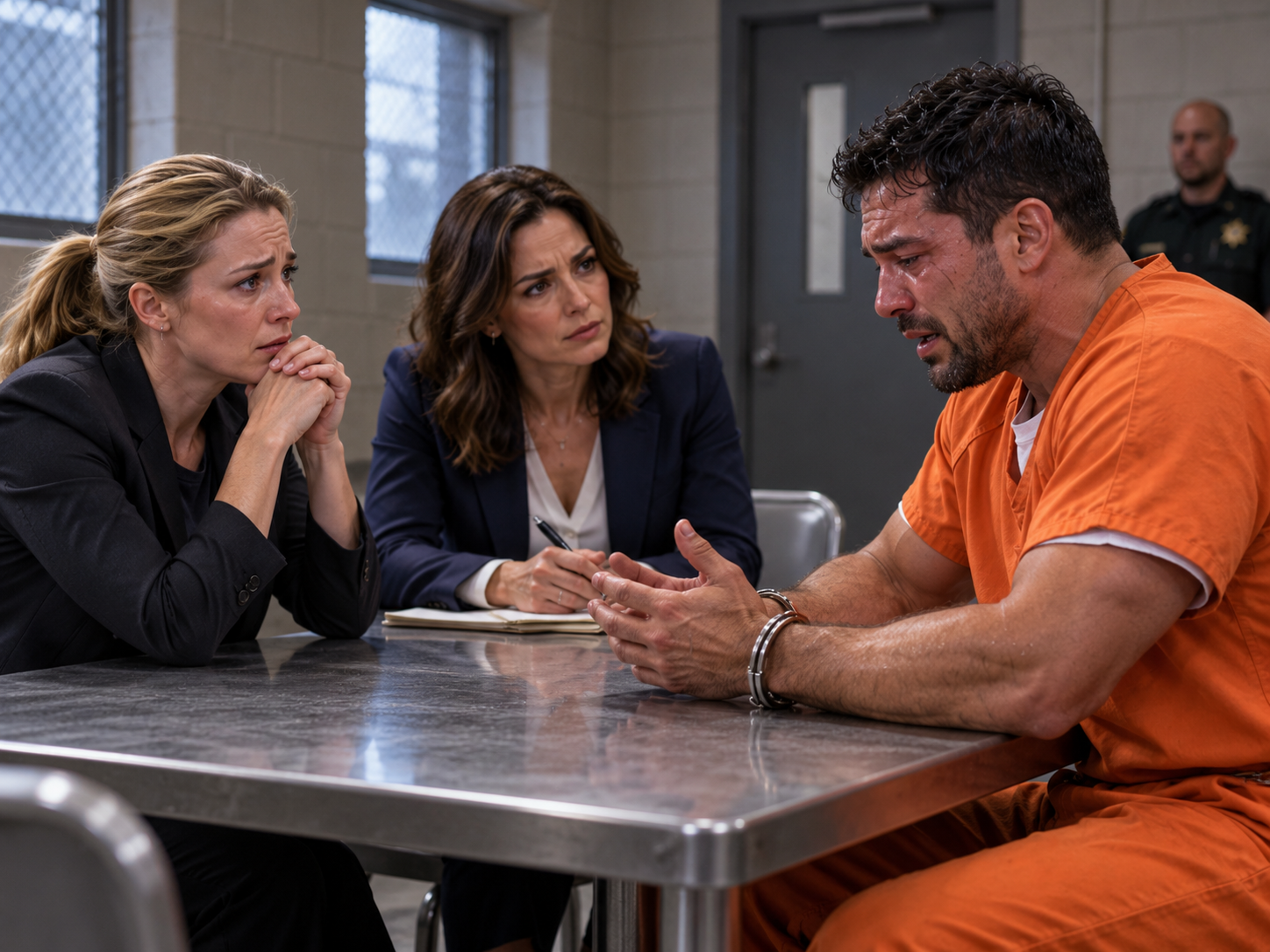
I leaned forward.
“Daniel, listen to me. You did everything you could.”
He shook his head.
“You don’t know that.”
“No,” I said softly. “But I know the dog who pulled you out. He doesn’t give up on someone he loves.”
Daniel looked at me for a long time.
Then he began to cry.
By Friday, Special Agent Hale had secured a court-authorized preservation order covering relevant department records.
His investigators obtained the warehouse footage from an off-site archival contractor that still possessed the original digital backup.
The improved recording didn’t reveal the driver’s face.
But it revealed something else.
The SUV carried a fleet number.
Twenty-seven.
Vehicle 27 was assigned to the Special Operations Division.
At the time of the fire, that division was commanded by Richard Voss.
It was a devastating discovery.
But it wasn’t conclusive.
Several officers had access to the vehicle.
And a defense attorney could argue that its presence near the warehouse was connected to legitimate police activity.
Hale needed more.
The missing fabric sample remained unaccounted for.
The vehicle access logs had been altered.
And the original warehouse security equipment was gone.
I began to fear the truth had been buried too deeply.
Then Sergeant Brooks remembered something.
A retired evidence technician named Harold Finch had worked in Property Room B when Daniel was arrested.
He had signed the original inventory entry for the fabric sample.
And unlike most people who’d worked on the case, Finch no longer depended on the department for his employment.
Olivia contacted him.
At first, he refused to speak.
Then Sarah Whitaker sent him a photograph of Thomas standing beside Daniel and Titan.
He agreed to meet Hale.
What Finch revealed changed the investigation.
Four years earlier, he had been ordered to prepare several evidence items for disposal.
One was the gray canvas fabric.
He remembered it because the disposal order had arrived before the associated case was closed.
That violated normal procedure.
Finch questioned the instruction.
The next day, his supervisor told him the item had been transferred and he was no longer responsible for it.
But Finch had already made a duplicate of the intake photograph and handwritten inventory sheet.
He also remembered the name of the officer who personally collected the sealed evidence envelope.
Not Richard Voss.
Lieutenant Aaron Pike.
Voss’s former executive officer.
Pike had retired suddenly six months after Daniel’s conviction.
And according to Hale, he now lived under a different surname in another state.
Two days later, Marcus Hale called with news I had barely dared to hope for.
Aaron Pike had agreed to cooperate.
Not out of generosity.
Not because his conscience had suddenly awakened.
But because investigators had confronted him with financial transfers linked to shell companies that handled the department’s evidence-disposal contracts.
Pike’s accounts contained payments he could not explain.
He asked for an attorney.
Then he began talking.
He admitted that Voss had overseen a network of unauthorized property transfers.
Evidence scheduled for destruction was quietly redirected to private buyers through fraudulent contractor paperwork.
Pike had helped manipulate records.
He also admitted collecting the fabric sample.
But the most important part of his statement concerned the night Thomas Whitaker died.
According to Pike, Voss learned that Whitaker had obtained records connecting the transfers to department officials.
Whitaker was lured to the municipal warehouse by a message sent from an internal account.
Voss arrived shortly before him.
An argument followed.
Pike claimed he was waiting outside when he heard shouting.
Then he saw smoke coming from a service entrance.
Voss emerged and ordered him to leave.
Pike insisted he hadn’t known Thomas was trapped inside.
And he claimed Voss had directed the effort to frame Daniel afterward.
Hale warned us that Pike’s account required independent corroboration.
A frightened accomplice had reasons to shift blame.
But for the first time, the investigation had a witness who could describe the scheme from inside.
Then came the discovery that nobody had expected.
Pike said Voss had kept copies of several original transfer ledgers in a personal storage unit.
He believed Voss intended to use them as protection against the other people involved.
A search warrant followed.
Inside the storage unit, investigators recovered financial records, equipment transfer forms, and a damaged hard drive.
They also found a sealed plastic evidence envelope.
Inside was a torn piece of gray canvas.
The original fabric sample.
The same item Titan had recovered four years earlier.
The envelope still carried an inventory label bearing Daniel’s name.
When Hale told me, I couldn’t speak.
“Can Titan identify the scent?” I finally asked.
“Possibly, but we’re not going to rely on an uncontrolled reaction.”
“What do you mean?”
“The sample is old and its handling history is compromised. Any canine examination would need an independent specialist, documented conditions, appropriate comparison samples, and a clear understanding of the limitations.”
“Of course.”
“Kate, I don’t want anyone claiming the dog solved a murder by himself.”
I looked down at the photograph of Titan on my phone.
“He didn’t.”
“Then you understand.”
“Yes.”
I did.
Titan had brought us to Daniel.
He had forced people to look at a story they’d tried to forget.
But the law would need documents, testimony, and independently verified evidence to correct the injustice.
Hale paused.
“There’s something else.”
I waited.
“The hard drive may contain material from the warehouse surveillance system.”
My heart quickened.
“Can you recover it?”
“Our digital forensics team is working on it.”
I closed my eyes.
For four years, Daniel had insisted the truth was still out there.
Now, piece by piece, it was beginning to emerge.
The forensic results came the following week.
Investigators recovered fragments of security footage showing Voss entering the warehouse.
Thomas Whitaker arrived several minutes later.
The men argued in a loading bay.
The recording had no sound.
But it showed Thomas trying to leave with a document pouch.
Voss blocked his path.
Thomas pushed past him.
Then Voss grabbed the pouch.
The camera lost sight of both men near the storage area.
A few moments later, smoke entered the frame.
The recovered recording ended before anyone emerged.
It did not show precisely how the fire began.
But it directly contradicted Voss’s earlier statement that he had never entered the building.
Combined with the financial evidence, altered access logs, Pike’s testimony, and documented suppression of evidence, it gave prosecutors grounds to pursue the case.
Voss was arrested outside his home three days later.
He was charged with offenses relating to corruption, evidence tampering, obstruction, and the warehouse fire. A homicide prosecution would require further proceedings and proof beyond a reasonable doubt.
When the news broke, reporters crowded the police headquarters.
Television cameras captured Voss being escorted into a vehicle.
He kept his head down.
The same man who had once ordered me to surrender my badge now faced an investigation into the actions he’d used his badge to conceal.
But I felt no satisfaction watching him.
Because Daniel was still in prison.
Thomas was still dead.
And Titan was still separated from us.
Justice had begun moving.
It hadn’t arrived yet.
The morning after Voss’s arrest, I received a letter from the department.
The emergency behavioral review had concluded that Titan displayed no generalized aggression and remained capable of controlled work.
His reaction at the memorial was classified as an extraordinary recognition event involving a former handler rather than a deliberate attack.
The permanent-retirement recommendation had been withdrawn.
My suspension was being reviewed separately.
I should have felt relieved.
Instead, I stared at the final paragraph.
Canine K9-17, commonly known as Titan, will remain in departmental custody pending reassignment determination.
Reassignment.
After everything we’d discovered, someone still thought they could simply send him to another officer.
I called Olivia.
“I’m not letting them move him again.”
“You won’t have to fight this alone,” she said.
“What can we do?”
“Daniel’s original ownership agreement is among the records Brooks preserved. He purchased Titan as a puppy and later transferred operational use to the department.”
“So who owns him?”
“It’s complicated. The agreement contains a reversion clause covering certain circumstances when the department ends a canine assignment.”
“Can we enforce it?”
“We’re going to find out.”
I looked at my empty living room.
“What does Daniel want?”
Olivia hesitated.
“He asked me a question yesterday.”
“What question?”
“He wanted to know whether you’d keep Titan if he couldn’t.”
The words struck harder than I expected.
I sat down.
“What did you tell him?”
“That you loved the dog.”
My eyes filled.
“Of course I do.”
“I know.”
I looked toward the empty bed beside the door.
“Olivia?”
“Yes?”
“Tell Daniel something for me.”
“What?”
“Tell him I’m not trying to take Titan away from him.”
I swallowed.
“I’m trying to bring them both home.”
PART 5 — A Promise Kept
The first time I saw Daniel Reyes without shackles, I almost didn’t recognize him.
He stood inside the courthouse wearing a dark blue suit that hung loosely from his shoulders.
His hair had been cut.
His face was clean-shaven.
But he still carried himself like a man expecting someone to order him back into a cell.
Olivia stood beside him.
Sarah Whitaker sat in the front row with her seventeen-year-old son, Matthew.
I had met Matthew only twice.
Both times, he’d barely spoken.
His father’s death had stolen something from him that no overturned conviction could restore.
And for years, he had believed Daniel Reyes was responsible.
I wondered what he was thinking now.
Six months had passed since the memorial ceremony.
Six months of hearings, forensic examinations, depositions, and negotiations.
The newly recovered evidence had fundamentally undermined Daniel’s original conviction.
The prosecution’s central witness had recanted material portions of his testimony after being confronted with evidence that he had received undisclosed benefits.
The original access logs had been shown to contain unauthorized modifications.
The financial records pointed toward the corruption operation Thomas had been investigating.
And the recovered surveillance footage contradicted the account that had been presented to Daniel’s jury.
The state had finally joined Daniel’s motion to vacate his conviction.
Today, the judge would decide whether the man Titan had embraced in front of five hundred people could walk out of the courthouse a free man.
Daniel glanced toward me.
I smiled.
He tried to smile back.
But his hands were shaking.
The hearing began at ten o’clock.
Judge Eleanor Whitcomb reviewed the evidence and listened to statements from both attorneys.
Olivia spoke about the years Daniel had lost.
She spoke about the damage caused when investigators conceal information that could change the outcome of a criminal trial.
And she spoke about the terrible consequences of treating a conviction as more important than the truth.
Then she turned toward Daniel.
“My client has spent four years imprisoned for a crime the state can no longer substantiate against him. He lost his profession, his reputation, his home, and the dog who had been his closest companion.”
Her voice remained steady.
“He cannot recover those years.”
She paused.
“But this court can ensure he does not lose another day because of that conviction.”
Across the courtroom, Sarah pressed a tissue against her eyes.
The prosecutor rose.
The state acknowledged that newly discovered evidence, material disclosure failures, and unreliable testimony had rendered the conviction unsustainable.
The prosecutor did not ask the judge to preserve it.
Instead, the state supported vacatur and dismissal of the charges against Daniel.
The judge read her ruling carefully.
Then she looked directly at him.
“Mr. Reyes, the judgment of conviction is vacated. The charges arising from this prosecution are dismissed.”
Daniel stared straight ahead.
For a moment, I wasn’t sure he’d understood.
The judge continued.
“You are to be released from custody in this matter immediately, subject to the completion of the necessary administrative procedures.”
Olivia closed her eyes.
Sarah began crying.
And Daniel lowered his head into his hands.
Four years.
Four years of waking behind locked doors.
Four years of hearing other prisoners call his name instead of his friends.
Four years of dreaming about a burning building and a dog he’d never had the chance to say goodbye to.
Now it was over.
Not all of it.
There would still be inquiries, civil proceedings, and criminal trials involving the men who had destroyed his life.
But Daniel was free.
Outside the courtroom, Sarah approached him.
Daniel saw her coming.
He stopped.
For several seconds, they faced each other in silence.
Then he spoke.
“Sarah, I’m so sorry.”
She shook her head.
“You didn’t kill him.”
Tears ran down Daniel’s face.
“I couldn’t save him.”
Sarah stepped closer.
“Tom knew you tried.”
Daniel covered his mouth.
“I heard him calling me.”
“I know.”
“I should have—”
“No.”
Her voice was gentle but firm.
“You don’t have to spend the rest of your life dying in that warehouse with him.”
Daniel began to sob.
Sarah embraced him.
And after a moment, Matthew stepped forward.
He was taller than his mother now.
He had Thomas’s dark eyes.
Daniel looked at him with an expression of unbearable sadness.
“Matthew.”
The young man hesitated.
“I hated you,” he whispered.
Daniel nodded.
“I know.”
“For years, I thought you killed my dad.”
“I know.”
Matthew’s eyes filled.
“Mom told me you were his best friend.”
Daniel swallowed.
“He was.”
The boy looked down.
Then he asked a question that made the hallway fall silent.
“Did my dad know you were trying to save him?”
Daniel’s expression crumpled.
“I hope so.”
Matthew stepped forward.
And hugged him.
It wasn’t a perfect moment.
There was too much grief for that.
Too many years that couldn’t be returned.
But it was a beginning.
And sometimes a beginning is the most beautiful thing two broken people can give each other.
Daniel’s release was followed by a complicated fight over Titan.
The department’s new leadership reviewed his original ownership agreement, the circumstances of his transfer, and his current welfare.
An independent veterinary specialist concluded that Titan was healthy, emotionally stable, and suitable for retirement.
The department eventually agreed to retire him from active service and release him under a jointly approved adoption arrangement.
Daniel would become his legal owner again.
But Daniel insisted on one condition.
He wanted me to remain part of Titan’s life.
When Olivia told me, I laughed through tears.
“That’s not a condition,” I said.
“Then what is it?”
“That’s family.”
My own suspension had been lifted after the investigation found no basis for the accusation that I had deliberately falsified or unlawfully exploited records.
I returned to duty.
But the events had changed me.
I began working with a new K9 partner, a young German Shepherd named Ranger.
He was enthusiastic, stubborn, and utterly convinced that every tennis ball on earth belonged to him.
Sometimes I caught myself giving him commands in the gentle voice I’d once reserved for Titan.
Then I’d smile.
Because Titan was finally going somewhere he belonged.
Three weeks after the courthouse hearing, Daniel invited me to his home.
He had rented a small house near the lake where he and Rebecca once spent their weekends.
There was a wooden porch.
A fenced yard.
And an enormous oak tree beside the water.
I pulled into the driveway just after noon.
Titan sat in the passenger seat.
He had been unusually quiet throughout the drive.
But the moment I stopped the car, his ears lifted.
He looked toward the house.
Then toward me.
“Do you know where we are?” I whispered.
His tail began moving.
I opened the door.
Titan leaped onto the gravel.
He sniffed the air.
Then a familiar voice came from the porch.
“Hey, big guy.”
Daniel stood beside the railing.
For a heartbeat, Titan froze.
Then he ran.
Not with the desperate urgency I’d witnessed at the memorial.
Not as though he feared losing someone again.
He ran with the pure, unrestrained happiness of a dog who had finally reached home.
Daniel dropped to his knees.
Titan collided with him, nearly knocking him backward.
They rolled together into the grass.
Daniel laughed.
A real laugh.
I had never heard him laugh like that.
“You remember this place?” he asked.
Titan licked his face.
“Of course you do.”
Daniel wrapped his arms around the dog.
“Welcome home, buddy.”
I stood beside the car, crying openly.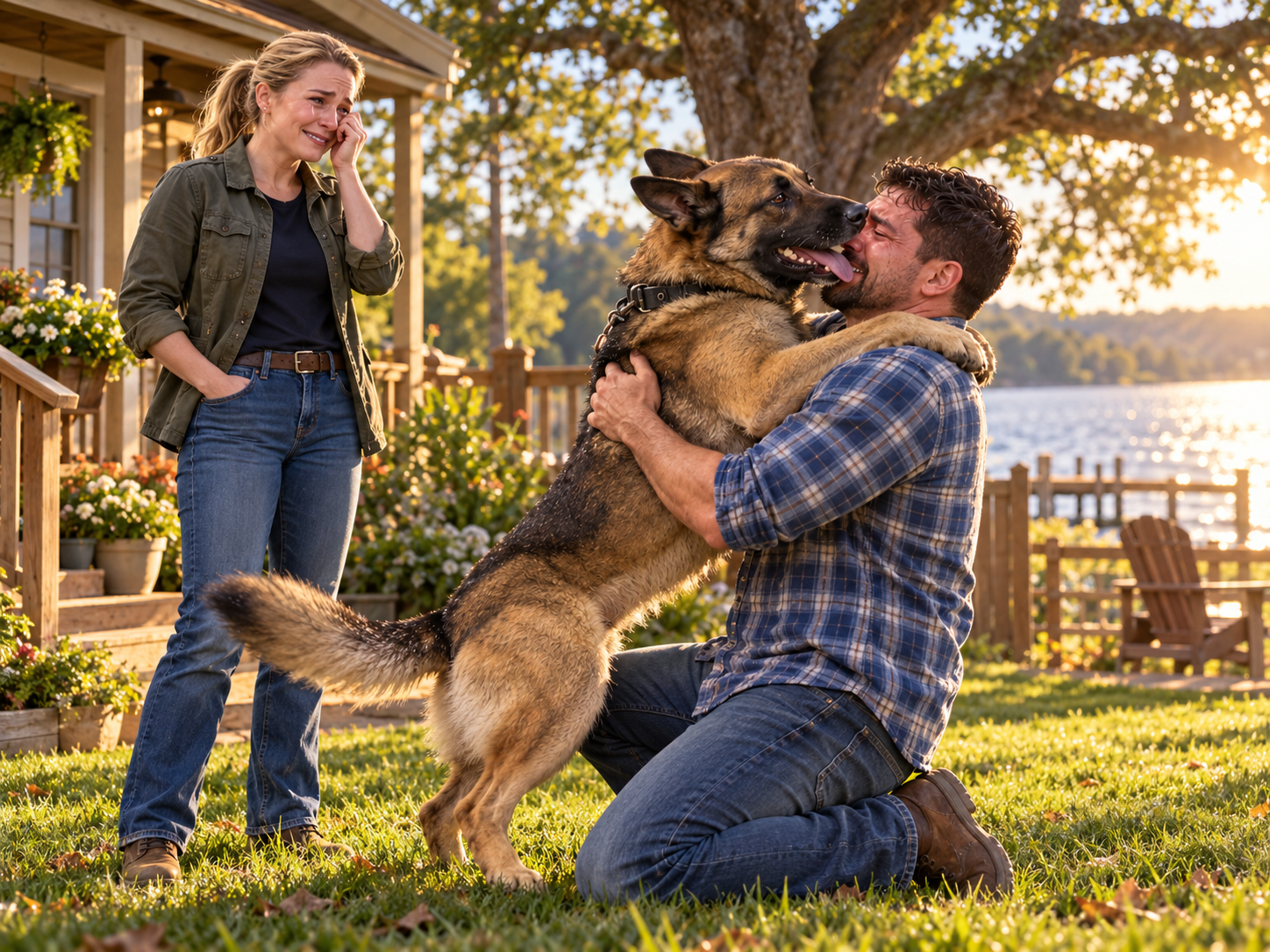
For three years, Titan had been my partner.
For four years before that, he had been Daniel’s best friend.
And somehow, after everything that had happened, we had found a way to give him both lives.
Daniel looked up.
“Kate?”
I wiped my cheeks.
“Yeah?”
“Come here.”
I walked toward them.
Titan immediately stood and hurried to me.
He pressed his head against my waist.
I knelt.
“Hey, partner.”
He leaned into my hands.
For a moment, I buried my face in his fur.
I thought about our first patrol.
The night he’d protected me during a dangerous arrest.
The mornings he’d refused to get out of bed.
The countless times he’d waited at the door because he knew I was coming home.
I kissed the top of his head.
“You were a good boy,” I whispered.
His tail swept the grass.
“The best.”
Daniel crouched beside us.
I looked at him.
“Take care of him.”
He smiled.
“With everything I have.”
I nodded.
Then Titan did something I wasn’t expecting.
He stepped backward.
Looked at Daniel.
Then at me.
And gently placed one paw on each of our knees.
Daniel laughed through tears.
I laughed too.
For a few seconds, the three of us stayed exactly like that.
Together.
A year later, the city held another Annual Fallen Officers Memorial Ceremony.
This time, Daniel was invited.
So was Titan.
The corruption investigation had led to multiple prosecutions. Captain Voss had been convicted of offenses involving the evidence-disposal scheme and obstruction, while proceedings concerning Thomas Whitaker’s death continued separately.
The department had introduced independent oversight for evidence handling, stronger reporting protections, and new procedures governing K9 retirement and reassignment.
Nothing could restore Thomas’s life.
Nothing could undo Daniel’s imprisonment.
But their names would no longer be used to protect the people who had betrayed them.
Sarah and Matthew stood beside Daniel when the ceremony began.
I waited near the memorial wall in my dress uniform.
Titan wore a simple blue collar.
No tactical harness.
No restraint chain.
Just a retired dog standing beside the people who loved him.
When the bagpipes began, Daniel rested one hand on Titan’s shoulders.
The dog stood calmly.
Five hundred people watched.
Some of them had been present the year before.
They remembered the screaming.
The raised shotgun.
The desperate chase across the lawn.
They remembered the prisoner in orange.
And the police dog who refused every command to reach him.
Now Daniel stood before them as a free man.
When the ceremony concluded, Sarah walked toward the granite wall carrying a single white rose.
She placed it beneath Thomas’s name.
Daniel joined her.
For several moments, they stood without speaking.
Then Daniel reached into his pocket and removed an old photograph.
The same photograph I’d seen in Sarah’s house.
Thomas.
Daniel.
Titan.
Three partners smiling beside a patrol vehicle.
Daniel set it against the stone.
“I’m sorry it took so long, brother,” he whispered.
Titan approached.
He sniffed the photograph.
Then lowered himself quietly beside it.
He rested his head on his paws.
Nobody gave him a command.
Nobody asked him to stay.
He simply remained there.
Beside the name of a man he’d once loved.
Sarah began crying.
Matthew put an arm around her.
Daniel bowed his head.
And I realized something.
For years, I’d thought Titan’s greatest gift was his courage.
His speed.
His strength.
His willingness to run toward danger when everyone else ran away.
But I had been wrong.
His greatest gift was that he had never stopped loving the people who mattered to him.
He had remembered Daniel when the world had forgotten him.
He had recognized the man beneath the prison uniform when everyone else saw only a number.
And when the entire crowd expected violence, Titan had offered something else.
Love.
The kind that asks nothing.
The kind that survives separation.
The kind that doesn’t disappear simply because someone has been taken away.
That evening, after the ceremony, Daniel invited Sarah, Matthew, and me to the lake house for dinner.
We grilled burgers beneath the oak tree.
Matthew threw a tennis ball for Titan until the old dog finally decided he’d had enough and carried it beneath the porch.
Sarah laughed for the first time I’d heard in years.
Daniel told stories about Thomas.
Not the terrible final night.
The good stories.
The time Thomas fell into a creek while chasing a suspect who turned out to be an escaped goat.
The afternoon Titan stole his entire lunch from an unlocked patrol car.
The Christmas when Thomas dressed the dog in reindeer antlers and convinced everyone at the precinct to pose for a photograph.
By sunset, we were all laughing.
And for a little while, grief loosened its grip.
Later, I found Daniel standing near the water.
Titan rested beside him.
“Thinking about Thomas?” I asked.
Daniel nodded.
“I used to believe surviving was the worst thing that happened to me.”
I stood quietly.
“Every morning in prison, I woke up angry that he was gone and I was still here.”
He looked down at Titan.
“But now I think about everything I would have missed.”
“Like what?”
He smiled faintly.
“This house. Sarah smiling again. Matthew becoming a good man.”
Then he looked at me.
“And meeting the officer who refused to let someone shoot my dog.”
I laughed softly.
“You would’ve done the same.”
“Maybe.”
He grew quiet.
Then he said, “You saved both of us, Kate.”
I shook my head.
“No.”
I looked toward Titan.
“He saved us.”
Daniel followed my gaze.
Our old dog was lying in the grass, watching the sunlight shimmer across the water.
For once, he didn’t look like a police K9.
He didn’t look like an animal trained to chase danger.
He looked like what he’d always deserved to be.
A beloved dog.
Safe.
At peace.
Home.
I knelt beside him and scratched behind his ear.
“Home base, Titan.”
His eyes closed.
His tail tapped the ground once.
Daniel smiled.
And under the fading gold of the evening sky, I finally understood what those two words had meant to them all along.
Home wasn’t a building.
It wasn’t a uniform.
It wasn’t a badge, a title, or a place on a map.
Home was the person who remembered you.
The person who came looking when the world abandoned you.
The person who refused to believe that your story was over.
Four years earlier, Daniel Reyes had lost everything.
A friend.
His freedom.
His reputation.
His best friend.
At the memorial, the world had watched a police dog break free and race toward a shackled prisoner.
They thought they were witnessing an attack.
But Titan had recognized something that hundreds of people couldn’t see.
Not a criminal.
Not Inmate Number 34.
Just Daniel.
The man who had raised him.
The man who had loved him.
The man he’d spent four long years waiting to see again.
And in the end, Titan hadn’t needed words to tell the truth.
He had simply run toward the person he remembered.
Because sometimes the most powerful act of loyalty isn’t fighting for someone.
It’s refusing to forget them.
And sometimes, the one who brings a lost man home has four paws, a faithful heart, and a love that never learned how to give up.
THE END.