The Feared Cowboy Gave a Frozen Widow and Her Children the Only Bed in His Cabin PART 2 — The Secret Beneath the Snow
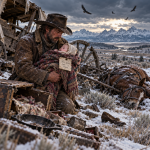
For years, the people of the county had feared the lonely cowboy who lived beyond the northern ridge. They called him dangerous, ruthless, and incapable of kindness.
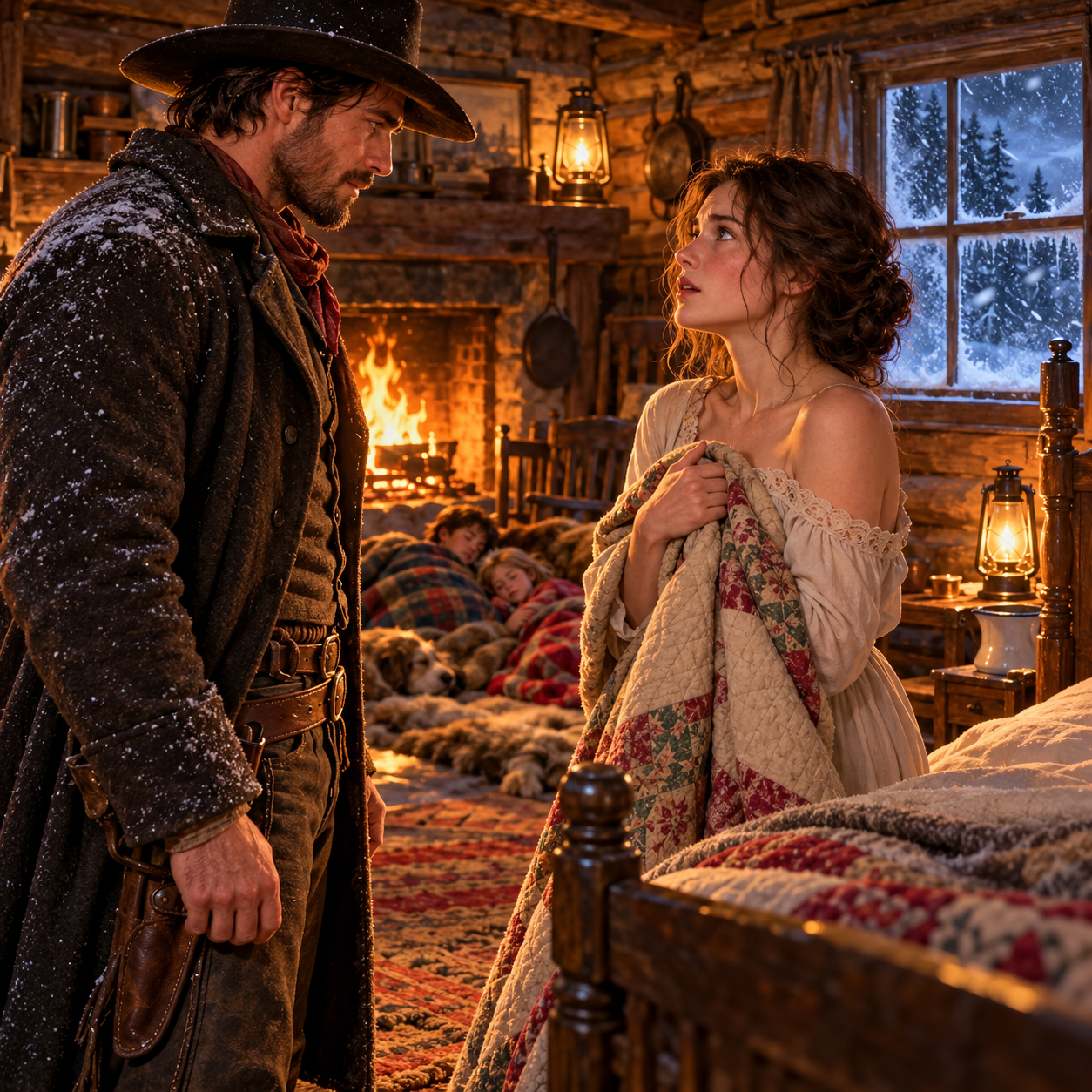
But when a desperate widow and her two freezing children appeared at his cabin during the worst blizzard of the winter, he did something nobody would have believed.
He carried the children inside, fed them, sheltered their exhausted horse, and offered them the only proper bed in his home.
The widow had buried her husband just six days earlier. The bank had taken their farm, and the neighbors who once called them friends had turned their backs.
With nowhere else to go, she had nearly lost her children to the storm.
Now, standing inside a stranger’s cabin, she faced a different kind of uncertainty.
There was only one bed.
And the feared cowboy had just told her she would sleep beside him—or not sleep at all.
What she didn’t know was that the man who had saved her children was hiding something about her dead husband.
And before another sunrise, the past would come knocking at his door.
PART 2
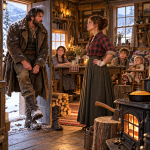
For several seconds, the widow simply stared at me.
The fire crackled behind her, throwing trembling shadows across her tired face.
She was a beautiful woman, though exhaustion and grief had nearly erased every trace of it. Her dark hair had loosened from its pins. Her hands were red and swollen from the cold, and there was something in her eyes I recognized immediately.
A woman who had spent too many days being afraid of what might happen next.
“My name is Margaret,” she said at last.
I hadn’t asked.
Perhaps that was why she told me.
“Margaret Whitcomb.”
The name struck me harder than the winter wind.
Whitcomb.
I kept my expression still.
“And the children?” I asked.
“Samuel and Lucy.”
I looked toward the hearth.
The boy couldn’t have been older than eight. His little sister was perhaps five. They slept curled beneath the heavy blankets I’d given them, their faces finally showing the peace their mother had been denied.
“I’m Caleb Mercer,” I said.
Margaret’s expression changed.
It was a small thing.
A tightening around her mouth.
A flicker of recognition.
Then she looked toward the door as though she had suddenly remembered every warning she’d ever heard.
“Caleb Mercer?”
I nodded.
“The one from Blackthorn Ridge?”
“That’s what folks call the place.”
Her fingers tightened around the blanket.
I knew what came next.
The stories always reached people before I did.
The man who once broke a cattle thief’s jaw with his bare hands.
The cowboy who supposedly killed three men in a saloon dispute.
The rancher who refused visitors and kept a loaded rifle beside his door.
Some stories were exaggerated.
Others weren’t entirely wrong.
But none of them explained why I lived alone.
“You’ve heard of me,” I said.
Margaret lowered her eyes.
“People talk.”
“They usually do.”
Another gust of wind slammed against the cabin.
The little girl stirred in her sleep.
Margaret immediately turned toward her.
I watched the way she moved.
Even with her own body trembling from exhaustion, her first thought was for the children.
That told me more about her than anything people might have said.
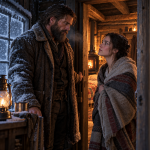
“You can have the bed,” I told her.
She glanced back.
“And you?”
“I’ll sleep where I please.”
“But you said—”
“I said you weren’t sleeping on the floor. I didn’t say you had to share my bed if you didn’t want to.”
A faint expression crossed her face.
Relief, perhaps.
Or surprise.
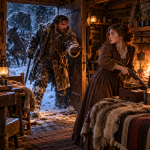
I pulled a spare buffalo hide from a chest near the wall and spread it beside the hearth.
“I’ve slept on colder ground than this.”
Margaret looked at the hide.
Then at the bed.
Then, unexpectedly, she gave a small, tired laugh.
It was the first pleasant sound I’d heard in that cabin for months.
“You certainly have an unpleasant way of being kind, Mr. Mercer.”
“Most folks say I have an unpleasant way of doing everything.”
Her smile disappeared almost as quickly as it came.
“I’m sorry.”
“Don’t be.”
I added another log to the fire.
“Get some sleep, Margaret.”
For a moment, she seemed about to argue.
Then she looked at her children and quietly obeyed.
I turned away while she settled beneath the covers.
But long after the lamp went out, I remained awake.
Because I knew that name.
Whitcomb.
And I knew her husband had not been the kind of man who would willingly leave his family with nothing.
I knew something else, too.
Three weeks earlier, a man named Thomas Whitcomb had ridden to my ranch carrying a leather satchel.
And what he’d told me that afternoon had changed everything.
The storm grew worse after midnight.
Wind screamed through the pines, sending waves of powdered snow against the cabin walls.
I lay on the buffalo hide, staring into the dying fire.
Margaret slept in the bed.
Her children breathed softly near the hearth.
For the first time in seven years, there were other people beneath my roof.
I should have found comfort in that.
Instead, I felt the weight of a promise I’d made to a dead man.
Thomas Whitcomb had arrived at my ranch on a gray afternoon near the beginning of winter.
His horse was exhausted.
His coat was muddy.
And someone had been following him.
I remembered how he’d looked over his shoulder before dismounting.
“Mercer,” he’d said, “I need a man who isn’t afraid of powerful people.”
I’d nearly sent him away.
“Then you came to the wrong place.”
He’d given me a strange smile.
“No. I think I came to the only place.”
We’d spoken for nearly an hour.
When he finally rode away, he’d left something in my keeping.
Something dangerous enough to destroy the men who controlled half the county.
I’d promised to keep it hidden until he returned.
But he never did.
And six days ago, according to his widow, Thomas Whitcomb had been buried.
I closed my eyes.
There were too many things that didn’t fit.
Thomas had been a careful man.
He understood numbers, property boundaries, and contracts better than most lawyers.
He’d told me that the bank was involved in something far worse than ordinary foreclosures.
And he’d sworn he had proof.
So why had he died?
And why had the bank taken his family’s home so quickly?
A soft voice interrupted my thoughts.
“Mr. Mercer?”
I turned.
Margaret was sitting up in bed.
Her hair fell loose around her shoulders.
“Go back to sleep,” I said.
“I can’t.”
“Too cold?”
“No.”
She looked toward the sleeping children.
Then she whispered something that made me sit upright.
“Do you believe a man can know he’s going to die?”
I didn’t answer immediately.
“Sometimes.”
“My husband did.”
The cabin seemed to grow very quiet.
Margaret drew the blanket closer.
“Thomas was different during his last few weeks. He kept looking down the road. He stopped sleeping properly. Sometimes I’d wake in the night and find him standing at the window.”
I watched her carefully.
“Did he tell you why?”
“He said he was worried about the farm.”
“Was he?”
“I thought so.”
Her voice trembled.
“But the day before he died, he told me something strange.”
“What?”
Margaret swallowed.
“He said that if anything happened to him, I shouldn’t trust the bank.”
The fire snapped sharply.
I felt my jaw tighten.
“Did he say anything else?”
She nodded.
“He told me there was one man who could help us.”
My heart began pounding.
“What man?”
Margaret hesitated.
“That’s the part I never understood.”
She raised her eyes.
“He said I should find Caleb Mercer.”
For a moment, neither of us spoke.
Outside, the storm howled against the cabin.
Finally, Margaret whispered, “He told me you were dangerous.”
I gave a humorless smile.
“That’s a common opinion.”
“But he said something else.”
“What?”
Her eyes glistened.
“He said you were dangerous to the right people.”
I stood and walked toward the window.
Snow pressed against the glass.
Beyond it, the world was nothing but blackness and white.
Thomas had known.
Somehow, he’d known there might not be time to come back.
And now his family was sleeping beneath my roof.
“Did your husband tell you how he died?” I asked.
Margaret stared at me.
“How he died?”
I turned.
“You said you buried him six days ago.”
“Yes.”
“What happened?”
Her face lost its color.
“He was thrown from his horse.”
“Where?”
“Near Miller’s Crossing.”
I knew that stretch of road.
It was narrow and rocky, with a steep embankment above the creek.
A careless rider might easily lose his footing there.
But Thomas Whitcomb had ridden that road for twenty years.
“He was found at the bottom of the ravine,” Margaret continued. “Sheriff Harlan said his horse must have stumbled on the ice.”
“Did anyone see it happen?”
“No.”
“Was his horse found?”
“Yes. The next morning.”
“Was it injured?”
She frowned.
“I don’t know.”
I turned back toward the window.
There it was.
Another piece that didn’t fit.
A careful rider.
An empty road.
A sudden death.
And a bank that moved with remarkable speed to claim his property.
“Mr. Mercer?”
I looked back.
“Why are you asking me these questions?”
I could have told her everything.
I could have opened the locked chest beneath my floorboards and shown her what her husband had trusted me to protect.
But she had barely survived the storm.
Her children were finally warm.
And I hadn’t yet established who might be watching the ranch.
“Because your husband came to see me,” I said.
Margaret went perfectly still.
“When?”
“Three weeks ago.”
Her lips parted.
“Thomas never told me.”
“He had reasons.”
“What reasons?”
“Margaret—”
“No.”
She pushed the blanket aside.
“Please don’t tell me to rest. Everyone has been telling me what to do since Thomas died. The sheriff told me not to ask questions. The banker told me to be reasonable. Our neighbors told me to accept what happened.”
Her voice grew stronger.
“I have buried my husband, lost my home, and nearly watched my children freeze to death.”
She stood beside the bed.
“If you know something about Thomas, I deserve to hear it.”
I couldn’t argue with that.
But the truth was dangerous.
Before I could answer, Samuel began coughing.
At first, it was a small, dry sound.
Then it grew deeper.
Margaret hurried toward him.
“Samuel?”
The boy twisted beneath the blanket.
His cheeks were flushed.
I crossed the room and touched his forehead.
Hot.
Far too hot.
His skin had been icy when I carried him inside, but now the boy’s body burned with fever.
Margaret looked at me with sudden terror.
“He was fine before.”
“He was exhausted.”
Samuel coughed again.
His breathing sounded rough.
I brought another blanket, checked his hands and feet for lingering cold injury, and helped Margaret settle him near the fire without overheating him.
“Has he been sick?” I asked.
“He had a cough before we left. I thought it was only the cold.”
She brushed damp hair from his forehead.
“Samuel, sweetheart, can you hear me?”
The boy opened his eyes.
“Ma?”
“I’m here.”
His voice was barely a whisper.
“Are we home?”
Margaret’s face crumpled.
She looked at the rough cabin walls.
At the fire.
At me.
Then she bent and kissed his forehead.
“Not yet, darling.”
Something in my chest twisted.
I had survived broken ribs, stampedes, and more winters than I cared to count.
But that little boy asking whether he was home nearly brought me to my knees.
I went to the cupboard and took down the medical supplies I kept for emergencies.
The boy needed rest, warmth, fluids, and someone to watch his breathing.
If his condition worsened, he would need a doctor.
But the nearest physician was twelve miles away.
And outside, the blizzard was still raging.
I looked at Margaret.
“Keep him comfortable. Offer him small drinks when he’s fully awake.”
“What are you going to do?”
“See how much of the trail is buried.”
Her eyes widened.
“You can’t go out there.”
“I’m not riding to town in this.”
“Then why—”
“Because when the storm breaks, I may have to.”
She looked back at her son.
“Will he be all right?”
I wished I could promise her.
Instead, I knelt beside the boy.
“Samuel?”
He opened his eyes again.
“Yes, sir?”
“You’ve got some strength left in you?”
A small nod.
“Good. Your mother’s going to need you to use it.”
The boy tried to smile.
“I can.”
I patted his shoulder.
“That’s what I wanted to hear.”
By morning, the storm had weakened slightly.
Snow still fell, but the wind no longer shook the cabin with quite the same fury.
Samuel’s fever remained, though he was alert enough to drink warm broth.
Lucy had awakened frightened and hungry.
Margaret sat between her children, trying to hide her own exhaustion.
I made breakfast.
Biscuits.
Beans.
The last of the smoked bacon.
Lucy watched me from beneath a blanket.
“Are you really a bad man?”
Margaret nearly dropped her cup.
“Lucy!”
I glanced at the little girl.
“Depends who you ask.”
She considered this.
“Mrs. Bell said you once threw a man through a window.”
“Lucy, that’s enough,” Margaret whispered.
I stirred the beans.
“Did she say why?”
Lucy shook her head.
“He was trying to steal my horse.”
Her eyes widened.
“Did he get it?”
“No.”
“Did you really throw him through a window?”
I paused.
“Doorway.”
Lucy blinked.
“That’s different?”
“Very.”
For the first time, Samuel laughed weakly beneath his blankets.
Margaret pressed a hand over her mouth, fighting a smile.
It was a small moment.
Ordinary.
Warm.
The sort of moment my cabin had forgotten how to hold.
Then Lucy asked a question that made every sound seem to disappear.
“Mr. Mercer, do you have children?”
I stopped moving.
Margaret looked up.
“Lucy, sweetheart—”
“It’s all right,” I said.
I set the pan aside.
“No, little one. Not anymore.”
Lucy frowned.
“What does that mean?”
I stared at the fire.
“It means I used to.”
Margaret’s face softened.
“I’m sorry.”
I nodded once.
That was all I could manage.
Seven years had passed.
Seven winters.
And still, there were mornings when I expected to hear small footsteps running across the floor.
I turned away before anyone could see my expression.
But children notice things grown people pretend not to.
Lucy climbed down from her chair.
She crossed the room with her blanket dragging behind her and took hold of my hand.
Her fingers barely circled two of mine.
“You can borrow us,” she said.
I looked down.
She gave me a solemn nod.
“Until you aren’t sad anymore.”
I couldn’t speak.
Behind her, Margaret’s eyes filled with tears.
I squeezed the little girl’s hand gently.
“That’s a mighty generous offer.”
Lucy smiled.
Then she returned to her breakfast as though she hadn’t just broken open a part of me I’d spent seven years burying.
Near midday, I went outside to clear the barn entrance.
Snow reached above my knees in places.
The wind had carved enormous drifts against the fence, and the wagon was almost completely buried.
Margaret’s horse stood inside the barn, warm and fed.
I checked its hooves, rubbed down its coat, and gave it fresh water.
Then I noticed something strange.
There were tracks near the outer fence.
Not mine.
Not the wagon horse’s.
The snow had partly covered them, but I could still make out the shape.
A shod horse.
Large.
Heavy.
And the tracks led toward the ridge.
Someone had been near my property.
During the storm.
I crouched and examined the impressions.
The wind had erased most of their edges, but one was sheltered beneath a fallen branch.
The shoe had a distinctive notch on its outer rim.
I knew that mark.
I’d seen it once before.
On the horse belonging to Sheriff Amos Harlan.
I stood slowly.
Across the white valley, the ridge disappeared beneath low clouds.
What reason would the sheriff have to ride this far into the mountains during a blizzard?
And why would he leave without approaching the cabin?
I looked toward the house.
Smoke rose gently from the chimney.
Behind those walls were a woman and two children who had nowhere else to go.
A terrible thought settled into my stomach.
Perhaps Margaret hadn’t found my ranch by accident.
Perhaps someone had been following her.
I returned to the cabin carrying an armful of firewood.
Margaret looked up immediately.
“Is something wrong?”
“Why?”
“Your face.”
I dropped the wood beside the hearth.
“Nothing you need to worry about.”
She gave me a look that reminded me sharply of Thomas.
“Mr. Mercer, I am beginning to think that whenever you say that, there is something I absolutely need to worry about.”
I almost smiled.
Instead, I checked Samuel’s forehead.
His fever had eased slightly, and he was sleeping more comfortably.
Lucy sat nearby drawing shapes in the dust on a wooden board.
I waited until both children were occupied.
Then I turned to Margaret.
“Did anyone know you were coming here?”
She frowned.
“Coming here?”
“To my ranch.”
“I didn’t know where I was going. I was trying to reach my cousin in Cedar Hollow.”
“Who knew you were leaving town?”
“The banker. Sheriff Harlan. A few neighbors.”
“What did the sheriff say?”
Her expression darkened.
“He told me the roads weren’t safe.”
“Anything else?”
“He said I ought to stay in town until the bank finished its paperwork.”
“Why didn’t you?”
She looked toward her children.
“Because Mr. Pritchard had already changed the locks on our house.”
I felt something cold and angry rise inside me.
“He put you out in winter?”
“He said the property had been surrendered to the bank.”
“Had it?”
Margaret hesitated.
“Thomas owed money. I knew that much. But the amount Mr. Pritchard showed me was almost three times what my husband had mentioned.”
“Did you see the original loan documents?”
“No.”
“Did you sign anything?”
Her face changed.
“Yes.”
My stomach sank.
“What?”
“A release. Mr. Pritchard said it would allow him to sell the livestock and settle the debt.”
“Margaret…”
She looked frightened.
“What?”
“Did you read it?”
“He wouldn’t let me take it home. He said the children and I would receive enough money to start over.”
“And did you?”
She shook her head.
“He told me there were additional charges. Storage fees. Interest. Legal expenses.”
I clenched my jaw.
Thomas had been right.
The bank wasn’t merely foreclosing on properties.
It was manufacturing debt.
And the widow sitting before me was its latest victim.
Margaret watched my expression.
“You know something.”
I went to the fireplace.
Above it hung a small framed photograph.
Most visitors never noticed it.
A younger version of myself stood beside a woman with bright eyes and a little boy holding a wooden horse.
My wife.
My son.
Both gone.
I took the photograph down and set it carefully on the mantel.
Then I knelt beside the hearth.
Margaret watched in silence as I lifted the edge of a loose floorboard.
Beneath it was a narrow compartment.
Inside lay a small iron box.
I carried it to the table.
Margaret stared.
“What is that?”
“Something your husband left with me.”
Her breath caught.
“Thomas?”
I nodded.
“When he visited three weeks ago, he was frightened.”
She sat down slowly.
“Thomas was never frightened.”
“Everyone gets frightened when the stakes are high enough.”
I unlocked the box.
Inside were several folded documents, a leather-bound account book, and a sealed envelope.
Across the envelope, written in Thomas Whitcomb’s unmistakable handwriting, were five words:
For Margaret, if I disappear.
Her hand flew to her mouth.
“Oh, God.”
She reached toward it, then stopped.
“Why didn’t you tell me?”
“Because Thomas asked me not to open the box unless he came back—or unless you found me.”
Tears spilled down her cheeks.
She touched the envelope as though it were something alive.
“May I?”
“It’s yours.”
She broke the seal.
I watched her read the first line.
Then the second.
Her expression changed.
Grief gave way to bewilderment.
Then disbelief.
She whispered, “No…”
I leaned forward.
“Margaret?”
She looked up at me.
Her voice shook.
“He says he didn’t owe the bank anything.”
I nodded grimly.
“He’d paid every dollar.”
“But then why—”
“Because somebody wanted the farm.”
She lowered her eyes to the letter again.
I watched the color drain from her face.
“What is it?”
She read aloud.
“If Mr. Pritchard claims the land, do not sign away the north pasture. Whatever happens, Margaret, you must protect the old well.”
I went still.
The old well.
Thomas hadn’t mentioned an old well.
He’d spoken of fraudulent accounts, stolen land, and powerful men.
But never a well.
Margaret looked at me.
“What does that mean?”
“I don’t know.”
“Thomas says there is something beneath it.”
She turned the page.
Then her hands began shaking so violently she could barely hold the paper.
“Caleb…”
It was the first time she’d spoken my given name.
I looked at her.
“What?”
She swallowed.
“Thomas says if anyone discovers what’s buried there, they will kill to keep it hidden.”
Before I could answer, three sharp knocks struck the cabin door.
Margaret jumped.
Lucy looked up from the hearth.
“Who is it?”
I rose.
No one came to my ranch in winter without a reason.
And no one traveled through that much snow unless the reason was important.
Or dangerous.
I moved toward the window.
Through a narrow gap in the curtain, I saw three mounted men standing in the yard.
Their horses steamed in the cold.
The man in front wore a dark coat and a silver star.
Sheriff Amos Harlan.
Beside him sat the bank manager, Edwin Pritchard.
The third man was a stranger.
Tall.
Broad-shouldered.
A rifle across his saddle.
Margaret came to stand behind me.
Her face went white.
“Why are they here?”
I didn’t answer.
Harlan raised his fist and hammered on the door again.
“Mercer!”
His voice carried through the wood.
“I know you’re in there.”
I turned to Margaret.
“Take the children into the back room.”
She stared.
“Why?”
“Now.”
Something in my voice made her obey.
She gathered Lucy and helped Samuel to his feet.
Before disappearing behind the curtain, she looked back.
“Caleb…”
I met her eyes.
“Don’t come out unless I call you.”
Then I took the rifle from above the door.
Not because I intended to shoot.
Because I knew the men standing outside.
And I knew they weren’t there to ask for coffee.
I opened the door.
Cold air rushed into the cabin.
Harlan sat on his horse with an expression of practiced authority.
“Afternoon, Mercer.”
“Sheriff.”
His eyes moved past my shoulder.
“Got some visitors, I hear.”
“Most folks call them guests.”
Pritchard leaned forward.
“We have reason to believe Margaret Whitcomb and her children are here.”
I rested one hand against the doorframe.
“Do you?”
The banker scowled.
“Mrs. Whitcomb is occupying property that rightfully belongs to the bank.”
I stared at him.
“She’s occupying my cabin.”
“You know what I mean.”
“Then say what you mean.”
Harlan raised a gloved hand.
“Easy, gentlemen.”
He looked directly at me.
“Mrs. Whitcomb left town without resolving certain legal obligations.”
“She left because the bank threw her and her children into a blizzard.”
Pritchard’s face flushed.
“That’s an outrageous accusation.”
“Then you shouldn’t have done it.”
The stranger shifted in his saddle.
His hand drifted toward the rifle.
I noticed.
So did Harlan.
“Nobody needs trouble,” the sheriff said.
“Then you’ve come a long way for nothing.”
Harlan’s expression hardened.
“We need to speak to the widow.”
“Not today.”
“Mercer—”
“There’s a sick child in my house. The boy has a fever. His mother hasn’t slept properly in days. And the roads are buried.”
The sheriff leaned forward.
“Are you refusing to cooperate with the law?”
I looked at the silver star.
Then at the man wearing it.
“I’m refusing to hand a widow and two children over to men who’d rather protect a bank than protect a family.”
For several seconds, nobody moved.
Then Pritchard said something that made the blood pound in my ears.
“We know Thomas left something behind.”
I kept my face still.
“Thomas Whitcomb is dead.”
“That doesn’t mean his papers are.”
Harlan shot the banker a warning glance.
Too late.
I had heard enough.
“What papers?”
Pritchard opened his mouth.
The sheriff interrupted.
“Private business.”
“Then handle it privately somewhere else.”
Harlan stared at me.
Finally, he spoke quietly.
“Mercer, you’ve made enemies before. You know what happens when you stand against people who have more power than you.”
I stepped onto the porch.
Snow creaked beneath my boots.
“I know exactly what happens.”
My hand rested near the rifle.
“But you ought to remember something, Amos.”
His eyes narrowed.
“What’s that?”
“This is my land.”
I looked at the three men.
“And on my land, I decide who gets to stay.”
For a long moment, the only sound was wind moving through the pines.
Then Harlan pulled his horse around.
“This isn’t finished.”
“It never is.”
The sheriff rode toward the gate.
Pritchard followed.
The stranger remained a moment longer.
He looked at me.
Then at the cabin.
Then, deliberately, at the window where Margaret’s shadow had briefly appeared.
He smiled.
It wasn’t a pleasant smile.
I recognized the kind.
A man who enjoyed letting others know they were being watched.
Then he turned his horse and rode away.
I stood on the porch until they disappeared beyond the ridge.
Only then did I notice something.
The stranger’s horse left a distinctive mark in the snow.
A notch on the outer rim of its shoe.
The same mark I’d found near my fence that morning.
It hadn’t been the sheriff riding through the blizzard.
It had been the stranger.
And now I knew someone had been watching my cabin before the men ever knocked.
When I returned inside, Margaret stood beside the table.
Her children were behind her.
She held Thomas’s letter in one hand.
In the other was the leather-bound account book.
“They came for this,” she whispered.
I shut the door.
“Yes.”
“How did they know?”
“I don’t know.”
She looked toward the window.
“They’re going to come back.”
I didn’t lie.
“Probably.”
Lucy began crying quietly.
Margaret immediately knelt and pulled her close.
“It’s all right, sweetheart.”
But her voice trembled.
Samuel stood beside the hearth, pale and exhausted.
“Are those the bad men, Mama?”
Margaret looked at me.
I looked at the boy.
“Yes,” I said.
“Are they going to take us?”
I crossed the room and crouched in front of him.
“Not while I’m standing.”
He studied me.
Then held out his small hand.
I shook it solemnly.
It felt like a promise.
One I intended to keep.
That evening, after the children had eaten and Samuel’s fever had begun to settle, Margaret and I examined Thomas’s papers.
The account book contained names, dates, payments, and property transfers.
At first glance, it resembled an ordinary bank ledger.
But some entries had been marked in red.
Every marked name belonged to a farmer who had lost his property in the past two years.
And beside each name was the same notation.
N.P.
North Pasture.
Margaret pointed to the letters.
“Thomas wrote this beside our farm too.”
I nodded.
“More than once.”
She turned another page.
There were numbers beside each property.
Large numbers.
Far larger than any of those farms were worth.
“Caleb, what are these?”
“I don’t know yet.”
Then I found a folded map tucked inside the back cover.
It showed the northern part of the county.
Several properties were circled in red.
Each circle included a well, spring, or underground water source.
And all of them surrounded one long stretch of land.
The Whitcomb farm.
Margaret leaned closer.
“Those are the farms the bank took.”
I studied the map.
The markings didn’t follow property boundaries.
They followed something beneath the ground.
A narrow, winding pattern.
Like a river no one could see.
I looked at the final notation written along the bottom of the page.
It was in Thomas’s handwriting.
The water isn’t what they’re buying. It’s what lies beneath it.
Margaret whispered, “What does that mean?”
I shook my head.
But a memory had begun to surface.
Years earlier, a survey crew had passed through the northern valley.
They’d taken soil samples near old wells and dry creek beds.
The work had continued for weeks.
Then, without explanation, the surveyors had disappeared.
Not long afterward, men began buying land through banks and holding companies.
Land that had never been valuable before.
Land nobody had wanted.
Until suddenly everyone wanted it.
I stared at the map.
And I began to understand why Thomas Whitcomb might have been killed.
That night, I checked every window before turning down the lamps.
Margaret watched me from the table.
“You think they’ll come back tonight?”
“They might.”
“Should we leave?”
“Not with Samuel sick and the roads like this.”
She looked toward the sleeping children.
“I’ve brought danger into your home.”
“No.”
She turned to me.
“Caleb—”
“I said no.”
My voice was harsher than I intended.
I softened it.
“Those men were dangerous before you came here. They were dangerous when Thomas was alive. And they’ll be dangerous after this storm passes.”
Margaret lowered her eyes.
“Then why help us?”
I knew what she meant.
Why risk my land?
My safety?
My life?
For a widow I’d met only yesterday?
I looked toward the photograph on the mantel.
Because I’d once had a wife who needed help.
And a child who trusted me to keep him safe.
Because seven years ago, I’d been too late.
Because Thomas Whitcomb had walked into my home and trusted me with the future of his family.
But I couldn’t put those things into words.
Not yet.
So I gave her the only answer I could.
“Because someone should have.”
She looked at me for a long time.
Then she reached across the table and gently covered my hand with hers.
I hadn’t felt a woman’s touch in years.
For a moment, I forgot the storm.
Forgot the sheriff.
Forgot the dead man whose secrets lay between us.
Margaret whispered, “Thank you.”
I turned my hand beneath hers.
Our fingers rested together.
Then something struck the barn door.
A heavy metallic sound.
I stood instantly.
Margaret pulled her hand away.
“What was that?”
I listened.
Another sound followed.
A horse snorting.
Then silence.
I crossed to the window.
The yard was dark.
Snow still drifted past the glass.
I saw nothing.
But I knew my animals.
And I knew what it sounded like when someone disturbed them.
“Stay here,” I said.
Margaret rose.
“Caleb, no.”
I took my coat and rifle.
“Lock the door behind me.”
“Please—”
“Margaret.”
She stopped.
I looked at her.
“If someone comes to that door, you don’t open it. Not unless you hear my voice.”
She nodded.
I stepped outside.
The cold struck like a hammer.
I moved along the wall of the cabin, keeping low where the snow had drifted against the foundation.
The barn stood thirty yards away.
Its door was partly open.
I’d latched it myself.
Someone had opened it.
I approached from the side, my boots making almost no sound in the deep snow.
Inside, the horses shifted nervously.
I heard a faint scrape.
Then a man’s voice.
“Where the hell is it?”
I stopped.
There was another voice.
“I told you, he keeps things in the cabin.”
“Then check the wagon.”
I tightened my grip on the rifle.
Two men.
At least.
I stepped into the barn doorway.
“Looking for something?”
Both figures froze.
One held a lantern.
The other was searching Margaret’s wagon.
The man with the lantern was the stranger who’d ridden with Harlan.
He stared at me.
Then slowly smiled.
“Evening, Mercer.”
“You’re trespassing.”
He raised one hand.
“Easy.”
The other man moved behind the wagon.
I shifted my aim slightly.
“Tell your friend to come out.”
He did.
The second man was younger, nervous, and visibly frightened.
The stranger, however, looked amused.
“Mr. Pritchard said you might be stubborn.”
“Mr. Pritchard talks too much.”
“We only want what Whitcomb left.”
“You’re in the wrong barn.”
The stranger tilted his head.
“Are we?”
His eyes narrowed.
“You know, Mercer, I heard about what happened to your family.”
Every muscle in my body stiffened.
He noticed.
Of course he noticed.
“Terrible thing,” he continued. “A cabin fire. Wife and little boy. Must’ve been awful coming home to that.”
My finger tightened against the rifle stock.
“Careful.”
The man smiled wider.
“Folks said you blamed yourself.”
I stepped forward.
The younger man backed against the wagon.
The stranger’s smile faltered.
“Get off my property,” I said.
He opened his mouth.
I raised the rifle.
“Now.”
For the first time, he looked uncertain.
They backed toward the door.
But just before leaving, the stranger paused.
“You ought to ask yourself something, Mercer.”
I didn’t speak.
“Why would Thomas Whitcomb leave those papers with you?”
I stared at him.
He continued.
“Of all the men in the county, why choose the one whose family died in a fire seven years ago?”
Something shifted inside me.
The stranger watched my face.
Then he said the words that made my blood run cold.
“Maybe Thomas knew who started it.”
For seven years, I had believed the fire was an accident.
A damaged chimney.
A winter night.
A strong wind.
By the time I’d returned from delivering cattle, the cabin had burned to its foundation.
My wife, Anna, and our little boy, Daniel, had been found together.
The sheriff back then had called it a tragedy.
The whole county had called it a tragedy.
And I’d spent seven years blaming myself for not being there.
But the stranger standing in my barn had just suggested something else.
I lowered the rifle slightly.
“What did you say?”
He smiled.
“Now I’ve got your attention.”
I stepped closer.
The man raised his hands again.
“Thomas Whitcomb knew things, Mercer.”
“What things?”
“Things that don’t stay buried forever.”
I could hear my heartbeat.
“Who started the fire?”
He shook his head.
“That’s not my story to tell.”
I grabbed the front of his coat and slammed him against the barn wall.
The lantern swung wildly.
“Whose story is it?”
For the first time, fear appeared in his eyes.
Then he whispered a name.
“Edwin Pritchard.”
I stared at him.
The banker.
The man who’d taken Margaret’s farm.
The man who’d arrived with the sheriff that afternoon.
The stranger leaned closer.
“You think this is about some widow’s property?”
His voice dropped.
“You’ve got no idea how long they’ve been watching you.”
I released him.
He stumbled backward.
The younger man bolted through the door.
The stranger followed.
I let them go.
Not because I wasn’t angry enough to stop them.
Because suddenly I understood that the danger was much larger than I’d imagined.
And I needed to get back to Margaret.
I returned to the cabin just before midnight.
Margaret opened the door after recognizing my voice.
The moment she saw my face, she knew something had happened.
“Caleb?”
I stepped inside.
She locked the door behind me.
“Was someone out there?”
“Two men.”
Her hand flew to her mouth.
“Did they hurt you?”
“No.”
“Then what’s wrong?”
I couldn’t answer.
My eyes went to the photograph on the mantel.
Anna.
Daniel.
My family.
Margaret followed my gaze.
She said nothing.
I crossed the room and lifted the photograph.
My son’s face smiled up at me from seven years ago.
He had been six.
He loved horses, hated thunderstorms, and believed his father could fix anything.
I had believed it too.
Until the night everything burned.
Margaret approached quietly.
“Caleb, who are they?”
“My wife and son.”
Her expression softened.
“The ones you lost?”
I nodded.
“How?”
I swallowed.
“A fire.”
“I’m so sorry.”
I looked at her.
“For seven years, I thought it was an accident.”
She went still.
“What do you mean?”
I set the photograph down.
“The men in my barn knew about it.”
Margaret’s face drained.
“How?”
“One of them said Thomas knew who started the fire.”
She gripped the edge of the table.
For a long moment, neither of us moved.
Then Margaret whispered, “Thomas was investigating something before he died.”
“I know.”
“No. I mean something besides the bank.”
I turned sharply.
“What?”
She hesitated.
“He kept an old newspaper clipping in his desk. I found it once.”
“What was it about?”
“A fire.”
My heart stopped.
“Where?”
She stared at me.
“Blackthorn Ridge.”
The cabin seemed to tilt beneath my feet.
“Margaret.”
Her eyes filled with fear.
“Caleb, I didn’t know it was your family.”
I stepped toward her.
“What did the article say?”
She shook her head.
“I can’t remember all of it. Thomas took it away when he saw me reading.”
“Think.”
She closed her eyes.
“There was a picture of the ruins. The headline mentioned a rancher’s wife and child.”
I gripped the chair.
“And?”
“Thomas had written something along the bottom.”
“What?”
Margaret opened her eyes.
Her voice was barely audible.
“He wrote, ‘The first family wasn’t an accident.'”
I had thought there was nothing left in the world that could hurt me more than losing Anna and Daniel.
I was wrong.
Because in that moment, a possibility I’d never allowed myself to consider became impossible to ignore.
My family might have been murdered.
And Thomas Whitcomb might have died trying to prove it.
I sat down heavily.
Margaret knelt beside me.
“Caleb…”
I couldn’t look at her.
For seven years, I’d lived alone because I believed isolation kept other people safe from my mistakes.
But what if I hadn’t made a mistake?
What if someone had deliberately set the fire?
What if the same men now hunting Margaret’s children had destroyed my family?
I stared into the flames.
Then I remembered something.
Thomas’s envelope.
The letter she’d read contained two pages.
But one corner of the second page had been folded over.
A note.
A final instruction.
I stood abruptly.
Margaret rose with me.
“What is it?”
“The letter.”
I crossed to the table.
Thomas’s papers lay where we’d left them.
I unfolded the second page completely.
At the bottom, beneath his signature, was a short paragraph written in smaller handwriting.
I read it once.
Then again.
Margaret came beside me.
“Caleb?”
I couldn’t speak.
She looked at the words.
And suddenly her hand began to shake.
The note read:
If I am dead, and Margaret has reached Caleb Mercer, then the truth must no longer remain hidden.
The men who took our farms are the same men responsible for the fire at Blackthorn Ridge.
But there is something Caleb must know before he confronts them.
His wife did not die in that fire.
Margaret gasped.
I stared at the page.
The room seemed to fall silent.
Anna.
My Anna.
For seven years, I had stood beside her grave.
For seven years, I had believed she was dead.
My hands trembled as I read the final line.
And if he wants to know where she is now, he must find the woman living beneath the name Eleanor Vale.
I looked toward the window.
Somewhere beyond the mountains, beyond the snow and the darkness, there was a woman who might hold the truth about everything I’d lost.
My family.
My past.
The fire.
And the men who’d been watching my ranch.
Margaret touched my arm.
“Caleb… do you know that name?”
I opened my mouth.
But before I could answer, a faint sound came from the back room.
Samuel was standing in the doorway.
His face was pale.
His eyes were wide with fear.
And he was holding something I’d never seen before.
A small silver locket.
“Mr. Mercer?” he whispered.
I turned.
“Samuel, what are you doing out of bed?”
The boy looked at his mother.
Then back at me.
“Papa told me to hide this.”
Margaret froze.
“What?”
Samuel held out the locket.
“He said I mustn’t show anyone unless we found the cowboy on Blackthorn Ridge.”
I slowly approached.
The boy placed it in my hand.
It was old.
Scratched.
The silver chain had been broken.
But I knew that locket.
I’d given it to Anna on the morning of our wedding.
My fingers went numb.
I opened it.
Inside was a tiny portrait of our son, Daniel.
And tucked behind the portrait was a folded scrap of paper.
On it were six words.
Caleb, they lied about our boy.
I couldn’t breathe.
Margaret stepped beside me.
“Caleb?”
I stared at the handwriting.
Anna’s handwriting.
Then I turned the paper over.
There was one more sentence.
One that made me realize Thomas Whitcomb hadn’t simply been protecting his own family.
He’d been trying to return mine to me.
Daniel is alive. And he knows who took him.
Somewhere outside, beyond the walls of the cabin, a horse whinnied in the darkness.
Then came a single gunshot.
And from the back room, little Lucy screamed.
TO BE CONTINUED IN PART 3…
💖 If you enjoyed this story, please leave a “YES” in the comments below to read the full story!