Three Men Left Her to Die in the Mountains—Then She Discovered a Wagon Missing for 27 Years, Carrying a Name From Her Own Family
PART 1
At twenty-three, Clara Montalvo discovered that three men could abandon someone without a single argument or even the slightest sign of guilt.
Rafael Sebrián merely pointed toward a narrow trail winding between the rocks.
“Go check the stream,” he instructed. “Find out whether there’s enough water for the animals.”
Clara had spent the previous six days managing the caravan’s accounts. She knew the northern mountain routes, had beautiful handwriting, and could calculate a long list of expenses without making a single mistake.
The work was exhausting, but she desperately needed the money. Her mother, Teresa, was waiting for her near Astorga, and every coin Clara managed to save brought her closer to returning home.
She picked up her partially filled canteen and followed the trail.
When she returned less than forty minutes later, the mountain pass was completely deserted.
The mule had disappeared. Her blanket, travel bag, and the notebook containing six days of financial records were gone.
The only evidence left behind was a set of wagon tracks cutting across the dirt, heading west toward the distant mountain ridges.
Clara didn’t scream.
She didn’t chase after them or waste her strength calling their names.
She simply stood in the cold October wind, watching the tracks disappear around a bend.
Her father, Joaquín, had spent more than twenty years delivering mail between isolated mountain villages. When Clara was a child, he sometimes allowed her to ride beside him on his mule, teaching her to recognize every valley, stream, and hidden passage along their routes.
He had once given her a piece of advice she never forgot.
“Don’t memorize just the road, Clara. Learn what’s around it, too. Roads can disappear, but the land will always be there.”
Joaquín had been gone for four years.
But his lessons remained with her.
Clara studied the sky, examined the surrounding slopes, and looked down at her worn boots.
Following three men who had already taken the animals, food, and supplies would be a terrible decision. They had a considerable head start, and she had no way of knowing where they were going.
The air smelled damp, and dark clouds were beginning to gather.
Then she remembered a deep gully below the trail and an old shepherd’s passage her father had once mentioned.
It might lead to water.
It might lead to nothing.
But at least it gave her somewhere to go.
She turned southeast and began descending.
The journey was far more difficult than she expected. Thorny heather caught against her skirt, loose stones shifted beneath her feet, and the freezing wind found every opening in her thin jacket.
Twice, she had to stop and remove small stones that had worked their way into her boots.
By late afternoon, her canteen was completely empty.
She was beginning to wonder whether she had made the wrong choice when she heard something beneath the sound of the wind.
Water.
A faint, continuous trickle echoed between the rocks.
Clara followed the noise until she reached a narrow stream flowing through a channel of moss-covered stones.
She knelt and drank carefully, then refilled her canteen.
Afterward, she searched the surrounding area for somewhere to spend the night.
Eventually, she discovered the remains of an old stone wall. It had partially collapsed, but one section still provided enough protection from the wind.
Clara sat against the stones, ate half of her remaining stale bread, and wrapped herself in what little warmth her clothing could provide.
She barely slept.
Throughout the night, she listened to the strange noises of the mountain—the wind moving through the rocks, distant branches cracking, and occasional sounds that seemed to come from somewhere deep beneath the earth.
The following morning, thick rain clouds gathered above the ridge.
By midday, while following the lower trail, Clara noticed something unusual beneath a cluster of dry branches.
A pale, circular shape was barely visible through the brush.
At first, she thought it might be a large stone.
But when she climbed down and pushed the branches aside, she stopped in astonishment.
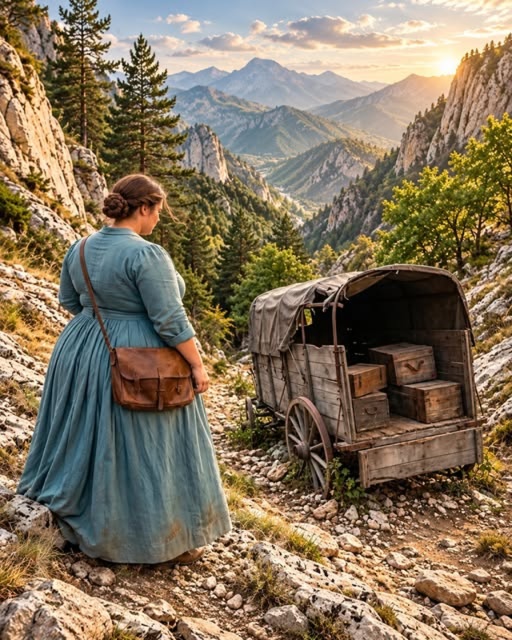
Hidden beneath the mountainside was an old freight wagon.
Its enormous iron-rimmed wheels were trapped between rocks, and part of its roof had disappeared beneath a small landslide.
This was no ordinary passenger carriage.
The wagon had a wide, enclosed wooden cargo compartment, and beneath the layers of dust, Clara could still make out traces of faded green paint.
One of its front wheels had broken, leaving the entire vehicle tilted at an awkward angle.
Its rear section rested directly against a natural stone wall, making it almost impossible to see from the trail above.
Someone could have walked past that spot dozens of times without ever realizing it was there.
Clara slowly circled the wagon.
Then she noticed a rusty metal plate attached to the door.
Despite the corrosion, two words remained visible.
Llorente Brothers.
The name immediately stirred an old memory.
Years earlier, when Clara had worked at an inn, a traveler had told her a strange story about a wealthy trading company based in Salamanca.
The Llorente Brothers had transported expensive merchandise between towns, including watches, fine fabrics, jewelry, and other valuable goods.
According to the story, one of their freight wagons had disappeared twenty-seven years earlier.
Neither the vehicle nor its cargo had ever been recovered.
Clara looked at the abandoned wagon again.
Could this possibly be the missing one?
She approached the rear door and examined the lock. Years of exposure had left the metal badly corroded.
Fortunately, her father had taught her to carry a small pocketknife, and she still had it tucked inside her clothing.
She carefully inserted the blade between the rusted latch and the wooden frame, working patiently until the mechanism finally gave way.
The heavy door creaked open.
Inside, Clara discovered six wooden crates.
The air carried the unmistakable smell of aged timber, dry leather, and fabric that had remained sealed away from the elements for decades.
She approached the first crate and lifted its lid.
Inside were precision instruments carefully arranged in hardened grease. There were compasses, measuring gauges, and delicate drawing tools.
The second crate contained rolls of expensive fabric. Some had deteriorated with age, but others were still protected by their original waxed coverings.
Then she opened the third crate.
It contained dozens of small cases.
Clara cautiously opened the first.
A beautiful silver pocket watch rested inside.
The next contained a brooch decorated with green gemstones. Another held a pair of delicate gold earrings.
She examined several more cases and noticed something unusual.
Every single one carried a small paper label with a handwritten number.
Clara slowly lowered the lid.
These weren’t abandoned personal belongings.
Someone had carefully organized and recorded every item.
There was a system behind all of it.
At the bottom of the wagon, inside a narrower wooden crate, she discovered several old account books.
She opened the first one.
The faded writing on its opening page was still readable.
Llorente Brothers, Salamanca.
Clara turned several pages, examining the old entries before noticing another object tucked beneath the wagon’s front bench.
It was a worn leather wallet, wedged tightly behind a loose wooden board.
She pulled it free and opened it.
Inside were several folded letters.
The oldest envelope carried a date from twenty-seven years earlier.
Clara carefully unfolded the paper.
At the bottom of the letter was a signature.
Vicente Llorente.
Outside, the first drops of rain began striking the wagon’s wooden roof.
Clara stood motionless in the dim interior, surrounded by crates of valuable merchandise, forgotten account books, and letters that had remained hidden for nearly three decades.
The three men who had abandoned her believed they had left her helpless in the mountains.
But they had no idea what she had just discovered.
And the name written on that old letter was about to connect this mysterious wagon to a secret much closer to Clara’s own family than she could possibly imagine.
PART 2
The first letter inside was dated twenty-seven years earlier—and if you want to know what it revealed, find Part 2 in the first comment.
Vicente Llorente wrote that the wagon carried more than the trading house’s merchandise. Families in Salamanca and León had entrusted the company with jewelry, savings, and documents—items to repair, sell, or deliver to relatives. The wagon also carried money gathered after a fire destroyed several homes in a small town.
Clara looked at the numbered cases again. The cargo wasn’t a forgotten fortune. It belonged to people who might have spent twenty-seven years believing it was gone.
The next letter said Vicente had heard that men were following the route. He planned to take a little-used pass and wait until the danger had passed.
The last note was unfinished.
The axle has given way. Bartolomé has gone for help. If he doesn’t return by nightfall, I will try—
Nothing followed.
Clara could have taken a watch, a jewel, or a handful of coins. No one would have known. Instead, she closed the books and left the crates untouched.
She drew a map from the stream to the gully, the split rock, and the wagon’s hiding place. Then she took one letter, an account book, and a small empty case stamped with the company name. She shut the door and wedged a sturdy branch through the handles.
By late afternoon, she found a stone shepherd’s house. Andrés and Pilar listened as she explained what she had found. Andrés turned the empty case in his hands.
“My father used to speak of that wagon,” he said. “He said it carried money from half the world.”
The following morning, Andrés accompanied Clara to a village with a Civil Guard post. Sergeant Tomás Roldán listened, examined the letter, and stopped writing when Clara mentioned the men who had abandoned her.
“Rafael Sebrián,” he said quietly. “That name has appeared before.”
Two days later, an official expedition set out for the mountain, with Clara guiding them. They found the wagon exactly where she had left it. After hours of inventory, the officers opened the reinforced chest.
Inside were coins, sealed envelopes, property deeds, receipts, and a list of names.
Tomás unfolded the list. His face changed.
One of the names belonged to a family whose descendants had arrived that morning—and they were already waiting at the station.
PART 3 — THE SECRET THAT SURVIVED TWENTY-SEVEN YEARS
Clara followed Sergeant Tomás into the Civil Guard station.
A woman stood near the wooden counter, holding a small cloth bag against her chest.
Clara stopped breathing.
“Mother?”
Teresa turned.
For several seconds, neither woman moved.
Then Teresa crossed the room and embraced her daughter so tightly that Clara could barely breathe.
“My child. I thought I would never see you again.”
Clara buried her face against her mother’s shoulder.
She had endured hunger, cold, and the fear of dying alone in the mountains. Yet it was only then, in the safety of her mother’s arms, that she finally allowed herself to cry.
When they separated, Sergeant Tomás placed the old list on the table.
“Do you recognize this name?”
Teresa leaned closer.
Her expression changed immediately.
“Montalvo.”
Beneath the family name was another line.
Joaquín Montalvo — Astorga. One sealed packet. To be delivered personally or to his lawful heirs.
Teresa slowly sat down.
“That’s my husband’s name.”
Clara looked at her mother.
“What does Father have to do with this?”
Teresa opened the cloth bag and removed a small bundle of papers.
“Your father never liked discussing the years before you were born. But there was something he once told me.”
She unfolded a faded letter.
“Twenty-seven years ago, Joaquín worked as a mountain courier. He sometimes transported private correspondence for the Llorente company. One evening, he returned home injured and exhausted. He told me he had been accused of helping someone steal a freight wagon.”
Clara stared at her.
“He never told me that.”
“He was ashamed. He insisted he had done nothing wrong, but no one believed him. The company lost a fortune, and the authorities questioned everyone connected to the journey. Joaquín eventually left that work.”
Teresa’s voice trembled.
“He spent years trying to prove his innocence. Then, when he realized nobody would listen, he stopped talking about it.”
Clara looked at the name again.
Her father had been connected to the missing wagon all along.
Sergeant Tomás carefully opened the account book Clara had recovered.
He turned to the final pages, where the ink had survived better than on the earlier sheets.
There, beside several entries, was a handwritten statement.
Joaquín Montalvo warned us that our route had been betrayed. He refused the money offered to him by Álvaro Sebrián and immediately informed me of the danger.
He was the only man who remained honest when the others turned against us.
The statement was signed by Vicente Llorente.
Clara felt her knees weaken.
“Álvaro Sebrián?”
Tomás nodded.
“Rafael’s grandfather.”
He continued reading.
The next paragraph explained everything.
Álvaro Sebrián had been secretly working with two men who intended to intercept the Llorente wagon. They knew the cargo contained valuable property, family savings, and documents that could be sold or used to seize land.
Joaquín discovered their arrangement and warned Vicente.
When the wagon’s axle broke in the mountains, Joaquín rode toward the nearest village to find assistance. Bartolomé went in another direction.
Before help could arrive, a violent storm triggered a landslide.
The wagon was pushed deeper into the narrow gully, where rocks and fallen earth concealed it.
Vicente had survived the initial accident but was trapped beneath the collapsed rear section. His final letter had been written before the structure gave way completely.
Bartolomé never returned.
And Joaquín, who had gone for help, was left facing accusations from the very men responsible for the betrayal.
Clara closed her eyes.
For twenty-seven years, her father had carried a shame that had never belonged to him.
But there was something else.
Sergeant Tomás turned another page.
At the bottom was a separate entry.
Montalvo family — original property deed, family savings, and compensation for the loss of their home following the Valdeoro fire.
Teresa covered her mouth.
Clara looked at her.
“What fire?”
Teresa’s eyes filled with tears.
“Your grandfather’s house burned when your father was young. The family had placed their remaining savings and property documents with the Llorente company for safekeeping while they arranged to rebuild. Those documents were supposed to return with that wagon.”
She shook her head.
“When the wagon disappeared, your father’s family lost everything. The land was eventually taken because they couldn’t produce the original deed. Your father spent the rest of his life believing there was nothing left to recover.”
Clara could hardly speak.
The missing wagon had not simply contained merchandise.
It had carried the truth about her own family.
And somewhere inside that reinforced chest was the proof that could restore everything her father had lost.
Tomás looked at the sealed packet.
“We should open this in the presence of the witnesses.”
He carefully broke the old wax seal.
Inside was a property deed, several receipts, and a letter addressed to Joaquín Montalvo.
Teresa recognized the handwriting.
“That’s Vicente Llorente.”
Tomás read the letter aloud.
To Joaquín Montalvo,
If this letter reaches you, then I have failed to return as promised.
You were right about the betrayal. Álvaro Sebrián arranged for men to follow our wagon, hoping to seize the property entrusted to us.
You warned me, and you did everything in your power to protect the families who trusted our company.
The enclosed documents belong to your family. Your father’s property was paid for in full, and the accompanying receipts prove that no debt remained.
I also leave written testimony that you were innocent of the disappearance. Do not allow the Sebrián family to destroy your name.
You deserve to return home with your head held high.
Vicente Llorente.
For a moment, the room was completely silent.
Then Teresa began to weep.
Clara held her mother’s hand.
Her father had died believing that the world had forgotten him.
But a man twenty-seven years earlier had made certain that the truth would survive.
And now his daughter had brought it home.
Unfortunately, the story was far from over.
That afternoon, as Clara and Teresa were preparing to leave the station, the sound of horses stopped outside.
Three men entered.
Clara immediately recognized them.
Rafael Sebrián.
Martín.
And Esteban.
The same men who had taken her belongings, stolen her mule, and left her alone in the mountains.
Rafael looked genuinely shocked when he saw her standing beside the sergeant.
For a moment, his face lost every trace of confidence.
Then he recovered.
“There you are,” he said coldly. “We’ve been looking for you.”
Clara didn’t answer.
Rafael turned toward Tomás.
“This woman was employed by my caravan. She disappeared with our money and records. We want her returned for questioning.”
Sergeant Tomás remained seated.
“Interesting. And where exactly did you leave her?”
Rafael shrugged.
“She was supposed to meet us farther along the route.”
“Without her belongings?”
“She lost them.”
“And without the mule?”
Rafael hesitated.
“Animals wander.”
Tomás slowly closed the account book.
“Then perhaps you can explain why your grandfather’s name appears in the original Llorente records as the man who betrayed the company twenty-seven years ago.”
Rafael’s expression changed.
He looked toward the papers on the table.
For the first time, Clara noticed something she had missed before.
He wasn’t surprised by the name Álvaro Sebrián.
He was afraid of it.
“Those documents are old,” he replied. “They have nothing to do with me.”
“Then you won’t mind explaining why you have been searching for the missing wagon.”
Rafael said nothing.
Tomás motioned toward one of the officers.
“Search their belongings.”
Martín immediately stepped backward.
Esteban looked toward the door.
Rafael raised his voice.
“You have no right to search us!”
But the officers had already surrounded them.
Inside Rafael’s leather satchel, they discovered a folded mountain map.
Clara recognized the markings immediately.
The map showed the same gully, the split rock, and the hidden wagon.
There was also a copy of an old letter written by Álvaro Sebrián.
It described the route taken by Vicente Llorente and explained that the wagon had never been recovered.
Rafael had known about the missing cargo all along.
He had hired Clara because she understood the mountain routes and could keep accurate accounts.
He had used her knowledge to search the region.
And when he realized she had begun noticing inconsistencies in his records, he decided she was no longer useful.
The stolen notebook was also recovered.
Inside were Clara’s original accounts, along with several pages in Rafael’s handwriting detailing the expenses for the expedition and the money he intended to spend bribing local men to help him remove the cargo.
One final document was particularly damaging.
It was a handwritten instruction from Rafael to his companions.
Once the girl has identified the pass, leave her behind. Take the supplies and the mule. She must not return to town with what she knows.
Clara read the sentence twice.
She had not imagined their betrayal.
They had planned it.
Rafael lunged toward the papers, but two officers seized his arms.
“That belongs to me!” he shouted.
“No,” Tomás replied. “And neither does the property your family has been trying to steal for twenty-seven years.”
The officers arrested all three men.
Martín and Esteban attempted to blame Rafael, claiming they had simply followed his instructions.
But their signatures appeared on the expense records, and both men had participated in the abandonment.
Their excuses did little to help them.
The investigation that followed uncovered even more.
Rafael’s grandfather had not merely betrayed the Llorente company. He had also sold several stolen pieces of jewelry through intermediaries, keeping the proceeds for himself.
Some of the money had passed through accounts inherited by Rafael’s family.
Rafael had known the truth for years.
He had not been trying to recover the wagon to restore its contents to their rightful owners.
He intended to finish what his grandfather had started.
This time, however, the evidence was impossible to hide.
Within weeks, the three men were formally charged with conspiracy, attempted theft, fraud, and abandoning Clara in the mountains. Additional investigations were opened into the family’s historical thefts and the fraudulent claims connected to the missing property.
The court eventually found Rafael and his two accomplices guilty of their crimes.
Rafael received the harshest sentence because he had organized the expedition, deliberately abandoned Clara, and attempted to claim property that did not belong to him.
Martín and Esteban were also punished for their roles in the conspiracy.
For the first time in twenty-seven years, the Sebrián name was associated not with wealth and influence, but with disgrace.
Meanwhile, the Llorente company began a massive effort to contact the families listed in the recovered account books.
Some had already died.
Others had moved to distant towns.
But their descendants were finally able to receive what had been entrusted to the company so many years earlier.
The jewelry was returned where ownership could be established.
The family savings were distributed to the rightful heirs.
The deeds were examined and legally restored.
And the compensation money collected for the families who had lost their homes in the Valdeoro fire was finally paid.
Among those families was Clara’s.
Several months later, Clara and Teresa returned to Astorga.
They carried a small wooden box containing the original Montalvo deed, the restored property documents, and the letter Vicente had written to her father.
Their family’s old house was no longer standing, but the adjoining orchard and the land surrounding it were still theirs.
When Clara first walked through the property, she stopped beneath an old pear tree.
Her mother stood beside her.
“This is where your father used to sit when he was young,” Teresa whispered. “He always said he would rebuild the house one day.”
Clara looked at the empty ground.
“Then we’ll rebuild it.”
And they did.
The recovered family money, together with the compensation owed to them, gave Teresa enough to restore the small house and repair the orchard wall.
Clara refused to take any of the valuable jewelry from the wagon, despite the reward offered to her.
Instead, she accepted a modest payment from the Llorente heirs for her assistance in recovering the cargo and identifying its rightful owners.
She also received an offer that changed the direction of her life.
The Llorente company needed someone to organize the restored records, locate the remaining descendants, and manage the distribution of recovered property.
They wanted Clara.
She accepted.
Her father had spent years traveling between isolated villages, delivering letters that connected people who might otherwise never hear from one another.
Now Clara would do something similar.
She would help return lost names, forgotten documents, and stolen histories to the people who deserved them.
One evening, after the house had been repaired, Clara sat at the kitchen table with her father’s old pocketknife beside her.
She unfolded Vicente’s letter one last time.
At the bottom, beneath his signature, was a sentence she had not noticed before.
An honest man may lose his property, his reputation, and even his life. But the truth does not belong to those who bury it. It belongs to the people brave enough to uncover it.
Clara read the words aloud.
Teresa reached across the table and touched her hand.
“Your father would have been proud.”
Clara looked toward the window.
Beyond the orchard, the mountains stood beneath the evening sky.
Those same mountains had nearly taken her life.
They had hidden a wagon for twenty-seven years, concealed a terrible betrayal, and protected the truth until someone finally came looking.
Three men had left her there believing she would never return.
They had taken her mule, her belongings, her money, and the records she had worked so hard to protect.
But they had made one mistake.
They had underestimated the daughter of Joaquín Montalvo.
And in trying to bury the past, they had led her straight to the evidence that destroyed their own family legacy.
Clara folded the letter carefully and placed it inside her father’s old wooden box.
For the first time in years, the Montalvo name no longer carried the weight of an accusation.
It carried the truth.
And that was worth more than all the gold in the missing wagon.
THE END.
If this story touched your heart, please go back and LIKE the post, SHARE it with your friends and family, and leave a COMMENT telling us what you thought of Clara’s courage.
Sometimes the truth takes twenty-seven years to come to light, but justice should never be forgotten. ❤️