“LOOK OUTSIDE, JEFF”: THE CO-PILOT’S HAUNTING FINAL PLEA BEFORE THE LEARJET CRASH — WHAT IT MAY REVEAL ABOUT A TERRIFYING COCKPIT EMERGENCY
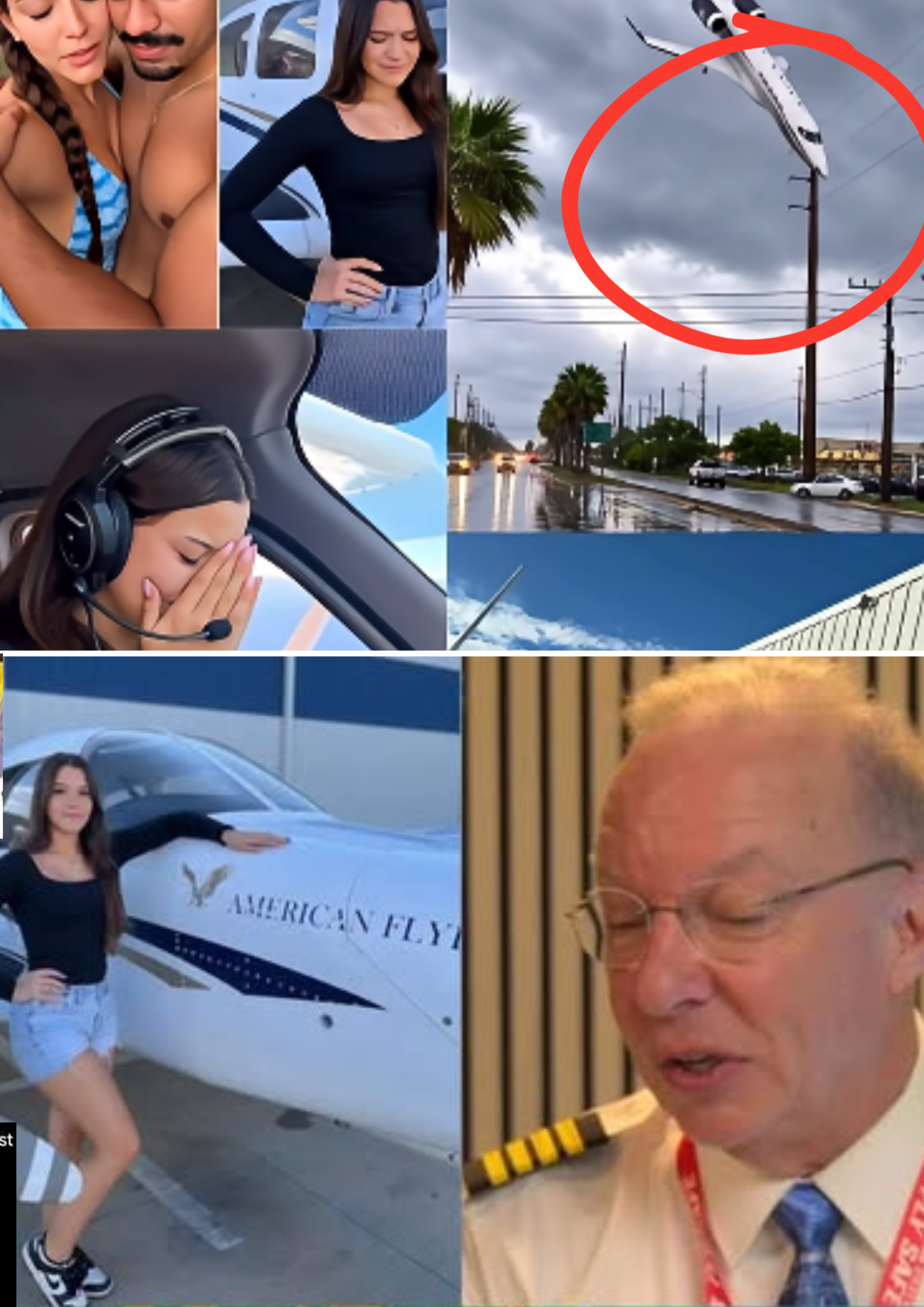
“LOOK OUTSIDE, JEFF”: THE CO-PILOT’S HAUNTING FINAL PLEA BEFORE THE LEARJET CRASH — WHAT IT MAY REVEAL ABOUT A TERRIFYING COCKPIT EMERGENCY
“Look outside, Jeff. Look outside.”
Those desperate words have become one of the most haunting moments in the investigation into the deadly Learjet 60 crash that killed nine people in Florida.
The voice belonged to 20-year-old First Officer Nathalia Gadelha Filgueiras, who was heard urgently calling to Captain Jeff Gregory during the aircraft’s final moments.
The November 1, 2026, disaster unfolded with terrifying speed as the business jet plunged from approximately 35,000 feet toward the ground near Greenacres, in Palm Beach County.
Now, aviation commentators and experienced pilots are examining the final radio transmissions, particularly Nathalia’s repeated instruction to look outside.
Could she have been trying to alert the captain to a dangerous aircraft attitude? Was she attempting to help him regain visual orientation? Or had she noticed something happening outside the aircraft that required his immediate attention?
These questions have attracted renewed attention as investigators work to reconstruct the final moments of Flight N722BD.
However, experts caution that the meaning of her words cannot be established from the radio recording alone.
 A ROUTINE FLIGHT TURNED INTO A TERRIFYING EMERGENCY
The Learjet 60, registered as N722BD and operated by Aurora Aviation, doing business as Upper Jet, departed Austin-Bergstrom International Airport in Texas on November 1.
Its destination was North Eleuthera Airport in the Bahamas.
There were nine people aboard: two pilots and seven passengers.
The flight crew consisted of Captain Jeff Gregory, 55, and First Officer Nathalia Gadelha Filgueiras, 20.
As the aircraft approached Florida, the crew encountered increasingly difficult weather conditions.
Nathalia communicated with air traffic controllers, reporting ice accumulation and moderate turbulence.
At one point, she explained that turbulence was causing the aircraft to experience significant altitude fluctuations, reportedly reaching hundreds of feet.
The crew sought a more favorable route and discussed the possibility of climbing to a higher altitude.
At approximately 35,000 feet, they requested permission to climb to 37,000 feet.
Air traffic control approved the request.
But what happened next was catastrophic.
 THE DESCENT BEGAN WITH ALARMING SPEED
Shortly after the climb clearance, the aircraft entered an extraordinary descent.
The crew began reporting rapidly increasing vertical speed as the situation deteriorated.
Nathalia’s radio transmissions became increasingly urgent.
The crew reported descending at approximately 8,000 feet per minute before issuing a Mayday call and reporting a descent rate of approximately 10,000 feet per minute.
Moments later, another transmission revealed an even more frightening development.
The aircraft was experiencing an overspeed condition while descending at approximately 20,000 feet per minute.
The situation was rapidly becoming uncontrollable.
In another transmission, the crew warned:
“We’re going to crash into the ground.”
The air traffic controller attempted to remain in contact with the pilots, repeatedly reassuring them that he was there and asking them to communicate what assistance they needed.
But the aircraft continued plunging toward the ground.
“LOOK OUTSIDE, JEFF” — THE WORDS THAT RAISED NEW QUESTIONS
Then came the moment that has captured the attention of aviation observers.
In the final publicly circulated radio communications, Nathalia can be heard urgently shouting:
“Look outside, Jeff. Look outside.”
The recording also captures screams and her desperate realization that they were running out of time.
“Holy f***, we’re out of time!”
Shortly afterward, communication with the aircraft ended.
The jet crashed in Greenacres, Florida, at approximately 12:50 p.m. local time.
All nine people aboard were killed.
The repeated instruction to look outside has since prompted discussion about what Nathalia may have been attempting to communicate to the captain.
Some aviation commentators have suggested that she could have been trying to redirect his attention toward the natural horizon during a possible loss of spatial orientation.
Others have raised the possibility that she was reacting to an external visual reference or an aircraft condition that required immediate attention.
Neither interpretation has been established by investigators.
WHAT IS SPATIAL DISORIENTATION — AND WHY IS IT SO DANGEROUS?
One possible explanation being discussed is spatial disorientation, a dangerous phenomenon that can occur when pilots lose an accurate perception of an aircraft’s position or movement.
The human body’s balance system relies heavily on signals from the inner ear, eyes and other sensory systems.
However, at high altitudes, particularly in darkness, clouds, precipitation or poor visibility, those signals can become misleading.
A pilot may believe the aircraft is level when it is actually banking, climbing or descending.
In certain circumstances, the sensation of turning can disappear even while the aircraft continues rotating.
This can create a dangerous mismatch between what the pilot feels and what the aircraft’s instruments indicate.
A pilot experiencing spatial disorientation may struggle to recognize the aircraft’s actual attitude.
That is why aviation training emphasizes disciplined instrument scanning and reliance on reliable flight instruments rather than bodily sensations.
Looking outside can also provide valuable visual references when a natural horizon is clearly visible.
However, there is an important distinction: looking outside is not automatically a solution to spatial disorientation.
If the aircraft is flying through clouds, darkness or heavy precipitation, the outside view may provide no reliable horizon at all.
In those circumstances, pilots must rely on their instruments and established recovery procedures.
Whether spatial disorientation played any role in the Learjet accident remains unknown.
COULD NATHALIA HAVE BEEN TRYING TO HELP THE CAPTAIN RECOGNIZE THE AIRCRAFT’S POSITION?
The timing of Nathalia’s repeated instruction has become particularly significant to those analyzing the available recording.
By the time she shouted for Jeff to look outside, the aircraft had already entered an extreme descent.
The crew had reported an overspeed condition, and the aircraft was experiencing a rapidly deteriorating emergency.
One interpretation is that Nathalia may have been attempting to draw the captain’s attention toward the external visual environment, possibly to help him understand the aircraft’s attitude or regain orientation.
Another possibility is that she had noticed something visible outside the cockpit that she believed the captain needed to see.
It is also possible that the words reflected a desperate attempt to communicate during an emergency in which the crew was struggling to understand what was happening.
The recording does not establish which explanation is correct.
Crucially, the publicly available transmission is radio communication with air traffic control. It does not provide a complete account of everything happening inside the cockpit.
The cockpit voice recorder is a separate source of evidence that investigators must examine to understand the crew’s conversations, warnings and actions.
A POSSIBLE STRUCTURAL PROBLEM ADDS ANOTHER LAYER TO THE INVESTIGATION
The investigation has also uncovered evidence suggesting that the aircraft may have begun breaking apart before hitting the ground.
NTSB investigators recovered components from the aircraft, including sections of its wings, engines and tail.
One particularly important discovery involved the left elevator, part of the aircraft’s tail control system.
Sections of the component were found several miles from the main impact site.
The elevator plays an important role in controlling the aircraft’s pitch, helping the pilots raise or lower the nose.
If an aircraft loses critical control-surface functionality, maintaining or recovering stable flight can become extremely difficult.
However, investigators have not established whether the elevator separated before the aircraft entered its fatal descent or whether it broke away because of the extreme aerodynamic forces during the dive.
That distinction is essential.
A structural failure could potentially have contributed to the loss of control, but the possibility that the damage occurred during the descent must also be considered.
Weather, icing, turbulence, aircraft systems and crew actions remain important areas of investigation.
THE COCKPIT VOICE RECORDER COULD PROVIDE CRUCIAL ANSWERS
One of the most important developments came when investigators recovered the aircraft’s cockpit voice recorder from the crash site.
The device was transported for examination at the NTSB’s Vehicle Recorders Laboratory in Washington, D.C.
Unlike the publicly available air traffic control recordings, the cockpit voice recorder can provide investigators with information about conversations inside the flight deck, depending on what was preserved.
Investigators can examine the crew’s communications, warnings, responses and other recorded sounds.
When combined with aircraft wreckage, flight-tracking information, weather data and technical examinations, this evidence can help reconstruct the final moments.
The NTSB is also examining whether the aircraft experienced a mechanical problem or structural failure before the crash.
As of November 23, 2026, the official cause of the accident has not been established.
NINE LIVES LOST IN A TRAGEDY THAT STILL HAS UNANSWERED QUESTIONS
The crash claimed the lives of both pilots and all seven passengers.
Among those aboard was 20-year-old Nathalia Gadelha Filgueiras, whose final radio communications have drawn widespread attention.
Her father, Allan Filgueiras, has spoken publicly about his daughter’s lifelong passion for aviation.
Nathalia first began flying with her father when she was 12 years old. By 17, she had earned her pilot’s license.
Her father described her as exceptionally talented and spoke emotionally about the bond they shared through their love of flying.
In an interview with ABC News, he said listening to her final communications was extremely painful.
He has been seeking answers about what happened during the flight and why the aircraft entered such a catastrophic descent.
The family has also defended her professional qualifications as investigators continue examining the circumstances surrounding the accident.
THE QUESTION THAT REMAINS
The words “Look outside, Jeff” may ultimately become an important part of understanding the final moments of N722BD.
But their meaning cannot be determined by emotion or speculation alone.
Was Nathalia attempting to help the captain recognize a dangerous aircraft attitude? Had she noticed something outside the cockpit? Or was she responding to a rapidly unfolding emergency that neither pilot could overcome?
The answers may depend on what investigators discover through the cockpit voice recorder, aircraft components and technical reconstruction.
For now, the final transmission remains a heartbreaking reminder of how quickly a flight can turn into a life-threatening emergency.
Nine people never made it to their destination.
And as investigators continue searching for answers, one desperate instruction from the final moments of the flight continues to raise questions:
“LOOK OUTSIDE, JEFF. LOOK OUTSIDE.”