Equatorial Coronal Hole on the Sun Sends High-Speed Solar Wind Toward Earth
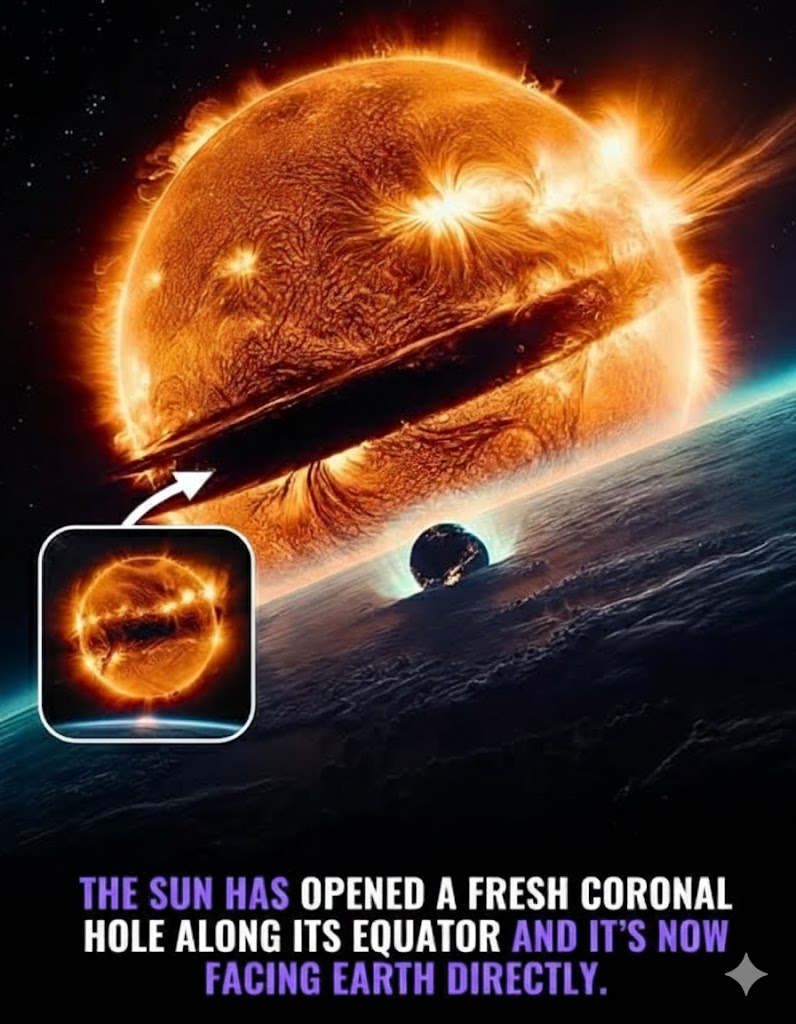
A fresh coronal hole has opened along the Sun’s equator and is now rotating into an Earth-facing position. This is not a solar flare, but rather a magnetic gap where high-speed solar wind escapes into space. These gaps form when the Sun’s magnetic field opens up, allowing charged particles to flow freely into space. The fact that this one is positioned near the Sun’s equator means that the solar wind has a clearer and more direct path toward Earth’s magnetic field, making it a notable event.
When such coronal holes face Earth, there can be significant effects on our planet’s magnetosphere. As the solar wind streams toward Earth, it interacts with the magnetic field, often leading to geomagnetic disturbances. These disturbances can result in auroras, especially near the polar regions, as the particles excite atoms in Earth’s atmosphere. Additionally, this solar wind can cause radio signal disruptions, particularly on high-frequency bands that rely on atmospheric reflection.
While the size of the coronal hole doesn’t directly determine the intensity of its effects, its position relative to Earth is crucial. In this case, since the hole is aligned with Earth, the stream of solar wind can have a stronger and more direct impact. As a result, we can expect subtle fluctuations in Earth’s power grids and electronic systems, especially in areas near the poles or during periods of high solar activity.
Solar activity like this is closely monitored because it can also affect satellite communications, GPS systems, and even electrical power infrastructure on Earth. The particles emitted during these solar events can potentially disrupt these systems, especially if they’re strong enough. Although this particular event doesn’t look like it will lead to catastrophic outcomes, scientists are keeping a close eye on it.
As the Sun continues its activity, it’s important to be aware of these solar phenomena and their effects. Even a subtle coronal hole can bring about visible displays like auroras and serve as a reminder of the Sun’s powerful influence on Earth’s space environment.