Artemis II Launch Delayed as NASA’s SLS Rocket Stands Ready for Historic Crewed Mission Around the Moon
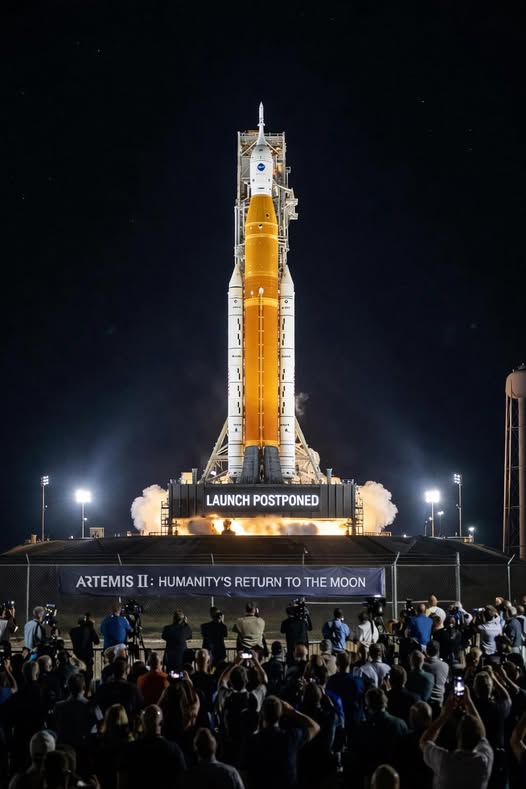
Under powerful floodlights at Kennedy Space Center, NASA’s Space Launch System (SLS) rocket rose against the night sky, fully stacked and prepared for what is set to become one of the most important human spaceflight missions in decades — Artemis II.
But as final preparations continued on the launch pad, a large display near the site confirmed a sudden change to the long-awaited schedule.
“LAUNCH POSTPONED.”
The announcement marked a delay to NASA’s next major step in returning humans to deep space.
The Artemis II mission is designed to be the first crewed flight of the Artemis program and the first time astronauts will travel toward the Moon since the Apollo era. The mission will send a four-member crew on a multi-day journey around the Moon, testing critical spacecraft systems and flight operations before future missions attempt a landing on the lunar surface.
Despite the postponement, the launch site remained charged with anticipation.
Vapor drifted from the base of the rocket’s core stage, glowing softly in the orange light beneath the vehicle, while engineers, technicians, and media crews gathered behind secured barriers to document the moment. Spectators raised cameras and phones, fully aware they were witnessing a milestone phase of a program meant to reshape humanity’s return to the Moon.
A banner displayed prominently below the rocket read:
“ARTEMIS II: HUMANITY’S RETURN TO THE MOON.”
NASA officials have emphasized that schedule adjustments are a normal and necessary part of preparing complex human spaceflight missions. The SLS rocket and Orion spacecraft represent some of the most advanced systems ever developed for exploration beyond low-Earth orbit, and every phase of testing must meet strict performance and safety requirements.
Artemis II will carry astronauts around the Moon and back to Earth, validating life-support systems, navigation, communications, and re-entry performance. The mission is viewed as a critical stepping stone toward Artemis III and future crewed landings on the lunar surface, as well as long-term goals for sustained exploration and international partnerships in deep space.