Shroud of Turin: When the Image Answered Back
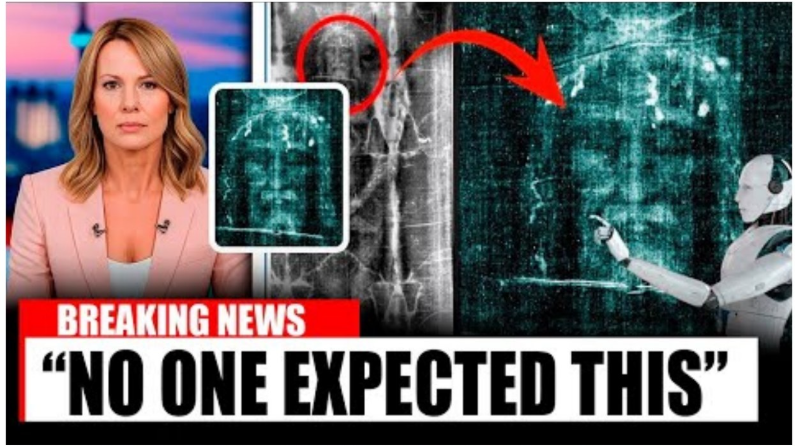
For nearly two millennia, the Shroud of Turin has remained silent — a faint, haunting imprint on ancient linen suspended between belief and doubt. The cloth, bearing the image of a crucified man, has endured fires, relocations, scientific testing, and relentless debate. Scholars have examined its historical record. Scientists have analyzed its fibers. Skeptics have challenged its authenticity. Yet despite centuries of scrutiny, the image itself has offered no definitive explanation. It has simply remained — enigmatic and unresolved.
Now, a new wave of analysis driven by advanced artificial intelligence has reportedly uncovered patterns beneath the surface that earlier technologies could not detect. Using high-resolution scans and machine-learning reconstruction, researchers have identified structural consistencies within the image that do not behave like traditional paint, pigment, or known medieval artistic techniques. According to those present during preliminary reviews, entire rooms fell quiet as layered models rendered unexpected mathematical symmetry. The glow of screens replaced speculation with something far more precise — and far more puzzling.
Importantly, this development has not been framed as a declaration of miracle, nor as a clean dismissal of forgery theories. Instead, it presents something more complex: measurable anomalies that resist easy categorization. The tonal gradients of the image appear encoded with depth information correlating to three-dimensional spatial mapping. The intensity variations do not follow patterns typical of brushstrokes or applied dyes. Rather than appearing artistically imposed, they seem structurally integrated into the linen’s microscopic fibers. The result is not proof of the supernatural — but it is also not comfortably ordinary.
One particular detail has drawn quiet attention among specialists. During early technical briefings, researchers reportedly flagged a specific anomaly related to spatial proportionality within the facial region of the image. It was documented thoroughly in internal summaries. Yet when public statements were released, references to this detail were softened, described in more cautious language. The reasons may be entirely procedural — the scientific process demands restraint before peer review. Still, observers have questioned why certain findings were emphasized while others were left understated.
For centuries, debates about the Shroud have been polarized: faith versus fabrication, devotion versus doubt. These new AI-driven findings do not settle the argument. Instead, they complicate it. If the image contains embedded dimensional information not visible to the naked eye — information consistent across fiber samples and independent scans — then both skeptics and believers must reconsider prior assumptions. It suggests a level of sophistication that challenges simplified narratives on either side of the divide.
If confirmed through rigorous peer review, the implications would be profound — not because they validate or invalidate religious belief, but because they reshape questions about historical capability and physical processes. Were ancient techniques more advanced than previously imagined? Could natural chemical reactions under rare conditions produce such encoding? Or are there mechanisms still undiscovered? For nearly two thousand years, the Shroud endured examination without reply. Now, through algorithms and digital reconstruction, the image appears to whisper back — not with certainty, but with deeper mystery. And perhaps what unsettles experts most is not what artificial intelligence found, but what it reveals about the limits of what we thought we understood.