📜 Secrets in the Parchment: DNA and the Mystery of the Dead Sea Scrolls
Few archaeological discoveries have captured the imagination of scholars and believers alike as powerfully as the Dead Sea Scrolls. Found in caves near Qumran in the mid-20th century, these ancient manuscripts reshaped our understanding of early Judaism and the historical background of the Bible. For decades, the dominant theory held that the scrolls were produced by a single, isolated Jewish sect living in the desert. Their devotion, discipline, and separation from mainstream society seemed to explain the remarkable preservation and unity of the texts. Yet recent genetic research has begun to challenge that long-standing assumption.
In a groundbreaking study, scientists turned not to ink or handwriting, but to the parchment itself. By extracting and analyzing ancient DNA traces embedded in the animal skins used to create the scrolls, researchers uncovered surprising variations. Some parchments were made from sheep that were genetically distinct from others, suggesting they did not all originate from the same local herds. This discovery opened an unexpected window into the production and movement of these sacred writings. The material evidence hinted at a story more complex than previously imagined.
For many years, scholars believed that a single community near Qumran—often associated with the Essenes—was responsible for copying and safeguarding the scrolls. The remote desert setting seemed ideal for a group seeking spiritual purity and separation. However, the new DNA findings suggest that at least some scrolls may have been produced elsewhere and later brought to the caves. If true, this would mean that the collection represents not just one community’s library, but a broader network of Jewish thought and tradition during a turbulent historical period.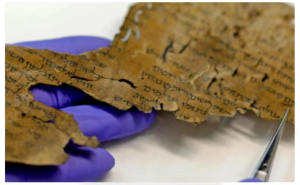
The implications are profound. If multiple communities contributed to the scrolls, then the texts themselves become evidence of dialogue, diversity, and perhaps even disagreement within ancient Judaism. Rather than a single, unified voice speaking from the desert, we may be hearing an entire chorus of perspectives. Some manuscripts might have traveled long distances, carried by traders, pilgrims, or refugees seeking to protect their sacred writings from conflict and destruction. The caves near Qumran may have served as a refuge not only for a community, but for ideas.
Unsurprisingly, the new research has sparked intense debate in academic circles. Some scholars urge caution, emphasizing that genetic diversity in parchment does not automatically prove multiple authors or communities. Others see the findings as a turning point, encouraging a reevaluation of long-accepted theories. As with many scientific breakthroughs, the discovery raises as many questions as it answers. Were these texts exchanged between groups? Did scribes collaborate across regions? Or does the truth lie somewhere between isolation and interconnectedness?
History, it seems, is whispering once again. The Dead Sea Scrolls have always carried an air of mystery, preserved for centuries beneath desert stone before emerging to transform modern understanding. Now, even the very fibers of their parchment reveal hidden stories. This discovery reminds us that the past is rarely simple. Even the most sacred traditions can contain layers of complexity waiting patiently to be uncovered. In the delicate strands of ancient DNA, we are remin