Federal Authorities Uncover $410 Million Transnational Drug and Financial Network Operating in Georgia
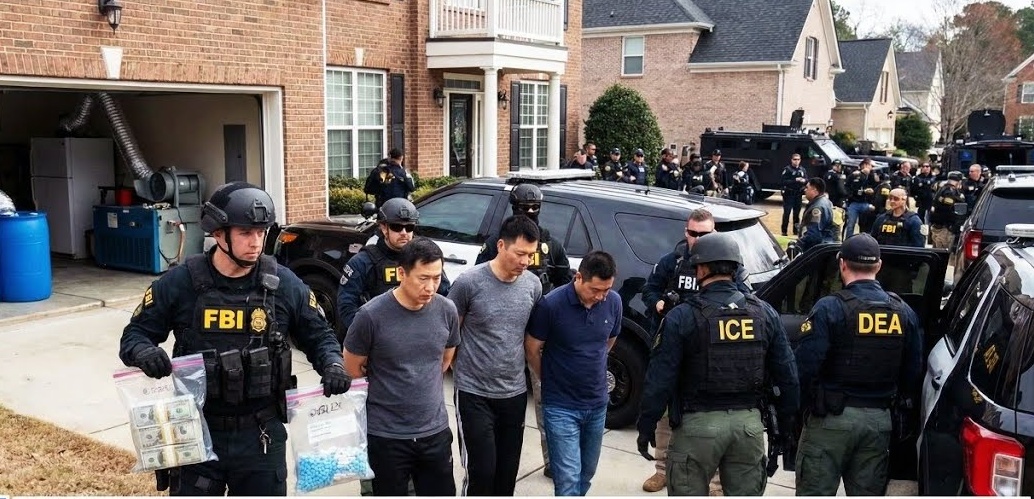
Georgia — Federal investigators have revealed details of what they describe as one of the largest coordinated narcotics and financial crime operations ever dismantled in the southeastern United States. The multi-agency investigation uncovered a sophisticated network connecting chemical suppliers in China, distribution channels in Georgia, and trafficking organizations linked to Mexico’s Sinaloa cartel.
According to summaries released by Homeland Security Investigations (HSI) and the Drug Enforcement Administration (DEA), the operation is believed to have laundered approximately $410 million over a two-year period while facilitating the production and distribution of synthetic narcotics across the East Coast and beyond.
The case began taking shape in late 2023 when federal analysts noticed an unusual surge in synthetic drug seizures across Georgia, particularly fentanyl and high-purity methamphetamine. What raised concern was the absence of traditional border-level trafficking indicators.

At the same time, customs records reflected a dramatic increase in shipments labeled as “industrial solvents” and “cleaning agents” arriving from cities including Shenzhen, Hong Kong, and Shanghai. While the paperwork appeared legitimate, laboratory testing later confirmed that many of these shipments contained precursor chemicals commonly used in the manufacture of synthetic opioids and methamphetamine.
Investigators concluded that Georgia’s infrastructure made it an ideal distribution hub. The state’s extensive highway system, rail connectivity, and international cargo volume — particularly through Hartsfield-Jackson Atlanta International Airport — created opportunities to move materials and finished product with minimal detection.
The first public arrest occurred in Duluth, Georgia, where federal agents detained a 48-year-old courier after nearly ten months of surveillance. Court documents later described structured cash drop-offs, late-night interstate travel, and connections to logistics intermediaries.
That arrest led authorities to properties in John’s Creek, Alpharetta, and Gwinnett County. Inside several upscale residential homes, agents reported finding large-scale drug production setups. Living rooms had been cleared and converted into work areas with industrial tables. Bedrooms functioned as drying rooms. Attics were equipped with ventilation systems designed to run continuously without attracting attention.
DEA seizure logs indicate that one property alone contained enough raw fentanyl to represent millions of potentially lethal doses if distributed on the street.
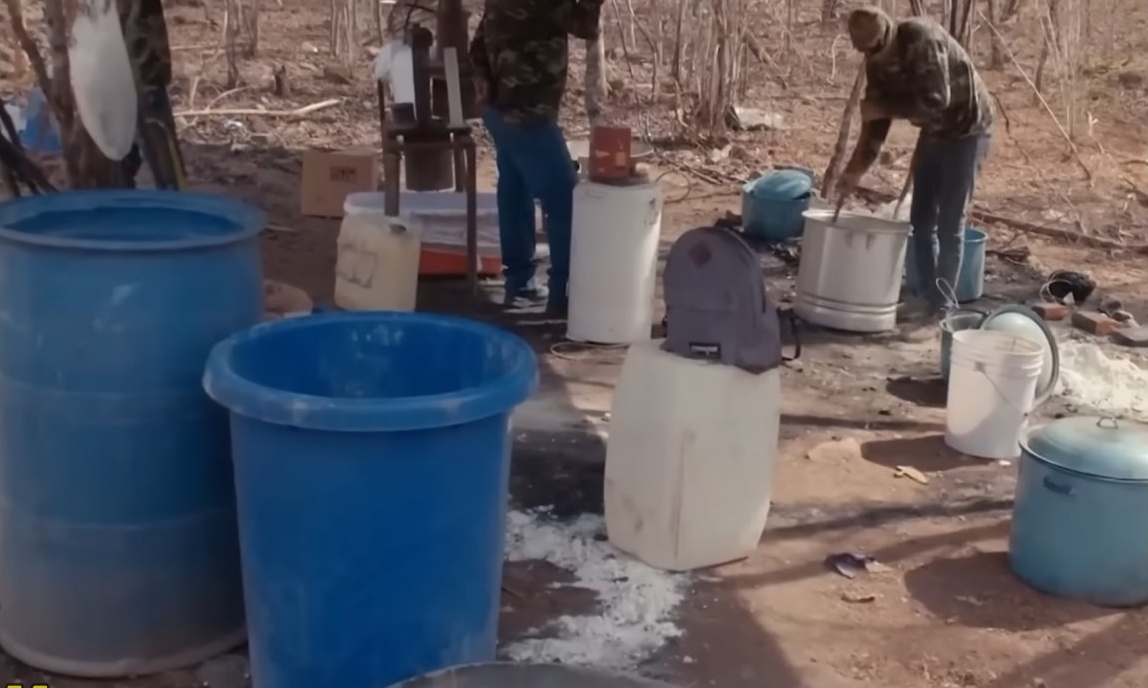
Neighbors later told investigators they assumed the constant mechanical humming came from air conditioning units. Officials now believe it was chemical processing equipment operating around the clock.
By September 2024, federal command determined the network was too expansive to dismantle incrementally. In the early morning hours of September 18, a coordinated statewide operation was launched involving HSI, DEA, FBI, ATF, the Georgia Bureau of Investigation, and local task forces.
Nearly 140 locations were targeted, including suspected labs, stash houses, financial fronts, and brokerage points. Over the course of a week, authorities reported more than 120 arrests, the seizure of over 12 tons of narcotics, more than one million counterfeit pills, hundreds of firearms, and approximately $30 million in cash and assets.
Officials stated that several suspects attempted to destroy evidence or flee during the operation, but the majority were taken into custody without injury.
While narcotics were the most visible component, investigators say the true backbone of the operation was financial.
In Norcross, agents raided a trucking company allegedly used to transport sealed containers of bundled cash rather than legitimate freight. Authorities reported seizing $14 million concealed in boxes labeled as office supplies.
Additional businesses — including nail salons, spas, and entertainment venues — were flagged after reporting revenues inconsistent with customer activity. Funds were allegedly routed through underground banking channels, with mirrored transfers appearing in Mexico and parts of East Asia.
Federal estimates suggest roughly $410 million moved through shell companies and layered transactions over two years. Officials have declined to release additional names, citing ongoing legal proceedings.
The investigation also highlighted how traffickers exploited high-volume cargo systems. With thousands of pallets moving daily through Hartsfield-Jackson Atlanta International Airport, officials say criminal actors relied on scale and timing to conceal shipments.
DEA intelligence reports noted that methamphetamine consolidated in Georgia could command significantly higher prices in overseas markets, including parts of Australia and East Asia. Couriers were reportedly paid substantial sums per trip, sometimes without full knowledge of the broader operation.
In the early coverage of this case, a previously recorded statement surfaced referencing an agreement with China’s leadership to impose the death penalty on individuals manufacturing fentanyl destined for the United States.
From an analytical perspective, that remark reflects the broader frustration surrounding the global supply of synthetic opioid precursors. However, investigators in this case emphasized that the operation uncovered in Georgia functioned less as a single-source pipeline and more as a decentralized multinational supply chain. The network relied on chemical suppliers, financial brokers, logistics intermediaries, and local production cells operating semi-independently.
Experts note that while international cooperation is important, the Georgia case demonstrates that domestic infrastructure — shipping systems, financial institutions, and residential properties — can be leveraged to create highly complex criminal enterprises without drawing immediate attention.