SHOCKING TRUTH EXPOSED: A $3,000,000,000 U.S. Submarine SURFACED Near an Iranian Patrol Ship… Then THIS Happened
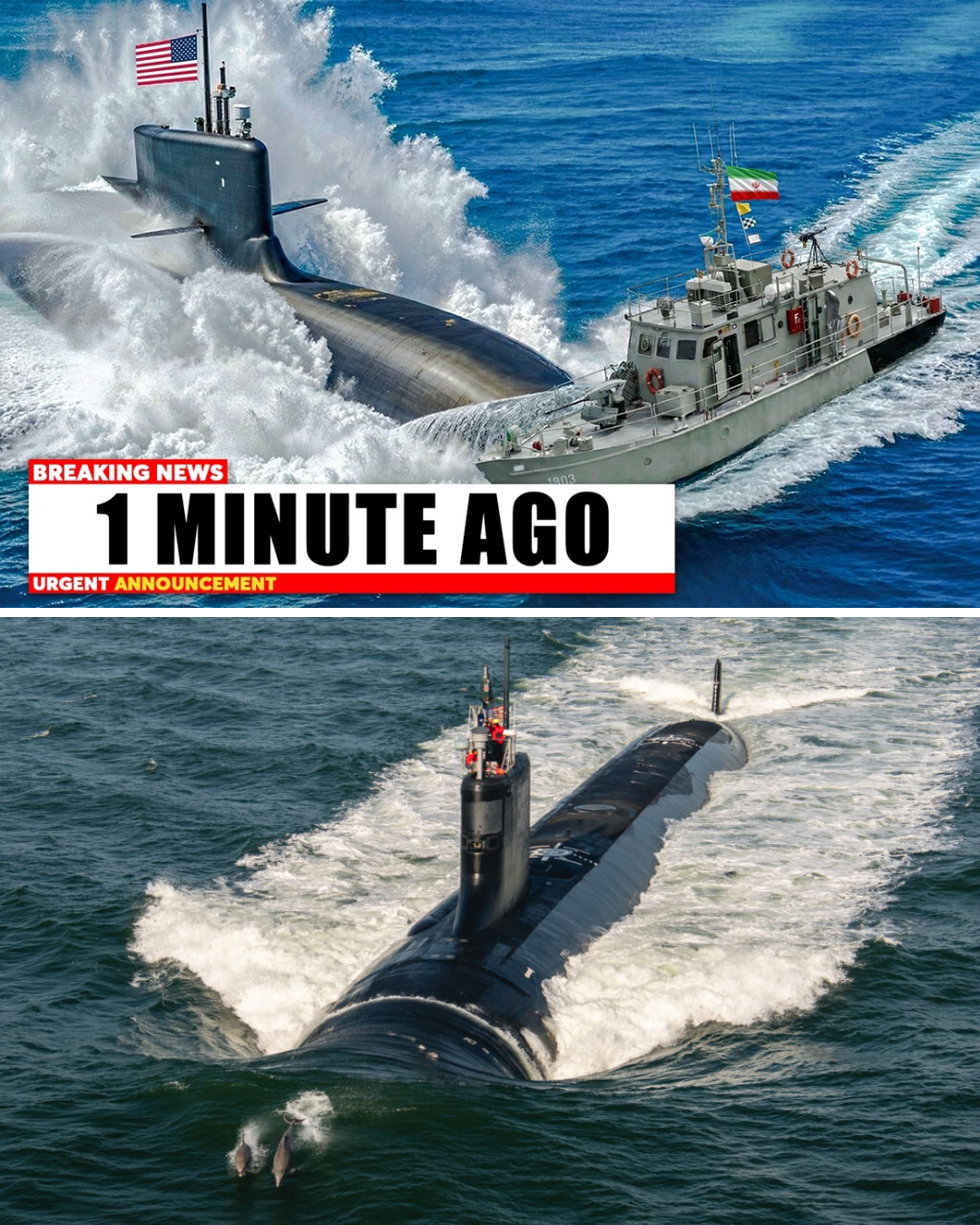
DUBAI — A dramatic online account published Tuesday claims a U.S. Navy Virginia-class submarine surfaced near an Iranian patrol vessel in the Strait of Hormuz, delivering what the article describes as a “silent show of force” amid heightened U.S.–Iran tensions. The story, posted on the “Family Stories” website, offers precise timing and tactical detail but provides no official confirmation from U.S. or Iranian authorities and cites no public incident report.
According to the post, the encounter occurred at 5:42 a.m. in the narrow waterway separating Iran and Oman. It alleges the submarine maneuvered into close operational proximity to an Iranian Ghaem (spelled “GAM” in the article) class patrol craft, while remaining largely undetected until it surfaced—an action the story frames as deliberate signaling rather than preparation for combat.
The author emphasizes the Strait’s strategic weight. That underlying premise is well-established: the Strait of Hormuz is widely regarded as the world’s most important oil chokepoint. U.S. Energy Information Administration reporting has repeatedly found that flows through the Strait represent a major share of global oil and petroleum trade—historically “almost 20%” of oil traded worldwide and, more recently, roughly one-fifth of global oil and petroleum product consumption in 2024 and early 2025.
In the article’s telling, the submarine’s value and capability are central to the message. It refers to a “$3 billion” Virginia-class boat with advanced stealth and sonar, arguing that simply revealing its presence close to an Iranian surface craft underscored U.S. undersea dominance without firing a shot. While the unit price of a Virginia-class submarine varies by block and configuration, Congressional reporting summarized by USNI News has noted that Virginia-class boats equipped with the Virginia Payload Module (VPM) in FY2020 and beyond had an estimated recurring procurement cost in the neighborhood of $3.2 billion (in then-current dollars), a figure consistent with the story’s “$3 billion” framing in broad terms.
The post also describes what it calls “layered maritime control,” claiming U.S. forces added surveillance pressure by deploying sonobuoys from an MH-60R Seahawk helicopter operating nearby—an anti-submarine warfare platform designed for exactly that kind of mission set. It asserts Iranian patrol boats adjusted speed and course while remaining unaware of the full extent of the monitoring network.
Beyond the narrative detail, the larger theme is deterrence. The author argues the operation’s significance lies not in confrontation but in restraint—“dominance without escalation”—and presents it as a preview of how modern maritime standoffs may increasingly unfold: stealth positioning, real-time sensing, intelligence collection, and psychological signaling rather than overt exchanges of fire.
What remains unclear is whether the specific incident occurred as described. The story states “no official statements confirmed direct confrontation,” and independent, high-quality reporting verifying a Virginia-class submarine surfacing near an Iranian patrol ship at that time and place is not provided in the post. In the past, maritime encounters in and around the Strait have generated competing narratives—particularly in Iran–U.S. disputes involving submarines—where Iranian claims have been publicly rejected by U.S. officials, underscoring how quickly information warfare can shape perceptions of events at sea.
Even so, analysts consistently warn that the Strait’s geography leaves little margin for error. Heavy commercial traffic, military patrol patterns, drones, and periodic naval exercises all compress into a narrow corridor where miscalculation can ripple into energy markets and diplomacy.
For now, the article’s most defensible takeaway is the one embedded in its own premise: the Strait of Hormuz remains a global pressure point, and undersea capability is a key element of deterrence in the region. Whether this particular “silent encounter” happened exactly as written is a separate question—one that would typically be answered by official statements, corroborating reporting, or public documentation that the post does not include.