When the Road Is No Longer Enough
- TranThuy
- February 26, 2026
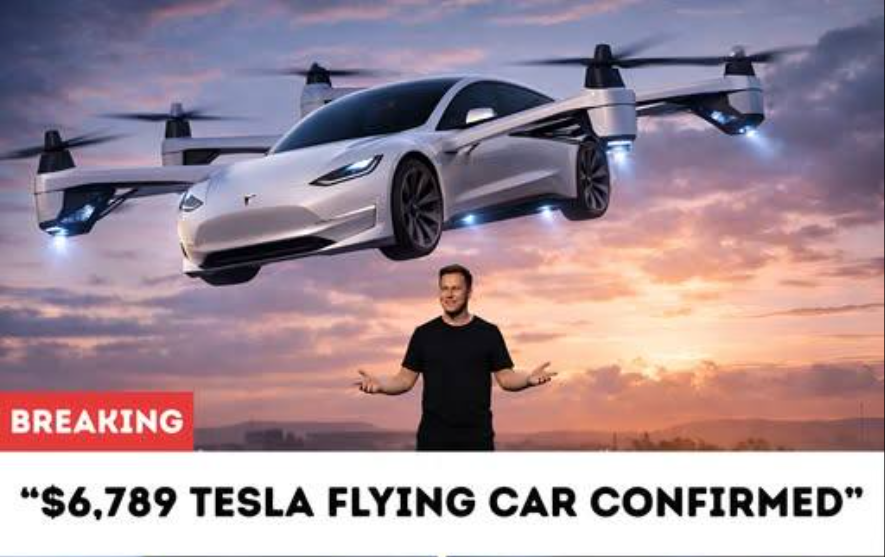
Last night, the world seemed to hold its breath as Elon Musk unveiled a vision bold enough to blur the line between science fiction and engineering reality. He announced that Tesla, Inc. is preparing a dedicated 2026 production line for a flying vehicle—whispered to begin at just $6,789. The figure alone sounded almost unreal, a price tag so surprisingly accessible that it ignited both excitement and skepticism across global markets. Within hours, headlines spread, debates flared, and imaginations soared.
For over a century, traditional automobiles have defined modern civilization. Highways carved through continents, cities expanded around road networks, and entire industries flourished to support life on wheels. From early combustion engines to today’s electric revolution, progress has largely remained grounded—literally. Yet Musk’s announcement challenges a fundamental assumption: that transportation must remain confined to asphalt and concrete. If Tesla succeeds, the next frontier may not stretch forward along highways but upward into open skies.
The concept of a flying vehicle is hardly new. Inventors and dreamers have imagined airborne personal transport for decades, often producing prototypes that dazzled but never scaled. What makes this moment different is Tesla’s reputation for turning ambitious ideas into mass-market realities. The company redefined electric mobility, accelerated battery innovation, and reshaped public expectations of sustainable technology. Now, by hinting at an affordable aerial vehicle, Tesla appears ready to disrupt not just a market, but a dimension.
Imagine the possibilities. Commuters lifting off above gridlocked highways, watching city lights shimmer beneath them as they glide toward their destinations. Emergency responders bypassing traffic entirely. Rural communities gaining faster connections to urban centers. The sky, once reserved for commercial airlines and private jets, could become an extension of daily life. Of course, such a transformation would require new infrastructure, updated regulations, and unprecedented coordination between governments and engineers. The dream is exhilarating—but the practical challenges are immense.
Critics question whether the promised price is realistic, pointing to the complexity of aviation technology and safety standards. Supporters counter that skepticism once surrounded electric vehicles as well, yet Tesla proved doubters wrong. Markets reacted with a mixture of caution and optimism, recognizing both the potential disruption and the enormous technical hurdles ahead. Whether the $6,789 figure represents an entry-level model, a long-term goal, or a bold symbolic statement remains unclear—but it has undeniably captured the public imagination.
Is this truly the end of traditional cars, or merely the breathtaking beginning of something greater? History suggests that innovation rarely erases the past overnight. Instead, it expands possibilities and reshapes priorities. When Tesla dreams, the world tends to look up—not just in admiration, but in anticipation. If even part of this vision becomes reality, the roads of the future may extend far beyond the ground beneath our feet, carrying humanity into a new era where mobility is measured not only in miles traveled, but in horizons redefined.