When the Sky Became the Highway
- TranThuy
- February 26, 2026
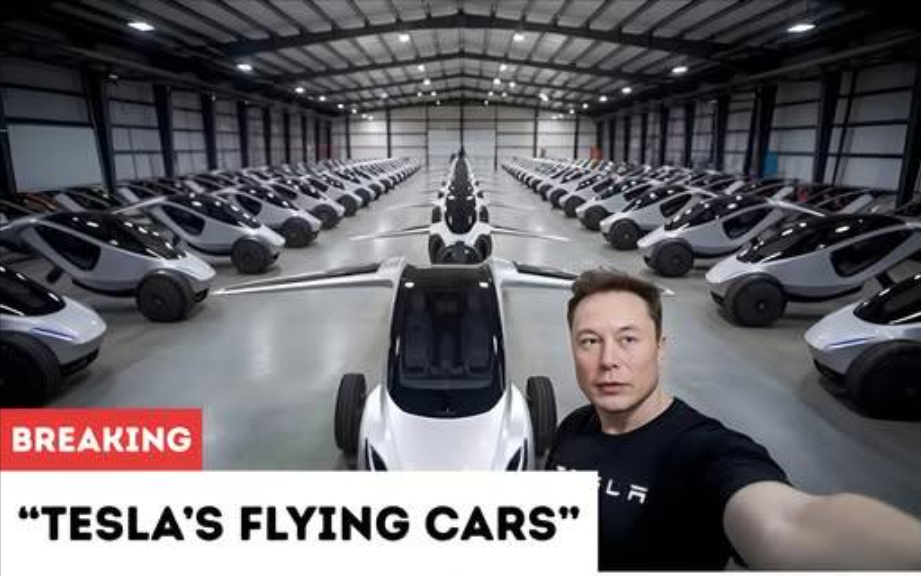
The world watched in astonishment as flying cars bearing the emblem of Tesla, Inc. finally lifted off the ground. What once sounded like science fiction unfolded in real time, engines humming as sleek vehicles rose vertically into the open sky. At the center of the spectacle stood Elon Musk, a figure long associated with ambitious promises and boundary-breaking innovation. With calm confidence, he addressed the global audience and declared, “The future of mobility starts today.” In that single sentence, years of speculation transformed into reality.
For decades, cars have defined freedom through roads stretching across continents. Yet congestion, pollution, and overcrowded cities have tested the limits of ground-based travel. Musk’s unveiling signaled a dramatic shift in perspective: perhaps mobility was never meant to remain confined to asphalt. As Tesla’s flying vehicles ascended in synchronized precision, the symbolism was impossible to ignore. The company that accelerated the electric vehicle revolution now appeared determined to rewrite the very concept of transportation itself.
The launch event was more than a technological demonstration—it was a statement of belief. Engineers who had spent years refining propulsion systems and safety mechanisms watched with visible pride. Investors analyzed the implications for infrastructure and urban planning. Families observing from home imagined a future where daily commutes might rise above gridlock. In that moment, traffic jams felt a little smaller, horizons a little wider. The sky, once distant and unreachable for ordinary travelers, suddenly seemed within grasp.
Of course, bold leaps invite bold questions. How will airspace be regulated? What infrastructure will support widespread adoption? Can such vehicles balance affordability with rigorous safety standards? Skeptics caution that transforming mobility requires more than spectacle—it demands careful coordination with governments, aviation authorities, and city planners. Yet history shows that transformative technologies often begin with a daring first step, followed by gradual adaptation and refinement.
For dreamers, this milestone felt like validation. Flying cars have long occupied the realm of imagination, featured in futuristic films and speculative designs. To witness them take to the skies under Tesla’s banner suggested that innovation still has the power to surprise. Musk’s career has been marked by ventures that challenge accepted limits—from electric vehicles to reusable rockets—and this latest achievement reinforced his reputation for refusing to let ambition remain grounded.
Is this the dawn of a new era or simply the boldest leap yet? The answer may unfold over years rather than days. But one truth is undeniable: the boundaries of possibility have shifted. The sky is no longer the limit—it is an open frontier. As Tesla’s vehicles disappeared into the clouds, they carried with them not just passengers, but a renewed sense that the future, once imagined, can indeed take flight.