One Hour Around the World: When Distance Loses Its Power
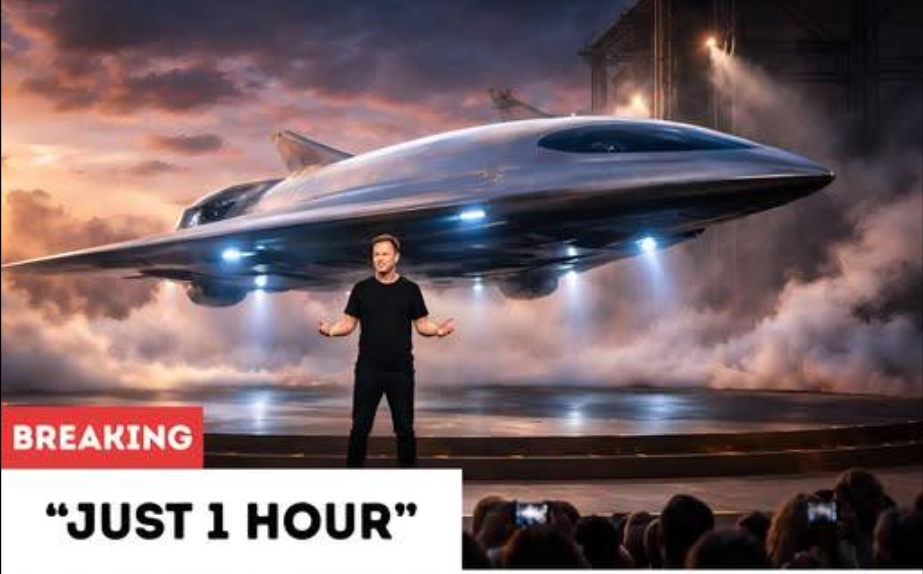
The line between science fiction and reality blurred once again at a high-voltage launch event where Elon Musk unveiled a bold new vision from SpaceX. Before a captivated audience, he introduced a hypersonic spacecraft concept capable of carrying passengers to virtually any point on Earth in under 60 minutes. The promise sounded almost impossible: breakfast in New York, lunch in Tokyo, dinner in London—without the exhaustion of long-haul travel. Distances that once felt endless suddenly appeared beautifully small.
As animated simulations lit up giant screens, the crowd watched trajectories arc across digital globes. From New York to Tokyo. From London to Sydney. Routes that currently demand grueling hours in the air could, in theory, be compressed into a single hour. Musk described a reusable rocket-based system designed to launch from coastal platforms, briefly exit the atmosphere, and descend toward its destination at breathtaking speed. The concept builds upon technologies SpaceX has been refining for years—rapid reusability, precision landings, and advanced propulsion systems.
Beyond engineering marvels, the emotional appeal of the announcement resonated deeply. Musk painted a future where borders feel softer and time zones less isolating. Families separated by oceans could reunite in the span of a morning. Business opportunities could expand without the burden of multi-day travel. Emergency response teams might deploy across continents with unprecedented speed. The vision extended beyond convenience; it suggested a transformation in how humanity experiences geography itself.
Of course, immense challenges remain. Hypersonic passenger travel would demand extraordinary safety standards, international regulatory cooperation, and infrastructure capable of handling rocket launches near populated areas. Environmental concerns, cost barriers, and technical reliability must all be addressed before such journeys become routine. Skeptics caution that translating prototypes into commercial passenger systems is a leap far greater than impressive demonstrations. Yet history shows that bold transportation revolutions often begin with daring prototypes and ambitious timelines.
Still, the symbolism of the moment mattered. For centuries, oceans defined separation and distance shaped identity. Innovations—from steamships to jet aircraft—gradually shrank the globe. Now, Musk’s proposal suggests another dramatic contraction of space and time. If realized, a planet once divided by vast waters and wearying flights could feel intimately connected, its people sharing not just ideas instantly through the internet, but physical presence within the same hour.
If this vision truly takes flight, the world will not merely move faster—it will feel closer. Cultural exchange could deepen, collaboration could accelerate, and the psychological sense of remoteness might fade. Humanity has always chased speed as a symbol of progress. Yet perhaps the greater achievement would be unity: a world where distance loses its power, and for the first time, we truly share the same hour.