Flags in the Wind: A Street Divided
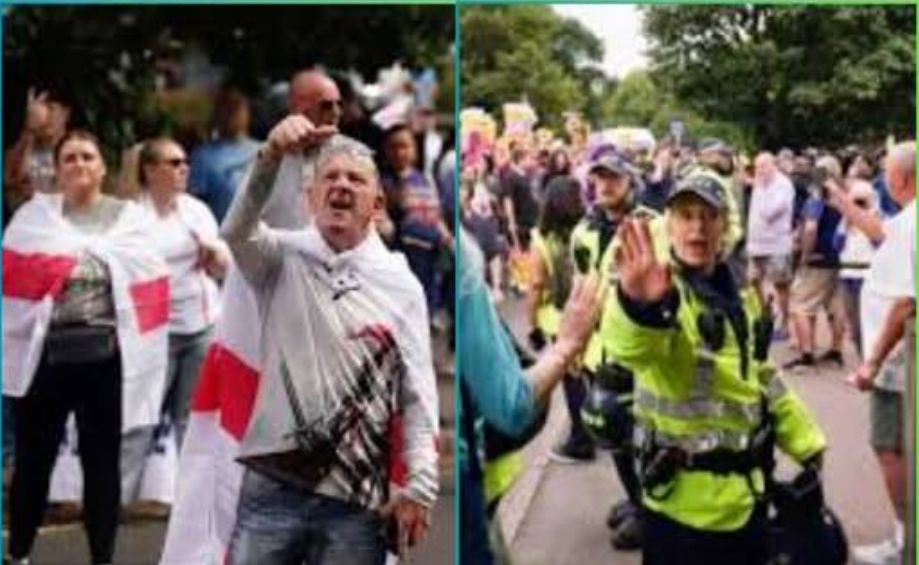
On a crowded street in the United Kingdom, beneath gray skies and the constant hum of traffic, a tense confrontation suddenly erupted. What began as scattered shouting quickly drew a circle of onlookers as a migrant man, visibly angry, tried to tear down several Union Jack flags held by a small group of locals. The bright red, white, and blue banners fluttered in the wind, no longer mere decorations but powerful symbols at the center of a growing storm. Voices clashed, accusations flew, and the air seemed to tighten with every passing second.
The Union Jack—officially known as the Union Jack—has long represented more than fabric stitched together. For many in the crowd, it symbolized home, heritage, and shared memory. For others, it carried complicated meanings shaped by history, empire, and personal experience. As the migrant reached upward in anger, one local man stepped forward. With arms spread wide and heart pounding, he positioned himself between the flags and the fury, declaring that the banner was a sign of belonging, not a target for rage.
For a breathless moment, time felt suspended. Bystanders froze, phones raised, recording every word and gesture. The confrontation was not only about a piece of cloth but about identity itself—about who feels welcome, who feels excluded, and who gets to define the meaning of national pride. Pride and pain collided openly on the pavement, revealing how deeply symbols can stir emotions on all sides of a debate.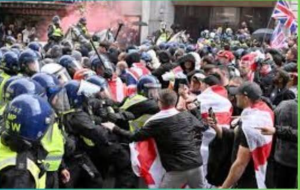
When police sirens finally pierced the tension and officers moved in to separate the groups, the immediate conflict subsided. The crowd dispersed slowly, conversations trailing off into murmurs. Yet the argument did not truly end; it simply migrated to social media platforms, where clips of the incident spread within minutes. Online, the scene was replayed again and again, each viewer interpreting it through their own beliefs and experiences.
Some commentators described the man who defended the flag as courageous, standing firm for his homeland and values. Others labeled his stance as confrontational or exclusionary, arguing that national symbols must evolve alongside increasingly diverse populations. The migrant’s anger was likewise interpreted in conflicting ways—either as disrespect toward a host nation or as an expression of frustration felt by those struggling to find acceptance in a new land. The digital debate mirrored the street clash: loud, divided, and emotionally charged.
Beneath the noise, however, a deeper question lingered. How do strangers become neighbors? How can a nation honor its history while embracing new voices within its borders? In a world that often feels fractured by politics, migration, and fear, the challenge is not merely to defend symbols or silence dissent, but to create space for dialogue. True strength may lie not in tearing flags down or guarding them with anger, but in finding ways for different stories to stand side by side—woven together like threads in a shared and still-unfinished fabric.