YOUR AMAZON DELIVERY IS DELAYED BECAUSE OF A WAR 10,000 MILES AWAY: The Bizarre New Normal of Global Commerce Under Fire
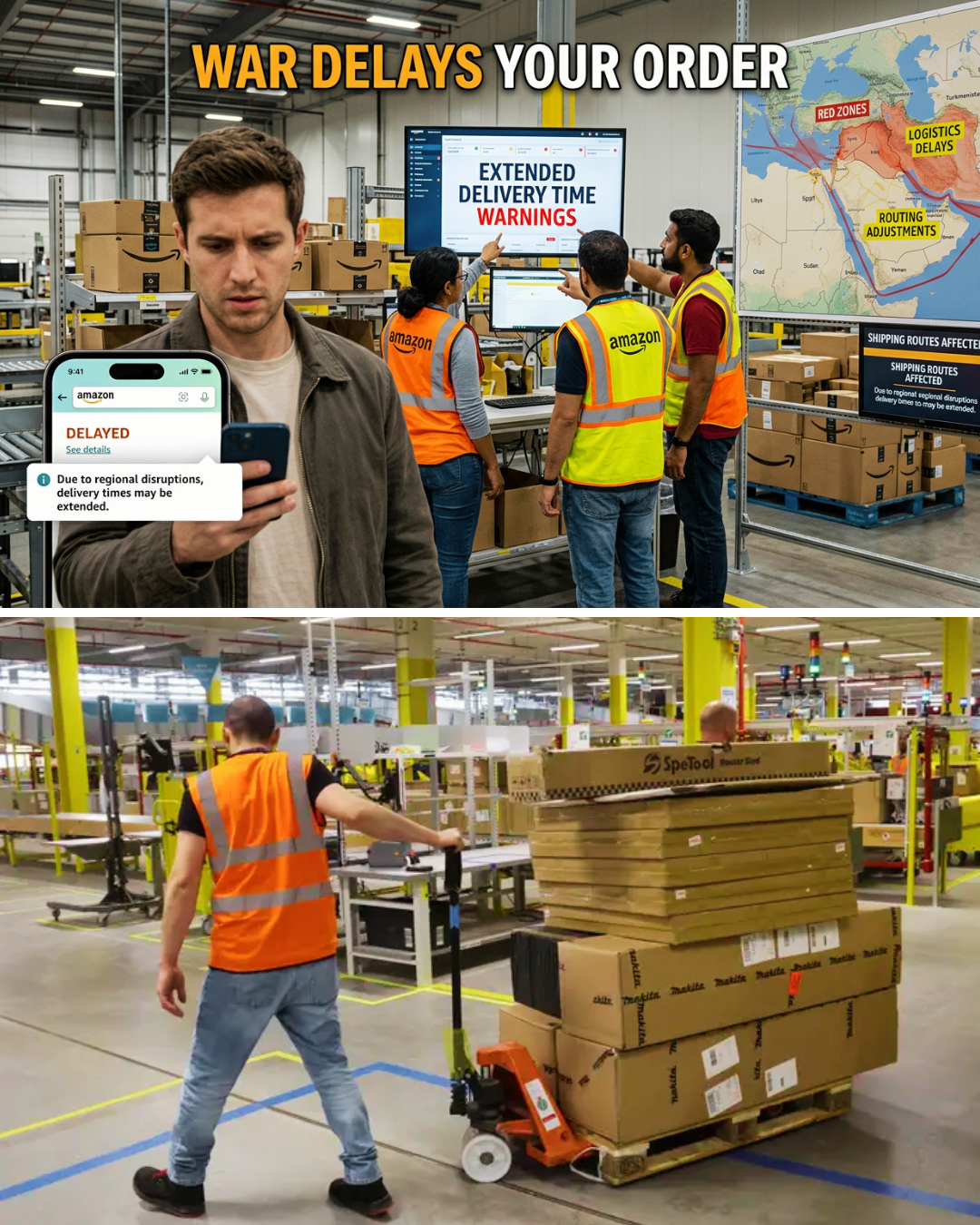
On Tuesday morning, customers across the Middle East opened their Amazon apps and encountered a message that might be the most absurd collision of modern commerce and ancient conflict in history: “Extended delivery time in your area.”
The polite corporate euphemism sat atop Amazon’s marketplaces in Israel, Saudi Arabia, Kuwait, Bahrain, and the UAE. A separate advisory appeared on the UAE site: “As we prioritize safety, some services may be temporarily unavailable in this area and delivery times may be impacted. Thank you for your patience and understanding.”
Thank you for your patience while missiles are falling on your city.
The notice captures something genuinely unprecedented about this war: it is the first major military conflict to directly disrupt the infrastructure of global e-commerce at scale. Amazon operates warehouses, cloud data centers, and corporate offices throughout the Middle East. Its data centers in the UAE and Bahrain experienced prolonged power outages on Monday as Iranian strikes damaged energy infrastructure. AWS — Amazon Web Services, the backbone of much of the internet — reported “connectivity disruptions” and “error rates” in its Middle East region, with no estimated time for restoration.
The ripple effects extend far beyond delayed packages. AWS does not just power Amazon’s shopping platform. It hosts the websites, applications, and databases of thousands of companies across the region. Financial services firms, healthcare systems, logistics companies, and government agencies that rely on AWS infrastructure have all been affected. When your cloud provider goes dark because a missile hit a power substation, every digital service built on that cloud goes with it.
For consumers in the Gulf states, the Amazon delay notice is almost comedic against the backdrop of air defense sirens, airport closures, and shelter-in-place orders. Nobody is worried about their next-day delivery when drones are falling from the sky. But the notice represents something more significant: the acknowledgment by one of the world’s most powerful corporations that its global supply chain is not immune to the oldest disruption of all — war.
The broader logistics disruption is staggering. With the Strait of Hormuz effectively closed, shipping routes that normally carry goods between Asia and Europe via the Gulf are either suspended or diverted around the Cape of Good Hope — adding two weeks and enormous costs to every shipment. Airlines have cancelled thousands of flights through Dubai, Doha, and Abu Dhabi — airports that serve as critical cargo hubs for time-sensitive shipments. Air freight rates are surging as capacity evaporates.
For businesses outside the Middle East, the effects are already being felt. Companies in India, Africa, and Southeast Asia that rely on Dubai as a logistics hub are scrambling for alternatives. Manufacturing operations in China that ship components through the Gulf are facing delays. Flower exporters in Kenya, who route a significant share of their product through Dubai, are watching perishable cargo rot.
United Airlines, Delta, and American Airlines all saw their shares drop 5 to 6 percent on Monday. Global hotel chains tumbled. Cruise lines like Carnival fell even harder. The travel and logistics sector — the circulatory system of global commerce — is hemorrhaging value.
The war has also exposed a strategic vulnerability that corporations have been reluctant to acknowledge: the concentration of digital and physical infrastructure in the Gulf states. Dubai and Abu Dhabi positioned themselves as the nexus of global trade routes, attracting trillions in investment on the promise of stability. That investment now sits in the path of Iranian missiles.
For Amazon CEO Andy Jassy, the Middle East represents both a growth market and a critical infrastructure region. The company’s decision to place major data centers in the UAE and Bahrain was driven by demand from regional customers and the desire for low-latency connections to Asian and African markets. Nobody stress-tested those data centers against sustained military bombardment.
The “Extended delivery time” notice will eventually disappear. The data centers will come back online. The flights will resume. But the lesson is permanent: in a world where your package, your data, and your streaming service depend on infrastructure in a region where ancient rivalries and modern missiles coexist, convenience is only ever one war away from disruption.
Your Amazon order is delayed. The reason is 10,000 miles away, and it involves cruise missiles.