When Legends Gather to Say Goodbye Inside the cathedral, three giants of an era stand in silence — and the world holds its breath.
When Legends Gather to Say Goodbye
Inside the cathedral, three giants of an era stand in silence — and the world holds its breath.
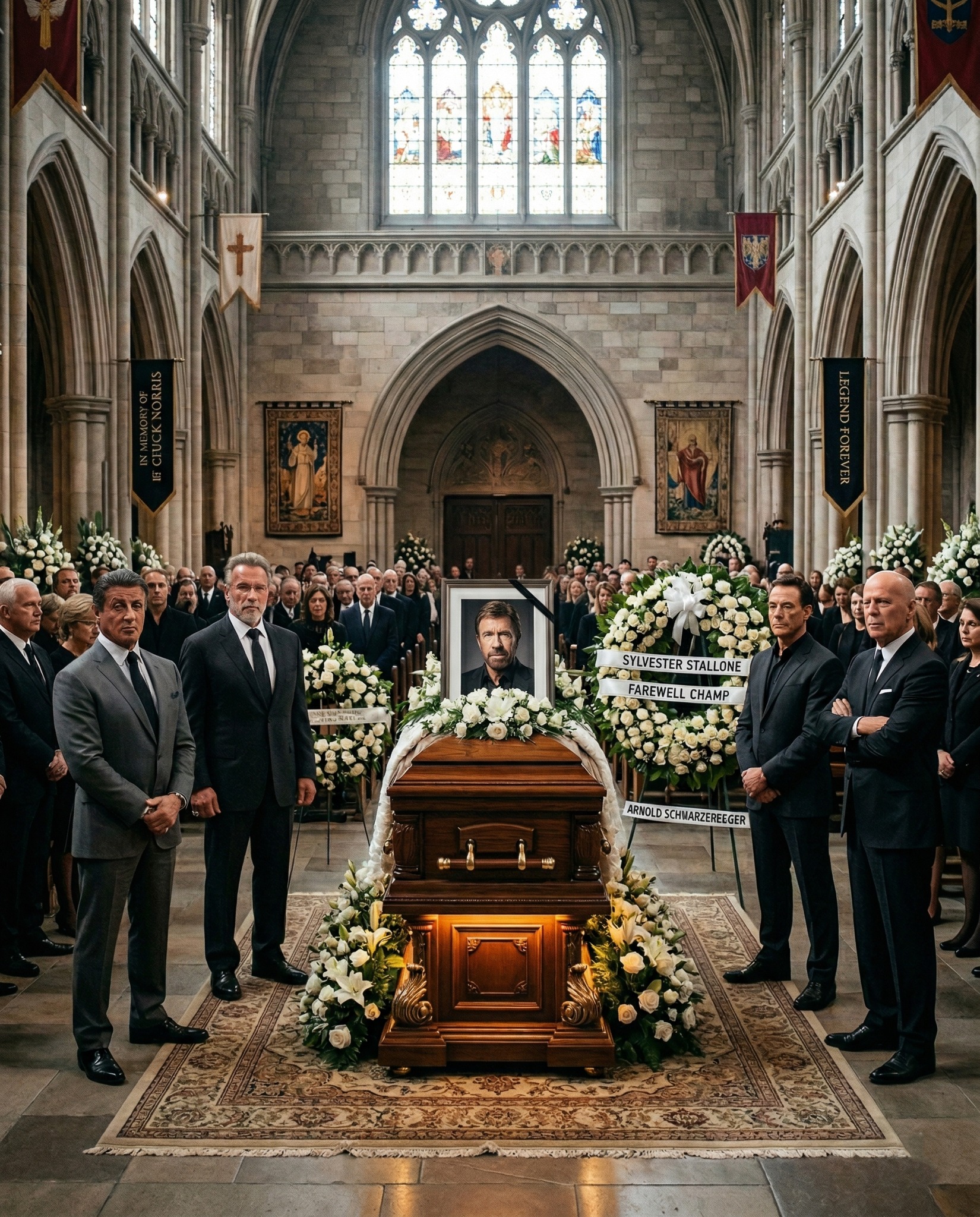
The great cathedral was hushed in a way that only grief can make a place truly quiet. Light poured down through ancient stained-glass windows, painting the stone floor in pools of amber and blue, as if even the light had come dressed in reverence. White roses — thousands of them — surrounded the casket in cascading arrangements so full and heavy they seemed to bow under the weight of their own mourning. Banners hung along the walls. One read simply: “In Memory of Chuck Norris.” Another: “Legend Forever.”
And there, standing at the head of the casket, shoulder to shoulder, were three men who once ruled the world.
Sylvester Stallone. Arnold Schwarzenegger. And beside them, others who had walked the same legendary road — men whose faces had filled cinema screens for decades, whose names were synonymous with an era of film that will never come again. They stood with their hands clasped before them, their chins slightly bowed, their eyes carrying something that no amount of movie stardom ever quite prepares a person for.
The look of a generation reckoning with its own mortality.
On the casket, framed in white flowers and soft candlelight, sat a portrait of Chuck Norris. Not the action hero. Not the meme. The man — blue-eyed, half-smiling, the way he always looked when he was about to say something quiet and true. A wreath of white roses leaned against the casket bearing a ribbon that read: “Sylvester Stallone — Farewell, Champ.” Beside it, another: “Arnold Schwarzenegger.”
These were not celebrity tributes sent by publicists from a safe distance. These men had come themselves. They had driven through the mourning crowds, walked through the cathedral doors, and taken their places beside the man they had known — truly known — as a friend, a rival, a brother in the particular fraternity of those who had carried the weight of being larger than life.
They stood there because Chuck Norris deserved to be stood for.
Chuck Norris was born Carlos Ray Norris on March 10, 1940, in Ryan, Oklahoma — a small town so small it barely left a mark on a map. He grew up poor and shy, a boy who could not bring himself to speak aloud in class, who carried the quiet shame of a broken home and a father lost to alcohol. Nothing about his beginning suggested what was coming. Nothing pointed toward the legend.
Except the man himself.
He enlisted in the Air Force at eighteen, shipped out to South Korea, and came home carrying something invisible but transformative: a discipline rooted in martial arts that would become the foundation of everything he would ever build. He trained. He competed. He won. Six times he claimed the World Professional Middleweight Karate Championship. He opened schools. He taught celebrities — Steve McQueen among them — who then pushed him toward the camera.
And so it began.
By the 1980s, Chuck Norris was not merely a movie star. He was a symbol. In Missing in Action, in The Delta Force, in Code of Silence and Lone Wolf McQuade, he embodied a version of American resilience that spoke directly to something deep in the cultural bloodstream — the belief that one disciplined, righteous man could walk into any darkness and come back out the other side. He never shouted about it. He never needed to. He simply walked forward, eyes forward, and trusted the audience to follow.
They always did.
Stallone understood this better than almost anyone.
Their careers had run on parallel tracks for decades — two men who had emerged from working-class obscurity to become the defining action icons of their generation. Where Stallone was volcanic, emotional, operatic, Chuck was still and measured. Where Rocky bled openly and loudly, Walker, Texas Ranger held his wounds in silence. They were different expressions of the same stubborn refusal to stay down.
When they finally shared the screen together in The Expendables 2 in 2012, the audience roared. Not just because of the action — but because of what it meant to see two survivors of that era standing side by side, older, heavier, but unbroken. The applause in theaters that night was not just for the film. It was for everything those two men represented to the people watching.
And now Stallone stands beside the casket, holding still, and the silence says everything the words cannot.
Schwarzenegger’s presence carries its own particular weight. He and Chuck existed in the same rarified atmosphere — men whose physical presence had become almost mythological, whose very names conjured entire decades of cinema, of Saturday afternoons in darkened theaters, of a time before irony made it dangerous to believe in heroes. Arnold had always carried himself with a certain exuberant invincibility, a grin that suggested nothing could ever truly touch him.
But grief touches everyone.
He stands with his arms at his sides, his great shoulders set, his face composed into something careful and controlled — the expression of a man who has decided that the most respectful thing he can offer the dead is his absolute, undivided presence. No performance. No posturing. Just a man in a cathedral, saying goodbye to someone who mattered.
Look at this image long enough and you begin to feel the full weight of what is ending.
These men — Stallone, Schwarzenegger, and all who stand with them in that cathedral — they are the last of something. They belong to an age of cinema that was built on physical reality, on actual danger, on the extraordinary spectacle of human beings pushing their bodies to extraordinary limits and letting the camera witness it. There were no digital doubles for what Chuck Norris did. There were no safety nets for the man who trained six days a week well into his eighties, who posted a birthday sparring video at 86 and grinned at the camera and said, “I don’t age. I level up.”
Nine days later, he was gone.
The precision of it is almost unbearable. As if he wanted to leave us one last image — still fighting, still smiling, still absolutely himself — before he quietly stepped away.
The white roses glow softly in the cathedral light. The portrait on the casket watches over everything with that half-smile, patient and calm. The banners along the walls stir slightly in some invisible current of air.
Stallone does not move. Schwarzenegger does not move. None of them move.
This is what loyalty looks like when it has nowhere left to go — when the person you would have fought for, laughed with, called on a hard day, is lying in a casket wrapped in flowers, and all you can do is stand there and make sure he knows, somehow, that he was never alone.
The congregation fills the pews behind them. Hundreds of faces, all turned toward the front, all holding the same complex thing — gratitude and sorrow braided together so tightly they become a single feeling without a proper name.
Outside, the world continues. Traffic moves. Phones ring. But in here, in this cathedral filled with white roses and old light and the quiet breathing of people who loved the same man, time has stopped entirely.
Chuck Norris came from nothing and became everything. He built himself by hand, piece by piece, out of discipline and faith and a refusal to accept the limits his early life had tried to place on him. He made millions of people feel braver than they were. He made the world believe, for the length of a film or a television episode, that one good man with enough conviction could make a difference.
He was right. He proved it — not just on screen, but in the eighty-six years he actually lived.
“To the world, he was a martial artist, actor, and a symbol of strength,” his family wrote. “To us, he was the heart of our family.”
The legends stand. The roses bloom white in the cathedral light. The portrait smiles on.
And somewhere, Chuck Norris is already training for whatever comes next.
Rest easy, Champ. The people you leave behind — every last one of them — are standing at attention.
Carlos Ray “Chuck” Norris — March 10, 1940 – March 19, 2026.
Warrior. Champion. Legend. Forever.