When America Stopped — The Day the Expendables Carried Their Last Hero Home
When America Stopped — The Day the Expendables Carried Their Last Hero Home
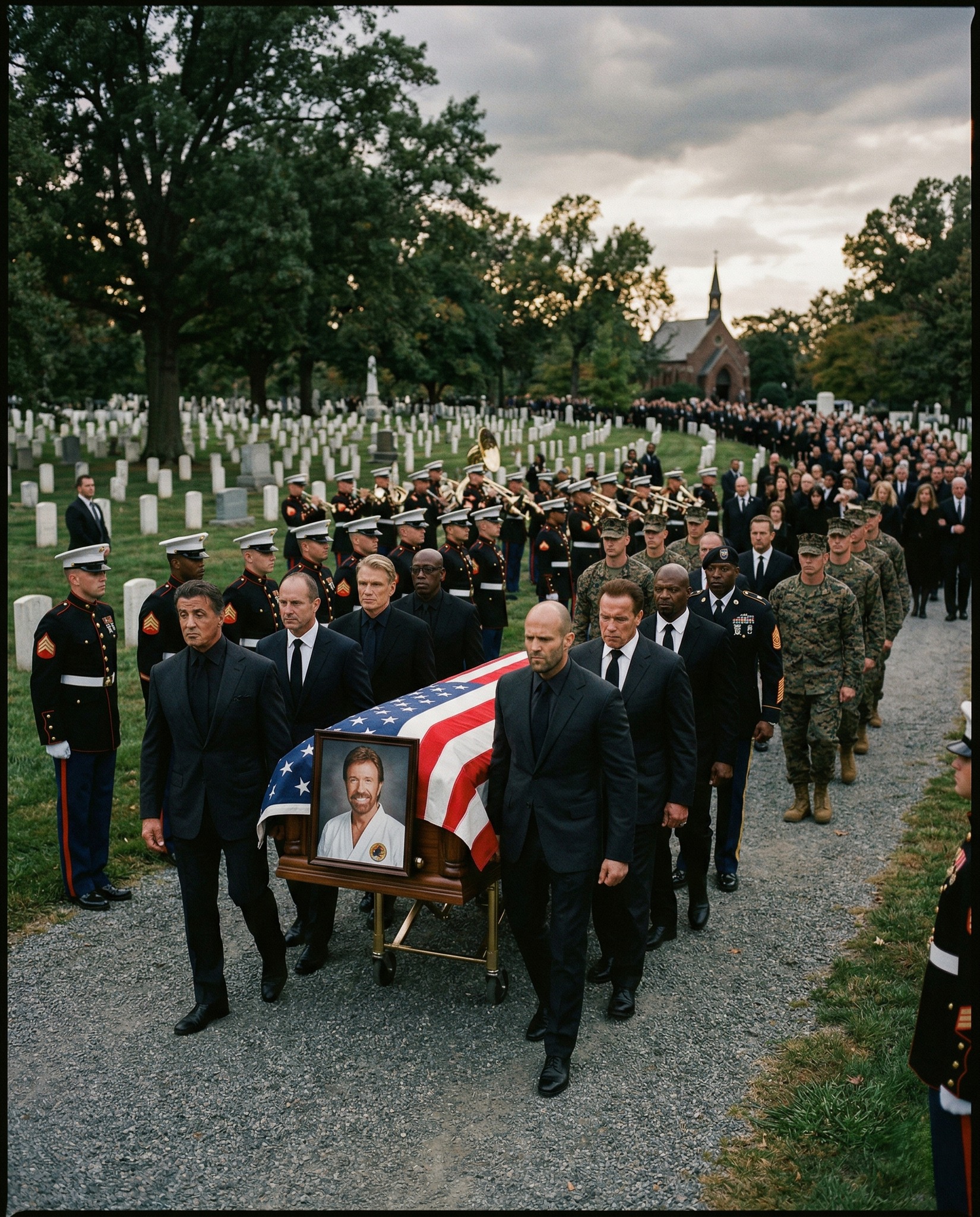
Arlington National Cemetery. Late afternoon. The sky above Virginia has turned the color of a bruise — deep purple and grey at the edges, the kind of sky that feels deliberate, as if the heavens themselves have dressed in mourning clothes.
The brass section of a Marine Corps band lifts their instruments.
And the procession begins.
There are moments in history that do not announce themselves. They arrive quietly, wrapped in the ordinary details of grief — the crunch of gravel underfoot, the rustle of dress uniforms, the sound of a flag snapping softly in the October wind. And then you look up, and you understand that you are standing inside something you will never forget.
This is one of those moments.
The photograph stretches back as far as the eye can follow — hundreds of people moving in slow, deliberate procession through the white-stone rows of Arlington, the most sacred ground in America. Marines in dress blues line the path, their white caps bright against the darkening sky. Soldiers stand at attention. Civilians in black fill the spaces between, an entire world come to a halt to say goodbye to one man.
At the front of it all, six men carry a flag-draped casket.
And on top of that casket — a photograph. A young Chuck Norris, white gi, the faint suggestion of a smile, eyes that have always known something the rest of us are still figuring out.
Sylvester Stallone walks on the left side, front position.
He has walked into a thousand difficult situations on screen. He has climbed mountains, crossed enemy lines, gone the distance with men twice his size and come out the other side bloody but unbroken. He has played characters who carry the weight of the world on their shoulders and make it look like a choice.
Today, the weight is real. Today, there is no character to hide behind.
His face holds the expression of a man who has arrived at a place beyond tears — the deep, still place that grief takes you when it has burned through everything else and left only the bare fact of loss. His jaw is set. His eyes are forward. He puts one foot in front of the other, the way he has always done, because that is the only thing left to do.
Behind him, the others follow — Jason Statham, Arnold Schwarzenegger, Dolph Lundgren, the men who together made up the most improbable ensemble in action cinema history. The Expendables. The men who were supposed to be too old, too past it, too much of a relic to still matter — and who proved, time and again, that legacy is not something that expires.
Today they are not expendable. Today they are essential. They are the ones who knew him. They are the ones who carry him.
Chuck Norris arrived in Hollywood the hard way, which is the only way he ever did anything.
He had been a U.S. Air Force veteran, a martial arts champion, a man who built his discipline in dojos and competitions long before anyone pointed a camera at him. When the film industry eventually came calling, he brought everything with him — the stillness, the precision, the absolute refusal to be less than fully himself in any room he walked into.
His characters — Colonel James Braddock, Sergeant Major Scott McCoy, Cordell Walker — were not complicated men in the psychological sense. They did not wrestle with moral ambiguity or crumble under the weight of their own contradictions. They simply knew right from wrong, and they acted on that knowledge, consequences be damned. In an era of increasing cynicism, Chuck Norris offered something almost radical: a hero who believed in something.
America believed back.
Walker, Texas Ranger ran for nine seasons — 203 episodes — and in its heyday drew 20 million viewers a week. Twenty million people, every Saturday night, tuning in to watch a man on a horse ride toward whatever needed fixing. There is something almost mythological about that number. Something that speaks not just to entertainment but to hunger — a deep, collective hunger for the kind of moral clarity that the real world so rarely provides.
He fed that hunger for four decades.
The Marine Corps band plays softly — not a dirge, but something with more dignity than sadness, the kind of music that acknowledges grief without surrendering to it. The brass carries the melody forward through the heavy air, and the procession moves with it, step by measured step, past the white headstones that stretch in every direction like sentences in the world’s longest and most important story.
Each headstone is a name. Each name is a world.
And now there will be one more.
Look at the sky in this photograph.
It is the sky of an ending — massive, unsettled, the light failing at the edges in that particular way it does in late autumn when the days have grown short and the warmth has gone out of things. But there is still light. There is still enough light to see by. And what you see, in that light, is something that transcends celebrity, transcends Hollywood, transcends every roundhouse kick and one-liner and box office statistic ever attached to this man’s name.
What you see is honor.
The Marines standing at attention did not come because Chuck Norris was famous. They came because he was one of them — a veteran, a man who served before he performed, who understood the weight of a uniform because he had worn one. He never forgot where he came from. He never let the fame convince him that he was something other than what he had always been: a man shaped by discipline, faith, and the conviction that your country and your family are worth fighting for.
The Expendables did not come because a publicist told them to. They came because you do not miss the funeral of a brother.
Stallone has spoken, in interviews over the years, about what the Expendables franchise meant to him beyond the commerce of it. He spoke about wanting to create something that honored a generation of action stars who had shaped his own understanding of what movies could be — men who had given audiences not just entertainment but something to aspire to. A standard of toughness and loyalty and refusal that felt, in its own way, like a kind of teaching.
Chuck Norris was always at the center of that aspiration.
When he appeared in The Expendables 2, walking out of the smoke with a rifle and a quip and that unmistakable bearing, the audience did not just cheer. They exhaled. Something long held was released. The legend had shown up, right on time, and the world was briefly, beautifully right.
He was 72 years old. He looked like a man who could still handle anything.
He probably could.
The procession has a destination — a plot of ground in Arlington where the earth will receive him, where a headstone will eventually bear his name alongside the names of soldiers and sailors and airmen and Marines who gave everything they had in service of something larger than themselves.
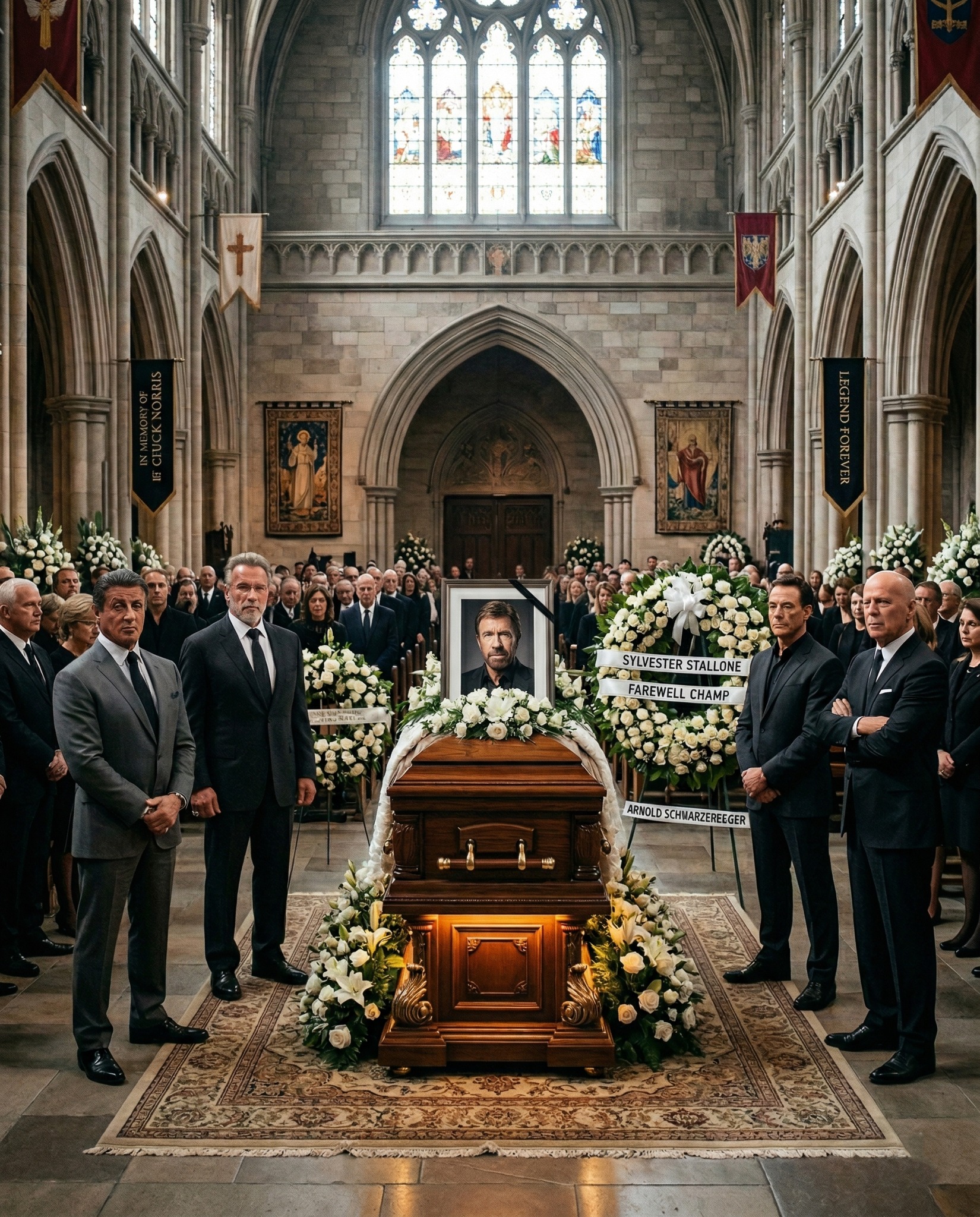
He belongs here.
Not because he was a movie star. But because he was, first and last and always, a man who served — his country, his faith, his family, his audience. A man who showed up. A man who, in his own way, understood that the stories we tell about heroism are really instructions for how to live.
He told that story for sixty years.
The photograph freezes the moment before the final goodbye. The men at the front of the casket have not yet arrived at the grave. The procession stretches back through the cemetery, through the crowd, back toward the entrance and the street and the world beyond — the world that Chuck Norris shaped, in ways large and small, for longer than most people get to matter.
His face on the photograph looks out at all of it.
Those eyes. Still steady. Still clear. Still carrying that quiet knowledge.
Still here.
Somewhere in America tonight, a child who has never seen a single Chuck Norris film will grow up and become the kind of person who stands firm when everything is falling. They will not know why. They will not be able to trace the thread back to its source.
But the thread is there.
It has always been there.
Rest easy, Sergeant Norris.
The watch is yours no longer.